
Temperature measurement is one of the most common sensing tasks in electronics, manufacturing, HVAC, and scientific research. Yet the range of available sensors — thermistors, thermocouples, RTDs, IC sensors, and infrared devices — is bewildering for beginners. Three types dominate industrial and professional use: thermistors, thermocouples, and RTDs (Resistance Temperature Detectors). Each has a distinct operating principle, accuracy profile, temperature range, and cost. Choosing the wrong one wastes money and causes measurement headaches. This guide gives you the complete picture so you can make the right choice first time.
1. Thermistors: High Sensitivity at Low Cost
A thermistor is a resistor whose resistance changes significantly and predictably with temperature. The name comes from thermal resistor. There are two types:
- NTC (Negative Temperature Coefficient): Resistance decreases as temperature rises. By far the most common type.
- PTC (Positive Temperature Coefficient): Resistance increases with temperature. Used mainly as resettable fuses and motor protection, not general sensing.
How NTC Thermistors Work
NTC thermistors are semiconductor ceramics (typically metal oxides like manganese, nickel, cobalt, or copper). The relationship between resistance and temperature follows a non-linear exponential curve described by the Steinhart–Hart equation or the simpler B-parameter equation:
1/T = 1/T₀ + (1/B) × ln(R/R₀)
Where T is temperature in Kelvin, T₀ is reference temperature (usually 298.15 K = 25°C), R₀ is resistance at T₀ (typically 10 kΩ), and B is the material constant (typically 3000–5000 K).
Thermistor Key Facts
- Typical range: −40°C to +125°C (glass-encapsulated up to 300°C)
- Typical accuracy: ±0.2°C to ±1°C (varies by grade)
- Sensitivity: Very high — 2–5% resistance change per degree. More sensitive than any other temperature sensor type.
- Readout: Simple voltage divider into an ADC. No amplifier needed for narrow ranges.
- Cost: Extremely cheap — ₹10–₹50 for bare thermistors
- Self-heating: Keep measurement current below 1 mA to avoid self-heating errors
Best Use Cases for Thermistors
Thermistors excel in battery temperature monitoring (Li-ion cells ship with an NTC thermistor), 3D printer hotend control, HVAC room temperature sensing, medical oral/rectal thermometers, and any application needing high sensitivity in a narrow temperature range (0°C–100°C).
2. Thermocouples: Extreme Range, Rugged Design
A thermocouple is formed by joining two dissimilar metals at one end (the “hot junction”). When a temperature difference exists between the hot junction and the reference “cold junction” (the other ends), a small voltage (typically 1–80 µV/°C) is generated. This is the Seebeck effect.
Thermocouple Types
| Type | Materials | Range | Sensitivity |
|---|---|---|---|
| K | Chromel / Alumel | −200 to +1260°C | 41 µV/°C |
| J | Iron / Constantan | −40 to +750°C | 52 µV/°C |
| T | Copper / Constantan | −200 to +370°C | 43 µV/°C |
| E | Chromel / Constantan | −200 to +900°C | 68 µV/°C |
| N | Nicrosil / Nisil | −200 to +1300°C | 39 µV/°C |
| S, R, B | Platinum / Rhodium | up to +1700°C | 6–10 µV/°C |
Type K is by far the most common for hobbyist and industrial use. The MAX6675 and MAX31855 ICs handle cold-junction compensation and SPI readout for Arduino.
Thermocouple Key Facts
- Typical range: −200°C to +1700°C depending on type
- Typical accuracy: ±1°C to ±2.2°C (Class 1)
- Output: Tiny voltage (µV range) — requires cold-junction compensated amplifier
- Cost: Moderate — bare K-type ₹50–₹200; MAX31855 module ₹200–₹400
- Response time: Very fast with bare wire thermocouples; slower with sheathed versions
3. RTDs: High Accuracy for Industrial Use
An RTD uses the predictable increase in electrical resistance of a metal with temperature. Platinum is the standard material for precision RTDs — the most common being the PT100 (100 Ω at 0°C) and PT1000 (1000 Ω at 0°C). The relationship is nearly linear: for PT100, resistance increases approximately 0.385 Ω per °C.
RTD Construction Types
- Wire-wound: Fine platinum wire coiled inside a ceramic or glass core. Most stable and accurate.
- Thin-film: Platinum film deposited on ceramic substrate. Cheaper, smaller, but slightly less stable at extreme temperatures.
- 2-wire, 3-wire, 4-wire: More wires eliminate lead resistance errors. Use 4-wire for laboratory accuracy; 3-wire is standard for industrial use.
RTD Key Facts
- Typical range: −200°C to +850°C (PT100 standard)
- Typical accuracy: ±0.1°C to ±0.5°C (Class A: ±0.15°C at 0°C)
- Output: Resistance change read via Wheatstone bridge or precision ADC (MAX31865 for Arduino)
- Cost: Higher — PT100 sensor ₹150–₹500; MAX31865 module ₹300–₹600
- Stability: Excellent long-term stability. No drift over years of use.
- Vibration: Wire-wound types are fragile in high-vibration environments; thin-film types handle vibration better.
4. Side-by-Side Comparison Table
| Feature | Thermistor (NTC) | Thermocouple (K-type) | RTD (PT100) |
|---|---|---|---|
| Temperature Range | −40 to +125°C | −200 to +1260°C | −200 to +850°C |
| Accuracy | ±0.2–1°C | ±1–2.2°C | ±0.1–0.5°C |
| Sensitivity | Highest | Low (µV/°C) | Medium |
| Linearity | Non-linear (exponential) | Non-linear | Nearly linear |
| Readout Complexity | Simple (voltage divider) | Complex (CJC needed) | Moderate (bridge/ADC) |
| Long-term Stability | Good | Good to fair | Excellent |
| Relative Cost | Very low | Low to medium | Medium to high |
| Self-powered | No (needs excitation) | Yes (generates voltage) | No (needs excitation) |
| Best Arduino IC | Direct ADC + math | MAX31855 / MAX6675 | MAX31865 |
5. Which Sensor Should You Choose?
Choose a Thermistor when:
- Temperature range is −40°C to +125°C
- High sensitivity is needed in a narrow range (body temperature, battery monitoring, 3D printer)
- Ultra-low cost is essential
- Simple readout (voltage divider to ADC) is preferred
- Fast response time is needed (small bead thermistors respond in <1 second)
Choose a Thermocouple when:
- Temperature exceeds 300°C (kiln, furnace, engine exhaust, foundry)
- Small probe size is needed (bare wire thermocouple is the smallest option)
- The sensor must survive harsh, contaminating environments
- Measuring gas flame, molten metal, or high-temperature industrial processes
- No power supply is needed at the sensing point (self-generating voltage)
Choose an RTD when:
- High accuracy (±0.1°C) is essential over a wide range
- Long-term stability over years matters (calibration standards, metrology)
- Linear output simplifies signal conditioning
- Range is −200°C to +600°C (pharmaceutical, food processing, HVAC)
- Budget allows for higher sensor cost
6. Interfacing All Three with Arduino
Thermistor (NTC 10kΩ)
#define THERMISTOR_PIN A0
#define R_FIXED 10000.0  // 10k pull-down resistor
#define R_NOMINAL 10000.0
#define T_NOMINAL 25.0
#define B_COEFFICIENT 3950.0

float readThermistor() {
  int raw = analogRead(THERMISTOR_PIN);
  float R = R_FIXED * ((1023.0 / raw) - 1);
  float T = 1.0 / (1.0/( T_NOMINAL + 273.15) + log(R/R_NOMINAL)/B_COEFFICIENT);
  return T - 273.15;
}
Thermocouple (K-type + MAX31855)
#include <Adafruit_MAX31855.h>
// CLK=6, CS=5, DO=4
Adafruit_MAX31855 tc(6, 5, 4);
void setup() { Serial.begin(115200); tc.begin(); }
void loop() {
  Serial.print(tc.readCelsius(), 2);
  Serial.println(" C");
  delay(1000);
}
RTD (PT100 + MAX31865)
#include <Adafruit_MAX31865.h>
Adafruit_MAX31865 rtd(10); // CS on pin 10
void setup() { Serial.begin(115200); rtd.begin(MAX31865_2WIRE); }
void loop() {
  Serial.print(rtd.temperature(100, 430.0), 2); // PT100, 430R ref
  Serial.println(" C");
  delay(1000);
}
7. Common Mistakes and How to Avoid Them
- Using a thermistor above 125°C: Accuracy degrades and the polymer bead may melt. Use a thermocouple instead.
- Forgetting cold-junction compensation with thermocouples: The MAX31855/MAX6675 handle this automatically. If building your own circuit, you MUST measure the cold junction temperature and add it to the reading.
- Using 2-wire RTD connections in long cable runs: Lead resistance (0.385 Ω/metre for copper) becomes a fixed offset error. Use 3-wire or 4-wire RTDs for cable runs over 2 metres.
- Self-heating thermistors: Using too high a measurement current (>100 µA) heats the thermistor itself, causing high readings. Keep excitation current below 1 mA for NTC types.
- Thermocouple polarity: Reversing the connections gives a negative reading that decreases as temperature rises. The connectors are colour-coded: for K-type, yellow is positive.
8. Temperature Sensors at Zbotic

LM35 Temperature Sensor
Analog IC temperature sensor with linear 10 mV/°C output. Easier than a thermistor for beginners — no linearisation math required. Range: −55°C to +150°C.

DS18B20 Programmable Resolution 1-Wire Digital Thermometer
9–12-bit resolution over 1-Wire bus. Up to 127 sensors on one wire. Accuracy ±0.5°C from −10°C to +85°C. An excellent thermistor alternative with digital output.
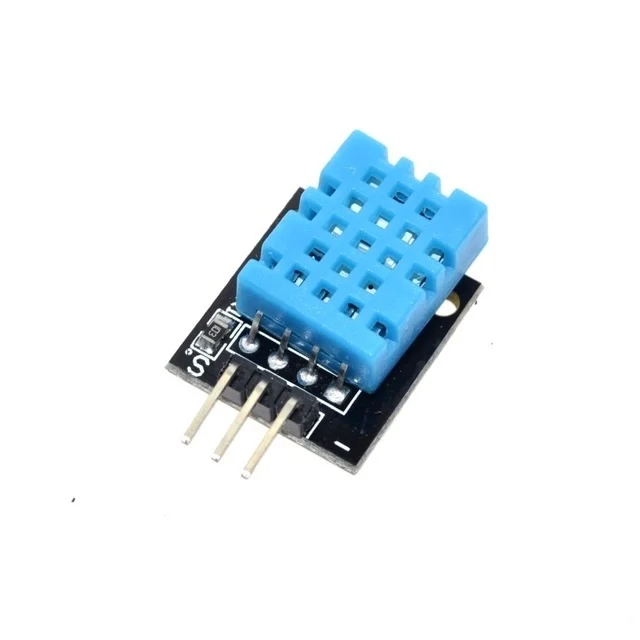
DHT11 Digital Relative Humidity and Temperature Sensor Module
Combined temperature + humidity sensing at very low cost. Great for home weather stations and HVAC monitoring where ±2°C accuracy is acceptable.
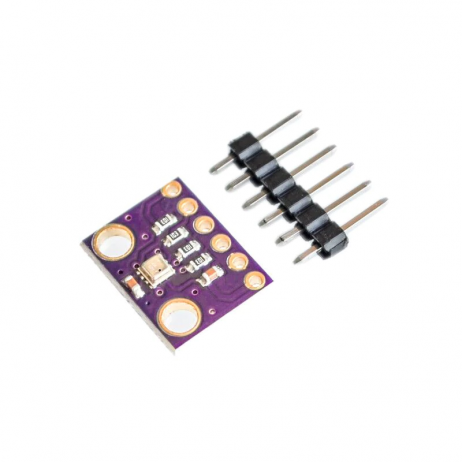
GY-BME280 Precision Altimeter Atmospheric Pressure Sensor Module
Bosch’s premium environmental sensor: temperature ±1°C, humidity ±3%, pressure ±1 hPa. I2C/SPI. A great RTD alternative for weather-station accuracy.
9. Frequently Asked Questions
Q: Which is more accurate — a thermocouple or an RTD?
RTDs are generally more accurate. A Class A PT100 achieves ±0.15°C at 0°C versus ±1°C for a Class 1 K-type thermocouple. However, thermocouples measure a far wider temperature range (up to 1700°C), which RTDs cannot match. For accuracy below 850°C, choose an RTD; for high temperatures, the thermocouple wins by default.
Q: Can I use a thermistor for industrial temperature measurement?
Yes, with caveats. Many industrial applications — like HVAC duct temperature sensing and battery management — use NTC thermistors. They are avoided in extreme-temperature or high-accuracy applications because of their non-linearity, limited range, and potential long-term drift. For precision industrial metrology, use an RTD.
Q: Why does my thermocouple reading drift over time?
Thermocouples drift due to: (1) oxidation or contamination of the junction metals, (2) gradients in the protective sheath causing parasitic voltages, (3) cold-junction temperature changes if ambient temperature fluctuates and your CJC compensation is poor. For stable long-term applications, choose a PT100 RTD instead.
Q: What is the difference between PT100 and PT1000?
Both are platinum RTDs with the same temperature coefficient (0.00385 Ω/Ω/°C). PT100 has 100 Ω at 0°C; PT1000 has 1000 Ω at 0°C. PT1000 has ten times higher resistance, which makes it less sensitive to lead resistance errors and easier to read with high-impedance ADCs. PT100 is the industrial standard; PT1000 is preferred in miniaturised or battery-powered devices.
Q: Is the DHT22 better than a thermistor for Arduino projects?
For most hobbyist purposes, yes. The DHT22 integrates a calibrated sensor, ADC, and digital output (single-wire protocol) in one package. Accuracy is ±0.5°C — much better than the ±1–2°C you typically get from an uncalibrated thermistor without factory correction. However, bare NTC thermistors respond faster (sub-second vs 2-second DHT22 sampling rate) and cost less.
Find the Right Temperature Sensor for Your Project
Zbotic stocks LM35, DS18B20, DHT11, DHT22, BME280 and more. Order today with fast shipping across India.




Add comment