
When you start a new Arduino project that needs a screen, you immediately face the classic question: OLED vs LCD arduino interface ease — which one should you pick? Both display technologies have their place in the maker’s toolkit, but they behave very differently in terms of wiring complexity, power consumption, library support, and visual output. This in-depth comparison will help Indian hobbyists and students make the right choice for every project.
OLED and LCD: The Basics
LCD (Liquid Crystal Display) modules for Arduino come in two common flavours: character LCDs (like the ubiquitous 16×2 or 20×4) and graphical TFT LCDs (like the 128×64 or 320×240 colour modules). Character LCDs use a fixed dot-matrix grid and a controller (usually HD44780) that handles character rendering internally. TFT LCDs use the ILI9341, ST7789, or similar drivers and require the MCU to push pixel data over SPI.
OLED (Organic Light-Emitting Diode) displays are self-emissive — each pixel generates its own light with no backlight needed. The most common Arduino OLED module is the 0.96″ 128×64 monochrome display with an SSD1306 controller, available for under ₹150 on Zbotic.in. Larger colour OLEDs (like the SSD1351 128×128) also exist and are covered in our separate deep-dive guide.
The fundamental difference that affects Arduino interfacing is the communication protocol and the driver complexity. Let’s break this down section by section.
Wiring Complexity Compared
16×2 Character LCD (Parallel Interface)
The classic 16×2 LCD with HD44780 controller uses a parallel data bus. In 4-bit mode (the standard approach), you need 4 data lines + RS + EN + RW (optionally tied to GND) + power = a minimum of 6 GPIO pins on your Arduino. For beginners, this is often intimidating but the LiquidCrystal library abstracts it well.
To reduce pin count, most hobbyists use a PCF8574-based I2C backpack module soldered to the LCD’s back. This reduces the connection to just 4 wires: VCC, GND, SDA, SCL — the same 4 wires used by the most popular OLED modules.
0.96″ SSD1306 OLED (I2C)
The SSD1306 OLED with I2C interface uses only 4 pins: VCC (3.3V or 5V), GND, SDA, SCL. That’s it. No backpack needed, no extra components. This is why OLED is generally considered easier to wire for beginners.
TFT LCD (SPI)
Colour TFT LCDs use SPI and require 5–7 wires: CS, DC/RS, RESET, MOSI, SCK, VCC, GND (and optionally MISO and BL). This is more wiring than OLED but still manageable on a breadboard.
Verdict on wiring: I2C OLED wins for simplicity. Character LCD with I2C backpack is equal. SPI TFT LCD requires the most wiring.
Library Support on Arduino
Both OLED and LCD displays have excellent library support in the Arduino ecosystem.
OLED Libraries
- Adafruit SSD1306 + Adafruit GFX — the most widely used combination. Supports bitmaps, custom fonts, lines, circles. Simple API. Install both from the Arduino Library Manager.
- U8g2 — a more feature-rich library that supports dozens of display controllers (not just SSD1306). Offers a larger font library and lower RAM usage modes. Better for complex UIs.
LCD Libraries
- LiquidCrystal — built into Arduino IDE. For 16×2 / 20×4 character LCDs. Dead simple API:
lcd.print("Hello!"); - LiquidCrystal_I2C — same API but for I2C backpack. Also in Library Manager.
- TFT_eSPI / Adafruit ILI9341 — for colour TFT LCDs. More complex setup but supports full graphical capabilities.
For a complete beginner, the LiquidCrystal library’s API is the simplest to learn. For graphical projects, the Adafruit SSD1306 + GFX combination for OLED is equally beginner-friendly.
Power Consumption
This is where OLED has a significant advantage — and also a hidden disadvantage.
OLED power advantage: Because each pixel generates its own light, black pixels consume zero power. A mostly dark screen (white text on black background, the default) uses very little current — typically 20–30mA for a 0.96″ SSD1306 at typical brightness. This makes OLED ideal for battery-powered projects.
OLED power disadvantage: A fully white OLED screen consumes the most power — up to 60–80mA. More importantly, OLED pixels degrade over time when driven at full brightness. Static images burnt in for hours cause permanent uneven brightness (screen burn-in). For a clock or always-on display, LCD is safer long-term.
LCD power: Character LCDs with backlight on typically draw 50–100mA (backlight is the main consumer). The backlight can be dimmed or turned off when not needed. TFT LCDs are the highest consumers at 100–300mA depending on backlight brightness.
Verdict on power: OLED wins for battery-powered projects with dark UIs. LCD wins for always-on applications where burn-in is a concern.

LM35 Temperature Sensors
A classic analog temperature sensor — a perfect beginner companion for your first Arduino display project. Read temperature and show it on your OLED or LCD screen.
Readability and Visual Quality
OLEDs produce stunning contrast because black pixels are truly off — there is no backlight bleeding through to muddy dark areas. The deep blacks and bright whites make OLED text look razor sharp even at small sizes. This is why 0.96″ OLED modules look so impressive despite their tiny size.
However, OLED modules available for Arduino use are typically small (0.91″ to 1.3″) and monochrome. While colour OLEDs exist, they are more expensive. The resolution is usually 128×64 pixels, limiting complex graphical layouts.
LCDs, especially IPS TFT panels, offer a much larger canvas. A 2.8″ 320×240 colour LCD can display weather icons, multi-column data, bitmap images, and smooth UI elements. For projects that need rich graphical content, an LCD simply provides more pixels and colour options.
Character LCDs are the least visually impressive — they only display alphanumeric characters in a fixed grid — but they are the easiest to read at a glance from across a room, which makes them ideal for status displays and data loggers.
Cost and Availability in India
Here is a rough price guide for Indian buyers as of early 2026:
| Display Type | Typical Price | Best For |
|---|---|---|
| 16×2 Character LCD + I2C backpack | ₹80–₹150 | Beginners, text-only data display |
| 0.96″ SSD1306 OLED (I2C) | ₹120–₹200 | Battery projects, compact builds |
| 1.3″ SH1106 OLED (I2C/SPI) | ₹180–₹280 | Slightly larger graphical display |
| 2.8″ ILI9341 TFT LCD (SPI) | ₹300–₹500 | Colour, graphical UIs, smart mirror |
| 1.5″ SSD1351 Colour OLED | ₹600–₹1,000 | Colour + OLED quality combined |
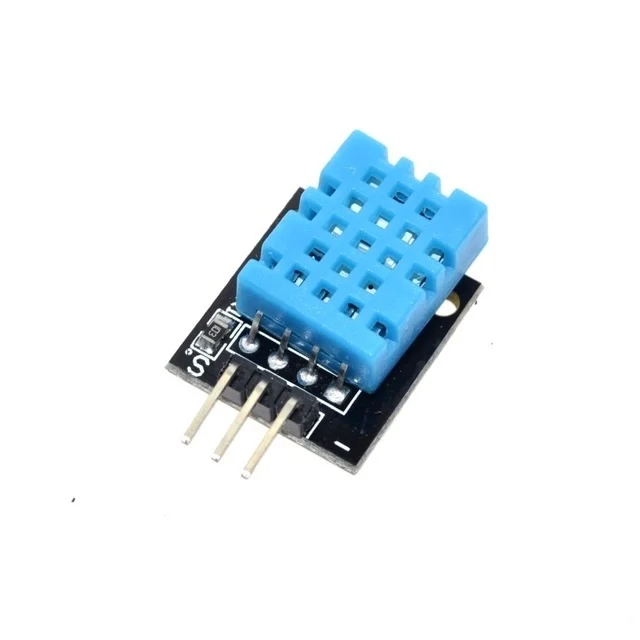
DHT11 Digital Relative Humidity and Temperature Sensor Module
Pair with any OLED or LCD to build a real-time temperature and humidity monitor — one of the most popular beginner Arduino display projects.
Which Should You Choose?
Here is a quick decision guide:
- Complete beginner? Start with a 16×2 LCD + I2C backpack. The
LiquidCrystal_I2Clibrary is the simplest API in the Arduino world, and thousands of tutorials use it as their display example. - Battery-powered wearable or compact project? Choose the 0.96″ SSD1306 OLED. Low power, tiny footprint, and eye-catching contrast.
- Need colour and graphics? Go for a TFT LCD (2.4″–3.5″). More wiring, but worth it for dashboards, weather stations, and smart mirrors.
- Want the absolute best visual quality in a small form factor? A colour SSD1351 OLED delivers, though at a higher price point.
- Always-on display (clock, server monitor)? Use LCD to avoid OLED burn-in. Set the backlight to dim after a few minutes of inactivity.
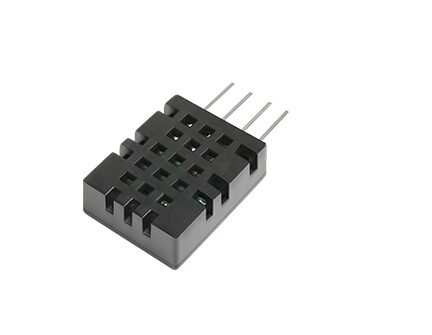
DHT20 SIP Packaged Temperature and Humidity Sensor
Upgrade your display project with the DHT20 — I2C interface means it shares the same bus as your OLED, requiring no extra GPIO pins on your Arduino.
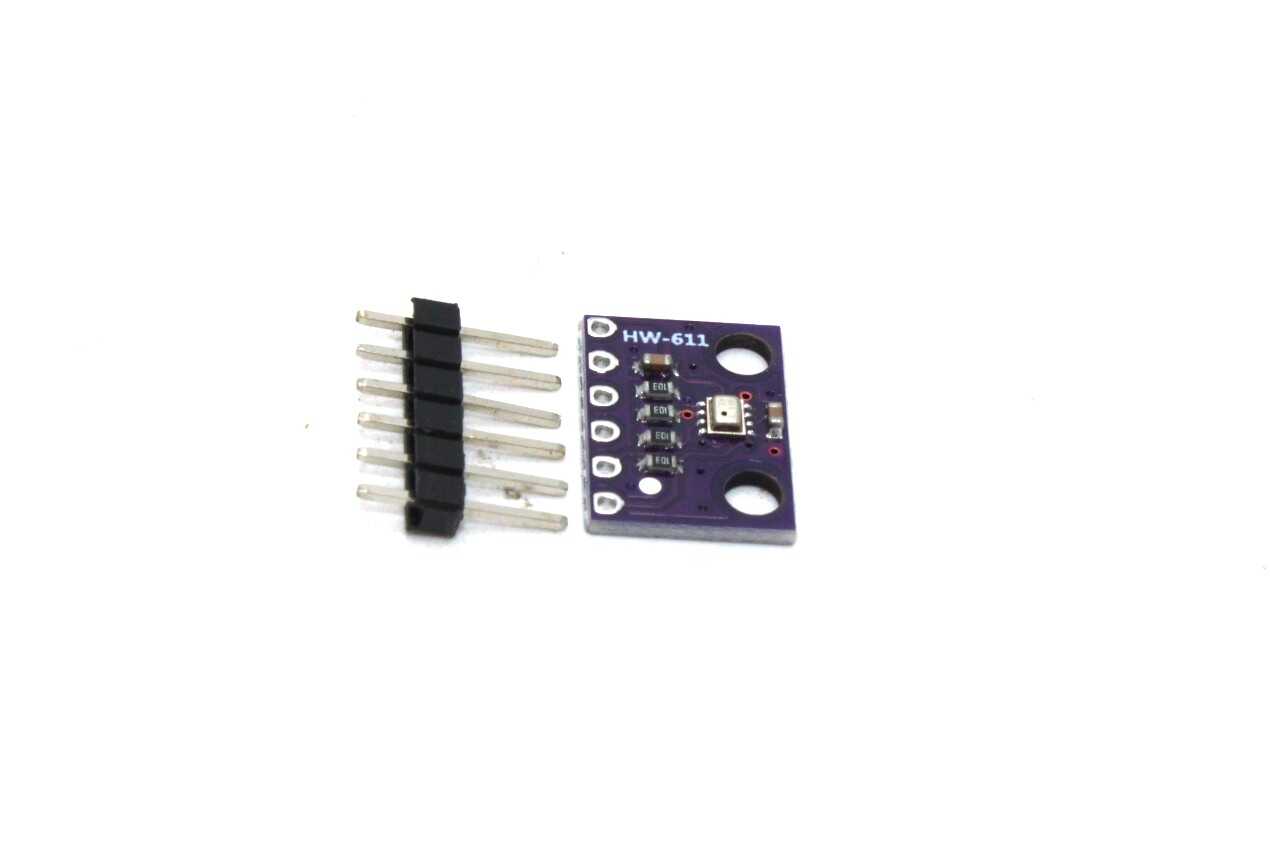
BMP280 Barometric Pressure and Altitude Sensor I2C/SPI Module
Add pressure readings alongside temperature to your display project. I2C interface compatible with both Arduino Uno and ESP32 boards.
Frequently Asked Questions
Can I use both OLED and LCD at the same time on one Arduino?
Yes. If both are I2C devices, they can share the SDA/SCL bus as long as they have different I2C addresses (SSD1306 OLED typically defaults to 0x3C or 0x3D; 16×2 LCD backpack typically defaults to 0x27 or 0x3F). Confirm addresses with an I2C scanner sketch before running your main code.
Does the SSD1306 OLED work at 5V?
Most SSD1306 modules sold for Arduino have an onboard 3.3V regulator and level shifting, making them safe to power from 5V. Always check the module’s datasheet or product page. When in doubt, use the 3.3V pin of your Arduino to be safe.
Which is better for outdoor use — OLED or LCD?
For outdoor use, sunlight-readable transflective LCDs or e-paper displays outperform both standard OLED and TFT LCD. However, if you must choose between the two, a high-brightness TFT LCD with backlight at maximum is slightly more readable in sunlight than a standard OLED.
How much RAM does the SSD1306 OLED use on Arduino?
The Adafruit SSD1306 library allocates a 128×64 bit = 1KB frame buffer in RAM. On an Arduino Uno with only 2KB of SRAM, this is significant. U8g2 in page mode avoids this by rendering one page at a time, using far less RAM — ideal for RAM-constrained Uno projects.
Is an LCD or OLED better for displaying sensor data continuously?
For long-running always-on sensor displays, character LCD wins due to burn-in resistance. Use a 20×4 LCD for maximum data density in text form. If you need OLED for aesthetics, set up a screensaver that inverts or shifts the display periodically to extend pixel life.


Add comment