
If you have been searching for the right microcontroller for your next IoT project, the ESP32-C3 has likely appeared on your radar. Espressif’s RISC-V based chip has taken the maker community by storm, especially among Indian hobbyists and engineers looking for an affordable yet capable board. But how does it stack up against the classic ESP32? This in-depth comparison will help you decide which board deserves your money.
Overview: ESP32-C3 and ESP32 at a Glance
The original ESP32 launched in 2016 and quickly became one of the most popular microcontrollers in the world. It combined dual-core processing, WiFi, Bluetooth Classic and BLE into a single chip at a very affordable price. For Indian makers, it was a game changer — finally a module that could power smart home devices, industrial sensors and wearable prototypes without breaking the bank.
The ESP32-C3 arrived in 2020 as Espressif’s answer to the demand for an even more budget-friendly, power-efficient chip. It uses a single-core RISC-V processor instead of the dual-core Xtensa LX6 found in the original ESP32. While that sounds like a downgrade, the ESP32-C3 packs several improvements over its older sibling, including better WiFi 4 performance, enhanced security features and dramatically lower deep sleep current.
Both chips are widely available in India through suppliers like Zbotic, but they serve somewhat different needs. Understanding those differences is the key to making the right purchase decision.
CPU Architecture: RISC-V vs Xtensa
The most fundamental difference between the ESP32-C3 and the classic ESP32 is the CPU architecture. The ESP32 uses Espressif’s licensed Xtensa LX6 dual-core processor running at up to 240 MHz. Each core is capable of running independent tasks, which is what makes the ESP32 so powerful for multitasking applications like running a web server while simultaneously reading sensor data.
The ESP32-C3, on the other hand, uses a single-core RISC-V processor (RV32IMC) running at up to 160 MHz. RISC-V is an open-source instruction set architecture that has been gaining tremendous momentum globally. While a single 160 MHz RISC-V core cannot match the raw throughput of two 240 MHz Xtensa cores, it is more than sufficient for the vast majority of IoT applications.
For tasks like reading a temperature sensor every few seconds, controlling a relay, or sending data to an MQTT broker, the ESP32-C3’s single core is completely adequate. Where you will feel the limitation is in applications that require heavy computation — like running machine learning inference, audio processing or managing multiple high-frequency communication tasks simultaneously.
The RISC-V architecture also brings a benefit that is often overlooked: better long-term community support. Since RISC-V is open-source, there is no licensing cost, which means Espressif can keep the ESP32-C3 priced lower than the original ESP32 indefinitely.
Specs Comparison Table
| Feature | ESP32-C3 | ESP32 (WROOM-32) |
|---|---|---|
| CPU | Single-core RISC-V RV32IMC, 160 MHz | Dual-core Xtensa LX6, 240 MHz |
| RAM | 400 KB SRAM | 520 KB SRAM |
| Flash | 4 MB (typical) | 4 MB (typical) |
| WiFi | 802.11b/g/n (2.4 GHz) | 802.11b/g/n (2.4 GHz) |
| Bluetooth | BLE 5.0 only | Classic BT + BLE 4.2 |
| GPIO Pins | 22 (11 usable on typical modules) | 38 (30+ usable) |
| ADC Channels | 6 × 12-bit (SAR ADC) | 18 × 12-bit (2 SAR ADCs) |
| DAC | None | 2 × 8-bit |
| Touch Pins | None | 10 |
| Deep Sleep Current | ~5 µA | ~10 µA |
| Secure Boot | Yes (v2) | Yes (v1) |
| Price (India approx.) | ₹150–250 | ₹250–450 |
GPIO, Peripherals and Connectivity
One area where the original ESP32 clearly wins is in the number of GPIO pins and peripheral interfaces. The ESP32 WROOM-32 module exposes 30+ usable GPIO pins with support for SPI, I2C, I2S, UART, PWM, CAN, Ethernet MAC and more. For complex projects that need to interface with multiple sensors, displays and actuators simultaneously, the ESP32 gives you far more flexibility.
The ESP32-C3 in a typical module like the Ai Thinker ESP32-C3-01M exposes only about 11 GPIO pins, which is a significant constraint. However, it does support SPI, I2C, UART and PWM — the essentials for most IoT projects. If your project needs more GPIO, look at the ESP32-C3-12F module, which has 22 GPIO pins and is a better option for moderately complex designs.
On Bluetooth, the ESP32-C3 supports only BLE 5.0, dropping Classic Bluetooth entirely. This is not a problem for most modern IoT projects where BLE is preferred for its lower power consumption. However, if you need to pair with a Bluetooth speaker or use A2DP audio streaming, you will need the classic ESP32.
The ESP32-C3 lacks DAC channels and capacitive touch pins — two features that the classic ESP32 has. If your project requires analog audio output or a touch-sensitive interface without an external controller, the ESP32-C3 is not the right choice.

Ai Thinker ESP32-C3-01M Wi-Fi + BLE Module
A compact and affordable ESP32-C3 module ideal for space-constrained IoT devices. Supports WiFi 4 and BLE 5.0 with a minimal footprint.
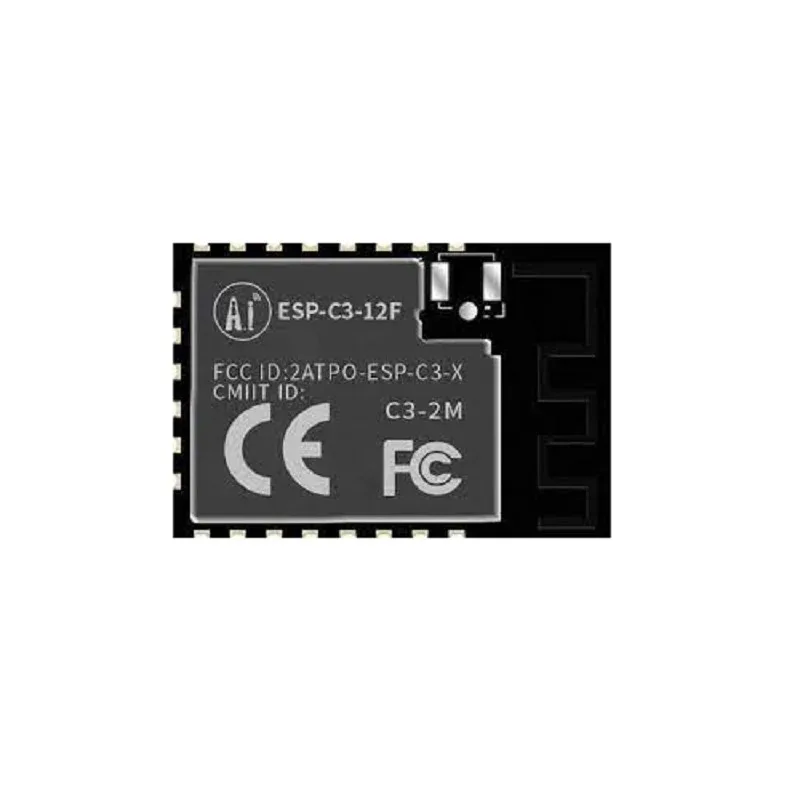
Ai-Thinker ESP32-C3-12F Wi-Fi + BLE Module
The larger ESP32-C3 module with 22 GPIO pins and 4 MB flash — perfect when you need more I/O than the compact C3-01M offers.
Power Consumption
Power consumption is one of the ESP32-C3’s strongest selling points, and it is especially relevant for Indian makers building battery-powered devices. In deep sleep, the ESP32-C3 draws around 5 µA compared to around 10 µA for the classic ESP32. While this sounds like a small difference, it can mean weeks of additional battery life in a sensor node that wakes up only periodically.
In active WiFi transmission mode, both chips consume roughly similar amounts of current (around 200–260 mA peak), but the ESP32-C3 tends to be more efficient for short burst transmissions due to architectural improvements. For projects running on 18650 lithium cells or small LiPo batteries — which is extremely common in Indian DIY IoT projects — this efficiency gain is meaningful.
If your project involves solar-powered weather stations, agricultural sensors or remote monitoring nodes where you want maximum uptime from a limited energy budget, the ESP32-C3 is the smarter choice.

2 x 18650 Lithium Battery Shield for Arduino/ESP32/ESP8266
Power your ESP32-C3 or ESP32 projects portably with this dual 18650 battery shield. Provides regulated 5V and 3.3V outputs with USB charging.
Software and Ecosystem Support
Both the ESP32-C3 and the classic ESP32 are well-supported by the Arduino IDE, ESP-IDF (Espressif IoT Development Framework), MicroPython, CircuitPython and PlatformIO. For Indian beginners who are comfortable with the Arduino ecosystem, both boards will feel familiar.
However, there are subtle differences. The ESP32-C3’s RISC-V architecture means that some older, architecture-specific libraries written for Xtensa may not compile directly. In practice, most popular libraries have been updated and the Arduino ESP32 core (v2.0+) fully supports both architectures. ESP-IDF also has first-class support for ESP32-C3.
Where the classic ESP32 wins on software is maturity. It has been around since 2016 and has an enormous library of community-contributed examples, projects and tutorials. If you are building something niche — like a specific industrial protocol or a hardware-accelerated computation task — you are more likely to find existing code for the ESP32 than for the ESP32-C3.
For Espressif’s newer frameworks like ESP-Rainmaker and Matter protocol support, the ESP32-C3 is actually better positioned. It received Matter certification early and is increasingly used in production smart home products. If you are building for the Matter ecosystem — which is gaining traction in India with Alexa and Google Home integration — the ESP32-C3 is the forward-looking choice.
Which Board for Which Use Case?
Choose the ESP32-C3 when:
- Your budget is tight (it costs ₹100–150 less per unit)
- You need long battery life (lower deep sleep current)
- Your project is a simple IoT node: temperature logging, button press, LED control, MQTT publishing
- You want BLE 5.0 with better range and speed
- You are building a Matter-compatible smart home device
- You need a small form factor (C3-01M is tiny)
Choose the classic ESP32 when:
- You need more GPIO pins for a complex project
- You require Bluetooth Classic (A2DP, SPP, HFP)
- Your application uses DAC for audio output
- You need capacitive touch sensing without an external IC
- You are doing heavy computation: ML inference, audio processing, multiple simultaneous tasks
- You want access to the largest community library base
- You need an on-board camera (ESP32-CAM is based on classic ESP32)

Ai Thinker ESP32 CAM Development Board WiFi+Bluetooth with Camera Module
The classic ESP32-based camera module with OV2640 sensor. Perfect for face recognition, video streaming and surveillance projects where the C3’s single core would struggle.
Recommended Products from Zbotic
Zbotic stocks a comprehensive range of ESP32 and ESP32-C3 modules. Whether you are starting with a simple C3 module or building a complex dual-core ESP32 project with a display, you can find the right hardware at competitive prices with fast shipping across India.

Waveshare ESP32-C3 0.71inch Round Display Development Board
An all-in-one ESP32-C3 development board with a built-in round display — great for wearables, smart badges and compact IoT dashboards.
Frequently Asked Questions
Is the ESP32-C3 compatible with ESP32 Arduino libraries?
Most popular Arduino libraries for ESP32 also work on the ESP32-C3 since the Arduino ESP32 core (v2.0 and above) supports both. However, a small number of libraries that use Xtensa-specific assembly or intrinsics will not compile for the ESP32-C3’s RISC-V core. Always check the library’s documentation or GitHub issues before committing to the C3 for a complex project.
Can I use MicroPython on the ESP32-C3?
Yes. MicroPython has supported the ESP32-C3 since version 1.17. You can flash the official MicroPython firmware and use the REPL over USB-serial just as you would on the classic ESP32. The standard network, machine and bluetooth modules all work on the C3.
Which is better for a beginner in India?
If you are just starting out, the classic ESP32 (like the NodeMCU-32S or a 30-pin ESP32 development board) is recommended because of the larger GPIO count and the wealth of beginner tutorials available online. Once you are comfortable with IoT programming, the ESP32-C3 is an excellent cost-saving choice for your next batch of projects.
Does the ESP32-C3 support over-the-air (OTA) updates?
Yes, the ESP32-C3 fully supports OTA firmware updates through both ESP-IDF’s OTA API and the Arduino ArduinoOTA library. This is one of the features that makes it well-suited for deployed IoT products where you need to push firmware updates remotely.
What is the price difference between ESP32-C3 and ESP32 in India?
Generally, the ESP32-C3-01M module costs around ₹150–200 while a comparable ESP32 module (like the ESP-WROOM-32) costs ₹250–400. For a prototype or a single unit, the price difference is modest. But if you are building 50 or 100 units for a small production run, the ESP32-C3 can save you ₹10,000 or more.
Conclusion
The ESP32-C3 is not a replacement for the classic ESP32 — it is a complement to it. For simple, battery-powered or cost-sensitive IoT projects, the ESP32-C3 is the smarter choice in 2026. For complex, multi-peripheral or compute-heavy applications, the dual-core ESP32 remains king.
The good news for Indian makers is that both chips are readily available, well-supported and extremely capable. Start with whichever fits your current project, and you will find that the skills you learn transfer directly between them.
Browse Zbotic’s full range of ESP32 and IoT modules — including ESP32-C3, ESP32-S3, ESP32-CAM and accessories — with fast shipping across India.



Add comment