
nRF52840 vs ESP32: BLE 5.0 Module Comparison for Wearables
Choosing between the nRF52840 and ESP32 for BLE 5.0 wearable projects is one of the most common dilemmas Indian makers and product developers face. Both chips support Bluetooth Low Energy 5.0, both are available as compact modules, and both have excellent Arduino/SDK support. But they’re designed for fundamentally different use cases — and picking the wrong one can mean a wearable with a 3-day battery life instead of 3 weeks. This deep-dive comparison covers power consumption, BLE 5.0 features, software ecosystem, available modules in India, and gives you a clear recommendation based on your specific wearable requirements.
Chip Architecture Overview
The two chips come from completely different design philosophies:
Nordic Semiconductor nRF52840 is purpose-built for ultra-low-power wireless. It’s an ARM Cortex-M4F running at 64 MHz with a BLE 5.0 radio, 1 MB Flash, 256 KB RAM, USB 2.0 FS, and an onboard hardware crypto accelerator (ARM TrustZone, AES, ECC). It runs on 1.7–5.5V and has best-in-class sleep current.
Espressif ESP32 is designed for connectivity-rich applications — it’s a dual-core Xtensa LX6 at up to 240 MHz with both WiFi (802.11 b/g/n) and BLE 5.0, 520 KB SRAM (external flash up to 16 MB), rich peripheral set. It runs on 3.0–3.6V and prioritises raw processing power and WiFi features over power efficiency.
The core philosophical difference: the nRF52840 was designed to run on a coin cell for years; the ESP32 was designed to be a powerful connectivity hub that can survive on a LiPo battery for days to weeks.
BLE 5.0 Features: What Actually Differs
Both chips claim BLE 5.0 support, but implementation depth varies:
| BLE 5.0 Feature | nRF52840 | ESP32 |
|---|---|---|
| 2M PHY (2× speed) | Full support | Full support |
| Coded PHY (Long Range 125/500 kbps) | Full support (4× range) | Partial (controller only) |
| Extended Advertising | Full support | Limited in ESP-IDF |
| Direction Finding (AoA/AoD) | Full support (nRF52833+) | Not supported |
| Mesh (Bluetooth Mesh) | Excellent (Zephyr) | Available (ESP-IDF) |
| Simultaneous central + peripheral | Yes | Yes (limited) |
| BLE Audio (LE Audio / LC3) | nRF5340 only | Not supported |
For most wearable projects (fitness trackers, health monitors, smart patches), standard BLE 4.x GATT profiles are sufficient — both chips handle this equally well. The nRF52840’s Long Range (Coded PHY) advantage matters for applications like asset tracking wearables or industrial wrist devices in large facilities.
Power Consumption Comparison
This is where the comparison becomes decisive for wearables. Here are real-world current figures:
| Operating Mode | nRF52840 | ESP32 |
|---|---|---|
| Deep sleep (RAM off) | 0.4 µA | 10 µA |
| Deep sleep (RAM on) | 1.5 µA | 150 µA |
| BLE advertising (1s interval) | ~3 µA avg | ~130 µA avg |
| BLE connected (1s conn interval) | ~10 µA avg | ~500 µA avg |
| CPU active (16 MHz) | 1.5 mA | — |
| CPU active (240 MHz) | — | 70–80 mA |
| WiFi TX (ESP32 only) | N/A | 240–290 mA |
The numbers tell a clear story: the nRF52840 draws 40–50× less current in BLE advertising mode than the ESP32. On a 100 mAh coin cell (CR2477), the nRF52840 can advertise BLE for over a year; the ESP32 would last about a month. On a 300 mAh LiPo wristband battery, nRF52840 wearable: 3–6 months; ESP32 wearable: 2–10 days depending on duty cycle.

Waveshare ESP32-S3 1.43inch AMOLED Display Development Board 466×466
A complete smartwatch-style development board with round AMOLED display. Ideal for ESP32-based wearable UI prototyping — BLE + WiFi built in with a stunning display.
Processing Power and Memory
The ESP32 is dramatically more powerful in raw compute:
- ESP32: Dual-core 240 MHz Xtensa LX6, 520 KB SRAM, hardware floating-point, DSP instructions, external flash/PSRAM support up to 16 MB. Can run TensorFlow Lite Micro, image processing, and heavy FFT workloads.
- nRF52840: Single-core 64 MHz ARM Cortex-M4F, 256 KB RAM, 1 MB Flash. Capable of light ML inferencing (NimBLE, TF Lite Micro for simple models), sensor fusion at 100 Hz, HRV algorithms — all the real work a wearable needs.
For typical wearables — pedometers, heart rate monitors, SpO2 trackers, temperature/activity patches — the nRF52840 has more than enough compute. The ESP32’s extra muscle is wasted unless your wearable needs on-device WiFi, video streaming, or complex ML inference in real time.

Waveshare ESP32-S3 1.46inch Round Display Board 412×412 WiFi Bluetooth
Round watch-form ESP32-S3 board with accelerometer, gyroscope, speaker, and microphone built in — a complete wearable development platform for rich UI prototypes.
Software Ecosystem and Libraries
nRF52840 software options:
- Zephyr RTOS (recommended): Nordic’s primary supported SDK. Excellent BLE stack, proper RTOS scheduling, power management APIs. Steeper learning curve but production-grade.
- nRF5 SDK: Legacy SDK, still widely used, mature BLE profiles, detailed power profiles.
- Arduino: Via Adafruit’s nRF52 board package or Arduino_nRF5x. Works for prototyping, less optimised than native SDK for production.
- CircuitPython: Adafruit’s Feather nRF52840 supports CircuitPython — great for rapid prototyping.
ESP32 software options:
- Arduino-ESP32: The most popular option for makers. Huge library ecosystem, easy WiFi+BLE. BLE implementation is Bluedroid or NimBLE (lighter).
- ESP-IDF: Espressif’s native framework. More control, better power management, required for advanced BLE 5.0 features.
- MicroPython / CircuitPython: Rapid prototyping with Python syntax.
For Indian hobbyists, the ESP32 with Arduino IDE wins on learning curve and community resources — vast amounts of Hindi and English tutorial content, large Indian maker community support. The nRF52840 requires more investment in learning but pays back in power efficiency for production wearables.
Form Factor and Available Modules in India
For wearables, compact form factor matters immensely. Available options for Indian makers:
ESP32 wearable-suitable boards:
- ESP32-S3 Waveshare round display boards (available on Zbotic) — complete smartwatch development kits
- ESP32-C3 mini modules (7×7 mm bare module, available at Zbotic)
- TTGO T-Watch (with integrated display, IMU, RTC — harder to find locally)
nRF52840 boards:
- Adafruit Feather nRF52840 — popular, requires import
- Nordic nRF52840 DK (dev kit only, too large for wearables)
- Seeed XIAO nRF52840 — ultra compact 21×17.5 mm, best for wearables, available from Seeed distributors
- Various custom modules available from PCBA vendors
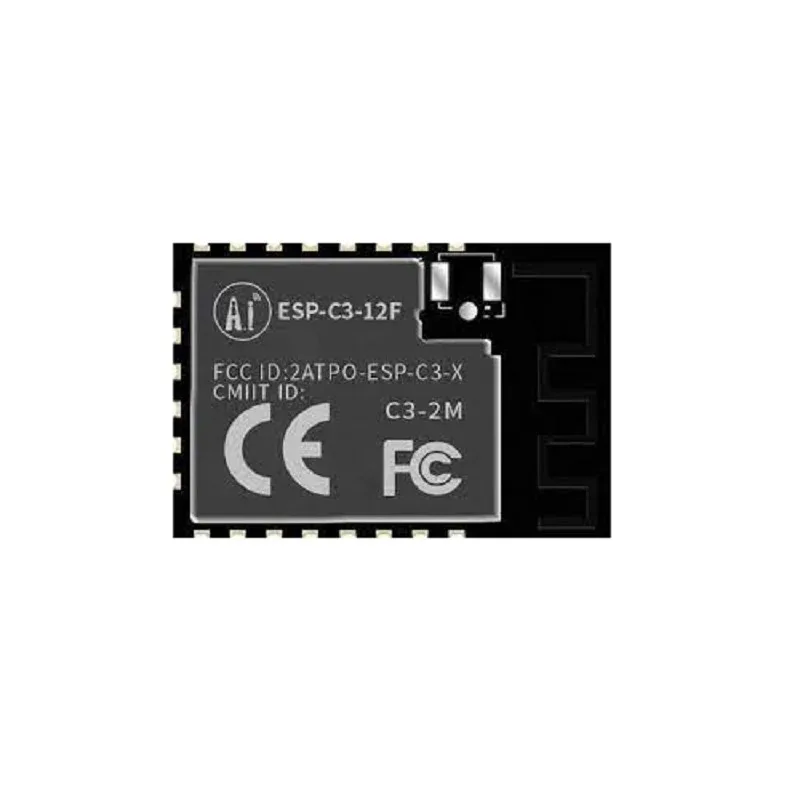
Ai-Thinker ESP32-C3-12F Wi-Fi + BLE Module
Compact ESP32-C3 module with integrated antenna. Lower power than full ESP32 while retaining BLE 5.0 + Wi-Fi. A great middle ground for wearable prototyping on a budget.
Wearable Use Case Decision Guide
Use this framework to decide which chip fits your project:
Choose nRF52840 if:
- Battery life is the #1 priority (coin cell, or 1+ week on small LiPo)
- Your wearable only needs BLE (no WiFi required)
- You’re building a medical/health sensor (BLE health profiles, DFU OTA, proper security)
- You’re targeting commercial production — nRF52840 is the industry standard for AMS certified products
- You need BLE direction finding (AoA/AoD) for precise location wearables
Choose ESP32 if:
- Your wearable also needs WiFi (cloud sync, OTA firmware, local server)
- You need a display with complex UI (Squareline Studio + LVGL + ESP32-S3 = excellent)
- Processing power matters — on-device voice, image processing, complex ML
- You’re prototyping rapidly and want the largest library ecosystem
- Battery life target is 1–7 days on a reasonably sized LiPo (achievable with deep sleep management)
Final Recommendation
For production wearables where battery life defines user experience — fitness bands, health patches, smart jewellery, industrial wrist devices — the nRF52840 is the clear winner. Its purpose-built BLE 5.0 radio, sub-microamp sleep currents, and Zephyr RTOS ecosystem are exactly what long-wearing devices need.
For prototyping, display-heavy devices, or anything needing WiFi alongside BLE — smartwatch concepts, WiFi-connected health monitors, maker projects — the ESP32 (especially ESP32-S3) is the better choice. The ecosystem richness, LVGL display support, and instant maker community help make development fast and enjoyable.
And for Indian makers on a budget building their first wearable prototype: start with ESP32. Learn BLE GATT, sensor fusion, and power management concepts. Then migrate to nRF52840 when you’re ready to push battery life for a real product.
Frequently Asked Questions
Can ESP32 achieve nRF52840-level battery life with optimisation?
With aggressive deep sleep cycling (CPU off between BLE events) and ULP co-processor tricks, ESP32 can reach ~20–50 µA average in BLE advertising — about 10× worse than nRF52840’s 3 µA. For a 100 mAh battery, that’s ~83 days for ESP32 vs 3+ years for nRF52840. Optimised ESP32 is adequate for weekly-charged wearables, not monthly-recharged ones.
Is nRF52840 compatible with Arduino IDE?
Yes — Adafruit and Nordic both provide Arduino board packages for nRF52840. However, BLE libraries for nRF52840 on Arduino are less mature than ESP32’s NimBLE. For serious production work, Zephyr RTOS is recommended. For hobbyist prototyping, Arduino on nRF52840 works fine.
Does the ESP32 support BLE 5.0 Long Range (Coded PHY)?
ESP32’s hardware supports BLE 5.0 Coded PHY (Long Range) but ESP-IDF’s host stack implementation has been historically incomplete. Recent ESP-IDF versions (v5.x+) have improved this. The nRF52840 has the most mature and tested Coded PHY implementation with proven 4× range extension.
What about ESP32-C3 — is it better than full ESP32 for wearables?
The ESP32-C3 (RISC-V, single core 160 MHz, BLE 5.0 only, no WiFi dual-band) is significantly more power-efficient than the original ESP32 — deep sleep around 5 µA, BLE advertising around 40 µA. It’s a better wearable choice than ESP32 or ESP32-S3, though still 10× more power-hungry than nRF52840 in BLE idle.
Which chip do commercial Indian wearable startups use?
Most serious Indian wearable startups (health monitoring, fitness) targeting 7+ day battery life use nRF52840 or nRF5340 (dual-core Nordic chip for BLE audio). ESP32 is more common in maker products, smartwatch prototypes, and devices where WiFi connectivity justifies the power overhead.


Add comment