
Crowbar Circuit: Overvoltage Protection for Your Electronics
Every power supply can fail. Voltage regulators go short-circuit. Feedback loops lose control. Transient spikes slam through inadequate filtering. When any of these events happen in a system without protection, the result is a cascade of damaged ICs, burnt PCB traces, and lost data. The crowbar circuit for overvoltage protection is a classic, proven technique that acts like an emergency fuse — deliberately short-circuiting the power supply the instant voltage exceeds a safe threshold, forcing the fuse or current limiter to trip and protecting everything downstream. In this guide, we’ll explain exactly how crowbar circuits work, when to use them, how to design one, and what alternatives exist.
What Is a Crowbar Circuit?
The name “crowbar” comes from the analogy of literally dropping a metal crowbar (a heavy iron bar) across the terminals of a power supply — a short circuit. Obviously, you don’t actually drop a crowbar. Instead, a semiconductor switch (typically an SCR — Silicon Controlled Rectifier, also known as a thyristor) is triggered to conduct heavily, creating a near-short-circuit condition across the power rails.
This has two important effects:
- The voltage across the load immediately collapses to nearly zero — protecting all downstream components from the overvoltage event.
- The resulting large current through the supply trips a fuse or current limiter — disconnecting the source and latching the system in a safe off-state.
Key characteristics that define the crowbar approach:
- Irreversible action: Once triggered, the SCR latches on and stays on until the supply is removed and current drops below the holding current. It does not self-reset.
- Very fast response: SCR trigger latency is typically under 1 µs — much faster than a fuse or circuit breaker alone.
- Destructive by design: The crowbar is meant to destroy itself (or at least the fuse) to save the load — it is the “sacrificial” protection element.
How a Crowbar Circuit Works
A basic SCR crowbar circuit consists of these elements working together:
1. The Sensing Network
A Zener diode or resistor divider monitors the supply voltage. The Zener is selected to conduct (break down) only when supply voltage exceeds the acceptable threshold. Below threshold, the Zener is non-conducting and the SCR gate sees no trigger current.
2. The SCR (Thyristor)
The SCR (e.g., 2N6397, BT151, TYN408) is connected in parallel with the load — anode to the positive rail, cathode to ground, gate to the Zener trigger circuit. In normal operation, the SCR is off (open circuit). When the Zener conducts, gate trigger current flows, latching the SCR on.
3. The Current-Limiting Fuse
A fast-blow fuse (or PTC resettable fuse) in series with the supply blows when the SCR turns on and draws very high current. This breaks the circuit and removes the overvoltage source.
4. The Gate Resistor
A resistor (100–470 Ω) in series with the SCR gate limits gate current to a safe value and prevents noise-induced false triggering.
Operational Sequence
- Supply voltage rises above the Zener breakdown voltage (Vz)
- Zener conducts → current flows through the gate resistor into the SCR gate
- SCR latches ON in microseconds → near-short-circuit across supply rails
- Fuse blows (or current limiter trips) → supply disconnected
- SCR current drops below holding current → SCR turns off (but supply remains disconnected by blown fuse)
- System is now safely off. Replace the fuse, find and fix the root cause.
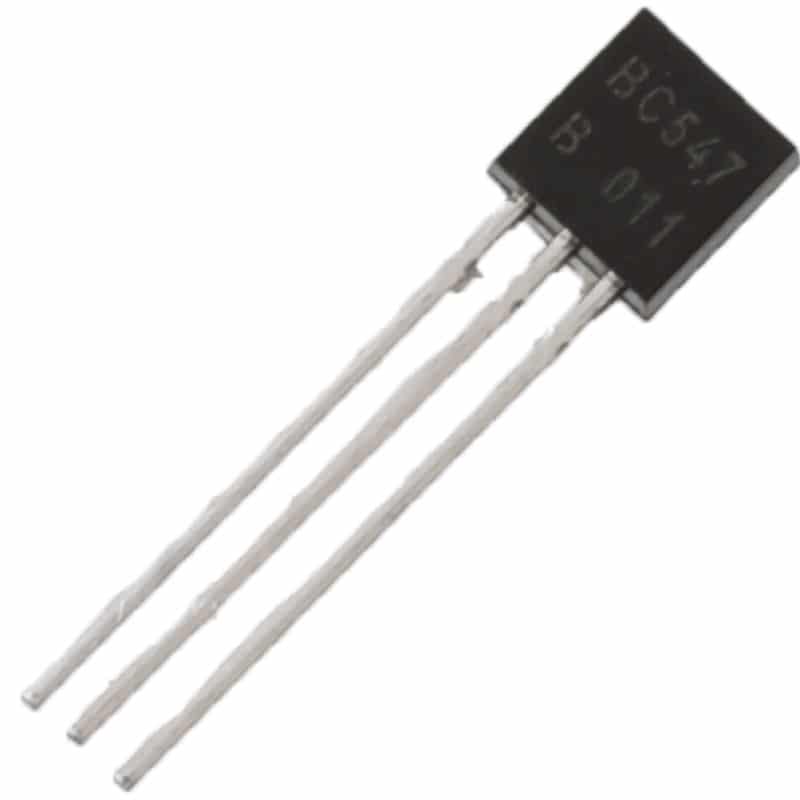
BC547 NPN 100mA Transistor TO-92 (Pack of 10)
Use the BC547 as a buffer or comparator stage in your crowbar trigger circuit, driving the SCR gate from a low-current Zener sensing network with higher reliability.
Types of Crowbar Circuits
1. Simple Zener-SCR Crowbar
The most basic form. A single Zener diode and SCR with a gate resistor. Trip point is set by the Zener voltage. Advantages: extremely simple — as few as 3 components. Disadvantages: Zener voltage tolerance is typically ±5–10%, so the trip point has significant variation. Also sensitive to temperature drift (Zener Vz changes approximately -2 mV/°C for junction-type Zeners above ~5V).
Typical component values: For a 5V supply, use a 5.6V Zener (BZX55C5V6 or 1N5231). SCR: 2N6397 (6A, 200V). Gate resistor: 270 Ω. Fuse: 1A fast-blow.
2. Improved TL431 Crowbar
The TL431 is a programmable precision shunt reference with a built-in comparator. Using a resistor divider on the TL431’s reference pin, the trip point is set very accurately (within ±0.5%). When the monitored voltage exceeds the trip threshold, TL431’s cathode pulls low, triggering the SCR gate. This is the most commonly used crowbar configuration in production designs.
Design example for 5V supply, trip at 5.5V:
- TL431 internal reference Vref = 2.495V
- Resistor divider: R1 and R2 on the Ref pin such that Vtrip = Vref × (1 + R1/R2)
- 5.5V = 2.495 × (1 + R1/R2) → R1/R2 = 1.205
- Use R2 = 10 kΩ, R1 = 12 kΩ (standard E12 value)
3. Op-Amp Comparator Crowbar
An op-amp (e.g., LM393 comparator) with a precision reference drives the SCR gate. Provides the highest accuracy trip point and fastest response. Used in high-reliability lab power supplies and precision instrumentation.
4. IC-Based OVP Crowbar (e.g., TPS3700)
Modern OVP monitoring ICs include precision references, hysteresis, time delay (to avoid false trips on transients), and reset logic. These are used in modern designs alongside MOSFETs instead of SCRs for a “soft” crowbar with reset capability.
5. Transistor Buffer Enhancement
Adding an NPN transistor (like BC547) between the Zener/TL431 and the SCR gate allows a weak sensing signal to drive a high-gate-current SCR reliably. The transistor buffers the signal, prevents loading of the Zener reference, and allows using higher-current SCRs without increasing Zener power dissipation.
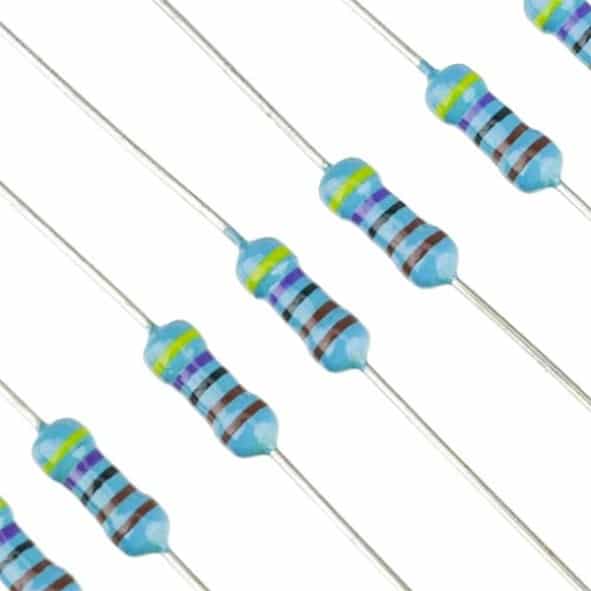
1.5 Ohm 0.25W Metal Film Resistor MFR (Pack of 100)
Precision metal film resistors for accurate Zener bias and TL431 voltage divider networks in your crowbar trigger circuit. Lower tolerance than carbon film for precision trip points.
Designing a Crowbar Circuit Step by Step
Let’s design a practical crowbar for protecting a 12V/2A supply (like the 12V 2A adapter from Zbotic):
Step 1: Define Requirements
- Nominal supply voltage: 12V
- Maximum acceptable overvoltage: 14V (set trip at 14V)
- Maximum load current: 2A
- Desired response time: < 10 µs
Step 2: Select the SCR
The SCR must handle:
- Off-state voltage: At least 1.5× supply max (12 × 1.5 = 18V minimum, use 50V+ for margin) → TYN408 (8A, 400V) or C106 (4A, 200V)
- On-state current: During the crowbar event, current is limited only by wiring resistance and fuse resistance. For a 2A fuse with ~0.5Ω total impedance: I_peak = 12 / 0.5 = 24A peak. The SCR must handle this surge — TYN408 handles 80A surge. OK.
- Holding current: Must be lower than the minimum fuse current to ensure SCR turns off after fuse blows. TYN408 Ih = 5 mA (well below any fuse rating)
Step 3: Select the TL431 and Resistor Divider
Trip at 14V using TL431 (Vref = 2.495V):
- Vtrip = Vref × (1 + R1/R2) → 14 = 2.495 × (1 + R1/R2)
- R1/R2 = 4.613 → use R2 = 10 kΩ, R1 = 47 kΩ (gives 14.2V trip — close enough)
- Fine-tune by using R1 = 43 kΩ + 5 kΩ trimmer for adjustable trip point
Step 4: TL431 to SCR Gate Interface
TL431 cathode drives an NPN transistor (BC547) base through a 1 kΩ resistor. BC547 collector connects through a 100 Ω resistor to the SCR gate. BC547 emitter to ground. When TL431 pulls low, the BC547 base goes low — wait, we need inverse logic: when TL431 reference is exceeded, cathode goes low, pulling BC547 base low. We need the SCR gate to go HIGH when voltage is exceeded.
Correct configuration: Use the TL431 as a shunt — when Vref is exceeded, TL431 conducts (cathode to anode current flows). A pull-up resistor from the 12V rail through a resistor to the transistor base — when TL431 conducts, it pulls the transistor base current path low, but the transistor should be configured to trigger on overvoltage. Simpler: connect TL431 cathode directly to SCR gate through a 100 Ω resistor. When TL431 conducts (overvoltage detected), current flows from the 12V rail through a gate resistor, through TL431 to ground — this current flows through the SCR gate triggering it.
Step 5: Select the Fuse
Use a fast-blow fuse rated at 1.5–2× the nominal load current. For a 2A load: use a 2A or 3A fast-blow fuse. A slow-blow fuse is not appropriate here — it won’t blow fast enough to protect the load during the crowbar event. Ideal: 2A, 250V fast-blow.
Step 6: Add Filter Capacitor for Noise Immunity
Add a 100 nF capacitor from the TL431 reference pin to ground. This filters out fast voltage spikes that might otherwise cause false triggering during normal switching transients on the supply rail.
Crowbar vs Clamp vs OVP IC: Which to Choose?
| Method | How It Works | Resets? | Best For |
|---|---|---|---|
| SCR Crowbar | Short-circuits supply, blows fuse | No (fuse must be replaced) | Critical protection where load must be positively isolated |
| Zener Clamp | Shunts excess voltage to ground | Yes (self-resetting) | Transient spikes, ESD protection, signal clamping |
| TVS Diode | Fast avalanche clamp | Yes | ESD and fast transient protection (nanosecond response) |
| MOSFET OVP Switch | Series MOSFET disconnects supply | Yes (auto-reset possible) | Battery systems, USB ports, smart protection |
| OVP IC (e.g., TPS25xx) | Integrated sensing + switch | Yes (programmable) | USB, portable devices, precision regulation |
The crowbar is the right choice when you need guaranteed hard disconnect of an unsafe voltage, and where a non-resetting action is acceptable or preferred (industrial equipment, lab power supplies, telecom power, legacy systems). For consumer electronics where seamless recovery is needed, a MOSFET-based OVP circuit with an auto-reset controller IC is more user-friendly.
Real-World Applications
1. Lab Bench Power Supplies
Commercial bench power supplies (like the Mastech or Uni-T series used in Indian labs) include crowbar protection on their output. If the feedback loop malfunctions and output voltage shoots up, the crowbar trips instantly — protecting the device under test. This is especially critical when working with sensitive microcontrollers, FPGAs, and RF ICs that would be instantly destroyed by even a brief overvoltage.
2. Telecommunications Power Systems
48V DC telecom systems use crowbar protection extensively. A failure of the -48V regulator can double the output voltage. A 65V-trip crowbar (Zener at 65V) protects DSLAM line cards, optical transceivers, and other sensitive telecom equipment.
3. Automotive Battery Protection
Load dump in automotive systems — when a large inductive load is suddenly disconnected — can produce voltage transients of 40–120V in a 12V system. Crowbar circuits (combined with TVS diodes for initial clamp) protect ECUs, infotainment systems, and sensors from these spikes.
4. DIY Arduino / Raspberry Pi Projects
Indian makers often power their Raspberry Pi and Arduino projects from surplus SMPS units or variable DC adapters. A 5V crowbar (trip at 5.8V) on the power rail can save your Raspberry Pi if the SMPS malfunctions. The Pi is particularly vulnerable — its switching regulators and USB chips die instantly at 6V+.
5. Battery Charger Protection
Li-Ion battery chargers with a defective feedback loop can overcharge cells to dangerous voltages. A crowbar on the battery terminal (trip slightly above max cell voltage × cell count) provides a last-resort hardware safety layer beyond the BMS’s software protection.
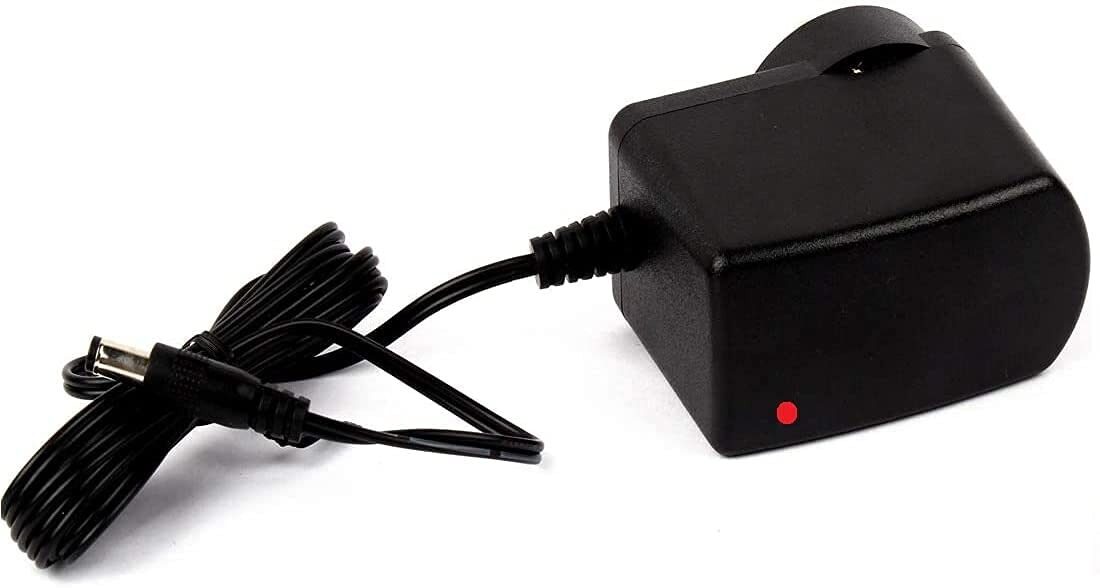
12V 2A Power Supply with 5.5mm DC Plug Adapter
Pair this reliable 12V adapter with a crowbar protection circuit for your projects. Protects downstream electronics from supply failure or voltage spikes.
Building and Testing a Crowbar Circuit
Here’s how to safely build and test your crowbar design:
Materials Needed
- SCR: TYN408 or C106 (available at local electronics markets like Lamington Road or SP Road)
- TL431 shunt reference
- Resistors: metal film for the voltage divider (better precision than carbon film)
- 100 nF ceramic capacitor for noise filtering
- Fast-blow fuse and fuse holder
- Prototype board for assembly
- Variable DC power supply (or a bench PSU) for testing
Testing Procedure
- Before connecting to your actual supply, test with a variable bench supply set below the trip point. Verify no SCR triggering at nominal voltage.
- Slowly increase the test supply voltage. The SCR should trigger within 1–2V above the designed trip point.
- When the SCR triggers, the supply current will spike — your bench supply’s current limit should kick in (set it to 200–500 mA for safe testing without a real fuse).
- Measure the actual trip voltage with a multimeter. Adjust R1 trimmer to calibrate to your target trip point.
- Once calibrated, test with a real fuse. The fuse should blow cleanly when the SCR triggers.
- Verify the blown fuse is the only casualty — all other components should be intact.
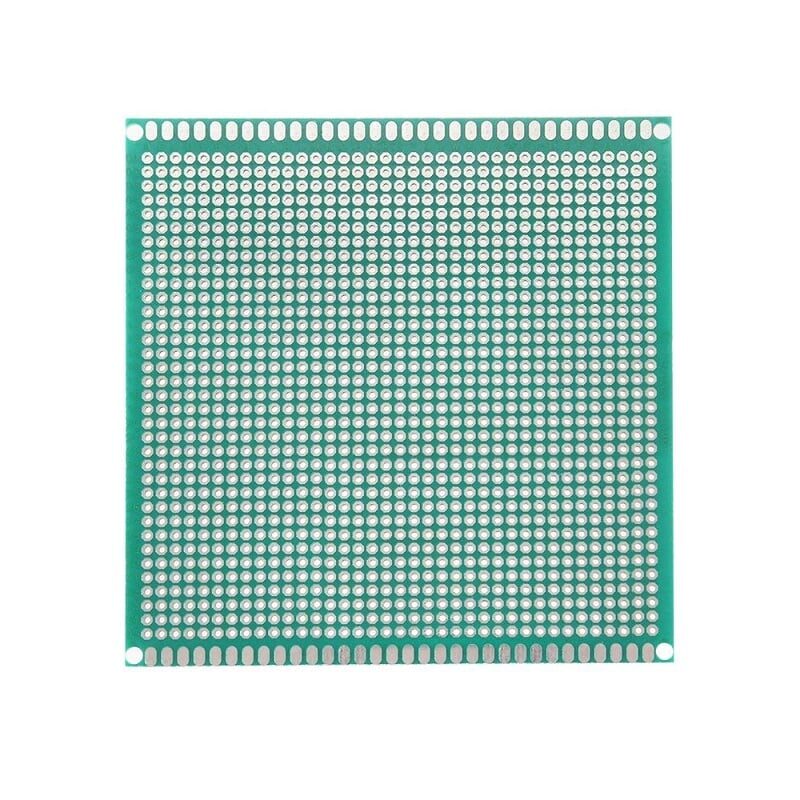
10 x 10 cm Universal PCB Prototype Board Single-Sided
Prototype and test your crowbar circuit before committing to a custom PCB. Large enough for the full crowbar circuit with fuse holder and terminal blocks.
Frequently Asked Questions
Q1: Will a crowbar circuit protect against ESD (Electrostatic Discharge)?
No — a crowbar circuit is not designed for ESD protection. ESD pulses are extremely fast (sub-nanosecond rise times) and very short duration. The SCR in a crowbar takes 1–10 µs to trigger, which is far too slow for ESD. ESD is handled by dedicated TVS diodes (like the SMBJ series), ESD protection arrays (PRTR5V0U2X), or varistors placed at board entry points. A crowbar protects against sustained or slow-rise overvoltage events, not nanosecond ESD spikes.
Q2: Can I use a MOSFET instead of an SCR in a crowbar circuit?
Yes, but with an important difference: MOSFETs don’t latch like SCRs. A MOSFET crowbar will turn off again as soon as the overvoltage condition clears — which means if the root cause (a failed regulator) is still present, it will oscillate. An SCR latches until power is removed, which is often the safer behavior. Modern OVP ICs use MOSFETs with software-controlled latching to get the best of both — fast response like an SCR but with intelligent reset capability.
Q3: How close can my trip voltage be to the nominal supply voltage?
As a rule of thumb, set the trip voltage at least 10–15% above the nominal supply voltage to avoid false trips during normal supply transients. For a 5V supply, trip at 5.5–5.8V. For a 12V supply, trip at 13–14V. If you set it too close, power-on inrush, load transients, or line regulation steps can trigger false trips. If you set it too high, you don’t get protection fast enough to save your components before they’re stressed.
Q4: What happens if the crowbar circuit itself fails?
The two failure modes of an SCR crowbar are: (1) SCR fails open — protection is lost silently. (2) SCR fails short — supply is permanently short-circuited (the fuse blows immediately, even on next power-up). The second failure mode is actually “fail-safe” — the system cannot be powered until the fault is found. To detect the first failure, periodic self-test is needed (inject a controlled test pulse to verify SCR triggers). High-reliability systems use redundant crowbar circuits.
Q5: Is a crowbar circuit necessary if I’m using a quality regulated power supply?
Quality regulated supplies (especially those with OVP built-in) reduce the need for an external crowbar. However, for prototype electronics, lab setups, or equipment handling expensive or irreplaceable components, adding a crowbar adds a cheap hardware safety net against the unexpected. A few rupees worth of SCR, Zener, and resistors is excellent insurance against losing a ₹500+ microcontroller or sensor module due to a power supply fault.
Protect Your Electronics Projects with Quality Components
Zbotic stocks transistors, resistors, capacitors, and prototype boards to build your crowbar and other protection circuits. Get all the components you need for safe electronics projects with fast delivery across India.







Add comment