
The question of ESP32 vs ESP8266 in 2026 is one of the most common debates in the Indian maker and IoT community. Both boards are made by Espressif Systems, both feature built-in WiFi, and both are available at accessible prices from Indian electronics suppliers. But they are fundamentally different in capability, and choosing the wrong one for your project can cost you time and money. This comprehensive comparison will help you make the right decision.
Full Specs Comparison: ESP32 vs ESP8266
Let’s start with the hard numbers. Here is a comprehensive side-by-side specifications comparison:
| Specification | ESP8266 | ESP32 | ESP32-S3 |
|---|---|---|---|
| CPU Cores | 1x Xtensa LX106 | 2x Xtensa LX6 | 2x Xtensa LX7 |
| CPU Speed | 80 / 160 MHz | 240 MHz | 240 MHz |
| RAM | ~80KB user usable | 520KB SRAM | 512KB SRAM + 8MB PSRAM |
| Flash | 512KB – 4MB | 4MB – 16MB | 4MB – 32MB |
| WiFi | 802.11 b/g/n (2.4GHz) | 802.11 b/g/n (2.4GHz) | 802.11 b/g/n (2.4GHz) |
| Bluetooth | None | BT 4.2 + BLE 4.2 | BT 5.0 + BLE 5.0 |
| GPIO Pins | 17 (11 usable) | 34 (30 usable) | 45 |
| ADC Channels | 1x 10-bit | 18x 12-bit | 20x 12-bit |
| DAC | None | 2x 8-bit | None |
| Touch Sensors | None | 10 | 14 |
| SPI / I2C / UART | 1 / 1 / 2 | 4 / 2 / 3 | 4 / 2 / 3 |
| I2S / CAN | 0 / 0 | 2 / 1 | 2 / 1 |
| Deep Sleep Current | ~20 µA | ~10 µA | ~7 µA |
| Active Current (WiFi TX) | ~170-200 mA | ~240 mA | ~260 mA |
| Price (India, 2026) | ₹120 – ₹200 | ₹250 – ₹500 | ₹400 – ₹1500 |
Processing Power and Memory
The ESP8266 runs a single Xtensa LX106 core at 80 MHz (overclockable to 160 MHz). It has approximately 80KB of usable RAM for user applications — a severe constraint when dealing with JSON parsing, TLS/HTTPS connections, and web server hosting simultaneously. The WiFi stack takes up a significant chunk of RAM, leaving precious little for your application code.
The ESP32 changes the game entirely. With two Xtensa LX6 cores running at 240 MHz and 520KB of SRAM, it is roughly 6x faster in CPU-bound tasks and offers almost 6x more usable RAM. Complex operations that the ESP8266 simply cannot handle — like running a full TLS web server while simultaneously reading multiple sensors and driving a display — are straightforward on ESP32.
The ESP32-S3 takes things further with the faster LX7 core architecture and optional 8MB of PSRAM, enabling applications like image processing, voice recognition (basic), and large web applications that would be impossible on earlier chips. If you are building anything involving machine learning at the edge, camera vision, or large data buffers, the ESP32-S3 is the chip to choose in 2026.

D1 Mini V2 NodeMCU 4M Bytes Lua Wi-Fi Development Board (ESP8266)
The D1 Mini is the most compact and affordable ESP8266 form factor, perfect for simple WiFi sensor nodes and home automation projects where the ESP8266’s processing power is sufficient.
Connectivity: WiFi, Bluetooth, and More
Both chips support 802.11 b/g/n WiFi on the 2.4 GHz band — no 5 GHz support on either. WiFi performance is comparable between the two for typical IoT use cases like HTTP requests, MQTT publishing, and web server hosting.
The biggest connectivity difference is Bluetooth. The ESP8266 has no Bluetooth at all. The original ESP32 includes both Classic Bluetooth (BT 4.2) and Bluetooth Low Energy (BLE 4.2). The ESP32-S3 upgrades to BT 5.0 + BLE 5.0 with longer range and faster throughput.
If your project needs to communicate with smartphones, BLE beacons, BLE sensors (like heart rate monitors or soil moisture sensors), smart locks, or BLE-based mesh networks — the ESP32 family is your only option among Espressif chips. BLE is also essential for Bluetooth Mesh protocols used in large-scale building automation.
GPIO Pins and Peripheral Interfaces
The ESP8266 is notoriously pin-limited. The ESP-12 module has 17 GPIO pins on paper, but several have restrictions: GPIO0, GPIO2, and GPIO15 affect the boot mode if their state is wrong at power-up. GPIO6-GPIO11 are used internally for the flash chip and cannot be used by the application. In practice, you have about 9-11 reliably usable GPIO pins. The single ADC channel has only 1V input range (not 3.3V), making it awkward to use.
The ESP32 offers 34 GPIO pins with true flexibility. It has 18 ADC channels (12-bit resolution, 0-3.3V), two 8-bit DAC outputs, hardware PWM on any pin via LEDC peripheral, capacitive touch sensing on 10 pins, and multiple SPI/I2C/UART/I2S interfaces. For projects with many sensors, buttons, LEDs, and actuators, the ESP32’s GPIO abundance is a significant practical advantage.
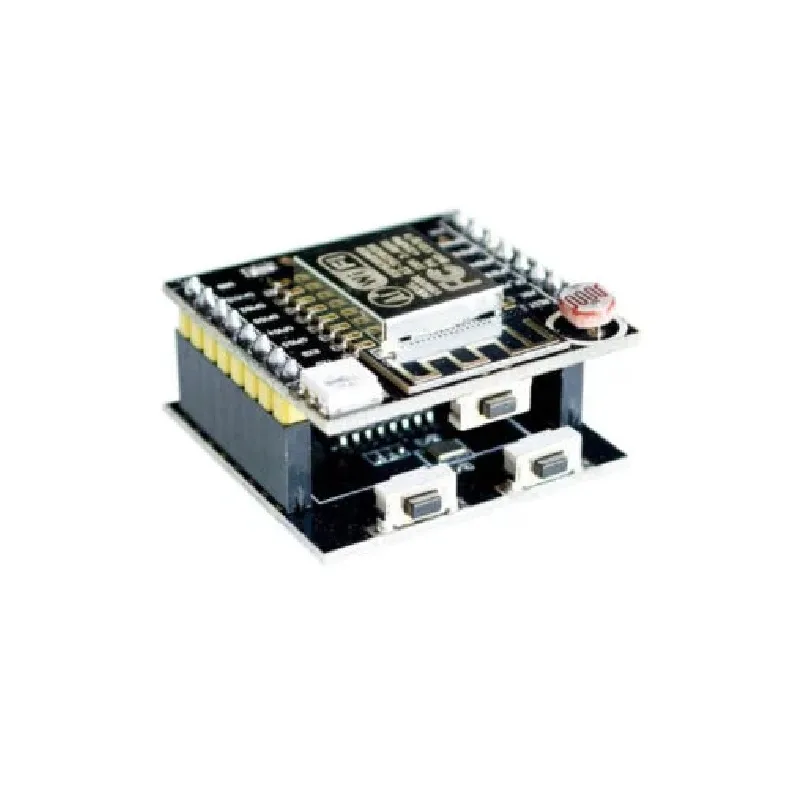
ESP8266 ESP-12F Module Serial WiFi Witty Cloud Development Board + Mini NodeMCU
The ESP-12F is the workhorse ESP8266 module with 4MB flash and a compact form factor. An excellent choice for production IoT nodes where cost savings per unit matter and processing requirements are modest.
Power Consumption and Battery Life
Power consumption is where the comparison gets nuanced. In deep sleep mode, the ESP32 actually wins — it draws only 10 µA vs the ESP8266’s 20 µA. Both can use deep sleep for battery-powered sensors that wake up every few minutes to take a reading and send it.
However, during active WiFi transmission, the ESP32 draws more current (up to 240 mA) compared to the ESP8266 (170-200 mA). This is because the ESP32 has two cores and more peripherals powered up. For battery-powered devices with very long sleep periods and brief active windows, the total energy per duty cycle can be similar between the two chips.
In practice, for battery-powered sensors in Indian homes with frequent load shedding and power outages, consider using a lithium battery with a battery shield for either board. The ESP32 family also supports ULP (Ultra Low Power) co-processor operation — the ULP core can run while the main cores sleep, reading ADC values and only waking the full system when a threshold is exceeded, allowing extremely long battery life.
Price and Availability in India 2026
Price is a significant factor for Indian makers and especially for large-scale deployments. As of 2026:
- ESP8266 (ESP-01): ₹80-120 per unit — the absolute cheapest WiFi microcontroller available in India
- ESP8266 (NodeMCU/D1 Mini): ₹150-250 per unit — development board with USB programming
- ESP32 (bare module): ₹180-280 per unit — competitive with high-end ESP8266 dev boards
- ESP32 (NodeMCU/development board): ₹280-500 per unit — the most popular all-purpose IoT dev board
- ESP32-C3 modules: ₹120-200 per unit — cheaper than ESP32 with RISC-V core, BLE, single-core 160 MHz
- ESP32-S3 (with display): ₹600-2000 per unit — premium boards with integrated displays
The price gap between ESP8266 and ESP32 has narrowed significantly since 2020. The ESP32-C3 in particular is now available at nearly the same price as ESP8266 while offering Bluetooth and a faster RISC-V core. This makes the ESP8266 increasingly hard to justify for new designs in 2026 unless you have a very specific reason (existing codebase, proven design, extreme cost sensitivity at massive scale).

Ai Thinker ESP32-C3-01M Wi-Fi + BLE Module
The ESP32-C3 is the sweet spot in 2026 — nearly ESP8266 pricing but with a RISC-V core, BLE 5.0, and modern security features. A compelling upgrade for new designs replacing ESP8266.
Which Board Should You Choose?
Here is a practical decision guide based on your project requirements:
Choose ESP8266 if:
- You have an existing ESP8266 codebase and no compelling reason to migrate
- You need the absolute lowest cost for a very large production batch (thousands of units)
- Your project is a simple WiFi sensor with no display, no Bluetooth, and minimal GPIO requirements
- You are teaching beginners and want the simplest possible platform with vast tutorial resources
Choose ESP32 if:
- You need Bluetooth (BLE or Classic) for any reason
- Your application requires concurrent tasks (FreeRTOS multitasking)
- You are building anything with a display, camera, audio, CAN bus, or multiple SPI devices
- You need more than 2-3 ADC channels or reliable 12-bit analog readings
- You are building a production product and need OTA updates, secure boot, and flash encryption
- HTTPS/TLS is required and memory constraints are a concern
Choose ESP32-S3 if:
- You are building a camera-based vision project or face recognition system
- You need edge AI/ML inference (ESP32-S3 has vector instructions for this)
- You want an integrated display in a compact form factor
- You need BT 5.0 with its extended range and throughput
Consider ESP32-C3 if:
- You want a modern chip at near-ESP8266 pricing
- Your project needs BLE but not dual-core or many GPIO pins
- You are designing a custom PCB and want a small, efficient RISC-V based module

Waveshare ESP32-S3 1.43inch AMOLED Display Development Board, 466×466
The pinnacle of ESP32 development boards in 2026 — an ESP32-S3 with a stunning round AMOLED display. Perfect for smart watches, wearables, and premium IoT dashboards where the ESP8266 could never compete.
Frequently Asked Questions
Is the ESP8266 still worth buying in 2026?
For most new projects, no. The ESP32-C3 is available at nearly the same price and offers a faster RISC-V core, BLE 5.0, better security features (secure boot, flash encryption), and a more modern SDK. The only compelling reason to still choose ESP8266 is compatibility with an existing design, very large scale cost optimization (the difference may matter at 10,000+ unit volumes), or exhausting existing stock. For anything new starting in 2026, use ESP32 family chips.
Are ESP32 and ESP8266 code compatible?
Partially. Both support the Arduino framework and share many libraries (WiFi connection, HTTP client, MQTT, sensor libraries). However, they are NOT pin-compatible, the GPIO numbers are different, and ESP32-specific APIs (FreeRTOS, Bluetooth, multiple SPI buses, DAC) do not exist on ESP8266. Porting a simple WiFi sketch from ESP8266 to ESP32 usually takes 15-30 minutes. Porting complex projects may take longer due to GPIO remapping and library differences.
Which has better WiFi range — ESP32 or ESP8266?
WiFi range depends more on the antenna design and RF layout than the chip itself. Both use 802.11 b/g/n at 2.4 GHz with similar RF specifications. Modules with external IPEX antenna connectors (like the NodeMCU-32S IPEX version) can attach a high-gain external antenna for significantly improved range — useful for large homes or outdoor IoT deployments across Indian farms or factory floors.
Can the ESP32 replace Arduino Uno and Mega for robotics projects?
For many robotics applications, yes. The ESP32 has sufficient GPIO, hardware PWM via LEDC peripheral for multiple servo/motor outputs, I2C for sensor clusters, and WiFi for remote control. However, for hard real-time motor control (e.g., CNC with stepper interpolation), dedicated motor controller firmware running on AVR or STM32 is still more reliable. Use ESP32 as the brain for high-level control and communication, with a dedicated motor driver board for precise step generation.
What is the latest ESP32 variant in 2026 worth knowing about?
The ESP32-P4 (announced in 2024-2025) is Espressif’s most powerful chip — a dual-core RISC-V at 400 MHz with USB 2.0 HS, MIPI-CSI/DSI display interfaces, AI acceleration, and up to 32MB PSRAM. It is aimed at edge computing, HMI, and advanced vision applications. For standard IoT in 2026, ESP32-S3 remains the practical sweet spot between capability and cost.
Find Your Perfect ESP32 or ESP8266 Board at Zbotic
Zbotic.in stocks the full range of ESP32, ESP8266, ESP32-S3, and ESP32-C3 development boards from trusted brands like Ai Thinker and Waveshare. Compare specs and prices, then order with confidence — fast pan-India delivery and GST invoices available.


Add comment