
Table of Contents
- Introduction: The Motor-Propeller Partnership
- How Brushless Motors Work
- Understanding KV Rating
- Propeller Fundamentals: Diameter, Pitch, and Blade Count
- How to Match Motor and Propeller
- Thrust Calculations: How Much Do You Need?
- Efficiency vs Performance Trade-offs
- CW vs CCW: Motor Rotation Direction
- Motor-Prop Matching for Large/Agricultural Drones
- Common Motor-Prop Problems and Fixes
- Frequently Asked Questions
Introduction: The Motor-Propeller Partnership
Pick up any well-designed drone and examine its propulsion system closely. You will notice that the motor and propeller are not chosen independently — they are paired with mathematical precision. A motor that is too powerful for its propeller will overheat. A propeller that is too large for its motor will create more load than the motor can efficiently handle. Get the combination wrong, and your drone will either underperform, overheat, or fail mid-flight.
Yet across India’s rapidly growing drone builder community, motor-propeller matching remains one of the most misunderstood aspects of drone design. This guide explains the physics in plain language, walks through the selection process step by step, and recommends proven motor-prop combinations for common build types — from 5-inch FPV racers to 40-inch agricultural hexacopters.
How Brushless Motors Work
The motors used in virtually all modern drones (except the cheapest micro toys) are brushless DC (BLDC) motors. Understanding why they are called “brushless” and how they work helps explain why KV rating matters so much.
Traditional brushed motors use physical copper brushes to switch electrical current between motor coils as the shaft rotates. This causes friction, heat, and wear — unsuitable for the high-speed, high-reliability demands of drones.
Brushless motors eliminate the brushes entirely. Instead, the ESC (Electronic Speed Controller) electronically switches current through the three motor phases in sequence, creating a rotating magnetic field that the permanent magnets in the rotor follow. Key advantages:
- Higher efficiency: No friction loss from brushes. Brushless motors typically run at 85–95% efficiency vs 60–75% for brushed motors.
- Longer lifespan: No brushes to wear out. A quality brushless motor lasts thousands of flight hours.
- Higher RPM capability: No arcing or contact resistance limiting speed.
- Better heat dissipation: The outer rotor design (most drone motors) exposes the windings to airflow from the propeller.
Outrunner vs Inrunner
Drone motors are almost universally outrunners — the outer shell (with the permanent magnets) spins around a fixed inner stator (with the copper windings). This design generates higher torque at lower RPM compared to inrunners, which suits the low-speed, high-torque demands of large propellers. The spinning outer shell also acts as a cooling fan, pulling air across the windings.
The motor is described by two numbers (e.g., 2207, 2306, 2812): the first two digits are the stator diameter in mm, the last two are the stator height in mm. A taller, wider stator contains more copper and generates more torque.
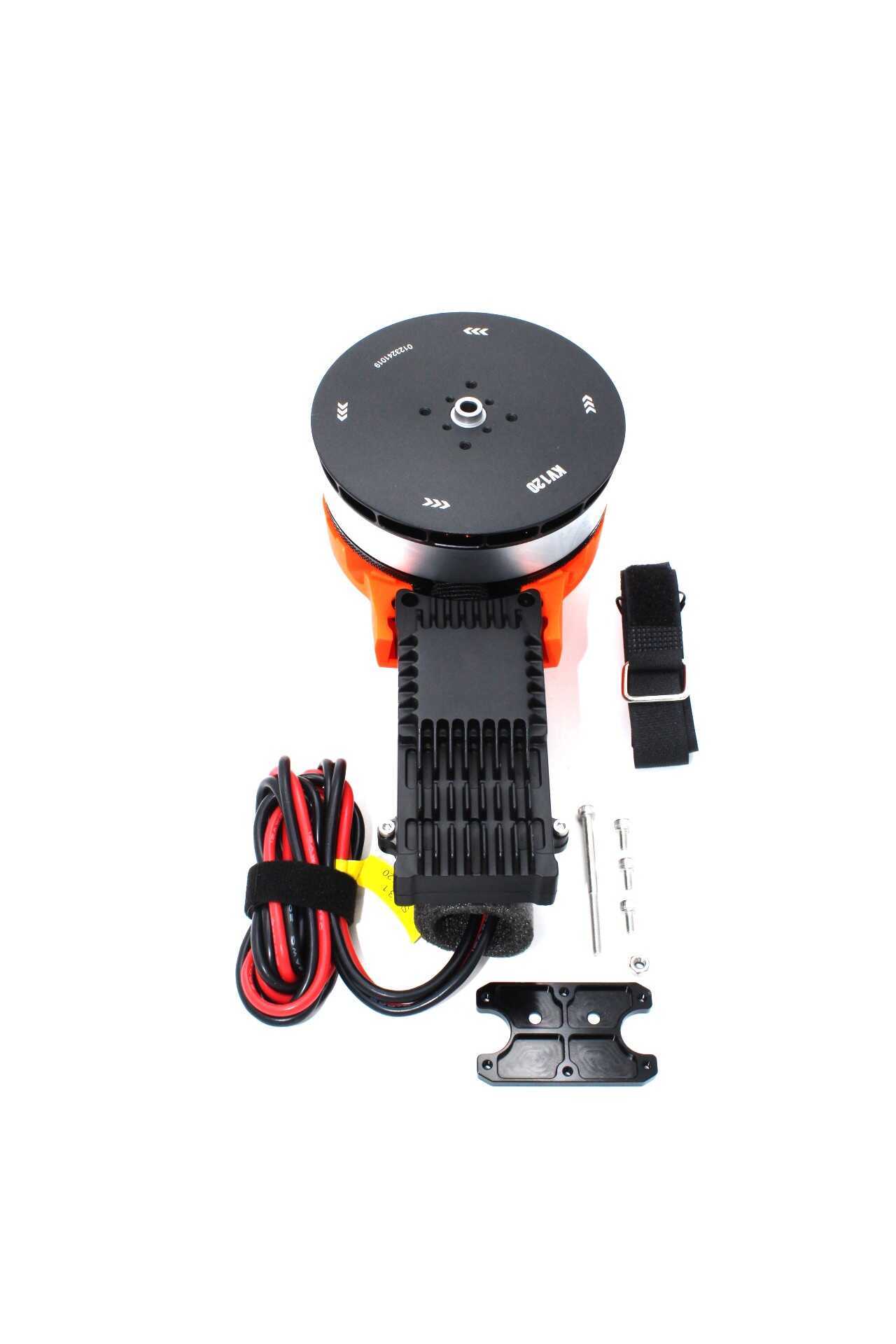
T-Motor A10-KV120 CCW Modular Propulsion System
A professional-grade T-Motor propulsion unit designed for heavy-lift drones. The 120KV rating is optimised for large-diameter propellers (30-inch+), delivering exceptional thrust efficiency for agricultural and delivery applications. Includes motor, ESC, and propeller as a matched system.
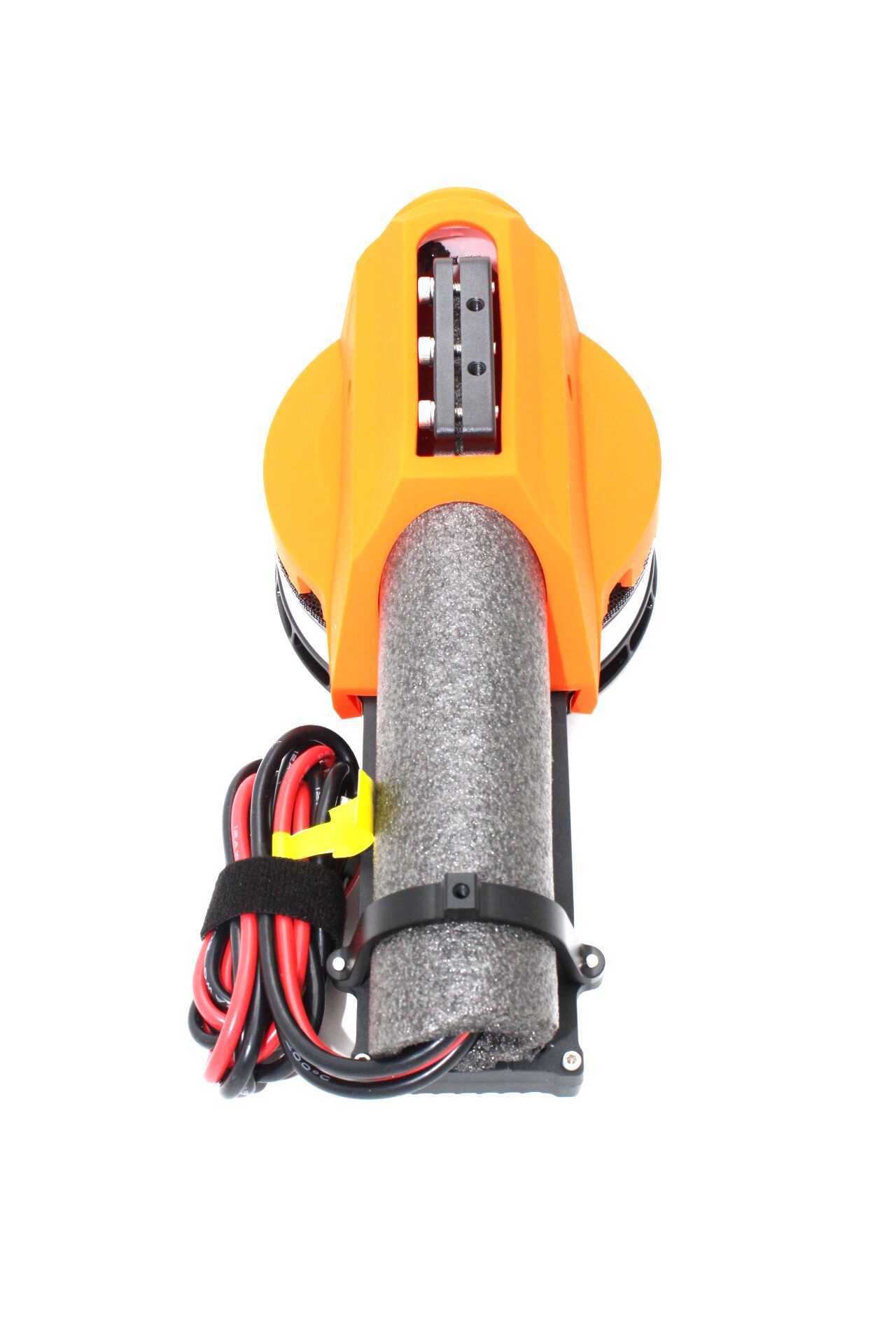
T-Motor A10-KV120 CW Modular Propulsion System
The CW (clockwise) counterpart to the CCW unit above. Drones use opposing rotation pairs to cancel torque. This matched pair ensures balanced flight characteristics. T-Motor is trusted globally for industrial and commercial UAV applications.
Understanding KV Rating
The KV rating is the single most misunderstood specification in drone motors. KV does NOT stand for kilovolts. It means RPM per volt — specifically, how many RPM the motor shaft turns per volt applied, with no load.
Formula: RPM = KV × Voltage
Examples:
- A 2300KV motor on 4S (14.8V): 2300 × 14.8 = 34,040 RPM (no load)
- A 920KV motor on 6S (22.2V): 920 × 22.2 = 20,424 RPM (no load)
- A 120KV motor on 12S (44.4V): 120 × 44.4 = 5,328 RPM (no load)
Under load (with propeller attached), actual RPM will be lower — typically 70–85% of no-load RPM at hover thrust. The ESC varies the effective voltage from 0V to battery voltage to control RPM.
High KV vs Low KV
| KV Range | Prop Size | Battery | Application |
|---|---|---|---|
| 2000–3000 KV | 3–5 inch | 3S–4S | FPV racing, freestyle |
| 1500–2000 KV | 5–7 inch | 4S–6S | 5-inch on 6S, 7-inch long range |
| 800–1200 KV | 10–15 inch | 4S–6S | Autonomous quads, cinematics |
| 100–400 KV | 15–40 inch | 6S–12S | Agricultural, heavy lift, delivery |
The fundamental principle: high KV + small prop for speed; low KV + large prop for efficiency and lift. You cannot put a 2300KV motor on a 15-inch prop — the motor would have to spin at dangerous RPM to generate useful thrust and would immediately overheat. Similarly, a 120KV motor on a 5-inch prop spins far too slowly to generate any meaningful thrust.
Propeller Fundamentals: Diameter, Pitch, and Blade Count
Diameter
The distance across the propeller in inches (or cm). A larger diameter moves more air per revolution, generating more thrust at lower RPM. This is why agricultural drones use giant 30–40 inch propellers spinning at just 1,000–2,000 RPM — they move enormous volumes of air very efficiently.
Drone constraints on diameter: your frame limits how large a prop you can use. A 5-inch frame physically limits you to 5-inch props. An EFT E410P agricultural frame is designed for 21–23 inch props.
Pitch
Expressed as inches, pitch is the theoretical distance the propeller would advance in one revolution if there were no slip. A 5045 propeller (5-inch diameter, 4.5-inch pitch) advances 4.5 inches per revolution in zero-slip conditions.
- Low pitch (3–4 inches): More torque-friendly, easier on motors, better for heavy lifting and efficiency. Less top speed.
- High pitch (5–7 inches): More aggressive, higher top speed, generates more thrust at high RPM. Harder on motors and batteries.
Blade Count
- 2-blade: Most efficient (less turbulence), higher top speed. Standard choice for most racing and general builds.
- 3-blade: More thrust per diameter (useful when frame constrains prop size), better low-speed control response, slightly noisier and less efficient than 2-blade at same diameter.
- 4+ blade: Used in very specialised applications where maximum thrust in minimum diameter is required. Rare in standard drone builds.
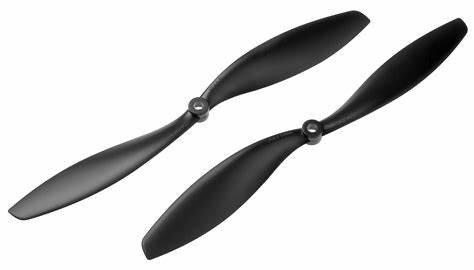
1045 Carbon Fiber 2-Blade Propeller CW & CCW Pair
10-inch diameter, 4.5-inch pitch carbon fiber propellers — the ideal match for 800–1000KV motors on 4S batteries. This is the most popular prop size for mid-range autonomous quads and educational builds in India. Lightweight, rigid, and durable.
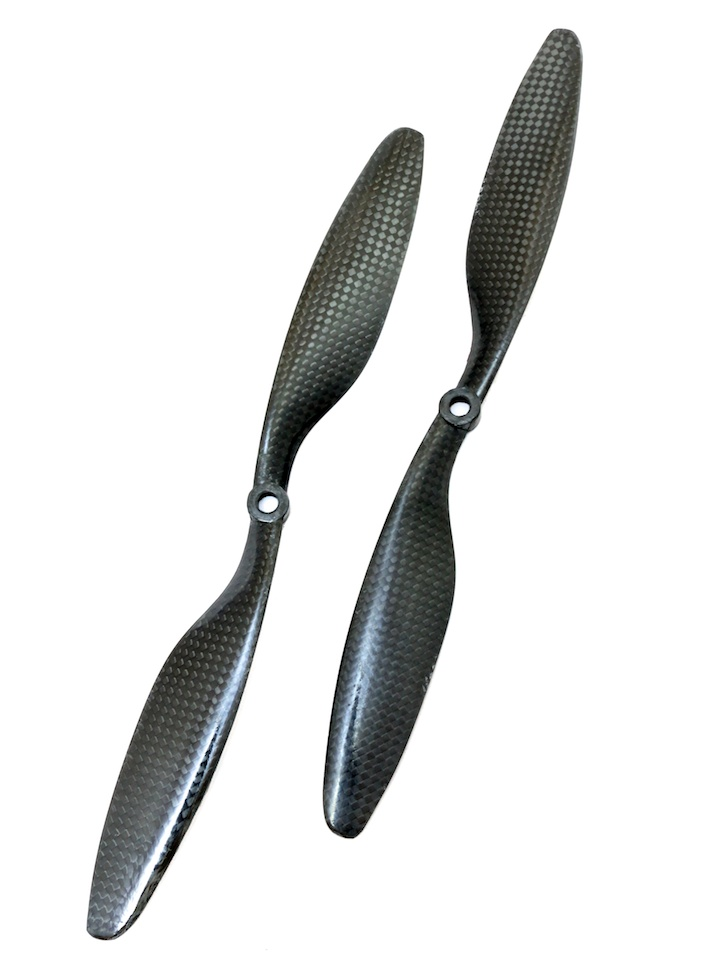
1045 Carbon Fiber Propeller CW & CCW Pair (DJI Compatible)
DJI-compatible mounting hub version of the 1045 carbon fiber prop. Drop-in replacement for DJI Phantom-class drones and compatible custom builds. Same 10-inch diameter and 4.5-inch pitch for familiar flight characteristics.
How to Match Motor and Propeller
The fundamental rule of motor-prop matching is to keep the motor operating in its optimal efficiency range — typically 65–80% of maximum throttle during normal flight (hover). Here is the step-by-step matching process:
Step 1: Define Your Build Type
Decide what you are building and its most important priority:
- FPV racing: maximum speed and acceleration
- Freestyle FPV: balance of power and efficiency
- Long-range: maximum flight time
- Aerial photography: smooth, stable hover
- Agricultural/delivery: payload capacity and reliability
Step 2: Choose Battery Voltage (Cell Count)
The battery voltage determines the practical KV range:
- 3S (11.1V): common for micro builds and beginner setups
- 4S (14.8V): standard for 5-inch FPV and mid-size autonomous quads
- 6S (22.2V): increasingly popular for 5-inch FPV performance and 7-inch long-range
- 12S+ (44.4V+): agricultural and heavy lift applications
Step 3: Determine Frame Size (Max Prop Diameter)
The frame physically constrains maximum prop diameter. Leave 5–10mm clearance between prop tips and frame arms as minimum safety margin.
Step 4: Select Motor KV for Chosen Prop Size and Voltage
Use this practical guide:
- 5-inch prop on 4S: 2200–2500KV
- 5-inch prop on 6S: 1600–1900KV
- 7-inch prop on 4S: 1200–1700KV
- 10-inch prop on 4S: 800–1000KV
- 15-inch prop on 6S: 400–600KV
- 22-inch prop on 12S: 120–200KV
Step 5: Verify with Motor Manufacturer Thrust Data
Every reputable motor manufacturer (T-Motor, Hobbywing, Emax, etc.) publishes a thrust test table showing: prop size, battery voltage, throttle percentage, current draw (amps), and thrust generated (grams). Check that:
- At hover throttle (~50%), current per motor is below the ESC continuous rating.
- At full throttle, motor temperature stays below 80°C after 30 seconds.
- Total thrust at hover throttle is at least 2× the total drone weight (for 2:1 minimum thrust-to-weight ratio).
Thrust Calculations: How Much Do You Need?
The thrust-to-weight ratio (TWR) determines your drone’s performance:
- TWR 2:1 (minimum): Can barely hover and manoeuvre. Suitable only for very stable, slow-flying platforms with no wind exposure.
- TWR 3:1: Good for autonomous platforms — stable hover, some wind resistance, reasonable climb rate.
- TWR 4–5:1: FPV freestyle and racing territory. Aggressive acceleration, high top speed, very responsive handling.
- TWR 6–8:1: Competition racing builds with extreme power-to-weight.
Example Calculation
Building an autonomous quadcopter:
- Frame weight: 500g
- FC + ESC + wiring: 200g
- 4× motors (100g each): 400g
- Battery (4S 5000mAh): 450g
- GPS + telemetry + accessories: 150g
- Total AUW (All-Up-Weight): 1,700g
For 3:1 TWR: Need 1,700 × 3 = 5,100g total thrust. Per motor: 5,100 / 4 = 1,275g.
Look for a motor+prop combination that generates at least 1,275g of thrust at 50% throttle on your chosen battery voltage. A 1000KV motor with 1045 props on 4S generates approximately 650g hover thrust (at 50% throttle) and 1,200–1,400g at full throttle — right in the target range for a 3:1 TWR build.
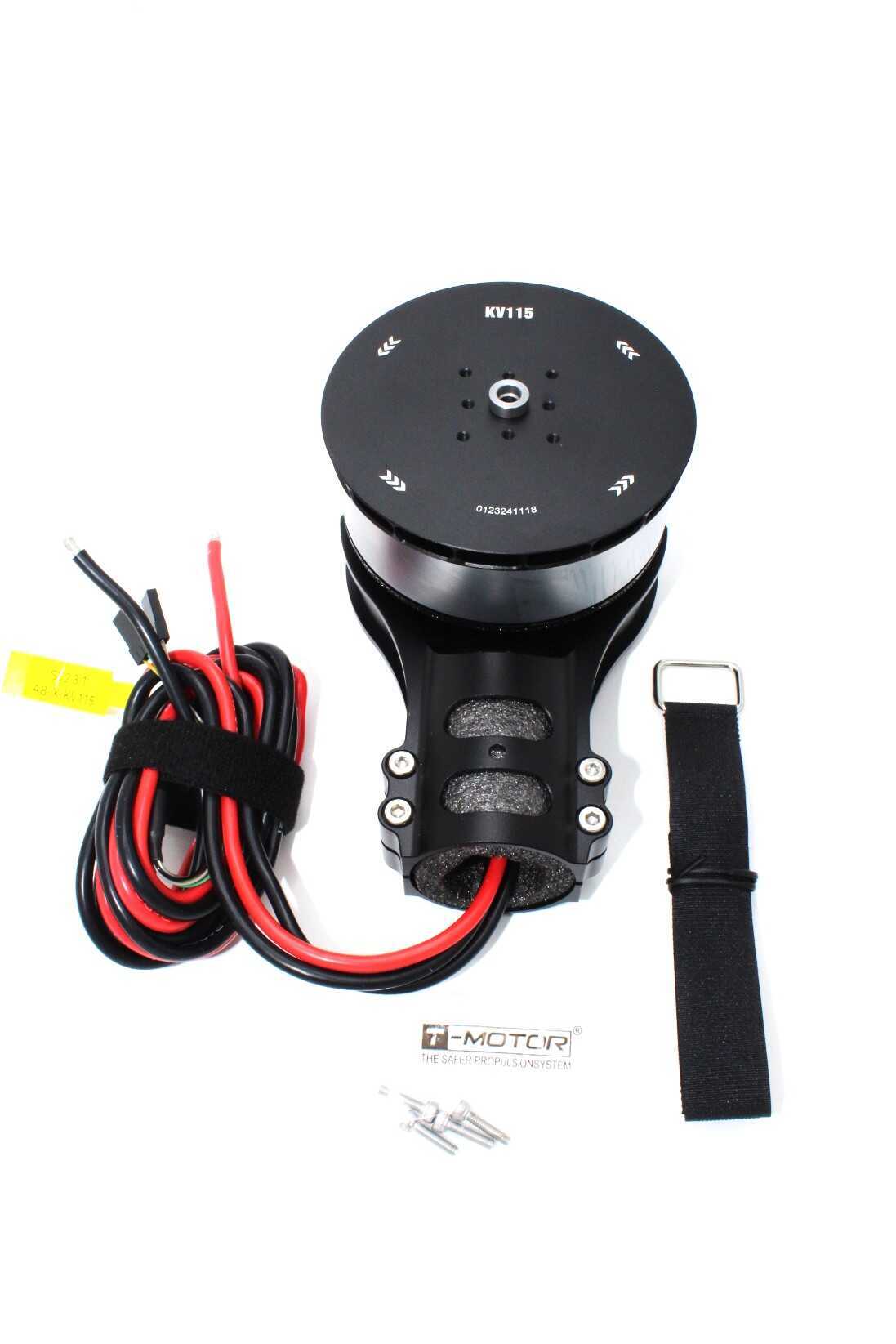
T-Motor A8-X KV115 CCW Modular Propulsion System
T-Motor’s A8-X series is engineered for industrial UAV applications requiring high efficiency. At 115KV, it is designed to spin large-diameter propellers on high-voltage battery packs, delivering the sustained thrust needed for agricultural and inspection drone operations.
Efficiency vs Performance Trade-offs
Every motor-prop selection involves trade-offs on the efficiency-performance spectrum:
For Maximum Efficiency (Longer Flight Time)
- Choose the largest prop diameter your frame allows
- Select lower pitch (3–4.5 inches for 10-inch+ props)
- Use a lower KV motor matched to large diameter
- Fly at 40–60% throttle (hover region, not climbing)
- Use 2-blade props (less turbulence than 3-blade)
- Carbon fiber props preferred (rigid = consistent performance, no flex waste)
For Maximum Performance (Speed and Responsiveness)
- Higher KV motor on the largest battery voltage possible
- Higher pitch props (4.5–6 inches for 5-inch builds)
- 3-blade props for better grip and punch at mid-throttle
- Accept shorter flight time as the trade-off
CW vs CCW: Motor Rotation Direction
On a quadcopter, motors are arranged in opposing rotation pairs to cancel rotational torque (a drone with all motors spinning the same direction would spin on its own yaw axis with no control input). The standard ArduCopter/Betaflight motor arrangement:
- Front-left + Rear-right: CW (clockwise) rotation
- Front-right + Rear-left: CCW (counter-clockwise) rotation
Motors are not mechanically locked to one rotation direction — you can swap the direction of any brushless motor by swapping any two of its three phase wire connections. However, it is better practice to buy matched pairs of CW and CCW motors, because:
- CW motors have M5 left-hand thread prop nuts (won’t loosen under CW rotation)
- CCW motors have M5 right-hand thread prop nuts (won’t loosen under CCW rotation)
- Using the wrong thread direction means props can unscrew mid-flight — catastrophic
Always buy props in CW/CCW matched pairs. Most props are labeled with an “R” for reverse (CCW) or no marking for standard (CW).
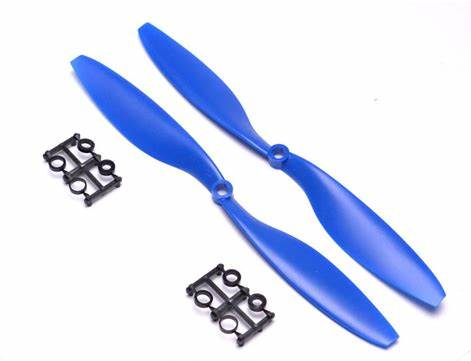
1045 2-Blade Propeller CW & CCW Pair (Blue)
High-visibility blue 1045 propellers in matched CW/CCW pairs. The distinct blue colour makes it easy to visually identify propeller rotation direction during assembly — an often overlooked but critical check for new builders. Compatible with 920–1000KV motors on 3S–4S builds.
Motor-Prop Matching for Large/Agricultural Drones
Large agricultural drones operating in India under the DGCA drone rules present unique motor-prop challenges. These drones typically need to:
- Carry 10–20kg of total weight (drone + tank + spray liquid)
- Operate efficiently for 10–20 minute spray missions
- Survive vibration from pumping mechanisms and rough handling
- Perform reliably in hot Indian summer conditions (40–45°C ambient)
For a typical 16L agricultural quad weighing 20kg total (AUW):
- Required thrust at 3:1 TWR: 60kg (60,000g) total
- Per motor (4 motors): 15,000g (15kg) each
- Motor selection: T-Motor or Hobbywing X-series, 115–180KV
- Prop size: 22–28 inch
- Battery: 12S–16S (44V–60V)
- ESC per motor: 60–100A continuous
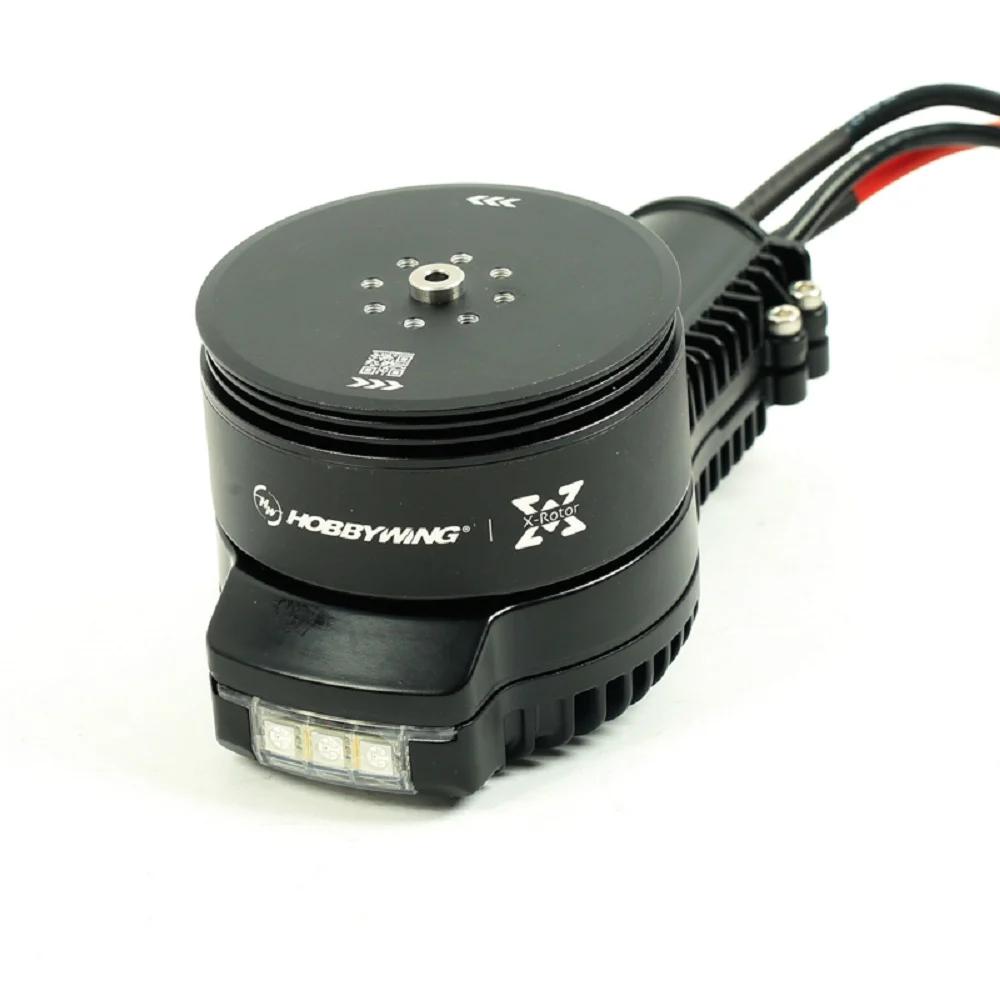
Hobbywing X6 Plus Motor CCW
Hobbywing’s X6 Plus is a premium agricultural drone motor with integrated FOC ESC. The matched motor-ESC integration eliminates wiring complexity and ensures optimal communication between motor and controller. Designed for 22–25 inch propellers on 12S+ systems.
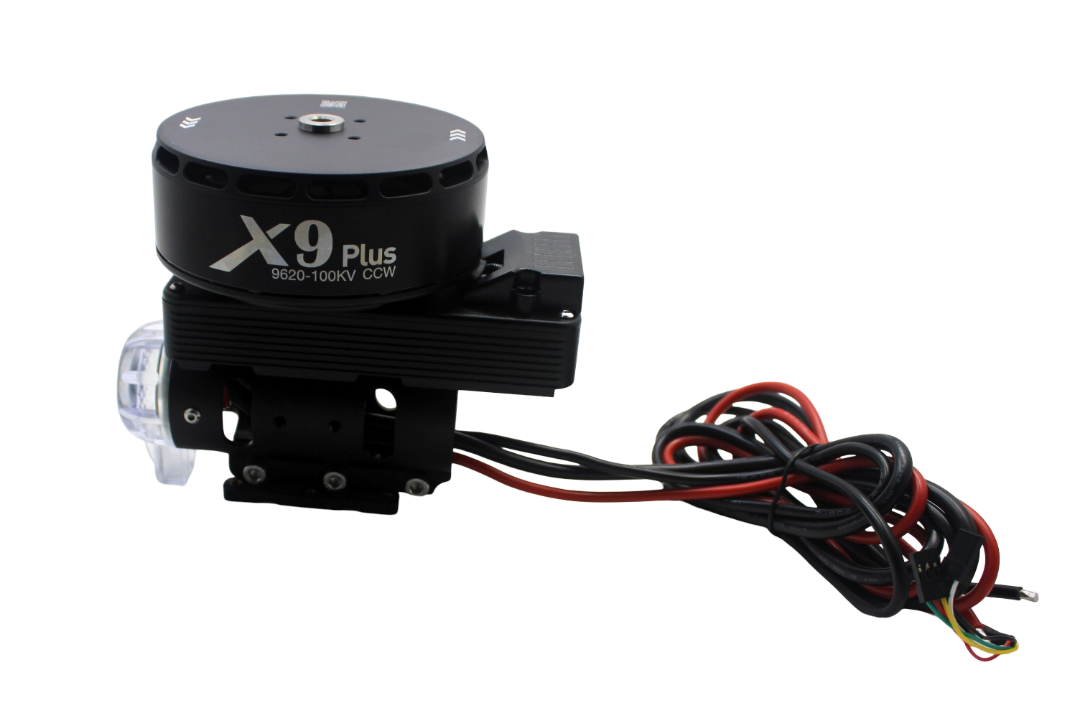
Hobbywing X9 Plus Motor CCW
The X9 Plus is Hobbywing’s most powerful integrated motor-ESC system, designed for heavy-lift drones requiring maximum thrust. Its 9-inch rotor diameter and high-pole count deliver the low-KV, high-torque characteristics needed for 28-30 inch propellers in large agricultural builds.
Common Motor-Prop Problems and Fixes
Motors Overheating
Cause: Props too large, KV too low for the voltage, motors drawing too much current continuously.
Fix: Switch to smaller diameter or lower pitch props. Reduce flight time. Check that hover throttle is not above 70%. Consider motors with higher KV for the same prop size.
Drone Drifts in One Direction During Hover
Cause: Props are not balanced. One or more props have unequal weight distribution, causing vibration and unequal thrust.
Fix: Balance all props using a prop balancer. Even 0.5g imbalance matters at high RPM. Also check motor bell for damage or debris.
Drone Oscillates / Jelly Video
Cause: Frame resonating at prop RPM frequency. Carbon arm stiffness matches vibration frequency.
Fix: Try different prop pitch or blade count to shift resonant frequency. Add vibration dampening to camera mount. Check motor bell screws are tight (loose bell causes unbalanced rotation).
Props Unscrewing Mid-Flight
Cause: Wrong thread direction. CW prop on CCW motor unscrews under rotation.
Fix: Verify each motor’s rotation direction and use the correct CW or CCW prop. Reinstall with correct props and verify by hand-spinning before flying.
Motor Making Grinding Noise
Cause: Bearing damage, bent motor shaft, or debris in motor bell.
Fix: Remove prop and spin motor by hand with no power. If rough or grinding, replace the motor. Do not fly with a damaged bearing — motor failure mid-flight is dangerous and almost always causes a crash.
Frequently Asked Questions
Can I use any propeller with any motor?
No. Motor-prop matching is critical for efficiency, motor longevity, and performance. A mismatched combination causes motors to overheat, batteries to drain rapidly, and the drone to behave poorly. Always use props recommended in the motor’s thrust table or follow the matching guidelines in this article.
What does 5045 mean on a propeller?
The first two digits are the diameter in inches (50 = 5.0 inches). The last two digits are the pitch in tenths of an inch (45 = 4.5 inches). So a 5045 prop is 5 inches diameter, 4.5 inches pitch. Some manufacturers use 4-digit codes differently — always confirm with the product listing.
How often should I replace propellers?
Inspect every propeller before every flight for cracks, chips, or delamination. Carbon fiber props should be replaced if any surface crack is visible — they can catastrophically fail under load. ABS plastic props are more flexible but should be replaced after any significant impact. In India’s dusty flying conditions, even small nicks on prop edges cause measurable efficiency loss and vibration.
Why do agricultural drones use such low KV motors?
Large propellers (22–30 inch) move enormous amounts of air at relatively low RPM (1,500–3,000 RPM). Using a high KV motor on a large prop would require massive reduction in voltage to keep RPM in range — extremely inefficient. Low KV motors are designed to generate high torque at low RPM on high-voltage (12S–16S) battery packs, achieving the same efficiency advantage but with precise electronic control.
Is carbon fiber better than plastic for propellers?
Carbon fiber props are stiffer, lighter, and maintain their pitch shape better under load — resulting in more consistent thrust and better efficiency. However, they are more expensive and shatter (rather than bend) in crashes, meaning the pieces can be dangerous projectiles. For racing and aggressive flying where crashes are frequent, ABS plastic props are safer and cheaper to replace. For agricultural, long-range, and aerial photography where efficiency matters more, carbon fiber is clearly superior.
Conclusion
The motor-propeller relationship is at the heart of every drone design. Understanding KV rating, propeller sizing, and thrust calculations transforms you from someone who follows a parts list to someone who can design a drone system from first principles. Whether you are building a nimble 5-inch FPV racer or a 20kg agricultural workhorse for the fields of Punjab or Telangana, the physics are the same — higher KV and smaller props for speed, lower KV and larger props for efficiency and lift.
Take time to look up thrust data for any motor you consider buying. The investment of 30 minutes reading thrust tables will save you from expensive mistakes and suboptimal builds. Zbotic stocks a full range of matched propulsion systems — from the T-Motor A-series and Hobbywing X-series for professional agricultural builds to affordable FPV motors and carbon fiber props for hobbyist builds across India.






Add comment