
Whether you are picking a battery pack for an Arduino project, choosing a LiPo for your FPV drone, or sizing a power bank for a remote IoT sensor, battery terminology like mAh, C-rating, and internal resistance can make or break your design. Get these numbers wrong and your robot runs for 3 minutes instead of 30, your RC car ESC catches fire, or your outdoor sensor dies in the first winter. This guide cuts through the jargon and gives you the practical understanding you need as a maker or hobbyist in India.
mAh: Milliamp-Hours Explained
mAh stands for milliamp-hours — it is the most commonly quoted battery specification and the one most people misunderstand.
Here is the core idea: if a battery is rated at 2000 mAh, it can supply 2000 mA (2 A) for 1 hour, or 1000 mA for 2 hours, or 200 mA for 10 hours, before it is discharged. Think of it like a water tank — mAh is the total volume of water (charge) the tank holds.
The Watt-Hour Connection
mAh alone does not tell you the total energy stored — you also need voltage. The formula is:
Energy (Wh) = Capacity (Ah) × Voltage (V)
Example: 2000 mAh × 3.7V = 7.4 Wh
This is why a 2000 mAh LiPo at 3.7 V stores the same energy as a 5000 mAh lead-acid cell at 1.2 V — apples to apples comparison always needs Wh.
Real-World Runtime Calculation
Suppose your Arduino project draws 150 mA average current and you have a 1000 mAh LiPo:
Runtime = Capacity / Current = 1000 / 150 = 6.7 hours (theoretical)
Practical runtime ≈ 6.7 × 0.8 = ~5.3 hours (80% efficiency)
Always apply an 80% derating factor. You cannot fully drain most batteries (especially LiPos which cut off at 3.0–3.2 V), and there are conversion losses if you are using a boost or buck converter.
C-Rating: What It Means and Why It Matters
The C-rating is a multiplier on the battery’s capacity that tells you the maximum safe continuous discharge current. It is especially critical for LiPo batteries used in drones, RC cars, and high-current robotics.
Calculating Maximum Current
Max current (A) = C-rating × Capacity (Ah)

Example: 2200 mAh 30C LiPo
Max current = 30 × 2.2 = 66 A continuous
This is the current you can draw continuously without overheating the battery or causing permanent capacity loss. Many packs also list a burst C-rating (e.g., 60C burst for 10 seconds) for brief peak demands like motor startup or aggressive throttle inputs.
Why C-Rating Matters for Drone Builders
A typical 250-size FPV quad with four 2207 motors can draw 80–120 A at full throttle. You would need at least a 1500 mAh 75C+ pack to supply this safely. Undershooting the C-rating causes:
- Voltage sag — the battery output voltage drops, reducing motor RPM mid-flight
- Heat buildup — excess resistance causes the pack to heat dangerously
- Premature capacity loss and puffing (irreversible internal damage)
- In extreme cases, thermal runaway and fire
C-Rating for Slow Discharge Applications
For slow devices like Arduino sensors, a 1C or 2C rating is perfectly fine. There is no benefit to a 30C pack for a circuit drawing 200 mA — you are just paying for capability you will never use. Standard 18650 cells rated 1–2C at 3000 mAh are ideal for such applications and are far cheaper.
Charge C-Rating
Batteries also have a charge C-rating — the maximum safe charging current. A 2200 mAh LiPo with 1C charge rating should be charged at no more than 2.2 A. Some premium packs allow 2C or 5C charging for fast turnaround in the field. Never exceed the charge C-rating — that is how fires start.
Internal Resistance: The Hidden Battery Killer
Internal resistance (IR) is the resistance inside the battery itself — measured in milliohms (mΩ). It is the single most important indicator of battery health and quality, yet it rarely appears on the package label of cheap batteries.
Why Internal Resistance Matters
When current flows through the battery, it loses voltage across the internal resistance (Ohm’s law: V = I × R). This causes two problems:
- Voltage sag: The terminal voltage drops under load. A 3.7 V cell with 50 mΩ IR supplying 10 A will sag by 0.5 V to just 3.2 V — close to cutoff voltage.
- Heat generation: Power = I² × R. The same cell at 10 A dissipates 10² × 0.05 = 5 W as heat inside the battery — reducing efficiency and lifespan.
Typical IR Values
| Battery Type | Good IR | Old/Degraded |
|---|---|---|
| LiPo (drone) | 5–15 mΩ | >40 mΩ |
| 18650 Li-Ion | 15–60 mΩ | >150 mΩ |
| NiMH AA | 50–150 mΩ | >400 mΩ |
| Lead Acid (12V) | 5–20 mΩ | >50 mΩ |
How to Measure Internal Resistance
A basic multimeter cannot measure IR accurately. You need:
- A dedicated LiPo battery checker/tester (₹300–₹800 online)
- A quality charger with built-in IR measurement (e.g., iCharger, ISDT series)
- An LCR meter with 1 kHz AC impedance mode
Check IR at full charge and at 50% charge. A battery is considered degraded when IR exceeds 2–3× its original value. Stop using it for high-current applications at that point.
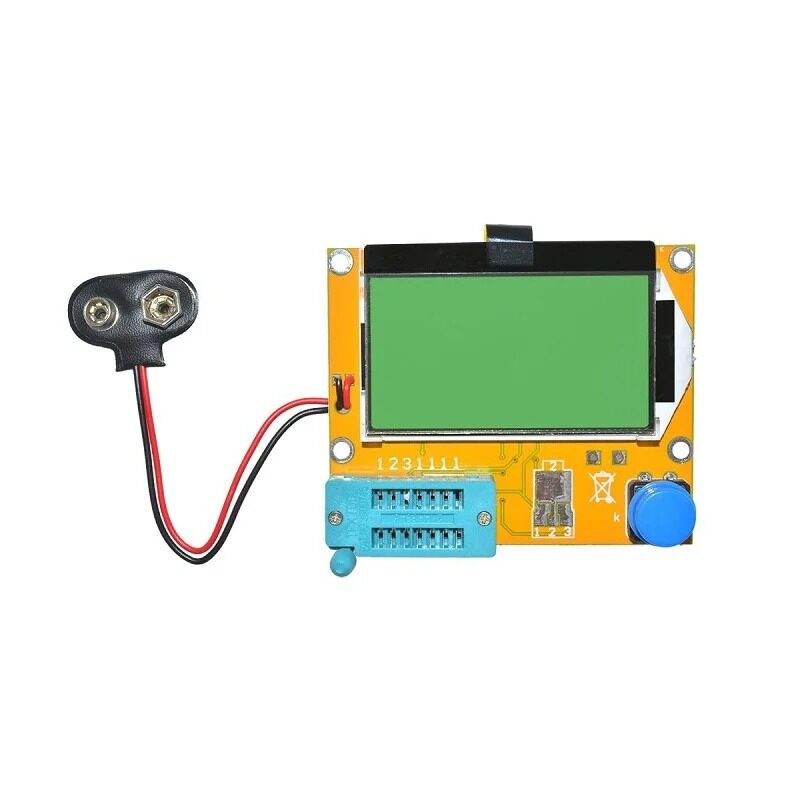
LCR-T4 Component Tester — ESR & Resistance Meter
Measure ESR (equivalent series resistance) of capacitors and verify component values. Useful for battery and circuit testing on your workbench.
Nominal Voltage, Cell Count, and S/P Configuration
Battery packs often come with labels like 3S2P — this is the cell configuration and it determines the pack’s voltage and capacity.
- S = Series: Adds voltage. A 3S LiPo = 3 cells × 3.7 V = 11.1 V nominal (12.6 V fully charged, 9.9 V cutoff).
- P = Parallel: Adds capacity. A 2P configuration doubles mAh while keeping voltage the same.
- 3S2P: 3 series groups, each group has 2 parallel cells = 11.1 V at double the single-cell mAh.
Common nominal voltages you will encounter:
- LiPo/Li-Ion single cell: 3.7 V (3.0 V min, 4.2 V max)
- 2S LiPo: 7.4 V nominal
- 3S LiPo: 11.1 V nominal
- 4S LiPo: 14.8 V nominal (common in 5-inch quads)
- LiFePO4 single cell: 3.2 V nominal
Choosing the Right Battery for Your Project
Use this quick framework to select the right battery for any project:
- Calculate average current draw — measure or estimate all components running simultaneously.
- Determine required runtime — how long before recharging is acceptable?
- Calculate minimum mAh: mAh = (Current × Runtime hours × 1.25) (25% buffer).
- Identify peak current — size the C-rating around peak, not average.
- Check voltage requirements — choose cell count (S) accordingly.
- Budget for form factor — 18650 cells are cheapest; cylindrical LiPos are flexible; pouch LiPos are flattest.
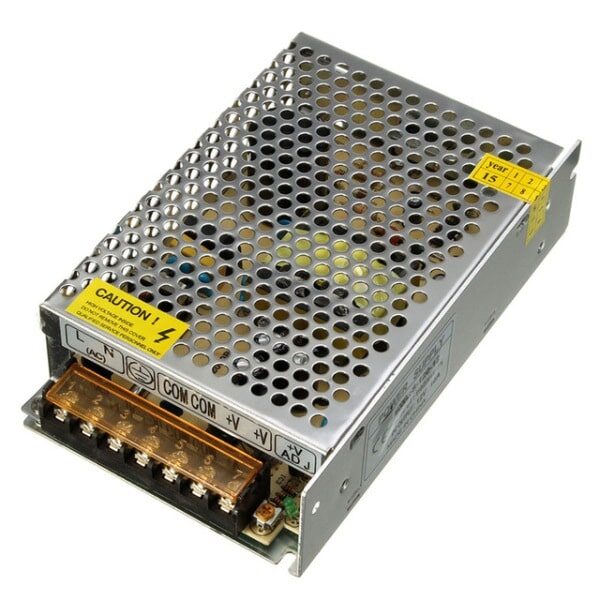
12V 10A SMPS — 120W DC Metal Power Supply
When a bench power supply beats a battery for stationary projects — this regulated 12V 10A SMPS powers most maker projects reliably.
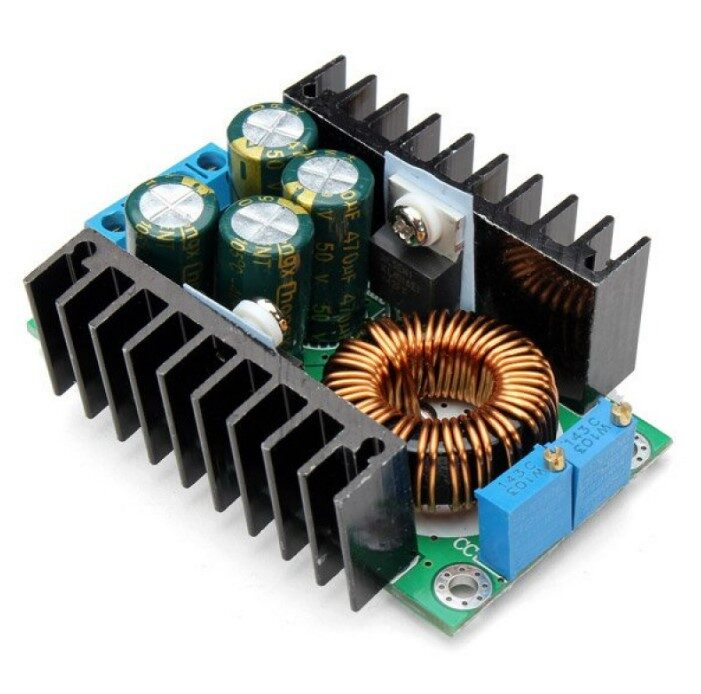
300W 10A DC-DC Step-Down Buck Converter
Step down battery voltage to the exact voltage your circuit needs — essential when running 3.3V or 5V circuits from a 3S/4S LiPo pack.
Battery Safety Tips for Indian Makers
Indian summers are harsh — temperatures can hit 40–45°C, which accelerates battery degradation and increases fire risk with LiPos. Here are critical safety rules:
- Never charge unattended — especially LiPos. Use a dedicated LiPo bag or a metal container.
- Store at storage voltage (3.8 V/cell for LiPos) if not using for more than a week. Most chargers have a storage mode.
- Never discharge below cutoff — for LiPo, never go below 3.0 V/cell under load. A battery protection board (BMS) is essential in DIY packs.
- Keep away from heat sources — do not leave battery packs in parked cars in summer, or near soldering irons.
- Inspect for puffing — a swollen LiPo is a fire hazard. Discharge it completely and dispose of it safely (submerge in salt water for 24 hours to fully discharge before bin disposal).
- Use the correct charger — never charge a LiPo with a NiMH charger or vice versa. Each chemistry requires a specific charging profile.
Frequently Asked Questions
Q1: Does higher mAh always mean longer runtime?
Yes, for the same device and same voltage. But comparing different voltages requires converting to Wh first. A 3000 mAh at 3.7 V (11.1 Wh) lasts longer than a 3000 mAh at 1.2 V (3.6 Wh).
Q2: What happens if I use a battery with a lower C-rating than required?
The battery will overheat, suffer accelerated internal damage, and its terminal voltage will sag significantly under load. In extreme cases (e.g., LiPos at 3× their C-rating) there is a real fire risk. Always match or exceed the required discharge C-rating.
Q3: Can I charge a 2C-rated LiPo at 1C safely?
Yes. Charging at or below the rated charge C-rating is always safe. Slower charging (0.5C) actually extends cycle life and is recommended for batteries you want to last 200+ cycles.
Q4: Is internal resistance affected by temperature?
Yes significantly. Cold temperatures (below 10°C) increase internal resistance dramatically — this is why EV range drops in winter and why your drone may fly erratically on a cool morning until the battery warms up. Always warm LiPos to room temperature before demanding high-current use.
Q5: How many charge cycles does a LiPo battery last?
Typically 200–500 full cycles for hobbyist-grade LiPos, and 300–1000 cycles for quality 18650 Li-Ion cells, before capacity drops to ~80% of original. Staying between 20–80% state of charge (avoiding full charge and deep discharge) can nearly double cycle life.
Shop Zbotic for power supplies, buck converters, and all the components you need to build reliable battery-powered electronics — with fast delivery across India.




Add comment