
Battery Cycle Life: How to Extend Lithium Battery Lifespan
Lithium batteries are everywhere — in your Arduino projects, solar energy storage, RC vehicles, power banks, and DIY portable tools. But they do not last forever. Understanding battery cycle life and how to extend lithium battery lifespan is essential knowledge for any maker who wants maximum value from their cells. The good news: with the right charging habits, storage practices, and hardware choices, you can easily double or triple the usable life of your lithium cells. This guide explains the science and gives you actionable steps.
Table of Contents
- What Is Battery Cycle Life?
- What Causes Lithium Batteries to Degrade?
- Depth of Discharge: The Biggest Lever
- Optimal Charging Habits for Longevity
- Temperature: The Silent Killer
- Long-Term Storage Best Practices
- How a BMS Extends Battery Life
- Frequently Asked Questions
What Is Battery Cycle Life?
A battery cycle is defined as one complete charge-discharge event. However, a cycle does not have to be from 100% to 0% — partial cycles count proportionally. Charging from 50% to 100% and discharging back to 50% counts as half a cycle.
Lithium-ion cells are typically rated for 300–500 full cycles at 80% capacity retention — meaning after 500 full cycles, the cell holds at least 80% of its original capacity. High-quality cells (like Sony VTC6, Samsung 30Q, or LG HG2) can reach 500–800 cycles at 80% retention. LiFePO4 chemistry is exceptional, with 2000–3000+ cycles rated.
What does 80% retention mean in practice? A 3000mAh cell that degrades to 80% now delivers 2400mAh. For most applications, this is still perfectly usable — the cell just needs more frequent charging. True end-of-life for most applications is around 60–70% capacity retention.
The critical insight: battery cycle life is not fixed. Abuse (deep discharge, overcharging, heat, high current) accelerates degradation dramatically. Gentle use (partial cycles, cool temperatures, moderate charging rates) extends life far beyond the rated cycles.
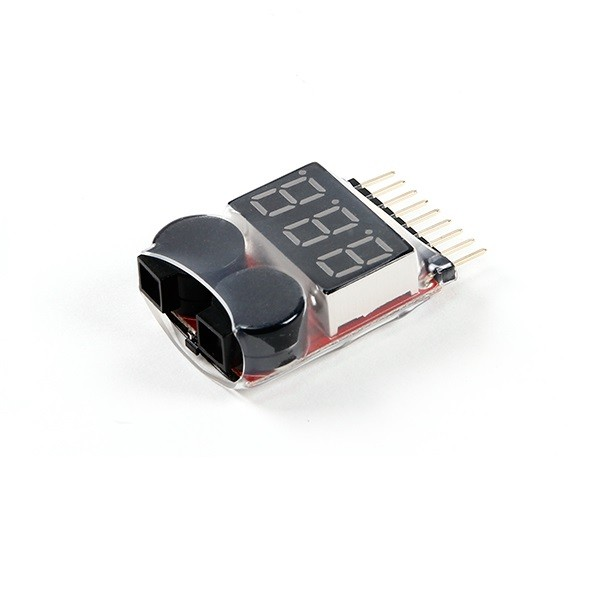
1-8S Lipo Battery Voltage Tester without Alarm
Monitor your LiPo pack’s per-cell voltage to detect imbalance early — a key step in extending your battery’s cycle life. Works for 1S to 8S packs.
What Causes Lithium Batteries to Degrade?
Lithium battery degradation happens through several chemical and physical mechanisms:
1. SEI Layer Growth
The Solid Electrolyte Interphase (SEI) is a thin film that forms on the anode during the first few charge cycles. It is actually beneficial — it protects the anode. However, over time, especially at high temperatures or high states of charge, the SEI continues to grow, consuming lithium ions and increasing internal resistance. This is the primary calendar aging mechanism.
2. Lithium Plating
When a cell is charged too quickly (especially at low temperatures), lithium ions cannot intercalate into the graphite anode fast enough and instead deposit as metallic lithium on the anode surface. This lithium is no longer reversibly available — it represents permanent capacity loss. Lithium plating can also form dendrites that eventually puncture the separator, causing internal short circuit.
3. Cathode Degradation
The cathode material (NMC, NCA, LFP, etc.) undergoes structural changes during cycling, especially at high voltages. Charging to 4.2V versus 4.0V significantly accelerates cathode degradation — research shows a cell charged to 4.0V has roughly 3× the cycle life of the same cell charged to 4.2V.
4. Electrolyte Decomposition
The liquid electrolyte slowly decomposes over time, especially at elevated temperatures and at extreme states of charge (very full or very empty). Products of decomposition can clog electrode pores and reduce ion transport, increasing internal resistance.
5. Gas Generation
Overcharging generates oxygen at the cathode, which reacts with the electrolyte. This produces gas that swells the cell (pouch cells visibly bloat) and can eventually rupture it. A proper BMS with overcharge protection prevents this entirely.
Depth of Discharge: The Biggest Lever
Of all the factors affecting battery cycle life, Depth of Discharge (DoD) is the one you have the most control over in practice. DoD is the percentage of capacity used in each cycle. Here is real-world data showing the effect:
| Depth of Discharge | Approximate Cycle Life | vs. 100% DoD |
|---|---|---|
| 100% (full cycles) | 300–500 cycles | 1× |
| 80% DoD | 600–900 cycles | ~2× |
| 50% DoD | 1200–1500 cycles | ~3-4× |
| 25% DoD | 2500–4000 cycles | ~8× |
| 10% DoD | 5000–10000+ cycles | ~20× |
The practical implication: if you have a battery-powered device that normally runs all the way from 100% to 0%, sizing up the battery pack (using more cells) so you only use 50–60% of total capacity per day dramatically extends the pack’s calendar life.
For stationary solar storage in India where the battery cycles once per day, using 50% DoD instead of 100% could mean 5 years of life instead of 2–3 years — a significant cost saving over the lifespan of the system.
Optimal Charging Habits for Longevity
How you charge your batteries has a major impact on their longevity:
Do Not Always Charge to 100%
Keeping a Li-ion cell at 4.2V (100% state of charge) for extended periods accelerates SEI growth and cathode degradation. If your project does not need maximum capacity for every use, charge to 80–90% (approximately 4.05–4.10V). Many premium battery management systems allow setting a charge cutoff below 4.2V for exactly this reason.
Do Not Let the Cell Fully Discharge
Discharging below 3.0V causes copper dissolution from the current collector and permanent capacity loss. Always use a BMS with low-voltage cutoff (typically 2.5–3.0V) to prevent over-discharge. Never leave a discharged Li-ion cell sitting for weeks — self-discharge can bring it below the safe threshold.
Use Moderate Charging Rates
The C-rate is the charge/discharge rate relative to cell capacity. A 2500mAh cell charged at 1C = 2500mA. Most Li-ion cells are designed for 0.5C–1C charging. Charging above 2C significantly increases lithium plating risk, especially at temperatures below 20°C. Stick to 0.5C or 1C for everyday charging.
Avoid Topping Up Constantly
Frequent small top-up charges (going from 90% to 100% repeatedly) do accumulate as partial cycles. While less damaging than deep cycles, the time spent at high voltage does contribute to degradation. It is better to let the battery drain to 20–30% before charging to 80–90%.

ISDT A4 Air Smart Battery Charger for NiMH, NiCd, Li-Ion, LiFePO4 with Bluetooth
Precision smart charger with configurable charge voltage and current limits — lets you charge to 80% or 90% instead of 100% for extended battery lifespan. Bluetooth monitoring included.
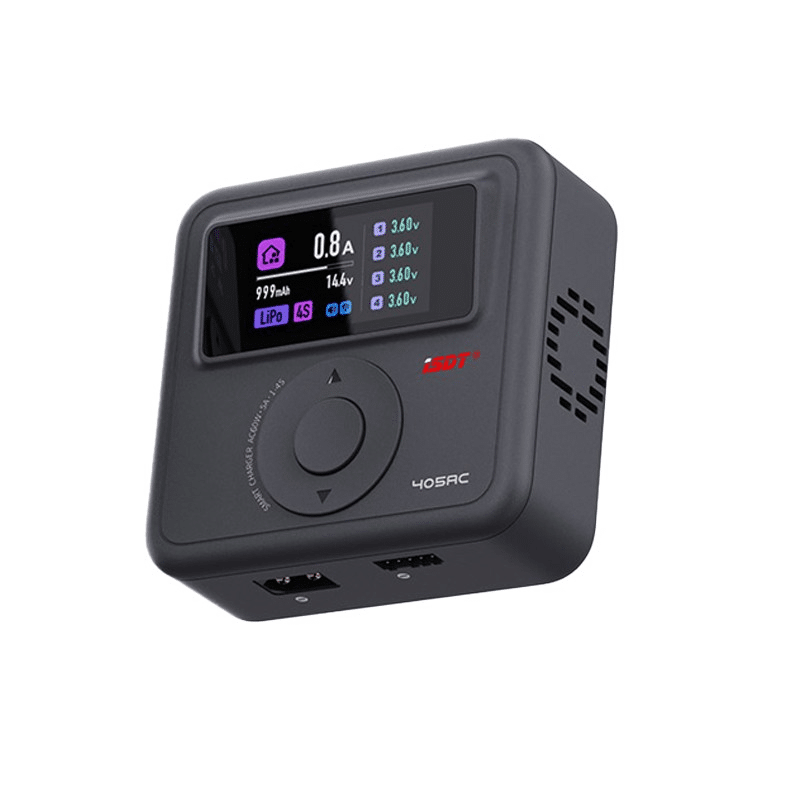
ISDT 405AC 60W AC GaN Smart Charger – 0.1-5A, 1-CH, Supports 1-4S LiPo/LiHv/LiFe
GaN-based smart charger with adjustable charge rate (0.1–5A) and cell chemistry awareness. Charge your LiPo packs at optimal rates to maximise cycle life.
Temperature: The Silent Killer
Temperature has an outsized effect on both charging performance and long-term battery health. India’s climate — with summer temperatures regularly exceeding 40–45°C in many regions — makes thermal management especially important for battery longevity.
High Temperature Effects
- SEI layer growth accelerates exponentially with temperature — a battery stored at 40°C ages twice as fast as one stored at 25°C
- Electrolyte decomposition rate increases significantly above 45°C
- LiPo pouch cells swell visibly when exposed to sustained high temperatures
- Above 60°C, thermal runaway becomes a risk for some cell chemistries
Low Temperature Effects
- Below 10°C, lithium plating during charging becomes a serious risk — charge slowly (0.2C or less) in cold conditions
- Cell internal resistance increases dramatically in the cold, reducing available power
- Discharge capacity is temporarily reduced in cold (it returns when the cell warms up)
- Never fast-charge a Li-ion cell below 5°C
Practical guidance for Indian makers: Avoid storing batteries in your car during summer — dashboard temperatures can reach 70–80°C and will visibly degrade LiPo cells within a few days. Store batteries in a cool, dry place. If your project enclosure is located outdoors or in a hot environment, add ventilation or consider LiFePO4 chemistry which is significantly more thermally robust.
Optimal Operating and Storage Temperature
- Charging: 10°C to 40°C (ideal: 20°C to 25°C)
- Discharging: -20°C to 60°C (ideal: 0°C to 40°C)
- Storage: 15°C to 25°C at 40–60% state of charge
Long-Term Storage Best Practices
If you need to store Li-ion or LiPo batteries for more than a few weeks (common for seasonal RC aircraft hobbyists or project batteries between builds), follow these guidelines:
- Store at 40–60% state of charge (approximately 3.7–3.85V for Li-ion, 3.8–3.85V per cell for LiPo). This is the sweet spot where SEI growth and electrolyte stress are both minimised. Most quality chargers have a dedicated “storage charge” mode that brings cells to exactly this voltage.
- Store in a cool, dry environment — a cupboard at 20–25°C is ideal. Avoid the bathroom (humidity) and direct sunlight.
- Check voltage monthly and top up to storage charge if it drops below 3.5V. Self-discharge rates for Li-ion are typically 1–3% per month.
- Use fireproof LiPo storage bags for LiPo pouch cells — they do not prevent fires but contain the flames if thermal runaway occurs.
- Do not store fully charged LiPo packs for more than a few days — the high voltage state accelerates degradation significantly.

25cm Lipo Battery Strap Belt Reusable Cable Tie Wrap
Keep your LiPo packs securely wrapped during storage and transport. Prevents physical damage that can compromise cell integrity and reduce lifespan.
How a BMS Extends Battery Life
A Battery Management System (BMS) is the electronic guardian of your battery pack. It performs several functions that directly extend battery lifespan:
Overcharge Protection
Cuts off charging when any cell reaches 4.2V (or 3.65V for LiFePO4). Prevents cathode degradation and gas generation from overcharging.
Over-Discharge Protection
Disconnects the load when cell voltage drops to 2.5–3.0V. Prevents copper dissolution and the cell reversal that causes irreversible damage.
Overcurrent / Short Circuit Protection
Disconnects output if current exceeds the BMS’s rated limit (e.g., 12A for a 1S 12A BMS). Protects both the cells and the connected load.
Cell Balancing (for multi-cell packs)
In series-connected packs, cells naturally drift slightly in voltage over time. Without balancing, the weakest cell hits the cutoff voltage first while stronger cells still have capacity remaining, artificially reducing pack capacity. A balancing BMS redistributes charge between cells to keep them matched, maximising usable capacity and preventing any single cell from being over-discharged.
Temperature Monitoring
Advanced BMS boards include NTC thermistor inputs to monitor cell temperature and reduce or stop charging/discharging when thermal limits are approached — critical for India’s hot climate.
Frequently Asked Questions
Should I fully discharge my 18650 battery to extend its life?
No — this is a myth from the NiCd era. For Li-ion cells including 18650, deep discharge is harmful. Keep cells between 20–80% state of charge for best longevity. Full discharge cycles are unnecessary and accelerate capacity fade.
Why do my LiPo packs swell after a season of use?
Swelling indicates gas generation inside the cell — typically from overcharging, overheating, or over-discharging. A swollen LiPo should be discharged to storage voltage and safely disposed of — do not continue using it as the separator may be compromised, creating a fire risk.
How much does charging rate affect battery life?
Charging at 0.5C (half the capacity rating in amps) versus 1C roughly doubles cycle life in controlled studies. For 18650 cells in DIY projects where lifespan matters, charge at 0.5C whenever time permits. Avoid fast charging (2C or above) except when necessary.
Do lithium batteries lose capacity even when not in use?
Yes — this is called calendar aging. A Li-ion cell stored at 100% charge at 25°C loses about 20% capacity per year. The same cell stored at 50% charge at 15°C loses only about 4% per year. Proper storage conditions dramatically slow calendar aging.
When is it time to replace a lithium battery?
Practical replacement time is when the cell retains less than 70–75% of original capacity (it will need charging too frequently), or if the cell shows visible swelling, excessive heat during charging, or abnormally high self-discharge rate (losing charge faster than 5% per week at room temperature).
Conclusion: Small Habits, Long Battery Life
Extending lithium battery lifespan is not about exotic treatment — it is about consistent good habits. Avoid deep discharges, do not always charge to 100%, keep cells cool, store at partial charge, use a quality BMS, and charge at moderate rates. Following these practices can realistically extend your battery’s usable life from 2 years to 5–6 years, saving significant money over time especially in solar storage and high-quality RC pack applications.
In India’s warm climate, temperature management deserves special attention. Store your batteries in the coolest available location, ventilate enclosures, and consider LiFePO4 chemistry for applications where thermal robustness and longevity matter more than energy density.
Shop Zbotic’s range of smart chargers, BMS boards, and battery accessories to keep your lithium cells in peak condition for years to come.






Add comment