
Octocopter Drone Build: Complete Guide to Heavy Lift Industrial Platforms
When a quadcopter simply does not have enough lift, and a hexacopter still falls short of your payload requirements, the octocopter is the answer. Eight rotors, extraordinary thrust headroom, redundancy that keeps the aircraft flying even after a motor failure, and the capacity to carry cameras, sensors, sprayer tanks, or delivery payloads that would be impossible on smaller configurations — the octocopter is the workhorse of professional and industrial drone operations.
Building an octocopter is significantly more complex than a typical FPV quad build. The electronics, power systems, frames, and firmware configuration all scale up in complexity and cost. This guide walks through every element of a successful octocopter build for industrial applications: from selecting the right frame architecture, through motor and ESC selection for your target payload, to flight controller setup, power distribution, and the regulatory landscape for commercial heavy-lift operations in India.
1. Why Build an Octocopter? Use Cases and Advantages
The octocopter configuration offers three critical advantages over smaller multi-rotor configurations: redundancy, stability, and raw lift capacity.
Motor Redundancy
This is the single biggest reason to choose an octocopter for professional work. An X8 or flat octocopter can lose one motor and still fly — albeit with degraded performance. On mission-critical work like survey flights over infrastructure, carrying expensive camera systems, or agricultural spraying over crops, this redundancy is the difference between a safe landing and a costly crash.
Vibration Characteristics
Eight motors produce more symmetric vibration cancellation than four or six. This means camera gimbals have less work to do, and your camera footage is inherently smoother. For cinema aerial work requiring the heaviest cameras (RED, Arri, etc.), the octocopter is the professional choice.
Payload Capacity
A well-designed octocopter with appropriate motors can carry 5–20 kg of payload depending on motor and propeller selection. This opens up applications including:
- Agricultural spraying (10–30L tank systems)
- Cinema and broadcast camera rigs (RED, Arri, large zoom lenses)
- LiDAR survey systems (typically 2–5 kg)
- Cargo and last-mile delivery (up to regulatory limits)
- Emergency payload drops (medicine, supply packages)
- Industrial inspection tools (thermal cameras, gas sensors)
In India, octocopter platforms are increasingly used in agriculture (drone spraying is growing rapidly across Punjab, Haryana, Maharashtra, and Andhra Pradesh), survey operations, and infrastructure inspection for power lines, oil pipelines, and railway networks.
2. Frame Architecture: Flat vs Coaxial Configurations
Octocopters come in two fundamentally different configurations:
Flat Octocopter (8-arm radial layout)
Eight arms radiate from a central hub, each with a single motor at the tip. This is mechanically simpler, easier to tune, and provides better aerodynamic efficiency per motor since no motor is operating in the downwash of another. The downside is physical size — a flat octo with 15-inch props will have an arm span of over 900mm.
Coaxial Octocopter (X8 configuration)
Four arms, each with two motors stacked vertically — one on top, one below, rotating in opposite directions. The X8 is far more compact for the same number of motors. However, the lower motor operates in the downwash of the upper, losing approximately 15–20% efficiency. For the same total thrust, an X8 requires more power than a flat octo.
For most Indian industrial applications (agricultural spraying, survey), the flat octocopter is preferred due to its superior efficiency and simpler maintenance. For photography applications where compactness matters for transport, the X8 is often the choice.
EFT Agricultural Frames
For heavy-lift agricultural builds in India, EFT (Eft Technology) frames have earned a strong reputation. Their agricultural drone frames are purpose-designed for carrying spray tank systems, with carbon fibre arms, folding mechanisms for transport, and integrated wiring channels.
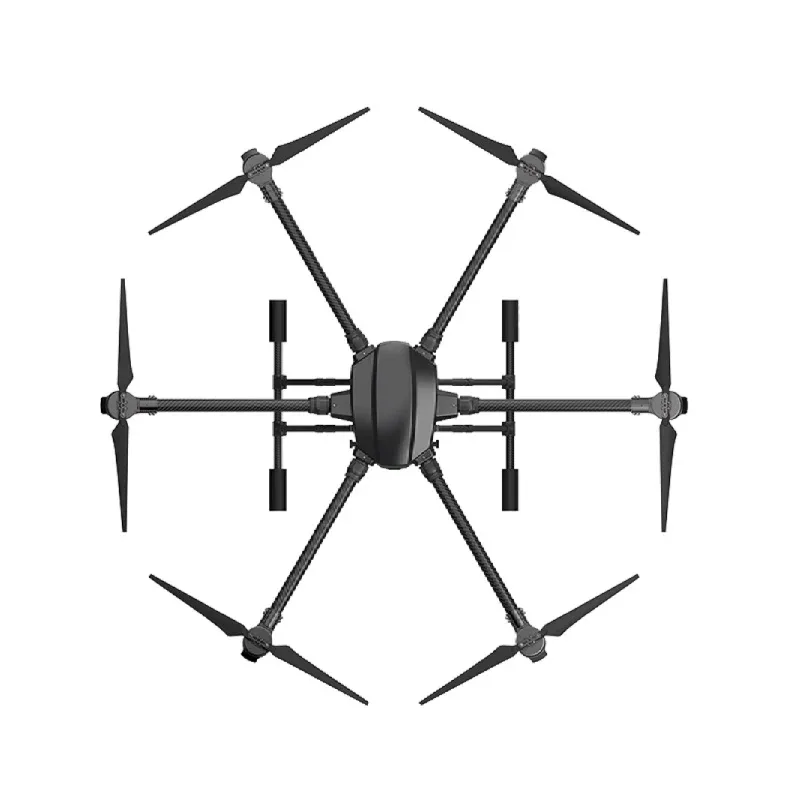
EFT 6120 Multifunction Surveillance Drone Frame
Professional-grade EFT frame designed for surveillance and industrial heavy-lift applications — excellent build quality with folding arms for field transport.
View on Zbotic
EFT E410P 10L 4 Axis Agricultural Drone Frame
10-litre agricultural drone frame from EFT — the perfect starting point before scaling up to octocopter configurations for larger spraying operations.
View on Zbotic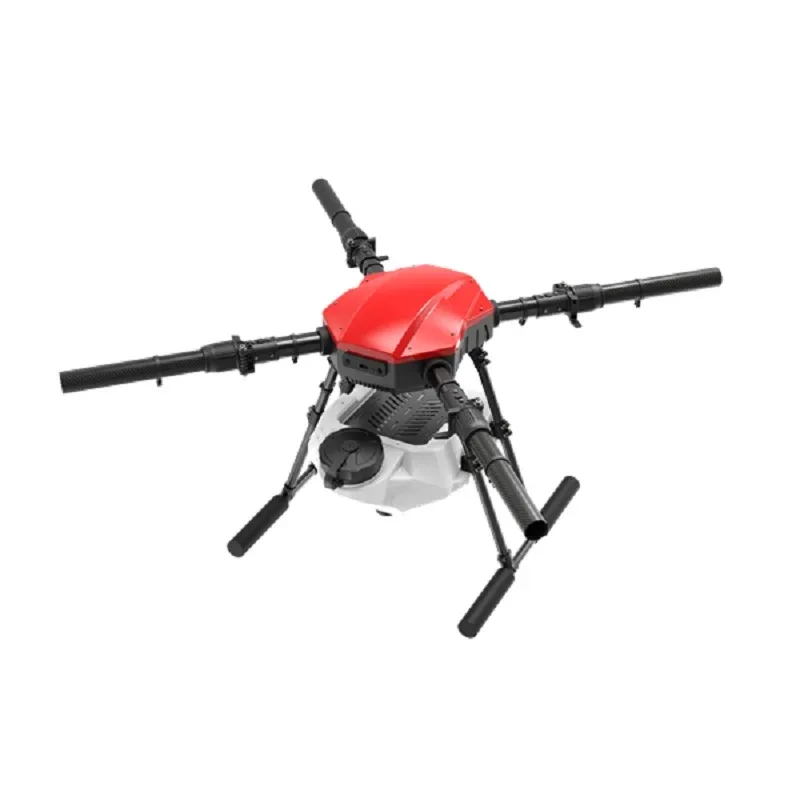
EFT E416P 16L 4 Axis Agricultural Drone Frame
High-capacity 16-litre agricultural frame from EFT — scale this architecture to an octocopter for extreme payload requirements in agricultural drone spraying.
View on Zbotic3. Motor Selection for Heavy Lift
Motor selection is the most critical decision in any heavy-lift build. The fundamental requirement is that your motors must produce at least 2:1 thrust-to-weight ratio (ideally 3:1 for agricultural spraying applications that need to manage varying tank weights).
Calculating Required Thrust
Formula: Total thrust required = (drone AUW including payload) × 2.5
For an octocopter: Per motor thrust = Total thrust / 8
Example: 5 kg drone + 10 kg agricultural sprayer = 15 kg AUW. Required total thrust = 37.5 kg. Per motor = 4.7 kg (46N). Each motor must be rated for at least 5 kg static thrust.
KV Rating for Heavy Lift
Heavy-lift motors use low KV ratings (80–200 KV) paired with large diameter propellers (15–30 inches). This low-KV + large-prop combination is far more efficient than high-KV + small-prop for lifting heavy loads.
T-Motor for Heavy Lift
T-Motor is widely regarded as the premium brand for heavy-lift drone motors. Their modular propulsion systems combine motor, ESC, and propeller as tested, matched units — ideal for professional octocopter builds where reliability is non-negotiable.

T-Motor A10-KV120-CCW Modular Propulsion System
Professional T-Motor A10 at KV120 — purpose-built for heavy-lift platforms, delivers outstanding thrust efficiency for octocopter industrial builds.
View on Zbotic
T-Motor A10-KV120-CW Modular Propulsion System
CW variant of the T-Motor A10 — pair with the CCW version for a full octocopter propulsion set with balanced torque cancellation on all 8 arms.
View on Zbotic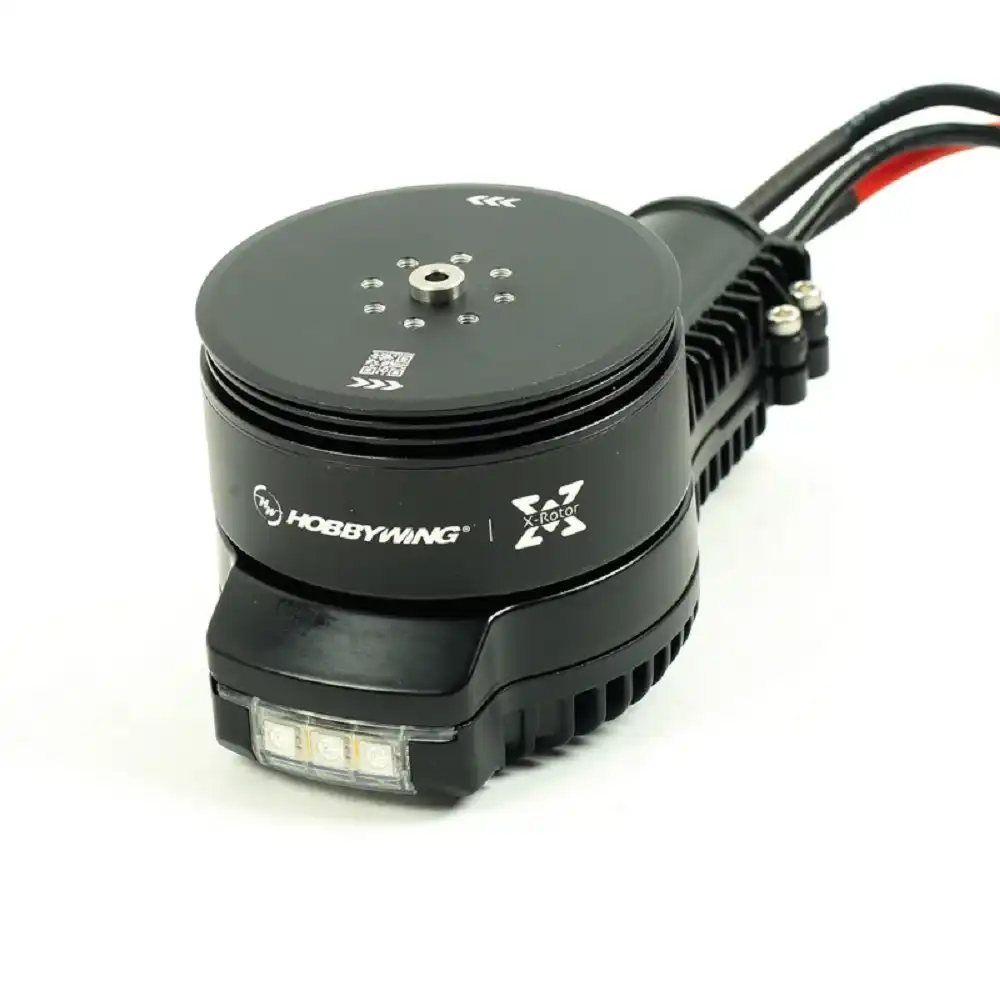
Hobbywing X6 Plus Motor CCW
Hobbywing’s X6 Plus is a flagship heavy-lift motor widely used in agricultural and industrial octocopter builds across Asia.
View on Zbotic
Hobbywing X9 Plus Motor CCW
The X9 Plus is Hobbywing’s top-tier ultra-heavy-lift motor — delivers massive thrust for the most demanding octocopter payloads including large spray tanks.
View on Zbotic4. Propeller Selection and Sizing
Heavy-lift drones use large-diameter, low-pitch propellers. Key specifications:
Diameter
Larger diameter props move more air per revolution and are inherently more efficient for heavy lift. Common heavy-lift prop sizes:
- 13–15 inches: Mid-range agricultural and survey builds
- 17–21 inches: Large agricultural octocopters (matched with T-Motor A10, Hobbywing X6)
- 24–30 inches: Ultra-heavy-lift platforms (matched with X9 class motors)
Pitch
Lower pitch (3–6 inches) provides better efficiency and stability for heavy payloads. High-pitch props generate more speed but sacrifice efficiency — unsuitable for agricultural or survey work where hover time matters.
Material
Carbon fibre is mandatory for props above 13 inches on any serious build. The centrifugal forces on large props at operating RPM are enormous — plastic or glass-fibre props can crack or delaminate catastrophically. Always inspect large carbon props before each flight session.

1045 2 Blades Carbon Fiber Propeller CW&CCW
10×4.5 inch carbon fiber propellers — a popular size for mid-range heavy-lift builds and test setups before upgrading to final large-diameter props.
View on Zbotic5. ESC Requirements for Octocopters
Eight motors means eight ESCs — or four dual-output ESCs. For heavy-lift octocopters:
Current Rating
Each ESC must be rated for at least the motor’s peak current draw, ideally with 30–50% headroom. If your motor draws 40A peak, use a 60A ESC. High-current agricultural and cinema builds often require 80A–120A ESCs per motor.
Voltage Rating
Heavy-lift builds commonly run on 6S (22.2V), 12S (44.4V), or even higher voltages. Ensure your ESCs are rated for the appropriate cell count. Running 12S through a 6S-rated ESC is a fire waiting to happen.
ESC Protocol
Use DSHOT300 or DSHOT600 on larger builds. Bidirectional DSHOT enables RPM filter telemetry which significantly reduces motor noise in the flight controller — important for smooth, precise hovering under heavy payload.

100A Multirotor ESC Power Distribution Battery Board
100A-rated power distribution board — handles the massive current demands of an octocopter’s 8-motor propulsion system safely and efficiently.
View on Zbotic6. Power Distribution and Battery Systems
The power system on an octocopter is where many first-time builders underestimate requirements.
Battery Capacity
Heavy-lift builds typically use high-capacity LiPo or Li-ion packs. For a 15 kg AUW agricultural build:
- 6S (22.2V) system: 22,000–30,000 mAh to achieve 20+ minute flight times
- 12S (44.4V) system: 12,000–16,000 mAh for similar performance with higher efficiency
Power Distribution
Octocopters require robust power distribution. Use thick silicone wire (10 AWG or heavier for mains) and proper XT90 or AS150 connectors. Power distribution boards rated for 300A+ total are available for professional builds. Every connection must be soldered, not crimped.
Dual Battery Configuration
Many professional octocopters carry two parallel battery packs — not only for capacity but for redundancy. If one pack fails (connector shorts, BMS fault), the second pack keeps the aircraft flying to a safe landing.
BEC for Accessories
With multiple accessories (GPS, telemetry, camera, gimbal, LED, buzzer), a dedicated BEC (Battery Eliminator Circuit) is essential. Do not draw accessory power from ESC BECs in heavy-lift builds — the ESCs are thermally loaded and their onboard regulators can fail under heavy current.
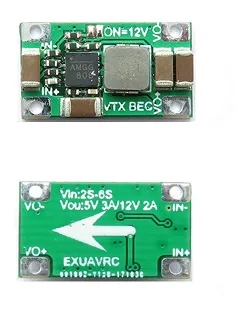
2-6S 5V 5A BEC For Quadcopter Drone
Dedicated 5V 5A BEC for powering flight controller, GPS, and accessories independently from the main ESC power rail on heavy-lift builds.
View on Zbotic7. Flight Controller and GPS Selection
For heavy-lift industrial octocopters, Betaflight is one option, but ArduPilot (ArduCopter) and PX4 are increasingly the preferred platforms due to their richer autonomous features:
ArduCopter on Pixhawk
ArduCopter running on a Pixhawk FC is the industry standard for industrial drones globally. It offers:
- Full autonomous mission planning (waypoint navigation)
- Geo-fencing and failsafe modes
- Terrain following
- Superior motor mixing for octocopter configurations including coaxial X8
- Extensive logging via Pixhawk’s SD card
- Real-time telemetry to ground station (Mission Planner, QGroundControl)
GPS for Industrial Octocopter
Use a Here3 or Here4 GPS (CAN-based, dual-frequency) for maximum accuracy. For budget builds, the NEO-M8N with compass is a reliable starting point. Mount on a tall mast to avoid RF interference from motors and ESCs below.

3DR 100mW Radio Telemetry 915MHz for APM PX4 Pixhawk
915MHz telemetry radio for real-time Mission Planner/QGC connectivity — essential for monitoring octocopter health and mission status during industrial operations.
View on Zbotic8. Payload Mounting and Weight Distribution
Payload placement critically affects flight characteristics. Keep these principles in mind:
Centre of Gravity
The payload must be suspended directly below the centre of thrust (the geometric centre of all 8 motors). Off-centre payloads cause one side of the octocopter to work harder, reducing efficiency and causing attitude drift under load.
Vibration Isolation for Cameras
Camera gimbals require vibration isolation from the main frame. Use a 3-axis gimbal suspended on silicone or rubber isolators. Even the best gimbal cannot fully compensate for frame vibrations transferred directly through a rigid mount.
Payload Release Mechanisms
For delivery or drop applications, use an electronically actuated payload release mechanism controlled via a spare PWM channel on the flight controller. Servo-based releases are simplest; electromagnet-based releases offer faster actuation.
9. Telemetry and Ground Control Setup
Industrial octocopters require real-time data connectivity for safe operations.
Radio Telemetry
The 3DR 915MHz telemetry system (used with APM/Pixhawk) provides reliable data link up to 5–10 km in open terrain. For longer range, 433MHz provides better penetration through vegetation and terrain but at lower data rates.

3DR Single TTL MINI Radio Telemetry 433MHz 500mW
500mW 433MHz telemetry radio providing excellent range for ground station connectivity during extended industrial octocopter missions.
View on Zbotic10. Indian DGCA Regulations for Heavy-Lift Drones
Heavy-lift octocopters fall under multiple regulatory categories in India. Here is what operators must know:
Weight Category Classification
- Small (2–25 kg): Most octocopters without payload fall here. Requires registration, UIN, and UAOP for commercial operations.
- Medium (25–150 kg): Fully loaded agricultural or heavy cinema octocopters. Stricter requirements including enhanced airworthiness testing.
Agricultural Drone Operations
The DGCA issued specific guidelines for agricultural drone operations in 2023. Spray drone operators must:
- Register the drone on the Digital Sky platform
- Obtain Type Certification from DGCA for the specific aircraft model
- Pilot must hold a valid Remote Pilot Certificate
- Operations must comply with State Agriculture Department guidelines on pesticide application
The PLI Scheme Opportunity
India’s Production Linked Incentive (PLI) scheme for drones offers financial support for Indian drone manufacturers. Building and operating octocopters domestically (with at least 50% local components) may qualify for PLI benefits — an important consideration for agri-drone businesses setting up in India.
No-Fly Zones
The B-VLOS (Beyond Visual Line of Sight) operation permit is required for long-range agricultural operations. These are obtained via the Digital Sky portal after demonstration of required safety features (redundant propulsion, parachute, or equivalent).
12. Frequently Asked Questions
Q: How much does it cost to build a professional octocopter in India?
A: A well-specced agricultural octocopter with T-Motor or Hobbywing propulsion, Pixhawk FC, spray tank, and batteries costs between ₹3–8 lakhs depending on component choices. Cinema-grade builds with high-end gimbals cost ₹8–20 lakhs. Entry-level survey builds can be done for ₹1.5–3 lakhs.
Q: How much payload can an octocopter carry?
A: With Hobbywing X9 class motors, a well-designed octocopter can carry 10–20 kg payload while maintaining 2:1 thrust-to-weight ratio. Standard builds with X6 class motors carry 5–12 kg payload.
Q: Can an octocopter fly with one motor failure?
A: A flat octocopter can typically fly safely with one motor failure, though performance is significantly reduced. The flight controller compensates by increasing throttle on the remaining motors. However, you should land as soon as safely possible after any motor failure — two failures are difficult to manage. X8 coaxial configurations are more vulnerable to certain motor failure combinations.
Q: What flight time can I expect from an industrial octocopter?
A: Flight time depends heavily on payload and battery capacity. An empty agricultural octocopter may fly 35–45 minutes. With a full 16L spray tank, this drops to 15–20 minutes. Most commercial operations plan for 12–15 minute work cycles with battery swaps.
Q: Is Betaflight or ArduPilot better for octocopter builds?
A: For industrial applications requiring waypoint navigation, autonomous spraying patterns, or precision mapping, ArduPilot (ArduCopter) on Pixhawk is strongly preferred. For experimental hobby builds or FPV multi-motor builds, Betaflight works but lacks many autonomous features. Professional operators choose ArduPilot.
Build Your Octocopter with Zbotic Components
From EFT agricultural frames and T-Motor propulsion to Hobbywing ESCs and power distribution boards, Zbotic has the heavy-lift components your industrial drone project needs. Shop our full drone parts range.
Shop Heavy-Lift Drone Parts at Zbotic


Add comment