
Whoop Drone for Indoor FPV: Best Tiny Whoops in India 2026
Imagine flying through your living room at 60 km/h, threading through doorways, diving under tables, and banking hard around the sofa — all from the safety of FPV goggles while standing in the middle of your own home. That is the magic of the Tiny Whoop. These small, ducted-fan micro drones have created an entirely new category of indoor FPV flying that is accessible, affordable, and addictive.
In India, where outdoor flying increasingly requires registration and approval through the DGCA’s Digital Sky platform, Tiny Whoops offer a beautiful loophole: they are typically under 250g (most are under 50g), exempt from most regulatory requirements, and can be flown legally indoors without any special permissions. This has made them enormously popular with Indian FPV pilots who want to practice their flying skills year-round regardless of weather or regulations.
This guide covers everything you need to know about Tiny Whoops in India: what makes them special, the best options available, how to build versus buy, and how to get started safely.
1. What is a Tiny Whoop?
A Tiny Whoop is a sub-100g micro FPV drone with ducted propellers — meaning the props spin inside circular plastic shrouds (ducts) rather than spinning freely in the open air. The ducts serve multiple purposes: they protect the propellers from impacts, protect people and objects from the props, and (with the right design) marginally improve thrust efficiency.
The original “Tiny Whoop” was a modified Inductrix micro drone, created by American FPV pilot Jesse Perkins in 2016. He added a tiny FPV camera to the Blade Inductrix and posted videos of flying through his house at insane speeds. The concept went viral, and an entire industry grew around the format.
Today, Tiny Whoops come in several size classes:
- 65mm (2.5″ props): The classic indoor whoop size. Light (25–35g), very agile, great for narrow spaces. Most popular for competitive indoor racing.
- 75mm (3″ props): Slightly larger, more powerful, better camera quality. Can handle mild outdoor flying as well.
- 85mm–95mm (3.5″–4″ props): Bridging the gap between micro indoor and 3.5″ micro outdoor quads. Less common but versatile.
2. Why Choose a Tiny Whoop in India?
For Indian pilots, Tiny Whoops offer several unique advantages:
- No registration required: Drones under 250g AUW in the Nano category have significantly relaxed requirements under DGCA rules. Most Tiny Whoops weigh 25–80g — well under the nano threshold.
- Year-round flying: India’s monsoon season (June–September) makes outdoor flying impractical for months. A Tiny Whoop lets you keep flying indoors regardless of weather.
- Skill building: Indoor flying in tight spaces sharpens your FPV stick skills faster than outdoor open-field flying. Many professional FPV pilots credit their indoor whoop flying for dramatically improving their outdoor quad control.
- Low cost to repair: When you crash (and you will), the damage is usually just a bent prop or broken duct — parts that cost ₹50–₹200 to replace.
- Safe for beginners: The ducts protect most household items and people from propeller strikes. While still capable of causing injury at speed, the risk is far lower than open-prop quads.
3. Anatomy of a Tiny Whoop
Understanding the parts of a Tiny Whoop helps you make informed purchasing decisions and repair your drone more efficiently:
- Frame: Usually a single injection-moulded plastic piece with four ducted prop guards attached. The FC/ESC stack mounts in the centre.
- AIO FC+ESC: Almost all modern Tiny Whoops use an All-In-One board combining the flight controller and 4x ESCs on a single tiny board (typically 26×26mm or 20×20mm).
- Brushless motors: Modern Tiny Whoops use brushless motors (1002 to 1105 size). Older designs used brushed motors but brushless is now standard even at the entry level.
- Props: Small 40mm–48mm bi-blade or tri-blade props that fit the duct profile.
- FPV camera: Ultra-compact cameras (nano or pico size) facing forward. Analog cameras weigh 1–3g. Digital cameras (Caddx Ant, O3 nano) weigh 3–5g.
- Video transmitter (VTX): Usually integrated on the AIO board at 25–200mW output.
- Receiver: Nano-sized ELRS, CRSF, or SPI-connected receiver. Some AIO boards have the receiver integrated.
- Battery: 1S or 2S LiPo/Li-HV. 1S 300–450mAh for 65mm; 2S 250–450mAh for 75mm.
4. Best Ready-to-Fly Tiny Whoops in India
If you want to start flying with minimal technical effort, a complete ready-to-fly (RTF) or bind-and-fly (BNF) Tiny Whoop is your best option. Here are the top choices for 2026:
BetaFPV Cetus X (75mm, 2S)
The Cetus X is one of the best beginner Tiny Whoops available. It comes with a dedicated controller, FPV goggles, and a complete BNF package. Runs Betaflight, supports Angle/Horizon/Acro modes. Price in India: approximately ₹12,000–₹18,000 for the full kit.
Happymodel Mobula6 (65mm, 1S)
The Mobula6 is the classic 65mm Tiny Whoop with internal ELRS. Extremely light (28g), runs Betaflight, and is compatible with any ELRS transmitter. Price: ₹4,000–₹6,000. Requires your own transmitter.
BetaFPV Meteor65 (65mm, 1S ELRS)
Another excellent 65mm option with ELRS. Very light and agile. Ideal for tight indoor spaces. Price: ₹4,500–₹6,000.
Happymodel Mobula7 (75mm, 2S)
The 75mm step-up from the Mobula6. More powerful, better range, can handle mild outdoor flying. Price: ₹5,500–₹7,500.
5. Build Your Own Whoop: DIY Guide
Building your own Tiny Whoop is more satisfying, teaches you how the drone works, and gives you full control over parts selection. A basic DIY 65mm whoop build includes:
- Frame: A 65mm brushless duct frame (e.g., BetaFPV 65mm, Happymodel 65mm frame). Cost: ₹400–₹800.
- AIO FC+ESC: A 5-in-1 AIO board with integrated FC, 4x ESC, and VTX. Popular options: BetaFPV F4 1S, Happymodel Happy F4. Cost: ₹1,500–₹3,000.
- Motors: 0802–1002 brushless motors in 19,000–25,000KV range for 1S operation. Cost per set of 4: ₹1,200–₹2,500.
- Props: 40mm bi-blade props compatible with the motor shaft. Cost: ₹150–₹300 for a set.
- Camera: A nano FPV camera. Cost: ₹500–₹1,500.
- Receiver: ELRS nano receiver or use an AIO board with integrated SPI ELRS receiver. Cost: ₹600–₹1,200 (or ₹0 if integrated).
- Batteries: 4–6 pieces of 1S 300–450mAh HV LiPo. Cost: ₹200–₹400 each.
- Battery charger: A multi-port 1S LiPo charger. Cost: ₹800–₹1,500.
Total DIY cost: approximately ₹6,000–₹12,000 depending on choices, not including a radio transmitter and goggles.
6. Motors, ESCs, and Props for Whoops
For a Tiny Whoop, the motor and ESC architecture is radically different from 5-inch FPV quads:
- Motor size: 0802 and 1002 stators are the norm for 65mm 1S builds. 1105 motors are used in more powerful 75mm 2S builds.
- KV range: Very high KV is needed for small props on low voltage. 19,000–26,000KV for 1S; 10,000–14,000KV for 2S.
- ESC current rating: 5–7A per motor for 1S whoops; 10–12A for 2S whoops. These are integrated on the AIO board.
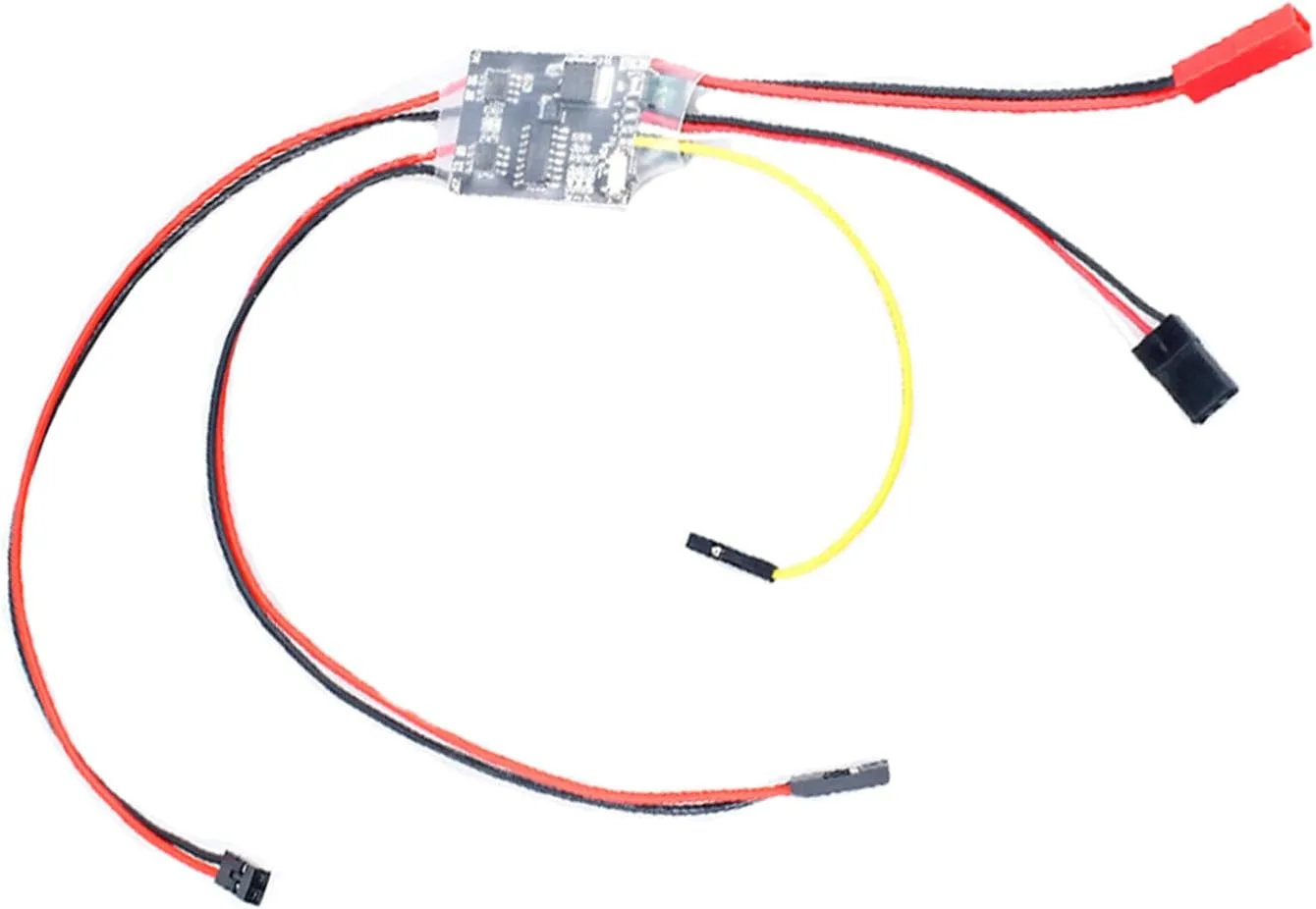
2S-6S 2Ax2 Dual Way Brushed ESC Bidirectional Electric Speed Controller
Compact bidirectional brushed ESC for small and micro RC vehicles. Supports 2S–6S voltage range with 2A per channel continuous current.

30A Brushed ESC No Brake
A 30A brushed ESC suitable for ground robots, micro RC vehicles, and small aerial platforms using brushed motors. No-brake variant for smooth deceleration.
7. FPV Cameras for Indoor Flying
The camera is your eyes in FPV flying. For Tiny Whoops, you want the smallest and lightest possible camera. Key specs to look for:
- Size: Nano (14×14mm) or pico sized cameras. Full-size cameras are too heavy for a Tiny Whoop.
- Dynamic range / WDR: Wide Dynamic Range (WDR) helps the camera handle both bright windows and dark room interiors in the same frame — crucial for indoor flying in India where rooms often have strong directional sunlight.
- Field of view (FOV): 120–165° for FPV. Wider gives a better sense of speed but distorts the image more.
- Format: PAL (25fps) or NTSC (30fps). PAL is preferred in India as it matches local TV standards, though for FPV flying it makes little difference.

1/3″ CMOS 700TVL Mini FPV Camera 2.1mm Lens PAL/NTSC
Compact 700TVL analog FPV camera with 2.1mm wide-angle lens. PAL and NTSC switchable. Perfect for indoor flying on micro and mini FPV quads.
8. Radio Transmitter Setup
To fly a Tiny Whoop in FPV mode, you need a radio transmitter with a compatible protocol. Most modern Tiny Whoops come in ELRS or Frsky variants:
- ELRS: Use any ELRS-capable transmitter (RadioMaster Pocket, Boxer, TX16S). Bind the receiver via the ELRS Lua script on your transmitter.
- SPI receiver (integrated): Some AIO boards have SPI-connected receivers that are preconfigured for a specific protocol. These can be harder to change later.
For indoor flying, 25mW transmitter power is more than sufficient. You are flying within line of sight in a home environment. Lower power also reduces interference with neighbours’ Wi-Fi and Bluetooth devices.
9. Indoor Flying Tips for Indian Homes
Indian homes present unique indoor flying challenges and opportunities:
- Ceiling height: Many Indian homes have 10–12 foot ceilings, which gives comfortable vertical clearance for Tiny Whoops.
- Ceiling fans: Turn ALL ceiling fans off before flying. A Tiny Whoop hitting a ceiling fan at speed can damage both the drone and the fan, and creates a serious safety hazard.
- Marble/tile floors: Most Indian homes have hard floors. Crashes on marble hurt the drone more than on carpet. Use prop guards and fly carefully until you have good control.
- Open plan vs compartmentalized: Older homes with many small rooms offer natural gate-like doorways for racing courses. Modern open-plan apartments give more space to build speed.
- Mirrors: Be careful with full-length mirrors — the drone will fly toward its own reflection. Cover or avoid them when setting up indoor gates.
- Pets and children: Clear the room of pets and small children before flying. Even with ducted props, impacts are unpleasant for living beings.
- Furniture course: Set up a simple course using chairs, doorways, and low furniture as natural gates. This is the most rewarding way to practice and improve quickly.
10. Regulations — What You Need to Know
Under India’s Drone Rules 2021 and subsequent DGCA amendments:
- Nano drones (under 250g): Most indoor Tiny Whoops fall in this category. Flying over your own premises does not require UIN registration for nano drones. However, flying outdoors in public spaces requires following standard rules.
- Indoor flying: Strictly indoor flying in private enclosed spaces is generally not regulated by DGCA rules (which govern airspace, not buildings).
- FPV goggles: DGCA rules require a visual observer when flying FPV (the pilot wearing goggles cannot simultaneously observe the drone). For indoor flying in your own home, this is a non-issue — but worth knowing for outdoor flights.
- UAS Traffic Management (UTM): The Digital Sky platform and UTM apply to outdoor flights in shared airspace. Indoor flights in private spaces are excluded.
The bottom line: flying a sub-100g Tiny Whoop indoors in your own home is completely legal and unregulated in India. This makes whoops the perfect tool for year-round flying practice.
Frequently Asked Questions
The BetaFPV Cetus X kit (comes with controller and goggles) is the best complete beginner package. If you already have a radio transmitter, the Happymodel Mobula6 ELRS is the best value standalone whoop.
Typically 3–5 minutes per 1S 300–450mAh battery at normal flying pace. At full race throttle, as little as 2 minutes. Most pilots buy 6–10 batteries and use a parallel charger to keep flying for extended sessions.
Yes, they are among the safest FPV drones for indoor use. The prop ducts prevent most direct propeller contact with objects and people. However, the drone itself can cause minor bruising if it impacts at high speed. Always fly with care around people and pets.
65mm whoops are very sensitive to wind and are not suitable for outdoor flying in any significant breeze. 75mm–85mm whoops can handle light wind outdoors. For outdoor flying, a 3-inch or 5-inch open-prop quad is more appropriate.
You can fly a Tiny Whoop in “line of sight” mode without goggles, but FPV goggles give you the full immersive experience that makes whoop flying so exciting. Budget box goggles (Eachine EV800D style) cost ₹2,500–₹4,000 and are fine for 65mm indoor flying.
A complete beginner kit (BNF whoop + radio transmitter + basic goggles + batteries + charger) costs approximately ₹10,000–₹20,000. Building from scratch is possible for ₹8,000–₹15,000 if you are comfortable with basic soldering.
Start Your Tiny Whoop Journey Today
Zbotic stocks micro FPV cameras, ESCs, motors, and accessories for building or upgrading Tiny Whoops and micro FPV drones. Fast delivery across all major Indian cities.


Add comment