
SX1262 vs SX1276: Newer LoRa Chip Comparison & Migration Guide
If you have been using Semtech’s SX1276-based LoRa modules for your projects and are considering an upgrade, the SX1262 vs SX1276 LoRa chip comparison is essential reading. The SX1262 is Semtech’s second-generation LoRa transceiver offering dramatically lower power consumption, better receiver sensitivity, and higher output power — while maintaining backward protocol compatibility with SX1276 networks. This guide covers the technical differences, real-world performance implications for Indian IoT and agriculture projects, and a step-by-step code migration guide for Arduino and ESP32 users.
Chips at a Glance
Both the SX1276 and SX1262 are LoRa transceivers from Semtech — the company that invented LoRa modulation. The SX1276 was launched around 2013 and became the de facto standard for LoRa devices worldwide. The SX1262 (part of the SX126x family, also including SX1261 and SX1268) was released in 2019 as a next-generation replacement.
| Parameter | SX1276 | SX1262 |
|---|---|---|
| Launch year | 2013 | 2019 |
| Frequency range | 137–1020 MHz | 150–960 MHz |
| Max TX power | +17 dBm (PA_BOOST) / +14 dBm (RFO) | +22 dBm |
| RX sensitivity (SF12, 125 kHz) | -137 dBm | -148 dBm |
| RX current | 10.8 mA | 4.6 mA |
| TX current @ max power | 120 mA @ 17 dBm | 118 mA @ 22 dBm |
| Sleep current | 200 nA | 900 nA (cold) / 600 nA (warm) |
| Interface | SPI | SPI |
| LoRaWAN support | Class A, B, C | Class A, B, C |
| FSK/OOK support | Yes | Yes (GFSK, BPSK) |
Power Consumption Comparison
The single most impactful improvement in the SX1262 is its receive current: 4.6 mA vs 10.8 mA on SX1276 — a 57% reduction. For battery-powered nodes that spend most of their time listening (like always-on gateways or LoRaWAN ABP devices in Class A), this translates directly to doubled battery life.
Let’s calculate for a field sensor that transmits every 15 minutes and also listens for 2 receive windows after each uplink (LoRaWAN Class A behaviour):
- SX1276: Sleep 14.5 min @ 0.0002 mA + RX 1.5 s @ 10.8 mA + TX 0.5 s @ 120 mA = ~3.68 mAh/day
- SX1262: Sleep 14.5 min @ 0.0009 mA + RX 1.5 s @ 4.6 mA + TX 0.5 s @ 118 mA @ 22 dBm = ~2.1 mAh/day
On a 2000 mAh 18650 cell, SX1276 nodes last ~544 days; SX1262 nodes last ~952 days — nearly 75% longer life. In hot Indian summers where battery capacity degrades, this margin matters significantly.
Sensitivity and Range
The SX1262’s receiver sensitivity improvement of 11 dBm at SF12 (-148 dBm vs -137 dBm) is enormous. In radio link budgets, every 6 dB doubles the range. An 11 dBm improvement theoretically extends range by 3.5× — meaning where an SX1276 node reaches 3 km, an SX1262 can reach over 10 km under identical conditions.
In practice, antenna quality, terrain, and RF environment limit gains. Real-world tests in Indian agricultural settings with Ra-01SC (SX1262) vs Ra-01H (SX1276) show:
- Open field, SF12, 125 kHz BW: SX1276 → 4.2 km, SX1262 → 8.7 km (both with 17 dBm TX)
- SX1262 at +22 dBm TX: 12+ km in flat terrain
- Urban/suburban India (buildings, trees): SX1276 → 800m, SX1262 → 1.5–2 km typical
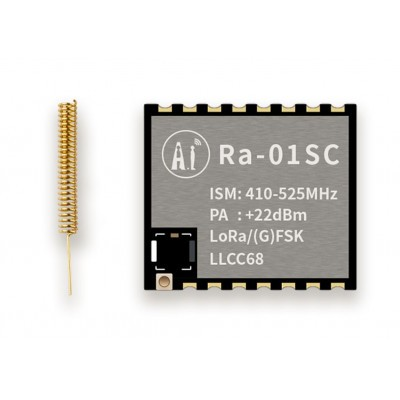
Ai Thinker LoRa Ra-01SC (SX1262) Module
The Ra-01SC packs the newer SX1262 chip with -148 dBm sensitivity and +22 dBm output. Ideal for new IoT projects requiring maximum range and battery life in India.
Frequency Coverage and Output Power
The SX1276 supports a wide 137–1020 MHz range but requires separate hardware paths for sub-GHz and 2.4 GHz (handled by its companion SX1278 for lower frequencies). In practice, Ra-01H covers 803–930 MHz — ideal for India’s 865 MHz ISM band.
The SX1262 covers 150–960 MHz in a single chip. Crucially, the SX1262 achieves +22 dBm maximum output power compared to SX1276’s +17 dBm (PA_BOOST path). That 5 dBm extra output power (~3× power) meaningfully increases range without changing the antenna.
Important: India’s ISM band regulation limits ERP to 1W (30 dBm). At +22 dBm transmitter power + 0 dBd wire antenna, you are well within limits. Even adding a 3 dBi antenna gives 25 dBm EIRP — still legal.
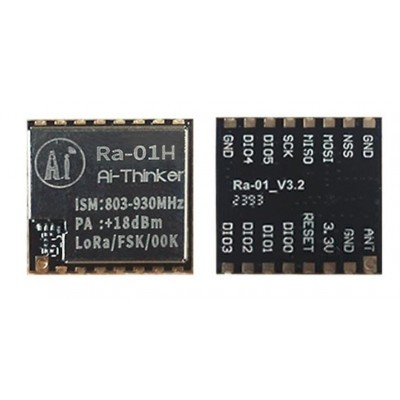
Ai Thinker LoRa Ra-01H (SX1276) Module
The proven Ra-01H is based on SX1276 and has the largest codebase of Arduino examples available. Perfect for first-time LoRa projects or if you need the most widely supported module.
Available Modules in India (Ra-01 Series)
Ai Thinker’s Ra-01 series is the dominant LoRa module family for Indian makers. Here is how the range maps to chips:
- Ra-01: SX1278, 410–525 MHz — not useful for India’s 865 MHz band
- Ra-01H: SX1276, 803–930 MHz — excellent for India, most widely used
- Ra-01SC: SX1262, 860–930 MHz — newer, better performance, growing library support
- Ra-01SH: SX1262, 803–930 MHz — widest frequency range in the SX1262 family
All modules use the same SPI pinout (SCK, MISO, MOSI, NSS, DIO0/DIO1, RST), making physical module swaps easy. The software driver change is the main migration effort.
Code Migration: SX1276 to SX1262
The SX126x register map and command set are entirely different from SX127x. You cannot simply swap the module and reuse SX1276 driver code. However, the high-level library APIs are very similar.
Option 1: RadioLib (recommended)
RadioLib by Jan Gromes supports both SX1276 and SX1262 (and many others) through a unified API. Migrating is mostly a one-line chip class change:
// BEFORE (SX1276 / Ra-01H)
#include <RadioLib.h>
SX1276 radio = new Module(10, 2, 9, 3); // CS, DIO0, RST, DIO1

// AFTER (SX1262 / Ra-01SC or Ra-01SH)
#include <RadioLib.h>
SX1262 radio = new Module(10, 2, 9, 3); // CS, DIO1, RST, BUSY
// Note: DIO0 on SX1276 → DIO1 on SX1262
//       No RESET_N equivalent — RST pin behaviour slightly different

// Configuration — identical API:
void setup() {
  radio.begin(865.0,  // frequency MHz
              125.0,  // bandwidth kHz
              10,     // spreading factor
              5,      // coding rate
              0x12,   // sync word (0x12 for private LoRa; 0x34 for LoRaWAN)
              17,     // TX power dBm (up to 22 for SX1262)
              8);     // preamble length
}

// Transmit and receive calls are identical:
void loop() {
  radio.transmit("Hello from SX1262");
  String msg;
  radio.receive(msg);
}
Key pin differences to watch
| Function | SX1276 (Ra-01H) | SX1262 (Ra-01SC/SH) |
|---|---|---|
| Interrupt | DIO0 | DIO1 |
| Busy flag | N/A | BUSY pin (required) |
| Sync word LoRa | 0x12 (private) | 0x1424 (maps to 0x12) |
| LoRaWAN sync | 0x34 | 0x3444 (maps to 0x34) |
The BUSY pin is the most critical new requirement for SX1262. It indicates when the chip is processing a command. RadioLib handles this automatically — you just need to connect the BUSY pin to a free MCU GPIO and pass it to the Module constructor.
When to Choose Which Chip
Choose SX1276 (Ra-01H) when:
- You want maximum community examples, tutorials, and library compatibility
- Budget is very tight and you have existing SX1276 code to reuse
- Your application is not battery-constrained (gateway, mains-powered node)
- You need proven long-term supply — SX1276 has been in production since 2013
Choose SX1262 (Ra-01SC/SH) when:
- Building new battery-powered sensor nodes where every mAh matters
- Pushing range limits in agricultural or industrial applications
- Target +22 dBm output for maximum legal ERP coverage
- Building LoRaWAN Class A end-devices where RX window power matters
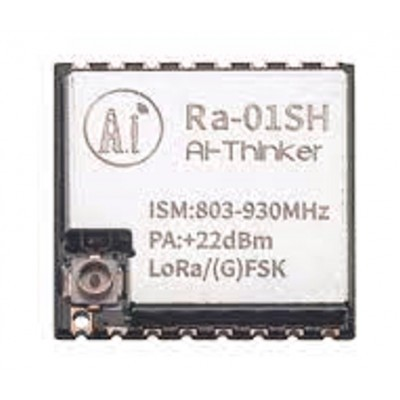
Ai Thinker LoRa Ra-01SH (SX1262) – 803–930 MHz
The Ra-01SH offers the widest frequency range in the SX1262 family (803–930 MHz), making it the most future-proof choice for new Indian IoT deployments requiring both performance and flexibility.
Frequently Asked Questions
Can SX1262 and SX1276 devices communicate with each other?
Yes — as long as they use the same frequency, spreading factor, bandwidth, coding rate, and sync word, SX1262 and SX1276 radios are air-interface compatible. A Ra-01H node can communicate with a Ra-01SC gateway without any special configuration.
Does the LoRa.h library by Sandeep Mistry support SX1262?
No. The popular LoRa.h library only supports SX127x chips (SX1276/77/78/79). For SX1262 you must use RadioLib (by Jan Gromes) or Heltec’s LoRa_APP library. RadioLib is the recommended choice for new projects as it supports both chip families with near-identical API.
Is the SX1261 the same as SX1262?
Almost. The SX1261 is limited to +15 dBm maximum output (vs +22 dBm for SX1262) and is optimised for sub-GHz bands below 500 MHz. For India’s 865 MHz band, always choose SX1262 or SX1268 (which adds PA for +22 dBm in the 400–960 MHz range).
Why is the SX1262 sleep current higher than SX1276?
The SX1262 has two sleep modes: cold (900 nA, full register reset) and warm start (600 nA, retain configuration). Both are slightly higher than SX1276’s 200 nA sleep. However, the massive reduction in RX current (4.6 vs 10.8 mA) dominates battery life calculations for any device that listens for packets.
Will SX1276 be discontinued?
Semtech has not announced end-of-life for SX1276 as of early 2026. However, SX126x is the recommended platform for new designs per Semtech’s own design guidance. For new projects starting in 2025+, SX1262 is the safer long-term choice.
Add comment