
Choosing between LoRaWAN vs LoRa point to point is one of the most important architectural decisions when building a long-range IoT system. Both technologies use the same LoRa physical layer radio modulation from Semtech, but LoRaWAN adds a complete network protocol stack with cloud integration, while point-to-point LoRa is a simple, direct radio link like a very-long-range serial cable. This guide explains both architectures clearly, compares them across key dimensions, and gives concrete guidance on which to choose for every common Indian IoT use case.
LoRa Physical Layer: The Common Foundation
LoRa (Long Range) is a patented spread spectrum modulation technique developed by Semtech. It uses Chirp Spread Spectrum (CSS) modulation which spreads the signal across a wide bandwidth, making it highly resistant to interference and capable of being decoded even when the signal is below the noise floor. This is what gives LoRa its extraordinary range — 5 to 15 km in rural India, 1 to 3 km in urban environments.
Key LoRa physical layer parameters:
- Spreading Factor (SF): SF7 to SF12. Higher SF = longer range, lower data rate. SF12 gives maximum range (15+ km) but at only 250 bps.
- Bandwidth: 125 kHz, 250 kHz, or 500 kHz. Wider bandwidth = faster data rate but shorter range.
- Coding Rate: 4/5 to 4/8. Higher CR adds more forward error correction, improving reliability at the cost of data rate.
- Frequency: In India, LoRa uses the 865 to 867 MHz band (IN865 region plan for LoRaWAN) or 433 MHz for point-to-point use.
Both LoRaWAN and point-to-point LoRa use the same radio chips (SX1276, SX1278, SX1262) and the same modulation. The difference is entirely in the software layers above the physical radio.
LoRa Point-to-Point Architecture
In a point-to-point (P2P) LoRa system, two or more LoRa modules communicate directly with each other at the physical layer, without any gateway, network server, or cloud infrastructure in between. Think of it as a very long-range walkie-talkie for data packets.
Architecture components:
- Node A (Transmitter): Arduino/ESP32 + LoRa module. Sends packets directly.
- Node B (Receiver): Arduino/ESP32 + LoRa module. Receives packets and takes action.
- No gateway, no server, no internet connection required.
The developer is responsible for all higher-layer concerns: acknowledgements, retries, addressing (if multiple nodes), duty cycle management, and security. Popular Arduino libraries for P2P LoRa include the RadioHead library and the Sandeep Mistry arduino-LoRa library, both of which provide simple begin/send/receive APIs.
#include <SPI.h>
#include <LoRa.h>

void setup() {
  Serial.begin(9600);
  if (!LoRa.begin(865E6)) {  // 865 MHz for India
    Serial.println("LoRa init failed!");
    while (1);
  }
  LoRa.setSpreadingFactor(10);  // SF10 for good range/speed balance
  LoRa.setSignalBandwidth(125E3);
  LoRa.setCodingRate4(5);
  Serial.println("LoRa P2P transmitter ready");
}

void loop() {
  LoRa.beginPacket();
  LoRa.print("Temp:28.5,Hum:65");
  LoRa.endPacket();
  Serial.println("Packet sent");
  delay(10000);
}
LoRaWAN Architecture and Stack
LoRaWAN is a LPWAN (Low Power Wide Area Network) protocol specification maintained by the LoRa Alliance. It defines the complete network architecture including end devices, gateways, network servers, and application servers.
LoRaWAN architecture layers:
- End Device: Battery-powered IoT sensor with a LoRa radio. Sends uplink messages and receives downlink commands. Does not communicate with other end devices directly.
- Gateway: Receives all LoRa transmissions within range on all channels simultaneously (using concentrator ICs like SX1301/SX1302). Forwards packets to a network server via IP (typically Ethernet or 4G backhaul).
- Network Server: Handles de-duplication (a packet may be received by multiple gateways), device authentication (DevEUI, AppEUI, AppKey), MAC layer management, and adaptive data rate. Popular open-source option: ChirpStack. Popular hosted option: The Things Network (TTN).
- Application Server: Decodes device payloads and integrates with your application (database, dashboard, alarm system). TTN and ChirpStack both include built-in application server functionality and webhooks.
End devices join the network using either OTAA (Over-The-Air Activation, the secure and recommended method) or ABP (Activation By Personalization). OTAA uses a key exchange handshake to derive session keys; ABP hardcodes them.
Detailed Comparison Table
| Dimension | LoRa P2P | LoRaWAN |
|---|---|---|
| Infrastructure needed | None (direct radio link) | Gateway + Network server required |
| Setup complexity | Very low (library + send/receive) | High (gateway provisioning, keys, TTN registration) |
| Scalability | Limited (point-to-point or small star) | Thousands of nodes per gateway |
| Security | Developer’s responsibility | AES-128 encryption built in |
| Cloud integration | DIY (need separate gateway device) | Built-in via network server webhooks |
| Duty cycle enforcement | Developer must manage | Stack enforces regional regulations |
| Typical use case | Two-node private link, remote control | City-scale sensor network |
| Downlink (server to device) | Bidirectional at any time | Limited (Class A: 2 windows after uplink) |
| Cost for 10 nodes | Rs.5,000 to Rs.10,000 (10 modules) | Rs.10,000 to Rs.20,000 (gateway + 10 nodes) |
| Internet dependency | None | Required for network server |
When to Choose Point-to-Point LoRa
Remote Off-Grid Installations
If you are monitoring a borewell pump, solar power system, or agricultural sensor at a location with no internet connectivity and no cellular signal, point-to-point LoRa is the only practical option. Run one LoRa node at the remote site and one at the farmhouse where you have power and a local display or data logger. No internet required.
Private, Secure Industrial Links
Some Indian industrial facilities need to bridge two buildings or monitoring points without using any internet-connected infrastructure. A P2P LoRa link with application-level AES encryption provides a simple, maintainable solution with no external dependencies and no subscription fees.
Learning and Prototyping
For students and hobbyists building their first long-range wireless project, P2P LoRa is far easier to get working in a weekend. You only need two modules and the arduino-LoRa library. LoRaWAN requires registering on TTN, provisioning a gateway (or finding one nearby), generating OTAA keys, and understanding the protocol stack before sending your first byte.
RC-Style Control Applications
For controlling a drone, boat, or other vehicle at long range with bidirectional communication, P2P LoRa’s free bidirectional communication (not constrained by LoRaWAN duty cycle rules) is essential. LoRaWAN’s Class A devices can only receive in small windows after transmitting, making true real-time bidirectional control impractical.
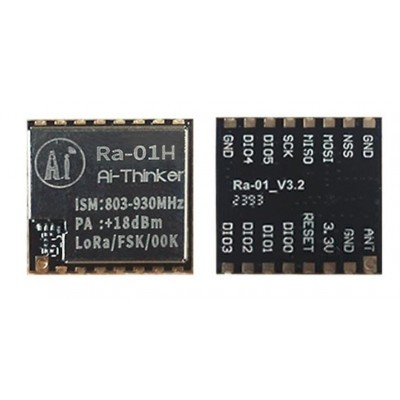
Ai Thinker LoRa Ra-01H Module
SX1276-based LoRa module for the 868 MHz band, ideal for Indian point-to-point and LoRaWAN applications. Ultra-compact with SPI interface for direct connection to Arduino, ESP32, or STM32. Excellent sensitivity of -148 dBm.
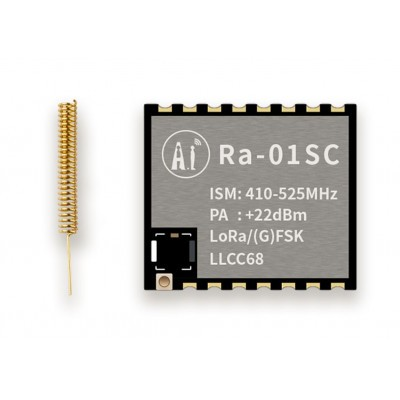
Ai Thinker LoRa Ra-01SC Module
SX1262-based LoRa module with improved sensitivity and lower power consumption than the SX1276. Supports LoRa and FSK modes. Best choice for new LoRaWAN end device designs targeting Indian 865 MHz band.
When to Choose LoRaWAN
Smart City and Municipal Projects
For deployments involving dozens to thousands of nodes spread across a city — smart meters, parking sensors, flood level monitors, air quality stations — LoRaWAN is the only practical architecture. A single LoRaWAN gateway can handle thousands of end devices. Municipal corporations in Pune, Bengaluru, Surat, and other Smart City Mission cities are actively deploying LoRaWAN infrastructure.
Projects Using Existing LoRaWAN Coverage
The Things Network (TTN) has growing community gateway coverage in Indian cities. If there is a TTN gateway near your deployment area, you can deploy LoRaWAN end nodes with zero gateway infrastructure cost. Check the TTN world map for gateway density in your city before committing to a private gateway purchase.
Projects Requiring OTAA Security
LoRaWAN’s OTAA activation and AES-128 encryption at both the network and application layer provide strong security for sensitive industrial or commercial applications. Each device has a unique DevEUI and AppKey, making device impersonation practically impossible. Point-to-point LoRa has no built-in security — you must implement encryption yourself.
Adaptive Data Rate (ADR) Benefits
In a LoRaWAN network, the network server can automatically adjust each device’s spreading factor and transmit power based on observed signal quality. Devices close to the gateway use higher data rates (SF7, 5 kbps) while distant devices use lower rates (SF12, 250 bps). This maximises network capacity and battery life automatically — something P2P LoRa requires manual tuning to achieve.
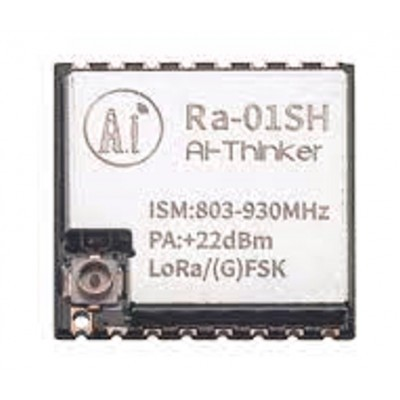
Ai Thinker LoRa Ra-01SH Spread Spectrum Wireless Module
High-frequency LoRa module from Ai Thinker for the 915 MHz band. Ideal for international LoRaWAN deployments and testing. Based on SX1262 for the best power efficiency and receiver sensitivity in its class.
LoRa in India: Networks and Regulations
India has specific frequency allocations for LoRa use:
- IN865 (LoRaWAN): 865.0625 to 867.0 MHz, 8 channels defined by LoRa Alliance IN865 regional parameters. Maximum EIRP: 14 dBm on most channels. This is the correct band for LoRaWAN in India.
- 433 MHz: License-free short range device band in India. Used for P2P LoRa in many hobbyist projects. Maximum power is lower (10 mW EIRP), so range is reduced compared to 865 MHz.
- 915 MHz: NOT unlicensed in India (it is the US ISM band). Do not use 915 MHz LoRa modules for Indian deployments without a WPC license.
For WPC compliance on commercial LoRaWAN products, apply for equipment type approval under the Short Range Devices category. Hobbyist and educational use within published power limits is generally unregulated.
Indian LoRaWAN deployments are growing in agriculture (Mahindra AgriTech, Fasal), smart cities (several NIC projects), and supply chain. Tata Communications and Actility have partnered for LoRaWAN network services in select Indian cities, providing a managed connectivity alternative to self-hosted gateways.
Frequently Asked Questions
Can I convert a P2P LoRa setup to LoRaWAN later?
The same LoRa radio module can be used for both, but the software is completely different. A P2P sketch using the arduino-LoRa library must be entirely rewritten using a LoRaWAN library such as LMIC (from MCCI or IBM) or the Arduino LoRaWAN library for MKRWAN boards. Plan your architecture before buying hardware to avoid wasted effort.
What is the maximum payload size in LoRaWAN?
LoRaWAN payload size depends on the spreading factor and regional settings. At SF7 (fastest, shortest range) in the IN865 band, maximum payload is 222 bytes. At SF12 (maximum range), maximum payload is only 51 bytes. Design your data encoding carefully. Use Cayenne LPP or custom binary encoding rather than JSON to stay within limits.
Is The Things Network (TTN) available in India?
TTN community gateways exist in several Indian cities including Bengaluru, Mumbai, Delhi, and Pune, but coverage is patchy compared to Europe. Check the TTN coverage map (ttnmapper.org) for your specific area. For reliable commercial deployments, deploy your own private LoRaWAN gateway using ChirpStack as the self-hosted network server.
How does LoRa handle multiple nodes in P2P mode?
The standard arduino-LoRa library does not implement any addressing or collision avoidance. If two P2P nodes transmit simultaneously on the same channel, packets collide and are lost. To handle multiple nodes in P2P mode, implement application-level addressing in the payload and use time-division or listen-before-talk (LBT) schemes in your code. LoRaWAN handles this automatically through its ALOHA-based MAC protocol.
Which LoRa module is best for beginners in India?
The Ai Thinker Ra-01H (SX1276, 868 MHz) is the most popular choice for beginners in India. It works with the simple arduino-LoRa library, is affordable at under Rs.400, and has good documentation and community support. For LoRaWAN, the Ra-01SC (SX1262) is the better long-term choice due to improved power efficiency and LoRaWAN 1.0.4 compliance.
Start Your Long-Range LoRa Project Today
Zbotic stocks Ai Thinker LoRa modules including Ra-01H, Ra-01SC, and Ra-01SH, covering all the frequency bands and use cases described in this guide. Same-day dispatch across India.


Add comment