
Sumo robotics is one of the most thrilling forms of robot combat — two autonomous machines shove each other out of a circular dohyo ring in a pure test of torque, strategy, and engineering. If you’re planning a sumo robot build for heavy class, this guide covers everything: chassis design philosophy, motor and wheel selection, sensor arrays, and the electronics stack that separates winners from first-round eliminations. Let’s dive deep into heavy class sumo robot design and electronics.
Sumo Robot Classes and Heavy Class Rules
Sumo robotics competitions follow standardised rules derived from the Robocup and All Japan Robot Sumo Tournament formats. The main weight classes are:
- Mini class: 500g max, 10×10cm footprint
- Lightweight / 1kg class: 1000g max, 10×10cm footprint
- Middleweight / 3kg class: 3000g max, 20×20cm footprint
- Heavy class / 3kg: 3000g max — the most common competition class in Indian robotics events
Key rules to design around: the robot must fit within a 20×20cm box at start. No weapons — only pushing is allowed. The dohyo is typically 154cm in diameter (77cm radius) with a black surface and a white edge line. Your edge sensors must detect this white boundary and reverse before being pushed out.
In the heavy class, mass is a weapon. A 3kg robot with good traction can overpower a lighter opponent even with identical motors. Fill your weight budget — use steel brackets, heavy batteries, or dense chassis material rather than leaving grams on the table.
Chassis Design for Maximum Push Force
The sumo chassis must be low, wide, and forward-biased. Here are the key design principles:
Low Centre of Gravity
Keep your heaviest components (batteries, motors) as low as possible. A low CG resists tipping when your opponent’s wedge gets under you. Aim for the CG to be at or below the axle height.
Front Wedge / Scoop
The front scoop is your most important offensive and defensive element. A low-angle wedge (8–12°) slides under opponents and lifts them, reducing their traction. Cut it from 3mm aluminium plate or steel. The leading edge should clear the dohyo by 0.5–1mm.
Wide Wheelbase
Wider is harder to flip sideways. Place your drive wheels near the outer edges of the frame. A 2WD differential drive with wheels at the rear-centre of the chassis provides good manoeuvrability and forward push bias.
Material Choice
Aluminium alloy (6061-T6) is the standard for heavy class — strong, machinable, and dense enough to fill weight budgets. HDPE plastic is great for secondary brackets. Avoid thin acrylic for structural parts — it shatters under impact.
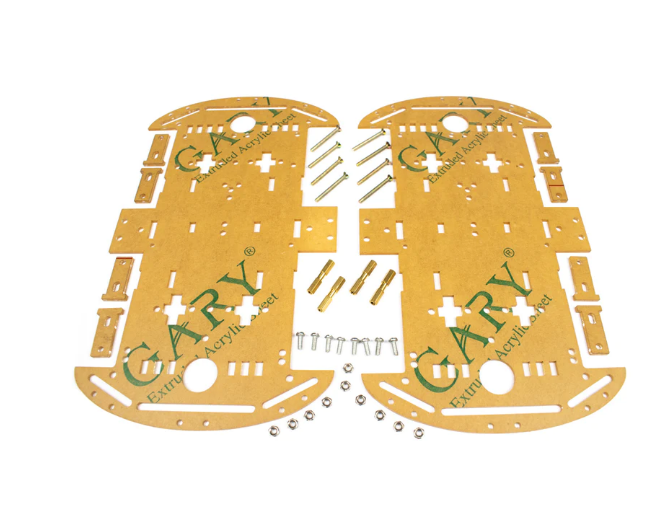
4 Wheels Car Chassis Acrylic Frame
A solid starting chassis for sumo robot prototyping. Use it for early testing of your motor and sensor layout before fabricating a competition chassis.
Motor and Wheel Selection
Motors are the heart of a sumo robot. You need high torque and enough speed to charge the opponent before they dodge. For heavy class:
Motor Specifications
- Type: High-torque DC gearmotor, 12V
- Speed: 100–200 RPM at no load (slow enough for torque, fast enough to charge)
- Torque: 5–15 kg·cm per motor (higher is better)
- Stall current: 3–8A per motor — size your motor driver accordingly
For a 3kg robot, two motors with 8–10 kg·cm each, driving 80–100mm wheels, gives approximately 2–3 kg of push force — enough to overpower most opponents.
Wheel Selection
The most critical spec is the coefficient of friction. Sumo robots win on traction. Use:
- Silicone or polyurethane wheels: Highest grip on the dohyo surface. Shore hardness 40–60A.
- Diameter: 80–100mm for good ground clearance and reasonable top speed.
- Width: Wider wheels spread the contact patch and resist spinning out during pushing.
Avoid standard rubber tyres — they harden at room temperature and lose grip. Avoid smooth plastic wheels. Mecanum wheels are not suitable for sumo (they move sideways, not forward).
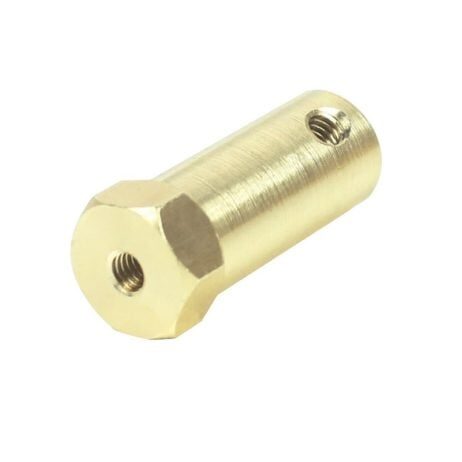
4mm Hex Coupling for Robot Smart Car Wheel 30mm Length
Solid hex shaft coupling for mounting robot wheels to motor shafts securely — no slipping under heavy torque loads during sumo combat.
Sensor Array: Edge Detection and Opponent Detection
A sumo robot needs two categories of sensors: edge detection (so it doesn’t drive off the dohyo) and opponent detection (so it knows where to attack).
Edge Detection: IR Sensors
QTR reflectance sensors or simple IR LED + photodiode pairs detect the white edge line on the black dohyo. Mount 3–4 sensors at the front and rear edges of your chassis, angled downward at 45°. When a sensor reads white (high reflection), the robot must reverse and turn.
// Edge detection logic
if (frontLeftEdge == WHITE || frontRightEdge == WHITE) {
  reverseAndTurn(); // reverse fast, then spin
} else if (rearLeftEdge == WHITE || rearRightEdge == WHITE) {
  moveForward(); // being pushed from behind — drive forward
}
Opponent Detection: Ultrasonic and IR Distance
For opponent detection, you have two main choices:
- Ultrasonic (HC-SR04): 2–400cm range, good for long-distance detection to aim at the opponent during search mode. Vulnerable to angled surfaces that deflect the beam.
- Sharp GP2Y0A21 IR distance sensor: 10–80cm range, faster response, good for close-range tracking. Less susceptible to angle issues than ultrasonic.
- 360° scan with multiple sensors: Mount 3–5 sensors at different angles (front, 45° left, 45° right) for a wide detection cone. No moving parts, low latency.
Many winning sumo robots use a combination: ultrasonic for initial search, IR for close-range locking.
Electronics: Controller, Driver, and Power
Microcontroller
Arduino Nano or Arduino Uno are standard for sumo robots — fast enough at 16MHz for the simple decision loop, and pin count is sufficient. For faster response and more processing headroom, use an STM32 Blue Pill (72MHz ARM Cortex-M3) or Arduino Mega.
Motor Driver
Your motor driver must handle the stall current of your motors. For 12V motors with 5–8A stall current per motor, use a dual H-bridge rated for at least 10A per channel:
- BTS7960 (IBT-2): 43A peak, 10A continuous — excellent for heavy class motors. Separate PWM for each direction.
- VNH5019: 30A peak, 12A continuous — good alternative with built-in current sensing.
- Avoid L298N: Maximum 2A per channel — completely inadequate for heavy class sumo motors.
Power System
Use a 3S LiPo (11.1V) for 12V motors. Capacity: 2200–3300mAh gives 3–5 minutes of match time with headroom. Include a main power switch and a blade fuse (25–30A). If your electronics run on 5V, use a separate DC-DC buck converter to avoid brownouts during motor stall spikes.
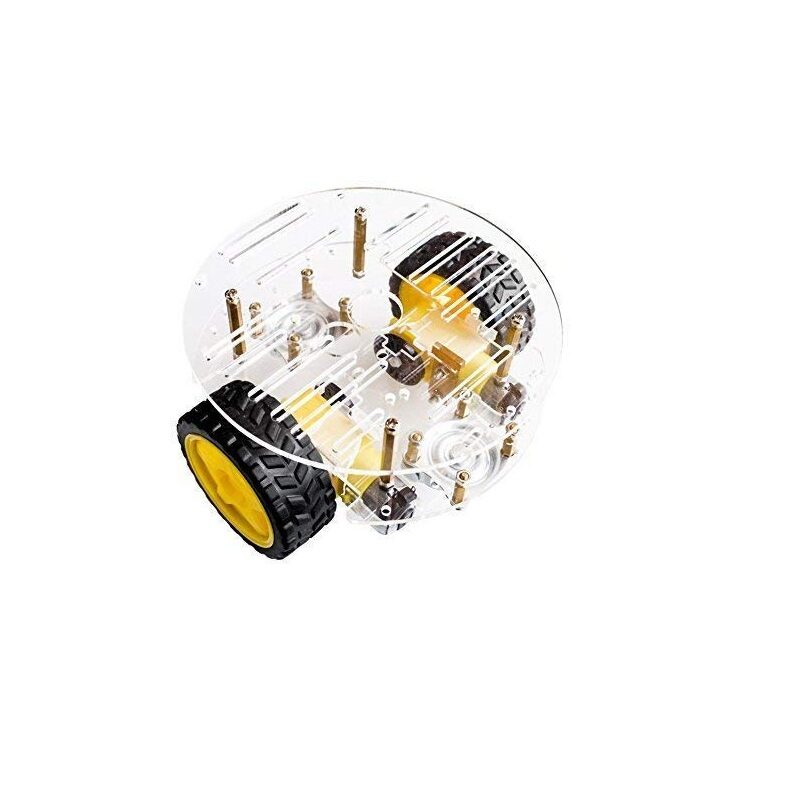
2WD Mini Round Double-Deck Smart Robot Car Chassis DIY Kit
Great 2WD chassis kit for building and testing your sumo robot’s electronics layout. Includes motors, wheels, and mounting hardware.
Sumo Strategy and Control Code
Most sumo robots implement 3 behavioural states:
1. Wait State
At match start, most rulesets require a 5-second delay. Keep all motors stopped and initialise sensors.
2. Search State
Rotate slowly on the spot (or drive in a wide arc) while scanning for the opponent. When an ultrasonic or IR sensor detects the opponent, transition to Attack.
void searchOpponent() {
  // Spin right at 30% speed
  motorLeft.setSpeed(80);
  motorRight.setSpeed(-80);

  if (frontSensor.read() < DETECT_DIST) {
    state = ATTACK;
  }
}
3. Attack State
Drive at full speed toward the detected opponent. Keep edge sensors running — if you hit a white line during attack, emergency reverse takes priority.
void attackOpponent() {
  // Full speed forward
  motorLeft.setSpeed(255);
  motorRight.setSpeed(255);

  // Steer toward opponent
  int leftDist = leftSensor.read();
  int rightDist = rightSensor.read();
  if (leftDist < rightDist) {
    motorLeft.setSpeed(200); // steer left
  } else if (rightDist < leftDist) {
    motorRight.setSpeed(200); // steer right
  }
}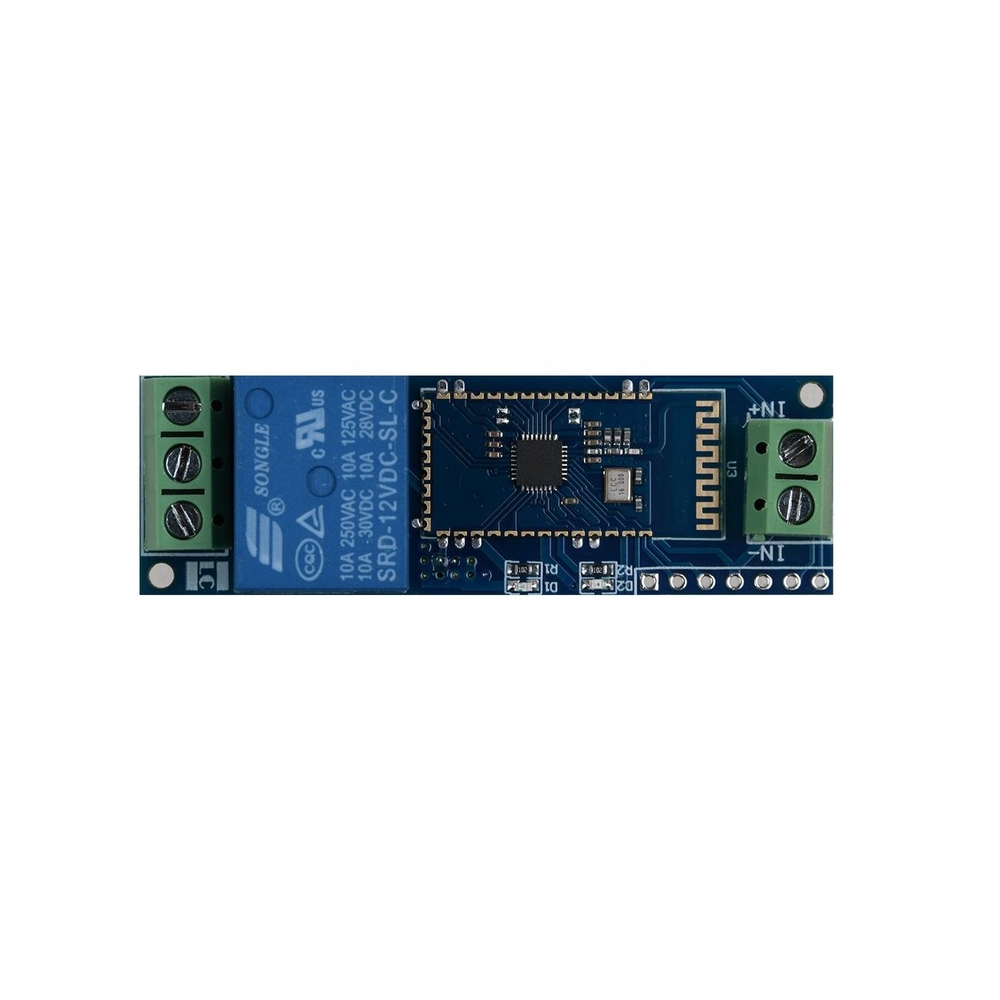
12V 1 Channel Bluetooth Relay Module
Use this Bluetooth relay module as a wireless start/stop trigger for your sumo robot — no physical switch needed during competition.
Build Tips for Competition Day
- Test on the actual dohyo surface: Different floor textures change your traction dramatically. If possible, get a sample of the dohyo material or test on a similar black matte surface.
- Bring spare fuses and batteries: Always carry two fully charged battery packs. Motor stall draws can blow fuses. Carry 5+ spares.
- Verify weight before every match: Judges will weigh your robot. Adding last-minute ballast can push you over — always weigh before submission.
- Practice edge recovery: Test your edge detection thoroughly. Missing even one white-line detection can cost you a match in seconds.
- Disable Bluetooth/WiFi during autonomous match: Interference from other robots’ electronics can affect your sensors. Shield sensitive circuits and use twisted-pair wiring for sensor lines.
Recommended Products from Zbotic

100pcs 5mm Light Assorted Kit DIY LEDs Set
Use LEDs as status indicators on your sumo robot — show power state, sensor detection, and match-ready status at a glance on the competition floor.
Frequently Asked Questions
What weight class is best for first-time sumo robot builders?
Mini class (500g) is the easiest to start with — cheaper, safer, and easier to iterate quickly. Heavy class (3kg) gives more room for powerful motors and sophisticated electronics but costs more and requires more mechanical skill to build well.
How important is the front wedge angle on a sumo robot?
Extremely important. A wedge angle of 8–12° lets you slide under opponents and neutralise their traction. Too steep an angle and opponents ride over you. Too shallow and it catches on the floor. Machine the wedge edge to be as thin and smooth as possible.
Can I use stepper motors for a sumo robot?
Stepper motors are not suitable for sumo robots. They have lower torque-to-weight ratio than DC gearmotors at competitive speeds, require more complex drivers, and lose steps under impact. Use high-torque DC gearmotors with H-bridge drivers instead.
How many IR sensors do I need for edge detection?
Minimum 2 front sensors and 2 rear sensors. Place them at the corners of your chassis so any direction of edge contact is detected. 4 sensors total is standard; some builders add 2 side sensors for complete coverage.
Is Bluetooth remote control allowed in sumo robot competitions?
In most sanctioned sumo robot competitions (RoboCup, All Japan style), the robot must be fully autonomous — no remote control during the match. You can use Bluetooth for pre-match configuration (PID gains, strategy selection), but it must be disabled before the match begins.
Ready to Build Your Sumo Robot?
Zbotic has everything you need for your heavy class sumo robot — chassis kits, motor couplings, LED indicators, and electronic modules. Get your components delivered fast across India and enter your next competition ready to win.







Add comment