
Table of Contents
- Introduction: Why Buck Converters Matter
- How Step-Down Buck Converters Work
- LM2596: Specifications and Strengths
- XL4016: Specifications and Strengths
- Head-to-Head Comparison
- Which One for Your Project?
- Design Tips and Common Mistakes
- Frequently Asked Questions
When you need to step down a voltage in an electronics project — from 12V to 5V for a microcontroller, from 24V to 12V for a motor driver, or from a solar panel output to a regulated supply — the LM2596 vs XL4016 buck converter comparison is one of the most common decisions Indian hobbyists face. Both chips appear on dozens of cheap DC-DC converter modules sold across India and both do the same basic job, but they differ meaningfully in current capacity, input voltage range, efficiency, and thermal performance. This guide gives you the complete picture so you always pick the right converter for the job.
Introduction: Why Buck Converters Matter
Linear voltage regulators like the LM7805 are simple: drop input voltage to regulated output by burning the difference as heat. Efficient? No — at 12V input and 5V output with 1A load, a linear reg dissipates 7W as heat. That’s 58% of input power wasted. The buck (step-down) switch-mode converter instead rapidly switches the input on and off, storing energy in an inductor between pulses and averaging to the desired output voltage. Efficiency of 85–95% is typical — dramatically better than linear regulators.
For battery-powered projects, this efficiency difference is enormous. At 85% efficiency vs 42% for a linear reg (12V to 5V), the buck converter doubles your battery runtime. For mains-powered projects, it means smaller heat sinks, cooler operation, and lower electricity costs. Understanding which buck converter IC to use — and how to use it correctly — is a foundational skill for any serious electronics maker.
How Step-Down Buck Converters Work
A buck converter uses four main components:
- Switch (MOSFET or BJT): The IC controls this switch, turning it on and off at high frequency (typically 50kHz–500kHz). The LM2596 switches at 150kHz; the XL4016 at 180kHz.
- Inductor: Stores energy when the switch is on, releases it when the switch is off. Acts as an energy buffer. Larger inductance = smoother output current but slower transient response.
- Diode (freewheeling diode): Provides a path for inductor current when the switch is off, preventing voltage spikes. Schottky diodes (like the SR540 or SS54) are preferred for their low forward voltage drop.
- Output capacitor: Filters the switching ripple, presenting a smooth DC output voltage. Higher capacitance = less ripple.
The output voltage is controlled by adjusting the duty cycle (ratio of on-time to total period) of the switch. A feedback loop compares the output to a reference voltage and adjusts the duty cycle to maintain regulation. The LM2596 and XL4016 both use voltage-mode PWM control internally.
LM2596: Specifications and Strengths
The LM2596 is a Texas Instruments (and cloned) step-down switching regulator IC that has been the workhorse of the hobbyist buck converter module market for over two decades. Key specifications:
- Input voltage: 4.5V to 40V
- Output voltage: 1.2V to 37V (adjustable, or fixed 5V/12V/15V/3.3V versions)
- Continuous output current: 3A (with adequate heat sinking)
- Peak current: 4A
- Switching frequency: 150kHz
- Typical efficiency: 77–88% (input/output ratio dependent)
- Line regulation: 0.1% typical
- Load regulation: 0.5% typical
- Package: TO-263-5 (D2PAK) or TO-220-5
- Operating temperature: -40°C to +125°C junction
Strengths of the LM2596:
The LM2596 is extremely well-documented. Texas Instruments provides a comprehensive datasheet with complete design equations, inductor selection charts, and layout recommendations. If you are learning buck converter design theory, the LM2596 reference design is the standard teaching example. It is also available in fixed-voltage versions (5V, 12V) that require fewer external components and reduce design risk for beginners.
The 150kHz switching frequency allows relatively small inductors and capacitors. The IC includes an on/off control pin useful for sleep-mode power management.
Weaknesses: The 3A current rating limits it to moderate-power applications. Efficiency is acceptable but not outstanding — Chinese clone chips often perform worse than the TI original. At high input voltages (30–40V) and high currents, thermal management becomes challenging in the compact TO-263 package.
XL4016: Specifications and Strengths
The XL4016 is a product of XLSEMI (a Chinese semiconductor company), designed as a higher-power alternative to the LM2596. Key specifications:
- Input voltage: 4V to 40V
- Output voltage: 1.25V to 36V (adjustable)
- Continuous output current: 8A
- Peak current: 10A
- Switching frequency: 180kHz
- Typical efficiency: 85–92%
- Dropout voltage: approximately 1.5V
- Package: TO-263-5 (same as LM2596) or TO-220
- Operating temperature: -40°C to +125°C junction
Strengths of the XL4016:
The headline advantage is current capacity — 8A continuous vs 3A for LM2596. This makes the XL4016 suitable for powering motors, high-power LED arrays, Raspberry Pi 4 clusters, and other demanding loads that would push the LM2596 into thermal shutdown. The slightly higher switching frequency (180kHz) allows the same size or smaller inductors compared to the LM2596 design, keeping module size compact despite the higher power handling.
Efficiency at typical operating points is also modestly better than the LM2596, especially at higher currents where switching losses dominate over conduction losses — the XL4016’s internal switch handles higher current more efficiently.
Weaknesses: The XL4016 is less well-documented than the LM2596. As a Chinese-sourced IC, counterfeit chips are common — some modules use a chip labelled XL4016 that is actually a rebranded lower-current part. Buy from reputable suppliers or verify by testing actual output current capability. The IC also does not have a fixed-voltage version — always adjustable, requiring careful external resistor divider setup.
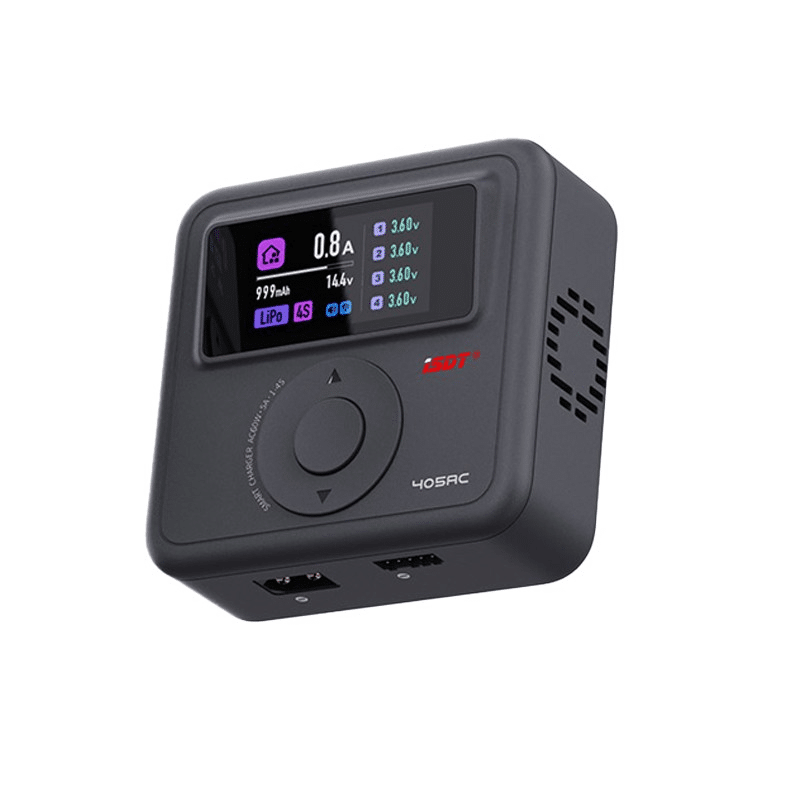
ISDT 405AC 60W AC GaN Smart Charger – 0.1-5A, 1-CH, Supports 1–4S LiPo/LiHv/LiFe
A professional GaN charger for LiPo, LiHv, and LiFe packs up to 4S. Uses highly efficient switching technology — exactly the same principles as the buck converter ICs discussed here.
Head-to-Head Comparison
Current Rating
LM2596: 3A continuous, 4A peak. XL4016: 8A continuous, 10A peak. This is the decisive difference for most applications. The LM2596 is adequate for microcontrollers, sensors, and small motors. The XL4016 handles servo banks, high-power LEDs, and DC motors without breaking a sweat.
Efficiency
Both ICs are switch-mode converters and both are dramatically more efficient than linear regulators. In typical operating ranges, the XL4016 has a slight efficiency advantage (about 5–8 percentage points better at moderate to high currents). However, Chinese clone LM2596 modules often underperform the datasheet due to inferior external component quality — particularly the freewheeling diode and inductor. A well-built LM2596 module with quality components can approach XL4016 efficiency at low currents.
Input Voltage Range
Both accept up to 40V input. The LM2596 minimum is 4.5V vs 4V for XL4016 — a negligible difference in practice. For solar panel inputs (which can vary from 12V to 30V+), both are suitable.
Output Ripple
The XL4016’s higher switching frequency (180kHz vs 150kHz) gives it marginally lower output ripple for the same filter component values. For noise-sensitive applications (audio, precision analog circuits), an additional LC filter or an LDO post-regulator stage may be necessary regardless of which IC you use.
Thermal Performance
Both ICs come in the same TO-263 package with the same thermal resistance from junction to case (~2°C/W). The XL4016 dissipates more power at higher currents — more importantly, it needs to, because it is handling more current. Ensure adequate heat sinking (copper pour area on the module PCB, or an external aluminium heatsink) for XL4016 modules operating above 4A continuously.
Module Availability and Price in India
LM2596-based buck converter modules are ubiquitous in India — available from virtually every electronics component supplier online and offline, typically at ₹30–₹80 per module. XL4016-based modules are slightly less common but readily available online at ₹60–₹150 per module, depending on features (with or without display, with or without ampmeter). The price difference is small relative to the performance advantage of the XL4016 for high-current applications.
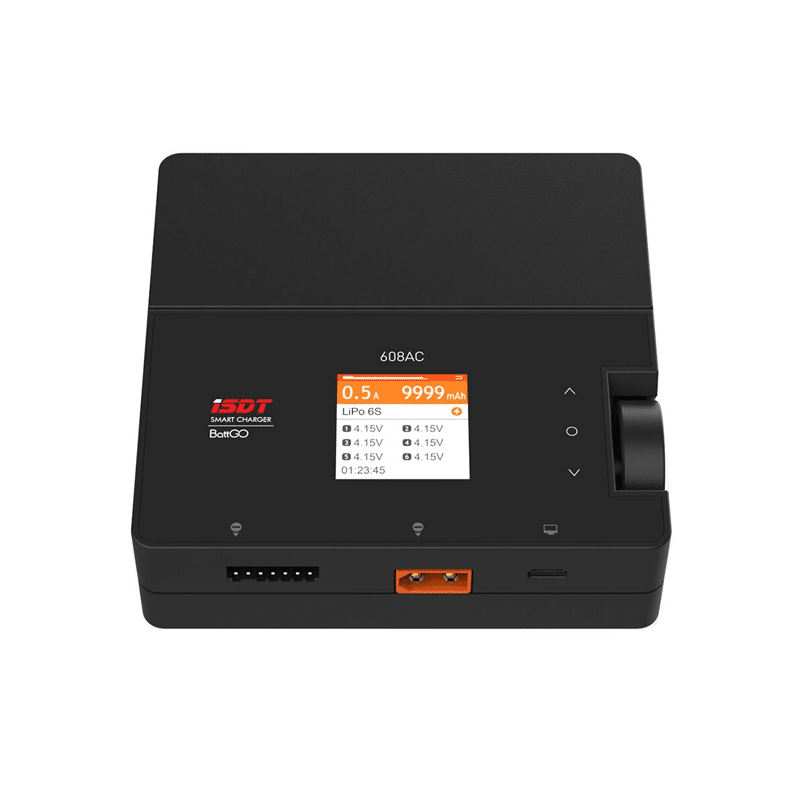
ISDT 608 AC Lipo Battery Charger – AC 50W / DC 200W Dual Mode RC Discharger/Charger
High-power dual-mode charger leveraging advanced DC-DC conversion — 200W DC input power demonstrates just how far switching regulator technology has come from simple buck converter modules.
Which One for Your Project?
Use the LM2596 for:
- Powering microcontrollers (Arduino, ESP32, STM32) — typically 150–500mA, well within LM2596 rating
- Sensor power supplies, IoT nodes, small peripherals
- Learning buck converter design — the wealth of documentation makes it the best teaching IC
- Applications where a fixed voltage version (5V) simplifies design and reduces component count
- Budget-sensitive projects where even the small premium of an XL4016 module matters
Use the XL4016 for:
- Raspberry Pi 4 or Pi 5 power supply (up to 5V/3A, sometimes more with accessories)
- DC motor controllers (motors typically draw 2–6A under load, especially at startup)
- High-power LED arrays (3W–10W LEDs, multiple strings)
- Battery charging applications (charging a 3S LiPo at 2A from a 24V supply)
- Industrial power supplies where the load is consistently above 3A
- Any application where output current might spike above 3A even briefly

ISDT A4 Air Smart Battery Charger for NiMH, NiCd, Li-Ion, LiFePO4 with Bluetooth
Multi-chemistry smart charger with Bluetooth monitoring — great companion for testing battery packs powered by your buck converter DC-DC regulation projects.
Design Tips and Common Mistakes
1. Do not forget the freewheeling diode. Ready-made modules include it, but if you are designing your own PCB, you must include a Schottky diode (fast reverse recovery, low forward voltage). Using a slow rectifier diode (like 1N4007) causes excessive switching losses and potential IC damage.
2. Output voltage setting. Both ICs use a resistor divider from the output to the feedback pin to set voltage. Use 1% tolerance resistors. Measure the output with a digital multimeter before connecting your load — a wrong resistor value will output the wrong voltage and potentially damage your project.
3. Input and output capacitors. Cheap modules sometimes use undersized or low-quality electrolytic capacitors. Replace with good-quality 105°C rated electrolytics for better reliability, especially in hot environments like Indian summers. Adding a small ceramic capacitor (100nF) in parallel with the electrolytic reduces high-frequency ripple significantly.
4. Minimum load requirement. Both ICs enter discontinuous conduction mode (DCM) at very light loads, which can cause output voltage to rise above the setpoint. If your application has periods of near-zero load, add a minimum bleed resistor (1kΩ on the output for a 5V supply = 5mA minimum load) to keep the converter in regulation.
5. Heat sinking. The TO-263 package exposed tab is the main thermal path. On cheap modules, this is soldered to a small copper area. For high-current operation, add a small aluminium heatsink to the module using thermal adhesive, or ensure the module has adequate airflow.
6. Input voltage headroom. Both ICs need at least 1.5–2V more input than output voltage to regulate properly. A LM2596 cannot output 5V from a 5.5V input — you need at least 6.5–7V input. Plan your input supply accordingly.
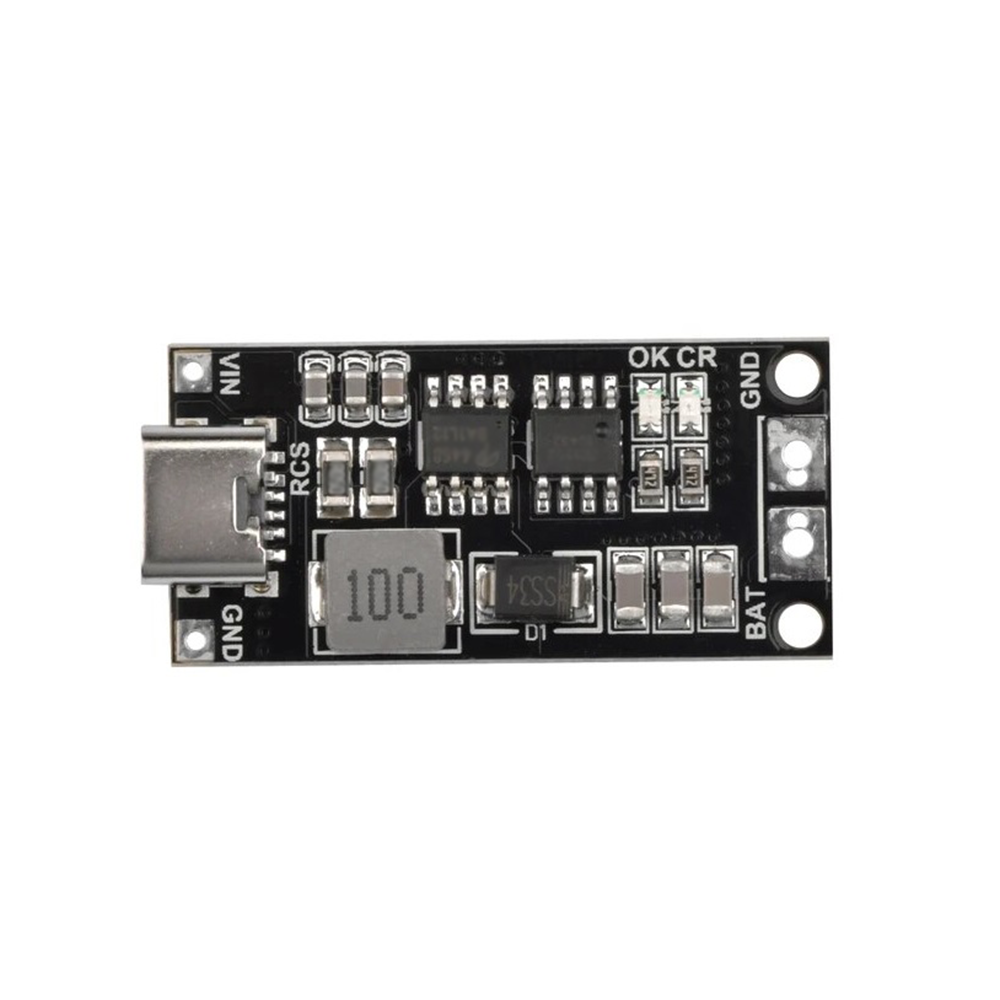
18650 Polymer Lithium Ion Charger Type C to 3S 12.6V 4A Booster Module
High-current 4A boost module for 3S lithium packs — perfect counterpart to a buck converter setup when you need both step-down and step-up regulation in a battery power system.
Frequently Asked Questions
Can I parallel two LM2596 modules to get 6A output?
You should not parallel switching regulators unless they are specifically designed for it with current sharing circuits. Parallel buck converters fight each other — one takes more current than the other due to slight output voltage differences, potentially overloading the higher-voltage module. For 6A, use a single XL4016-based module, which is a far cleaner solution.
What is the difference between a buck converter and a linear regulator?
A linear regulator (like the LM7805) drops excess voltage as heat. A buck converter switches the input rapidly and uses an inductor to convert the voltage efficiently. Linear regulators are simpler, quieter (no switching noise), and cheaper, but highly inefficient at large voltage drops. Buck converters are more complex but typically 85–95% efficient. For drops larger than 2V at currents above 500mA, a buck converter is almost always the better choice.
How do I set the output voltage on an LM2596 or XL4016 module?
Most ready-made modules have a multi-turn trimmer potentiometer on the feedback voltage divider. Turn the trimmer slowly while monitoring the output voltage with a multimeter — no load connected. Turn clockwise or counterclockwise depending on your module’s layout. Always set the voltage before connecting your load. Some modules also have a digital voltmeter display that updates in real time as you adjust.
My buck converter gets very hot. What should I do?
Heat indicates high power dissipation from conversion losses. First, verify you are not exceeding the rated current. Check efficiency: if your module is only 70% efficient at your operating point, 30% of input power is heat. Improve by: (1) using a module with better quality components, (2) adding a heatsink to the IC, (3) improving airflow, (4) reducing the input-to-output voltage difference (less duty cycle = less switching loss), or (5) upgrading to an XL4016 module if you are near the LM2596’s 3A limit.
Can I use a buck converter for audio power supplies?
Yes, but with care. Buck converters generate switching noise at their operating frequency (150–180kHz for these ICs) and its harmonics. This noise can appear in audio as a high-pitched whine. Mitigate by: using a well-filtered module, adding additional LC filtering on the output, using separate ground planes for the switching circuit and audio circuit, and keeping the buck converter physically away from audio circuitry. Some audiophiles prefer a linear post-regulator (LDO) after the buck converter for extremely clean audio supply rails.
Power Your Projects with the Right Buck Converter
The LM2596 vs XL4016 comparison comes down to a simple rule: if you need up to 3A and want abundant documentation and support, choose the LM2596. If you need more current, better efficiency, or headroom for load spikes, the XL4016 is the right choice. Both are excellent value for Indian makers and are available as ready-to-use modules that work right out of the box. Explore our full range of power management components, battery chargers, and DC-DC converter accessories at Zbotic.in — and build your next project with confidence.




Add comment