
Table of Contents
- Quick Overview: DRV8825 vs A4988
- Detailed Specifications Comparison
- Microstepping: 1/32 vs 1/16
- Current Rating & Voltage Range
- Current Limiting Procedure
- Pinout Differences & Compatibility
- Real-World Performance & Noise
- Price & Availability in India
- Which Driver Should You Choose?
- Frequently Asked Questions
If you’ve been building a CNC machine, 3D printer, or any precision motion project with stepper motors, you’ve almost certainly faced this decision: DRV8825 vs A4988. Both are drop-in compatible stepper drivers widely used in the maker community. Both fit the same footprint on RAMPS boards. But they have meaningful differences that can make one a significantly better fit for your specific application.
In this in-depth comparison, we’ll examine every specification that matters — microstepping resolution, current rating, voltage range, heat characteristics, noise, and price — and give you clear recommendations for different use cases. By the end, you’ll know exactly which driver to buy for your next project in India.
Quick Overview: DRV8825 vs A4988
Here’s the 30-second summary for those in a hurry:
- A4988 (Allegro Microsystems): The classic, proven, slightly cheaper option. 1/16 microstepping max. 2A peak per coil. 8–35V motor supply. Great for standard NEMA 17 3D printer and light CNC use.
- DRV8825 (Texas Instruments): More capable successor. 1/32 microstepping. 2.2A continuous per coil. 8.2–45V motor supply. Better thermal performance. Slightly more expensive. The preferred choice for heavier motors or higher-voltage systems.
Both drivers use a step/direction interface, have adjustable current limiting, and fit the same breadboard/PCB footprint. The physical difference is the potentiometer location — DRV8825 has it on one end, A4988 on another — which matters when measuring Vref.
Detailed Specifications Comparison
| Specification | A4988 | DRV8825 |
|---|---|---|
| Manufacturer | Allegro Microsystems | Texas Instruments |
| Motor voltage (VMOT) | 8V – 35V | 8.2V – 45V |
| Logic voltage (VDD) | 3V – 5.5V | 3V – 5.5V |
| Continuous current (per coil) | 1A (2A peak) | 1.5A (2.2A peak) |
| Max microstepping | 1/16 | 1/32 |
| Microstepping modes | Full, 1/2, 1/4, 1/8, 1/16 | Full, 1/2, 1/4, 1/8, 1/16, 1/32 |
| Sense resistors | 0.1Ω (typical) | 0.1Ω (typical) |
| Thermal shutdown | Yes (~150°C) | Yes (~150°C) |
| Overcurrent protection | Yes | Yes |
| Vref formula | Vref = I × 8 × Rsense | Vref = I × 5 × Rsense |
| PCB footprint | Same (drop-in compatible) | Same (drop-in compatible) |
| Approximate price India | ₹80 – ₹150 | ₹100 – ₹180 |
Microstepping: 1/32 vs 1/16
This is where the DRV8825 pulls ahead for precision motion applications. With 1/32 microstepping on a standard 1.8° NEMA 17 motor (200 full steps per revolution), you get:
- A4988 at 1/16: 3,200 microsteps per revolution → 0.1125° per microstep
- DRV8825 at 1/32: 6,400 microsteps per revolution → 0.05625° per microstep
In linear motion terms (assuming a typical 3D printer lead screw with 2mm pitch and 16-tooth pulley, or 8mm per revolution on a lead screw): at 1/32 stepping, each step moves approximately 0.00125mm (1.25 microns). This is significantly finer than the A4988 can achieve.
Does 1/32 Microstepping Actually Improve Print Quality?
This is debated in the 3D printing community. Microstepping beyond 1/8 or 1/16 doesn’t necessarily improve positional accuracy — due to motor mechanics and load variations, the theoretical positions between microsteps may not be perfectly realised. However, 1/32 microstepping does deliver noticeably smoother motion and significantly less vibration noise, which can improve surface quality and reduce ringing artifacts.
Current Rating & Voltage Range
Current Rating
The DRV8825 is rated for 1.5A continuous and 2.2A peak per coil, versus the A4988’s 1A continuous and 2A peak. In practice (with a heatsink), both can handle slightly more — but these ratings should be respected for reliability.
This matters for motor selection:
- Common NEMA 17 (e.g., 1.2A–1.5A): Both A4988 and DRV8825 work fine. For 1.5A motors, DRV8825 is safer with more headroom.
- Higher-current NEMA 17 (1.7A–2A): DRV8825 is clearly the better choice.
- NEMA 23 or NEMA 34: Both drivers are likely inadequate — you’ll need a higher-current driver like the TB6600 or DM542.
Voltage Range
The DRV8825 supports up to 45V motor supply, vs the A4988’s 35V. This is significant for high-speed applications: higher supply voltage allows faster current rise times in the motor coils, enabling higher RPM before torque falls off. A 24V supply with DRV8825 is a common and excellent combination for desktop CNC machines.

NEMA 17 5.6 kg-cm Stepper Motor – D-Type Shaft
The go-to NEMA 17 for both A4988 and DRV8825 projects — well within both drivers’ current ratings and delivers excellent torque for 3D printers and small CNC machines.
Current Limiting Procedure
Both drivers use a potentiometer to set the current limit, but the formula is different — a critical distinction that trips up many users swapping from one to the other.
A4988 Current Limit
Vref = I_max × 8 × R_sense
With 0.1Ω sense resistors: Vref = I_max × 0.8
DRV8825 Current Limit
Vref = I_max × 5 × R_sense
With 0.1Ω sense resistors: Vref = I_max × 0.5
So for a 1.5A motor:
- A4988 Vref target: 1.5 × 0.8 = 1.2V
- DRV8825 Vref target: 1.5 × 0.5 = 0.75V
Important: If you replace an A4988 with a DRV8825 on the same board without re-setting the current limit, you’ll be running at roughly 2.4A instead of 1.5A — potentially burning the motor. Always re-calibrate when switching drivers!
Measuring Vref
On both drivers, measure Vref with a multimeter (negative to GND, positive to the potentiometer wiper). On the A4988, the wiper is typically on the top-centre of the driver. On the DRV8825, the potentiometer is usually on one end of the module with the wiper accessible from the top.
Pinout Differences & Compatibility
The good news: the A4988 and DRV8825 are pin-compatible on the standard Pololu-style breakout footprint. You can swap one for the other on RAMPS 1.4, most Arduino CNC shields, and custom PCBs without rewiring — just re-calibrate the current limit.
Key Pinout Note
There is ONE critical difference: the STEP pin minimum pulse width. The A4988 requires at minimum 1µs HIGH and 1µs LOW. The DRV8825 requires at minimum 1.9µs HIGH and 1.9µs LOW. This is usually not an issue with Arduino-generated pulses (which are typically 2µs+), but at very high step rates in optimised firmware, it can cause missed steps with the DRV8825.
Enable Pin Polarity
Both drivers have active-LOW enable pins. No difference here — pull LOW to enable, HIGH to disable (coils de-energised, motor freewheels).
Real-World Performance & Noise
Vibration and Acoustic Noise
In full-step mode, both drivers produce significant vibration and audible noise. As microstepping increases, motion becomes smoother. At 1/16 (both drivers) versus 1/32 (DRV8825 only), the DRV8825 at 1/32 is measurably smoother and quieter — important for applications like camera sliders or lab equipment where vibration affects results.
Heat Generation
Both drivers generate heat proportional to motor current. The DRV8825 uses MOSFET technology that provides slightly lower RDS(on) than the A4988’s bipolar transistors, resulting in marginally less heat at the same current. In practice, both need a heatsink when running continuously above ~1A.
Speed Performance
With a 24V supply, the DRV8825 allows slightly higher maximum RPM due to the higher voltage headroom (45V vs 35V). At 12V, performance is essentially identical. For typical 3D printing speeds (up to 300mm/s), both are more than adequate.
Price & Availability in India
Both drivers are widely available in India. Pricing in 2025 is approximately:
| Driver | Price Range (India) | Typical Availability |
|---|---|---|
| A4988 module | ₹80 – ₹150 | Excellent — nearly every shop |
| DRV8825 module | ₹100 – ₹180 | Good — most online stores |
| A4988 pack (5 pcs) | ₹350 – ₹600 | Good value for multi-axis CNC |
| DRV8825 pack (5 pcs) | ₹450 – ₹700 | Slightly harder to find in bulk |
The price difference between a single A4988 and DRV8825 is typically ₹20–₹50. For a 5-axis CNC machine, that’s ₹100–₹250 more for DRV8825 — usually a worthwhile upgrade given the better specs.

A4988 Stepper Motor Driver Controller Board – RED
Reliable, widely available A4988 driver module with full breakout pins — the ideal starting point for NEMA 17 stepper projects and 3D printer builds.
Which Driver Should You Choose?
Choose the A4988 if:
- You’re a beginner building your first stepper motor project.
- Your motor is rated at 1.2A or less (plenty of headroom).
- You’re on a tight budget and building a proof-of-concept.
- You need maximum parts availability (the A4988 is truly everywhere).
- 1/16 microstepping is sufficient for your application (most 3D printing is).
- Your motor supply is 12V (both drivers perform essentially identically here).
Choose the DRV8825 if:
- Your stepper motor is rated at 1.5A or above.
- You want the smoothest possible motion (1/32 microstepping).
- You’re running a 24V system for higher-speed performance.
- You’re building camera sliders, lab equipment, or anything where vibration matters.
- You want to future-proof your design with more current headroom.
- You’re building a serious CNC machine or upgraded 3D printer.
The Bottom Line
For most Indian hobbyists building their first 3D printer or robot: start with the A4988. It’s cheaper, easier to find, and more than capable. Once you’ve outgrown it — or if you’re building something that truly needs the extra current, voltage headroom, or microstepping resolution — upgrade to the DRV8825. The ₹30–₹50 price difference is negligible in the context of the whole project cost.
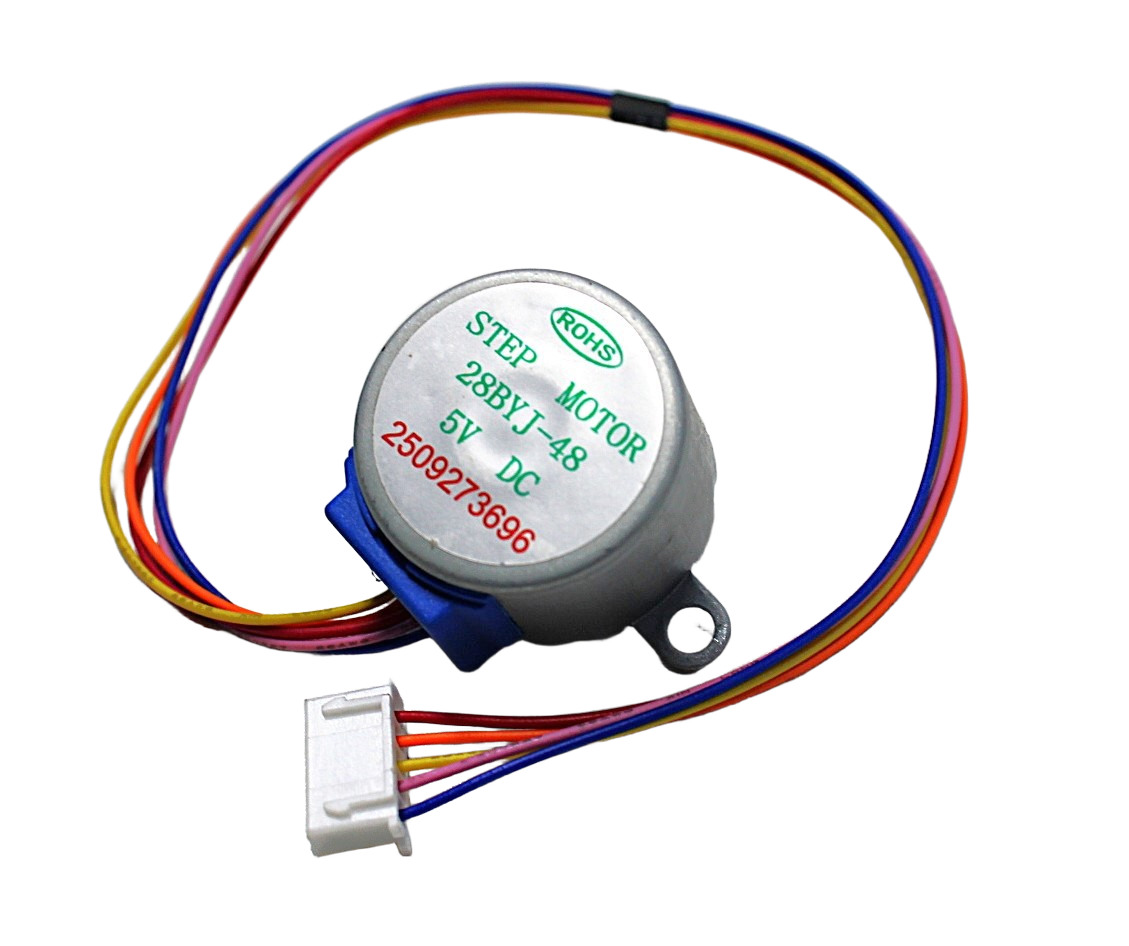
28BYJ-48 5V Stepper Motor
Learning steppers for the first time? Start with this affordable unipolar stepper — ideal for understanding concepts before moving to NEMA 17 with A4988/DRV8825.
Frequently Asked Questions
Are DRV8825 and A4988 truly drop-in replacements for each other?
Yes, electrically and physically — same pin footprint, same step/direction interface. But you MUST recalibrate the current limit when switching, because the Vref formula differs (×0.8 for A4988, ×0.5 for DRV8825). Running the wrong formula can damage your motor or driver.
Which driver is better for 3D printing?
Both work well for standard 3D printing. At 1/16 microstepping (both drivers), print quality is nearly identical. The DRV8825 at 1/32 can reduce vibration-related surface artifacts, but many printers using Marlin firmware already interpolate A4988 steps to 1/256 in software (using the stealthChop interpolation logic). For budget builds, A4988 is the standard choice. For premium builds, DRV8825 (or even TMC2208/TMC2209 for silent printing).
Can I mix A4988 and DRV8825 on the same CNC shield?
Yes. Each driver on a CNC shield is independent. You can use A4988 on the X and Y axes and DRV8825 on the Z axis, for example. Just calibrate each driver’s current limit individually according to the correct formula for each.
Does the DRV8825 run cooler than the A4988?
Marginally, due to its MOSFET technology with lower on-resistance. In practical terms, both get similar temperatures at similar current levels. A heatsink is recommended for either driver when running continuously above 1A.
What comes after A4988 and DRV8825?
If you need even smoother (silent) motion, look at the TMC2208 or TMC2209 from Trinamic. These use stealthChop technology and interpolate up to 1/256 microstepping internally. They’re significantly more expensive (₹250–₹600 per module) but are becoming the standard for quality 3D printers. For higher current (up to 4A), the TB6600 or DM542 external drivers are the go-to in hobby CNC.
My DRV8825 skips steps but A4988 doesn’t — why?
Likely the step pulse width. The DRV8825 requires a minimum 1.9µs step pulse, versus the A4988’s 1µs. At very high step frequencies in optimised code, pulses may be shorter than 1.9µs. Add a small delay after each STEP pin transition: delayMicroseconds(2); after each HIGH and LOW.
Is there a Chinese clone quality issue to worry about?
Yes — both A4988 and DRV8825 have many clones of varying quality in the market. Clones may use lower-spec sense resistors or chips that run hotter. Buy from reputable electronics stores in India to ensure genuine or quality-equivalent modules. Always burn-in test before installing in a critical project.
Conclusion
The DRV8825 vs A4988 debate ultimately comes down to your motor’s current requirement and your desired microstepping resolution. The A4988 remains an excellent, proven, and affordable driver for the vast majority of hobby projects. The DRV8825 is worth the modest premium when you need higher current handling, a 24V supply, or the smoothest possible 1/32 microstepping.
Whatever you choose, remember the fundamentals: always set the current limit correctly, use a 100µF capacitor across VMOT/GND, never disconnect the motor while powered, and use acceleration with AccelStepper or similar libraries for smooth motion. Both drivers will serve you well for years when used correctly.
Shop Stepper Drivers at Zbotic
A4988, DRV8825, NEMA 17 motors — everything you need for your CNC or 3D printer project, with fast shipping across India.






Add comment