
The extruder is the heart of your FDM 3D printer — it is the mechanism that feeds filament into the hotend at a controlled, precise rate. Every other aspect of print quality ultimately depends on the extruder delivering the exact right amount of filament at exactly the right moment. Choose the wrong configuration for your materials and printing style, and no amount of slicer tuning will fully compensate.
The debate between direct drive and Bowden extruder configurations has been ongoing in the 3D printing community for over a decade, and it remains highly relevant in 2026 because both approaches have genuine strengths. This guide provides a complete, honest comparison so you can make the right choice for your printer and the filaments you actually want to print.
How Extruders Work
An extruder has two jobs: gripping the filament and pushing or pulling it through the system. The drive gear (a toothed gear that bites into the filament) does the gripping. A stepper motor turns the gear to advance or retract the filament. The idler (a bearing or second gear) provides counter-pressure to keep the filament firmly against the drive gear.
The key variable is the distance between the extruder motor and the hotend nozzle. The filament must travel this distance — and the behaviour of the filament in this gap is what fundamentally differentiates direct drive from Bowden systems.
Direct Drive Extruder Explained
In a direct drive configuration, the extruder motor and gears are mounted directly on the printhead carriage, immediately adjacent to the hotend. The filament travels only a very short distance — typically 20–60mm — from the extruder gears to the hotend melt zone. There is no tube carrying filament across a long distance.
This short path is the defining advantage. When you command a 1mm retraction, the filament actually moves 1mm immediately and with great precision. When you resume extrusion, filament is immediately at the nozzle. The response time between the extruder command and the actual filament movement at the nozzle is minimal.
Examples of direct drive printers: Bambu Lab P1P/P1S/X1C, Prusa MK4 (optional), Creality Ender 3 S1 Pro, Creality K1, Ratrig V-Core 3, all Voron designs (using Stealthburner or Afterburner toolheads).
Key advantages of direct drive:
- Excellent flexible filament (TPU, TPE) printing — the short path prevents flexible filament from buckling
- Precise retraction — minimal distance means retraction commands have immediate, predictable effect
- Works well with more exotic filaments (soft PLA, silk, glow in dark) that are difficult in Bowden
- Simpler retraction tuning — small retraction distances (0.5–2mm) work reliably
- Better pressure advance (Klipper) and linear advance (Marlin) performance
Key disadvantages of direct drive:
- Heavier printhead — the motor adds significant weight to the moving carriage
- Heavier carriage increases resonance, limiting practical print speed on bed-slinger Cartesian printers
- More complex toolhead design — motors mounted on the carriage add wiring and potential cable failure points
- Z-wobble can be more visible on some designs because the heavy head amplifies any Z-axis imperfections
Bowden Extruder Explained
In a Bowden configuration, the extruder motor is mounted to the printer frame — stationary, not on the moving carriage. Filament is pushed through a PTFE tube (the Bowden tube) that runs from the extruder motor to the hotend. The tube length is typically 300–700mm depending on the printer’s build volume.
The Bowden tube is the defining feature. It guides the filament along its journey but introduces compliance — the filament can flex and compress slightly within the tube. This compliance means that extruder commands do not translate immediately and perfectly to filament movement at the nozzle. There is a lag and a loss of precision that Bowden systems must compensate for.
Examples of Bowden printers: Creality Ender 3 (V1, V2), Creality Ender 5, Artillery Sidewinder X2, Flashforge printers. Note: Many of these brands now also offer direct drive variants.
Key advantages of Bowden:
- Very light printhead — only the hotend is on the carriage, allowing much higher acceleration
- Higher achievable print speeds on bed-slingers because reduced carriage mass reduces resonance
- Simpler, cheaper toolhead design — motor is frame-mounted, easier to replace
- Lower inertia means the X-axis can change direction faster with less ringing
Key disadvantages of Bowden:
- Poor flexible filament performance — TPU and TPE frequently buckle in the Bowden tube
- Requires large retraction distances (5–8mm) to compensate for tube compliance
- Large retractions increase stringing and oozing risk and slow down multi-part prints
- Harder to tune precisely — PTFE tube wear over time changes retraction behaviour
- Higher risk of jams at PTFE/hotend junction due to small gaps developing over time
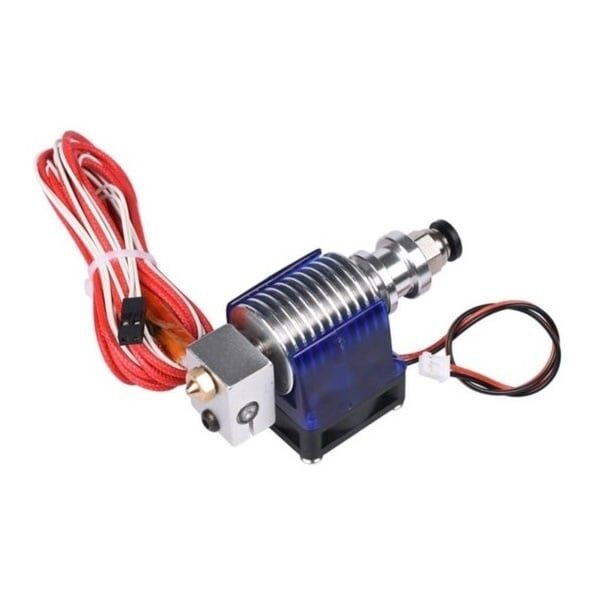
All Complete Bowden V6 Hotend with Fan Cable – 1.75mm, 0.2mm Nozzle
Complete Bowden-style V6 hotend assembly including fan and 30cm cable for 1.75mm filament. Ready to install on compatible printers for reliable extrusion.
View on ZboticRetraction Settings Compared
Retraction is the most visible practical difference between the two systems. Understanding why helps you tune either configuration effectively.
What retraction does: When the printhead travels over an open gap (not depositing material), molten plastic in the nozzle will ooze out due to gravity and residual pressure. Retraction pulls the filament back slightly to depressurize the nozzle and reduce oozing during travel.
Direct drive retraction:
- Typical retraction distance: 0.5–2.0mm
- Typical retraction speed: 25–45 mm/s
- Why so short: The extruder gears are immediately adjacent to the hotend, so 1mm of retraction actually moves 1mm of filament in the melt zone. Short retractions are effective and don’t risk pulling the melt plug up into the cold zone (which causes jams).
Bowden retraction:
- Typical retraction distance: 4–7mm
- Typical retraction speed: 40–60 mm/s
- Why so long: The long Bowden tube means the extruder must retract far more to actually move filament in the melt zone. Much of the retraction distance is simply compressing then releasing the slack in the filament within the tube.
Over-retraction risks on Bowden: Excessive retraction on a Bowden system pulls the melt plug up into the PTFE heatbreak, causing filament to cool and jam at the narrow cold zone. This is the source of many Bowden cold-pull jams. The maximum safe retraction depends on your specific hotend and tube condition.
The pressure advance solution: Both Marlin’s Linear Advance and Klipper’s Pressure Advance help both systems by modelling the pressure dynamics of the extruder. Bowden systems benefit significantly from pressure advance because it compensates for the lag and compliance inherent in the tube. On Klipper-based direct drive printers, pressure advance still helps but the tuning requirements are much lower.
Flexible Filament (TPU/TPE)
This is the clearest win for direct drive in the entire comparison. Flexible filaments — TPU (thermoplastic polyurethane), TPE (thermoplastic elastomer), and similar soft materials — behave fundamentally differently from rigid filaments in an extruder path.
Flexible filaments cannot sustain compressive force without buckling. In a Bowden tube, the extruder pushes the flexible filament from the back. If there is any resistance at the nozzle (partial clog, too-fast print speed, too-low temperature), the flexible filament will buckle and coil inside the Bowden tube rather than pushing through. You will get underextrusion followed by catastrophic jam as the buckled filament jams the tube completely.
In a direct drive setup, the extruder gears are immediately adjacent to the hotend. There is no room for the flexible filament to buckle — it is immediately consumed into the melt zone. Printing TPU on a direct drive is entirely manageable with proper settings. Printing TPU on a Bowden is possible but requires very slow speeds (15–25 mm/s), very high hotend temperatures, and often a slightly reduced Shore hardness specification — and it still jams far more frequently than on direct drive.
If flexible filament is a regular material in your workflow (and it is extremely useful for gaskets, grips, mounts, and protectors in Indian manufacturing contexts), direct drive is the only sensible choice.
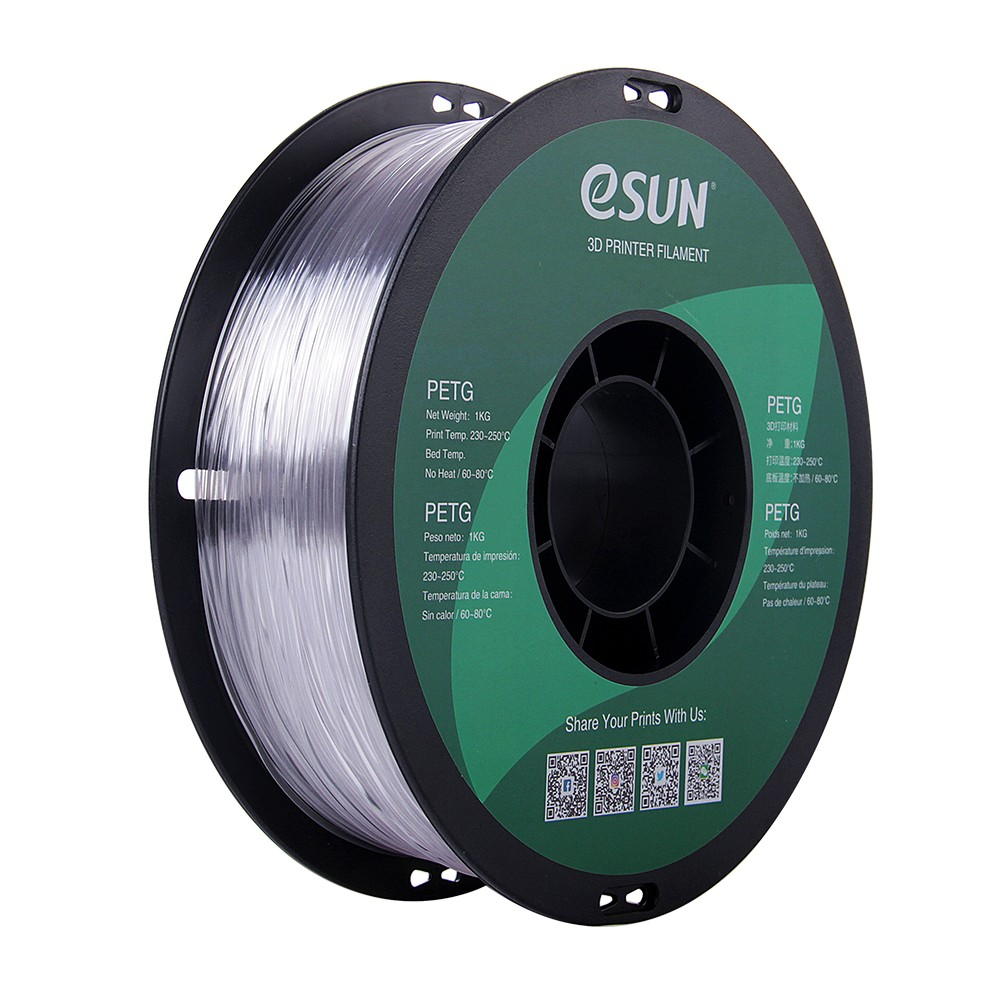
eSun PETG 1.75mm 3D Printing Filament 1kg – Clear
Premium eSun clear PETG filament — excellent on both direct drive and Bowden setups. Good inter-layer adhesion, low warping, and nice transparency for functional parts.
View on ZboticPrint Speed Trade-offs
Here is where Bowden has its best argument — on traditional bed-slinger Cartesian printers.
A Bowden setup removes the extruder motor from the moving carriage. A typical NEMA 17 stepper motor weighs 250–350g. Removing this from the X-axis carriage dramatically reduces the moving mass. Less mass means the carriage can accelerate and decelerate faster without inducing ringing artifacts.
On a stock Ender 3, the Bowden carriage (hotend only) weighs approximately 150g. A direct drive Sprite upgrade brings the carriage mass to approximately 350–400g. At the same print speed, the heavier direct drive carriage introduces more ringing. To maintain equivalent print quality, direct drive on a bed-slinger requires lower acceleration settings.
However — this trade-off is substantially mitigated by two factors in 2026:
1. Input shaping (resonance compensation): Klipper’s input shaping (using an ADXL345 accelerometer) can compensate for the higher resonance of a heavier direct drive carriage. With input shaping tuned, a direct drive bed-slinger can often achieve speed/quality parity with a Bowden setup and frequently exceeds it because of better retraction performance.
2. CoreXY architecture: On CoreXY printers (Bambu, Voron), the entire toolhead is the moving mass — and both direct drive and any alternative must be light. CoreXY printers already use lightweight direct drive designs (Orbiter, Galileo, Bambu’s integrated extruder) that bring motor mass close to the hotend without the same speed penalties seen on bed-slingers.
In short: on a pure Cartesian bed-slinger without input shaping, Bowden has a speed advantage. On modern CoreXY printers or Klipper-based Cartesian printers with input shaping, the speed difference between direct drive and Bowden shrinks dramatically or disappears.
Stringing and Oozing
Stringing (thin filament wisps left across open gaps) is the most visually frustrating print defect for most users, and it is directly related to extruder configuration and retraction performance.
Direct drive stringing behaviour: Short, precise retractions effectively prevent most stringing. With well-tuned retraction (1–1.5mm at 35–40 mm/s) and combing (travel paths stay within print boundaries where possible), direct drive printers can be essentially string-free on PLA and PETG.
Bowden stringing behaviour: The larger retraction distances and the compliance in the Bowden tube mean stringing is harder to eliminate entirely. At high print speeds, the lag between extruder command and actual filament movement means some oozing is inevitable during fast travels. With careful tuning (retraction 5–6mm, high retraction speed, reduced print temperature, wipe and Z-hop enabled), stringing can be minimised but direct drive is generally cleaner at equivalent temperatures.
Temperature effects: Both systems benefit from reducing print temperature to reduce oozing. PLA stringing is particularly sensitive to temperature — printing 5°C lower can dramatically reduce stringing on both Bowden and direct drive. Do not reduce temperature below the point where layer adhesion suffers.
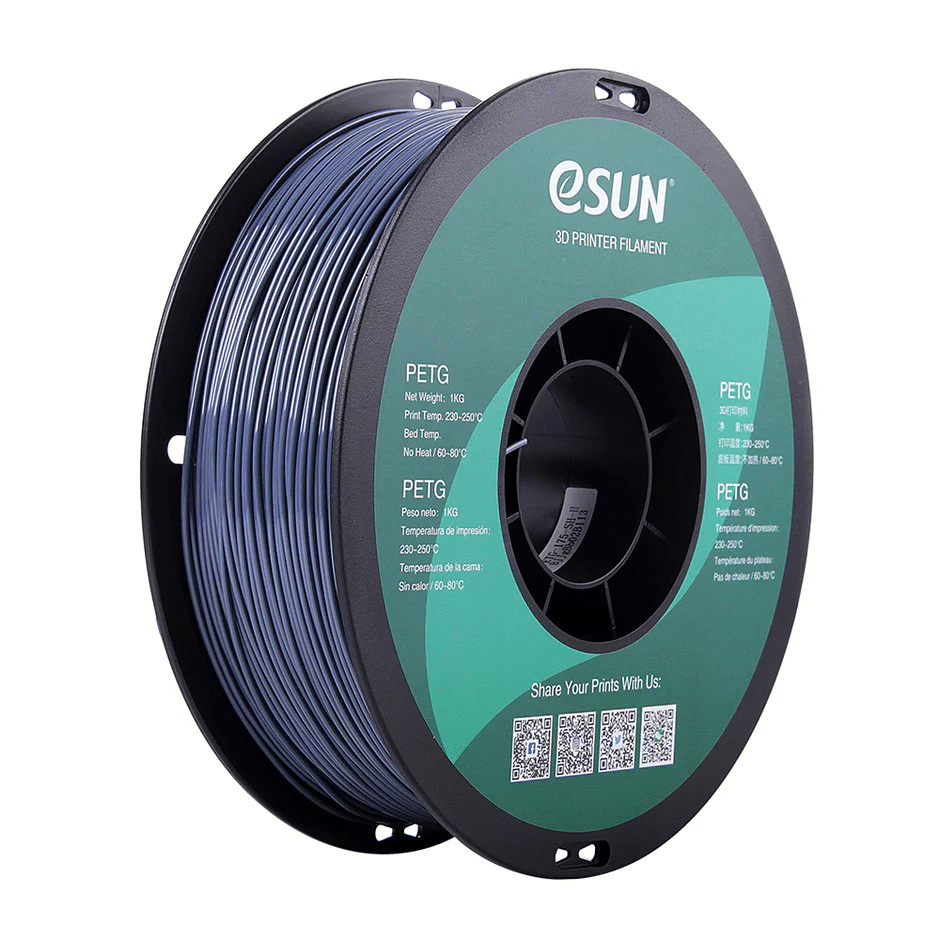
eSun PETG 1.75mm 3D Printing Filament 1kg – Grey
eSun Grey PETG with excellent dimensional accuracy and low moisture absorption. A go-to functional filament for both direct drive and well-tuned Bowden printers.
View on ZboticMaintenance Comparison
Bowden tube wear: The PTFE Bowden tube wears over time. The inner surface develops micro-scratches from filament abrasion. High-temperature use (above 240°C) can cause the PTFE to slightly deform at the junction with the hotend, creating a small gap where molten plastic can accumulate and carbonise, leading to clogs. Bowden tubes should be inspected every 3–6 months and replaced if there is visible scoring, discolouration, or a visible gap at the hotend fitting. Tubes are inexpensive (₹100–300) and easy to replace.
Direct drive: The extruder gears themselves require periodic inspection for filament debris accumulation. Clean with a small brush every 50–100 hours. The drive gear on cheap extruders can develop rounded teeth over time — symptoms include inconsistent extrusion and clicking noises. A quality extruder (BMG clone, Orbiter, Bondtech) lasts much longer before needing gear replacement.
Jam clearance: Bowden jams are generally more difficult to clear because you cannot directly access the jam point without disassembling the Bowden tube connection. Direct drive jams are more accessible — the hotend is directly below the extruder. Cold pulls are easier to execute on direct drive. However, direct drive jams are also slightly rarer because of the shorter, more controlled filament path.
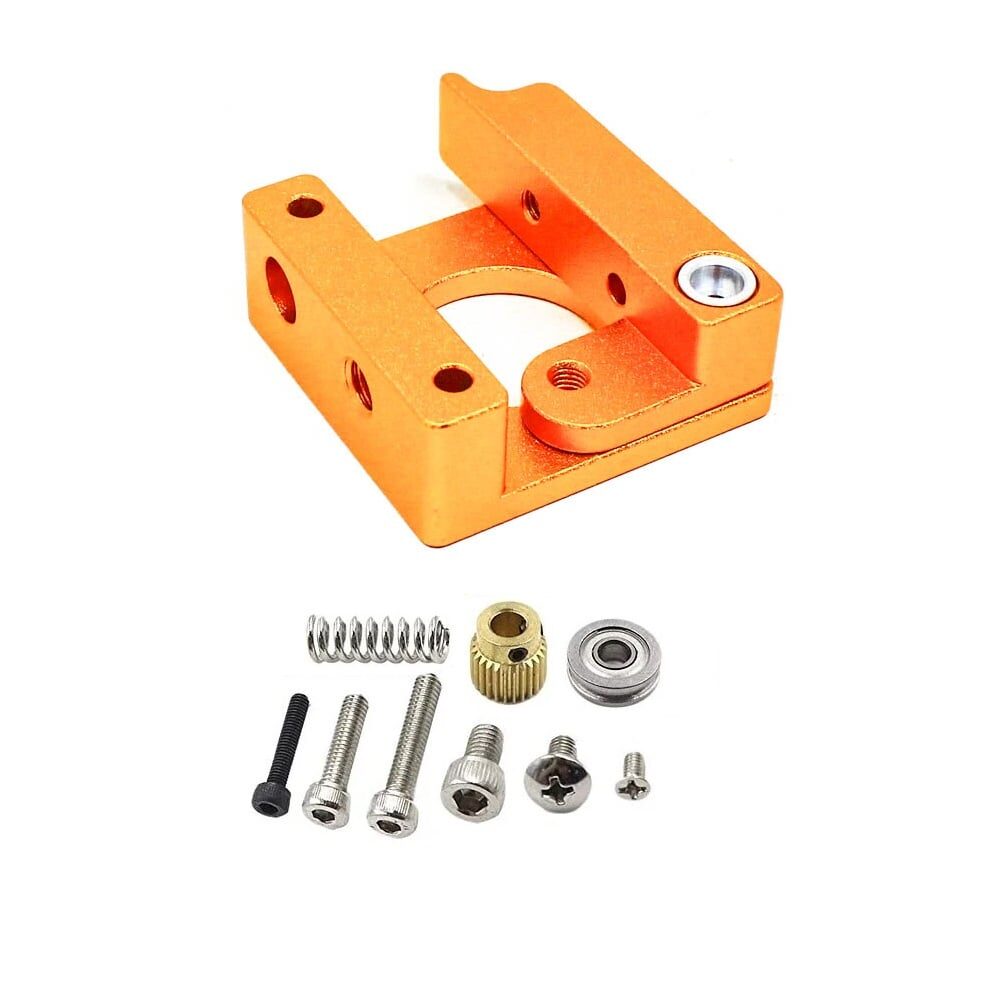
Left Side MK8 Extruder Aluminum 3D Printer Block
Aluminium MK8 extruder block for Creality and compatible printers. Durable metal upgrade over plastic extruder bodies — reduces heat creep and improves grip reliability.
View on ZboticUpgrading to Direct Drive
If you have a Bowden-based printer (Ender 3 series) and want to upgrade to direct drive, there are several proven paths:
Creality Sprite Extruder Pro: Creality’s own direct drive upgrade for Ender 3 printers. Plug-and-play compatible, includes the motor and extruder gears pre-assembled. The most straightforward upgrade for Ender 3 V2, V3, and S1 users.
Micro Swiss Direct Drive: American brand, available through importers in India. High quality dual-drive mechanism with very positive community reviews for Ender 3 compatibility.
Orbiter V2 / Galileo 2: Lightweight direct drive extruders popular in the DIY community, particularly for CoreXY builds. These require more assembly and firmware adjustment but are the lightest options for speed-focused builds.
What to configure after upgrading:
- Update extruder E-steps (steps per mm) for the new gear ratio
- Reduce retraction distance from ~5–6mm to 0.5–2mm
- Reduce retraction speed slightly from ~60mm/s to ~35–45mm/s
- Re-run pressure advance / linear advance calibration
- Re-run input shaping calibration (ADXL345) if using Klipper — the new carriage mass changes resonance frequencies
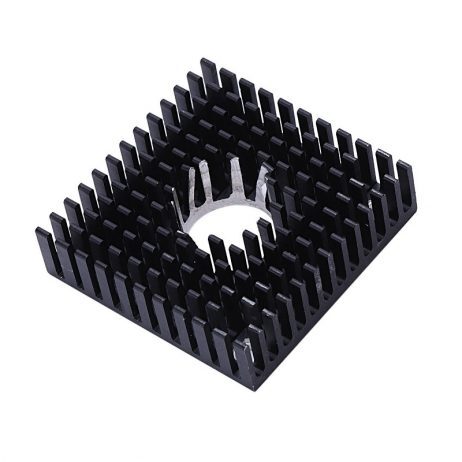
B Type Aluminium Heat Sink for MK7 MK8 Extruder
Aluminium heat sink for MK7/MK8 extruder hotends. Improves cold zone thermal management and reduces heat creep, particularly beneficial after upgrading to direct drive.
View on ZboticWhich Should You Choose?
The decision framework is simpler than the technical detail suggests:
Choose direct drive if:
- You print TPU, TPE, or any flexible filament
- You print silk, glow-in-dark, or composite filaments that jam easily in Bowden
- You use Klipper or Marlin 2.x with pressure advance/linear advance
- You want the lowest stringing and highest retraction reliability
- You are building a CoreXY printer (direct drive is standard on CoreXY)
- You are buying a new printer — most quality 2025–2026 printers are direct drive by default
Stick with Bowden if:
- You only print PLA and PETG and want maximum speed on a budget bed-slinger without input shaping
- You are building or maintaining a large-format Cartesian printer where keeping carriage mass low is critical
- You are printing on a tight budget and upgrading to direct drive is not currently feasible
The 2026 verdict: On printers purchased new today, direct drive wins for versatility and print quality in almost all scenarios. The speed advantage of Bowden is substantially negated by input shaping on modern Klipper machines. The only remaining strong case for Bowden is large-format Cartesian printers where the tube length is too long for reliable direct drive operation and speed is a priority over flexible filament capability.
Upgrade Your Extruder Setup
Shop extruder components, hotend assemblies, heat blocks, and nozzles at Zbotic — India’s specialist source for 3D printer parts and filaments.
Shop 3D Printer Parts at ZboticFrequently Asked Questions
Is direct drive better than Bowden for PLA?
For PLA specifically, both work well. Direct drive offers easier retraction tuning and less stringing. Bowden can achieve higher speeds on bed-slinger printers without input shaping. For most Indian hobbyists printing PLA, the difference is minor — both produce excellent results when properly tuned.
Can I print TPU on a Bowden printer?
Technically yes, but it is very challenging. TPU on Bowden requires very slow speeds (15–20 mm/s), high hotend temperatures, minimal retraction, and patience. Even then, jamming is common. Direct drive is strongly recommended for any regular TPU printing.
How do I upgrade my Ender 3 from Bowden to direct drive?
The most common upgrade is the Creality Sprite Extruder Pro, which is plug-and-play compatible with Ender 3 V2 and similar printers. After installation, update your E-steps, reduce retraction distance to 0.5–2mm, and re-calibrate your first layer Z-offset as the hotend position changes slightly.
What retraction settings should I use for direct drive?
Start with 1.0mm retraction at 35 mm/s for PLA on direct drive. Test with a stringing calibration print and adjust by 0.2mm increments. Most direct drive printers settle between 0.5–2.0mm retraction. Do not exceed 2.5mm retraction on direct drive — it risks pulling the melt plug into the cold zone.
Does Bowden tube length affect print quality?
Yes, significantly. Longer tubes introduce more filament compliance, requiring more retraction to compensate. A 600mm Bowden tube requires more retraction than a 300mm tube. This is why large-format printers with Bowden setups are harder to tune for stringing than smaller printers with shorter tubes.
Which extruder configuration is used on Bambu Lab printers?
All Bambu Lab FDM printers (A1, A1 Mini, P1P, P1S, X1C) use direct drive extruders. Bambu’s proprietary lightweight extruder design delivers the benefits of direct drive (excellent flexible filament performance, precise retraction) while keeping carriage mass low for high-speed CoreXY printing.





Add comment