
DC-DC Converter Efficiency: How to Maximize Battery Life
If your battery-powered project drains too fast, the culprit is often poor DC-DC converter efficiency. Every watt lost to heat in your power supply is a watt stolen from your run time. For Indian makers building everything from IoT sensor nodes to portable robotics rigs, understanding how to maximize battery life through efficient DC-DC converter design can be the difference between a 4-hour runtime and a full 24-hour day of operation. This comprehensive guide covers every factor that affects DC-DC converter efficiency and gives you practical steps to squeeze the maximum performance from every milliamp-hour.
DC-DC Converter Basics: Buck, Boost, and Buck-Boost
Before optimising efficiency, you need to understand which converter topology you are using. Each has a different inherent efficiency profile:
Buck (Step-Down) Converter: Converts a higher input voltage to a lower output voltage. Common example: stepping down a 12V battery to 5V for microcontrollers. Buck converters are generally the most efficient — typical efficiency ranges from 85–97% at full load. The formula is: V_out = D × V_in, where D is the duty cycle.
Boost (Step-Up) Converter: Converts a lower input voltage to a higher output voltage. Example: boosting a single 3.7V Li-ion cell to 5V USB output. Efficiency is slightly lower than buck, typically 82–94%, because of longer duty cycles at large step-up ratios.
Buck-Boost: Handles both step-up and step-down, which is essential when the battery voltage can swing above and below the required output (e.g., a 3S Li-ion pack ranging from 12.6V to 9.0V powering a 12V rail). These are the least efficient of the three, with typical efficiency of 80–90%, because current must pass through more switching elements.
The conversion ratio (V_out/V_in) matters enormously. A buck converter running at a 50% duty cycle (e.g., 12V in, 6V out) achieves near-peak efficiency. Running at extreme duty cycles (below 10% or above 90%) stresses the converter and reduces efficiency significantly.
Key Factors That Affect Converter Efficiency
DC-DC converter efficiency losses fall into three main categories:
1. Switching Losses (dominant at high frequency): Every time the MOSFET switches on or off, it passes through a linear region where both voltage and current are non-zero simultaneously — that overlap is power lost as heat. Switching loss = ½ × V_in × I_load × (t_rise + t_fall) × f_sw. Higher switching frequency means more switching events per second = more loss.
2. Conduction Losses (dominant at high load): When the MOSFET is fully on, its RDS(on) resistance causes I²×RDS(on) loss. For a 10A current through a MOSFET with 10mΩ RDS(on), this is 1W of heat. Using MOSFETs with lower RDS(on) directly reduces this loss.
3. Core Losses (inductor and transformer): The magnetic core in the inductor loses energy through hysteresis and eddy currents. At higher switching frequencies, core losses in ferrite cores increase significantly. This is why inductors are rated for specific frequency ranges.
Additional losses:
- Gate drive power: energy to charge and discharge MOSFET gate capacitance at every switching cycle.
- Dead-time body diode conduction: synchronous buck converters with improper dead-time settings let the body diode conduct (0.6V drop) instead of the RDS(on) channel.
- Quiescent current (IQ): the controller IC’s own power consumption, critical at light loads.
- Capacitor ESR losses: output capacitor equivalent series resistance causes I²×ESR heating.
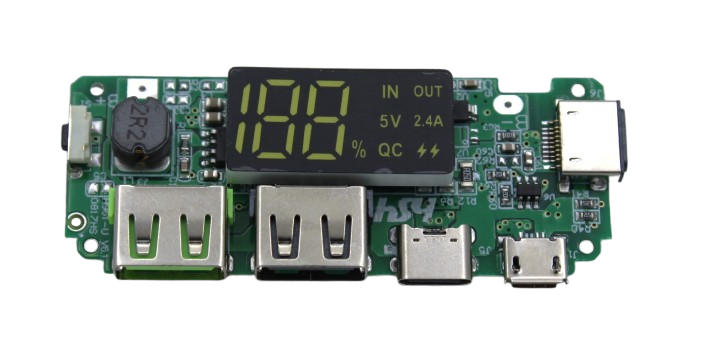
18650 5V 2.4A Lithium Battery Charging Module with Dual USB Output and Display
A well-designed boost module with a built-in display showing battery level. Uses an efficient synchronous boost IC making it ideal for high-drain USB power bank applications.
Switching Frequency vs Efficiency Trade-offs
The switching frequency of a DC-DC converter is one of the most important design decisions. Here is the fundamental trade-off:
Higher switching frequency (500kHz–3MHz):
- Smaller inductor and capacitor values needed → smaller and cheaper passives.
- Faster transient response (important for dynamic loads like microcontrollers that switch between sleep and active modes).
- Higher switching losses → lower efficiency, more heat generated.
- Better for designs where board size is critical.
Lower switching frequency (50kHz–200kHz):
- Larger inductor required → physically bigger design.
- Lower switching losses → higher efficiency (1–3% gain possible).
- Worse transient response.
- Better for battery-powered designs where every mW matters.
For maximising battery life in IoT nodes and portable instruments, a switching frequency of 200–400kHz with a well-chosen ferrite-core inductor typically hits the sweet spot of small size and high efficiency (92–96%).
Many modern converter ICs (like the TPS62xxx family, LM2596, or XL4016) allow you to select operating frequency externally or include auto-frequency scaling that drops to pulse-frequency-modulation (PFM) mode at light loads — this is critical for battery-powered devices where the system is often in standby.
Light Load Efficiency: The Biggest Killer of Battery Life
Most DC-DC efficiency specifications are quoted at full load (e.g., 95% at 3A). However, battery-powered devices spend the vast majority of their time at very light loads — an ESP32 drawing 30mA in WiFi standby, or an Arduino in sleep mode drawing just 5mA. At these light loads, many converters plummet to 60–75% efficiency.
The reason: at 5mA load from a converter designed for 3A, the fixed quiescent current (say, 3mA) of the controller IC represents 60% of the total input current — almost all of it wasted. Similarly, switching losses are proportional to frequency regardless of load, so at 5mA load the switching losses are the same as at 3A load but now represent a much larger fraction of output power.
Solutions for light-load efficiency:
- Choose a converter with low IQ: Modern low-power converters like the TPS62840 have IQ as low as 60nA — compared to 3mA for older designs. This single choice can double battery life in IoT applications.
- PFM/PSM mode: Pulse-Frequency Modulation skips switching cycles when no energy is needed, eliminating switching losses at light load. Look for converters with automatic PFM/PWM switching.
- Right-size your converter: A converter designed for 3A running at 50mA is inefficient. Use a smaller converter rated for 200–500mA if your peak load is under 300mA.
- Disable unused rails: Use enable pins on DC-DC converters to power down unused subsystems entirely rather than letting them idle at low efficiency.
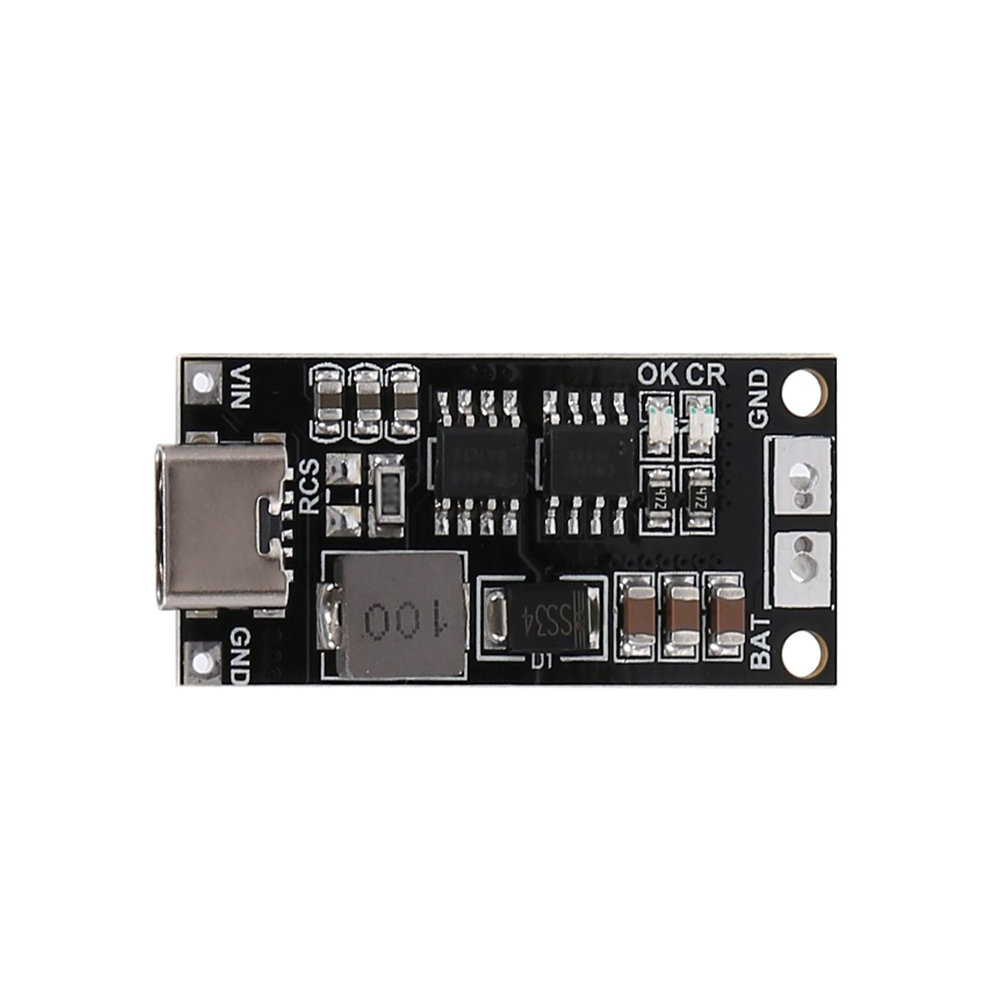
18650 Polymer Li-Ion Type-C to 3S 12.6V 2A Booster Module
A compact boost module for charging 3S 18650 packs via USB Type-C at up to 2A. Great for portable tool battery packs where efficiency in the charging circuit matters.
Inductor and Capacitor Selection for Maximum Efficiency
The inductor is the heart of any switching converter. A poor inductor choice can reduce efficiency by 5–8% and cause instability. Here is what to look for:
Inductor parameters that matter:
- DCR (DC Resistance): Lower DCR = lower I²R conduction loss. For a 2A converter, going from 100mΩ DCR to 20mΩ DCR saves 4×(0.1-0.02) = 0.32W of continuous loss.
- Inductance value: Determines ripple current. Too small → large ripple → higher peak currents → more core saturation risk and higher conduction losses. Too large → slow transient response and physically large component.
- Saturation current rating: Must exceed your peak current (load current + half of ripple current). A saturated inductor drops dramatically in inductance, causing runaway current.
- Core material: Ferrite cores are best for high frequency (100kHz+). Powdered iron is better for lower frequencies. Avoid cheap iron-powder cores at high frequency — losses skyrocket.
Capacitor guidelines:
- Use low-ESR ceramic capacitors (X5R or X7R dielectric) for output filtering. Electrolytic capacitors have 10–100× higher ESR and cause significant ripple losses.
- Place output capacitors as close as possible to the load — long PCB traces add parasitic inductance that degrades transient response.
- Use 10–22µF ceramic output capacitors for most designs up to 2A. Go higher (47–100µF) for loads with large current steps.
Thermal Management in Indian Climate
Converter efficiency drops with temperature — MOSFET RDS(on) increases with temperature, creating a vicious cycle: more loss → more heat → higher RDS(on) → even more loss. In Indian summers where ambient temperatures regularly hit 40–45°C, the thermal margin shrinks dramatically compared to the 25°C reference conditions in datasheets.
Rules of thumb for thermal design in India:
- Derate your converter to 70% of its rated maximum current in outdoor or non-air-conditioned environments.
- Add a small heatsink to converters running above 1A continuously. Even a TO-220 heatsink (1–2°C/W) can drop junction temperature by 20–30°C at 1W dissipation.
- Pour copper on PCB ground planes under converter ICs — this provides a low-cost heatsink with minimal impedance.
- Run the switching frequency slightly lower in high-temperature environments to reduce switching losses (if your IC supports it).
- Use 105°C-rated electrolytic capacitors, not standard 85°C parts, for any design that may see ambient temperatures above 40°C.
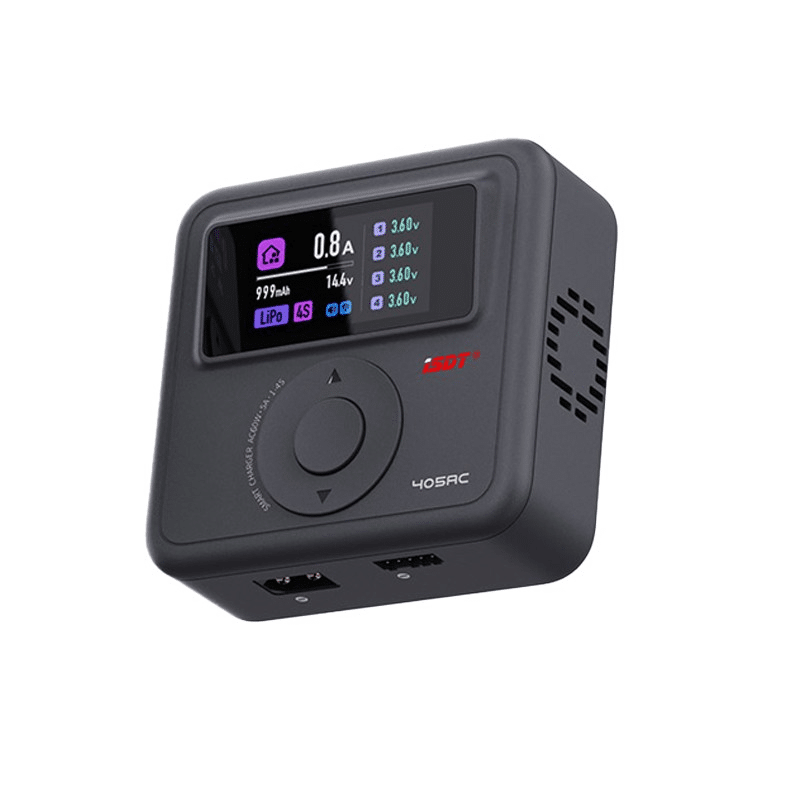
ISDT 405AC 60W GaN Smart Charger (1–4S LiPo/LiHv/LiFe, XT60)
A GaN-based charger that demonstrates what high-efficiency conversion looks like in practice — GaN transistors achieve far lower switching losses than silicon, delivering 60W in a compact, cool-running package.
Frequently Asked Questions
Q1: What efficiency should I expect from a buck converter module bought online in India?
Generic Chinese buck converter modules (based on LM2596 or XL4016) typically achieve 75–88% efficiency at moderate loads. High-quality modules using synchronous converters (MT3608, TPS62xxx) can reach 90–96%. Always check which IC is on the module before buying if efficiency matters.
Q2: How much does inefficiency actually affect battery life?
Directly proportional. If your converter is 80% efficient instead of 95%, you are wasting 15% more energy. For a 2000mAh battery, that means you get the equivalent of only 1684mAh instead of 1900mAh delivered to your circuit — a 12% reduction in runtime.
Q3: Is a linear regulator (LDO) ever better than a DC-DC converter?
Yes — when the voltage drop is small (e.g., 5V in to 4.5V out) and current is low (under 100mA). An LDO can be 90%+ efficient in this scenario, while a switching converter operating at very low duty cycles may be less efficient due to minimum on-time limitations. LDOs also have zero switching noise, which matters in audio or RF circuits.
Q4: What is the difference between CCM and DCM in a DC-DC converter?
CCM (Continuous Conduction Mode) means the inductor current never reaches zero between switching cycles. DCM (Discontinuous Conduction Mode) means it does. CCM is generally more efficient at heavy loads; DCM (or PFM) is more efficient at light loads. A well-designed converter transitions automatically between modes based on load current.
Q5: Can I parallel two DC-DC converters to handle more current?
Not without special consideration. Two converters fighting for voltage regulation will not share current equally and one will end up doing all the work. Use converters specifically designed for parallel operation, or use a single higher-rated converter. Some ICs support master-slave current sharing for parallel configurations.
Power Your Projects More Efficiently
Zbotic stocks quality battery modules, BMS boards, and charging circuits designed for efficiency. Whether you are building an IoT node that needs to last a year on a coin cell or a portable robot that needs to last through a full day of demos, we have the right components.






Add comment