
The RC circuit — a resistor and a capacitor connected together — is one of the first circuits every electronics student encounters, and for good reason. Understanding capacitor charging and discharging explains how timing circuits work, how filters shape signals, how microcontrollers debounce switches, and how power supplies smooth ripple voltage. This tutorial walks you through the complete theory with equations, explains the time constant concept visually, and shows you real-world applications you can build yourself.
What Is a Capacitor?
A capacitor is a passive two-terminal component that stores electrical energy in an electric field. It consists of two conductive plates separated by a dielectric (insulating) material. When a voltage is applied across the plates, opposite charges build up on each plate — positive on one, negative on the other — creating a stored charge.
The key property of a capacitor is capacitance, measured in Farads (F). In practice, most capacitors used in electronics range from picofarads (pF) for RF circuits to thousands of microfarads (µF) for power supply filtering. The capacitance determines how much charge the capacitor stores for a given voltage: Q = C × V.
Unlike an inductor (which stores energy in a magnetic field and resists current changes), a capacitor resists changes in voltage. You cannot instantly change the voltage across a capacitor — it ramps up or down as charge flows in or out. This is the fundamental principle behind every RC timing and filtering circuit.
Capacitor Charging: Step-by-Step
Consider a simple series RC circuit: a voltage source (Vs), a resistor (R), and an uncharged capacitor (C) connected in series, with a switch.
What Happens When the Switch Closes?
- t = 0 (switch just closed): The capacitor is uncharged (Vc = 0V). The full supply voltage appears across the resistor. Maximum current flows: Imax = Vs / R.
- t > 0 (charging in progress): As current flows, charge accumulates on the capacitor plates. The capacitor voltage rises. As Vc increases, the voltage across the resistor (Vr = Vs – Vc) decreases. Current slows down.
- t → ∞ (fully charged): The capacitor voltage reaches Vs. No voltage remains across the resistor. Current drops to zero. The capacitor is fully charged and no more charging occurs.
The charging is not linear — it follows an exponential curve. The rate of charging is fastest at the beginning (when the voltage difference is largest) and slows down as the capacitor approaches the supply voltage. This is because the driving force (voltage across the resistor) decreases as the capacitor charges.
Capacitor Discharging: Step-by-Step
Now assume the capacitor is fully charged to voltage V0 and the source is disconnected. A resistor is connected across the capacitor.
What Happens During Discharge?
- t = 0 (discharge begins): Capacitor is at V0. Current flows through the resistor: I = V0 / R.
- t > 0 (discharging in progress): Charge flows off the capacitor plates through the resistor. The capacitor voltage drops. As voltage drops, current decreases proportionally.
- t → ∞ (fully discharged): Capacitor voltage approaches zero. Current approaches zero. All stored energy has been dissipated as heat in the resistor.
Again, the discharge follows an exponential decay. The voltage drops fastest at the start and slows as it approaches zero — the mathematical mirror image of the charging curve.

0.1/100nF Multilayer Ceramic Capacitor – Pack of 50
Perfect for building RC filter and timing circuits on a breadboard. These 100nF capacitors are the standard choice for decoupling and RC timing applications.
The RC Time Constant (τ)
The time constant (τ, pronounced “tau”) is the most important parameter describing how fast an RC circuit charges or discharges. It is defined as:
τ = R × C
Where R is in ohms and C is in farads. The result is in seconds.
Example: R = 10kΩ (10,000 Ω), C = 100µF (0.0001 F) → τ = 10,000 × 0.0001 = 1 second
What Does One Time Constant Mean?
After exactly one time constant (τ), the capacitor has charged to approximately 63.2% of the final voltage (or discharged to 36.8% of its initial voltage). This comes directly from the exponential function e⁻¹ ≈ 0.368.
The 5 Time Constants Rule
Engineers use the rule that a capacitor is considered fully charged or discharged after 5 time constants. Here is the table:
| Time Elapsed | Charge Level (% of Vs) | Discharge Level (% remaining) |
|---|---|---|
| 1τ | 63.2% | 36.8% |
| 2τ | 86.5% | 13.5% |
| 3τ | 95.0% | 5.0% |
| 4τ | 98.2% | 1.8% |
| 5τ | 99.3% | 0.7% |
This rule is extremely useful. If you design a timer that needs to fully charge a capacitor before triggering, you know you need to wait at least 5τ seconds. If your RC filter needs to settle after a step change in input, it will be within 1% of the new steady-state after 5τ.
Voltage and Current Equations
The exact equations governing RC charging and discharging are derived from differential equations, but the results are simple exponentials:
Charging Equations
Vc(t) = Vs × (1 – e^(–t/τ))
I(t) = (Vs/R) × e^(–t/τ)
The capacitor voltage starts at 0 and rises toward Vs. The current starts at its maximum (Vs/R) and decays exponentially to zero.
Discharging Equations
Vc(t) = V0 × e^(–t/τ)
I(t) = (V0/R) × e^(–t/τ)
Both voltage and current decay from their initial values toward zero. Notice that during discharge, current flows in the opposite direction through the external circuit compared to charging.
Energy in a Charged Capacitor
E = ½ × C × V²
Interestingly, when you charge a capacitor from a DC source through a resistor, exactly half the energy supplied by the source is dissipated in the resistor — regardless of the resistor value. This is a fundamental result of RC circuit physics and explains why capacitor charging is inherently less than 100% efficient.
Real-World RC Circuit Applications
1. RC Timing Circuits
The 555 timer IC uses an RC network to set its timing period. In astable mode, the capacitor charges and discharges between two threshold voltages (1/3 and 2/3 of Vcc), with the time constant determining the frequency of oscillation. Changing R or C changes the timing. This principle is used in clocks, PWM generators, LED blinkers, and tone generators.
2. RC Low-Pass Filters
An RC low-pass filter uses a series resistor and a shunt capacitor. Low-frequency signals see high capacitive impedance and pass through to the output. High-frequency signals find a low-impedance path to ground through the capacitor and are attenuated. The cutoff frequency is:
fc = 1 / (2π × R × C)
This is the basis of anti-aliasing filters before ADCs, audio tone controls, and power supply ripple filters.
3. RC High-Pass Filters
Reverse the positions — capacitor in series, resistor to ground — and you get a high-pass filter. DC and low frequencies are blocked by the capacitor; high frequencies pass. Used for AC coupling between amplifier stages, removing DC offset from audio signals, and differentiating circuits.
4. Switch Debouncing
Mechanical switches bounce when pressed, producing many rapid transitions that microcontrollers misread as multiple button presses. An RC network (typically 10kΩ + 100nF) slows the signal transition enough that the bounces are smoothed out before the digital input sees them.
5. Power Supply Bulk Capacitors
The large electrolytic capacitors at the output of a power supply charge during each cycle and discharge into the load between cycles, maintaining a nearly constant DC voltage. The ripple voltage is determined by the time constant formed by the output capacitance and the load resistance.
6. Sample-and-Hold Circuits
In analog-to-digital converters, a sample-and-hold circuit charges a capacitor to the input voltage, then disconnects the input, holding the voltage stable while the ADC converts it. The acquisition time (how long to charge the capacitor to within the required accuracy) is determined by the RC time constant.

0.1µF Ceramic Capacitor – Pack of 50
The standard 104 ceramic capacitor for decoupling, RC filters, and timing circuits. A must-have in every electronics toolkit.
Hands-On Experiment: Observe RC Charging
You can easily observe capacitor charging and discharging with components from your parts drawer. Here is a simple experiment:
Components Needed
- 1× 1000µF electrolytic capacitor
- 1× 10kΩ resistor
- 1× LED with 470Ω series resistor
- 1× 9V battery
- Breadboard and jumper wires
Circuit
- Connect the 10kΩ resistor in series with the capacitor between the battery positive and negative terminals. Note that electrolytic capacitors are polarised — connect the positive leg (longer lead) toward the battery positive.
- Connect the LED with its 470Ω series resistor across the capacitor (positive side of cap → resistor → LED anode → LED cathode → negative side of cap).
What You Will Observe
- Charging (battery connected): The LED glows brightly at first as charging current flows through it. Over about 5τ = 5 × 10,000 × 0.001 = 50 seconds, the current diminishes as the capacitor charges. The LED dims gradually and eventually goes out when the capacitor is fully charged.
- Discharging (battery disconnected): Disconnect the battery. The capacitor now discharges through the LED and its series resistor. The LED glows as stored energy is released, then dims over roughly the same time period.
This experiment makes the abstract exponential equations tangible — you can literally watch the time constant in action.
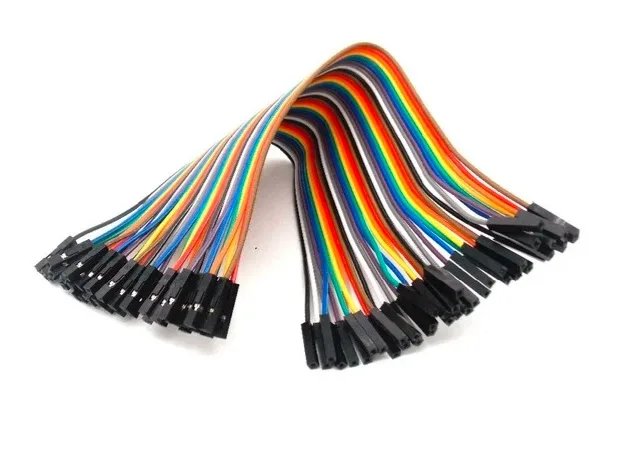
10CM Female to Female Breadboard Jumper Wires – 40Pcs
Essential for building the RC circuit experiment on your breadboard. Colour-coded for easy wiring and quick connections.
Capacitor Types for RC Circuits
Choosing the right capacitor type matters for reliable RC circuit behaviour:
Ceramic Capacitors (Class I: C0G/NP0)
Extremely stable capacitance over temperature and voltage. Ideal for precision RC timing circuits and filters where accuracy matters. Values up to about 100nF. The standard choice for decoupling and signal-path RC circuits.
Ceramic Capacitors (Class II: X5R, X7R)
Higher capacitance density but capacitance varies significantly with applied voltage and temperature. Suitable for decoupling but not for precision timing. Common values: 100nF to 10µF.
Film Capacitors (Polyester, Polypropylene)
Low leakage, good stability, suitable for audio and precision timing circuits. Available in 1nF to several µF. More expensive than ceramic but excellent for RC filters where stability matters.
Electrolytic Capacitors
High capacitance (1µF to several Farads). Polarised — must be connected the right way. Higher leakage current than ceramic or film. Suitable for long time constant circuits (seconds), power supply filtering, and coupling between audio stages where precise timing is not critical.
Tantalum Capacitors
Similar applications to electrolytic but smaller, more stable, lower ESR. More expensive. Polarised. Sensitive to voltage spikes — can fail short-circuit if over-voltaged (unlike aluminium electrolytics which tend to fail open).
Frequently Asked Questions
What is the RC time constant and why does it matter?
The RC time constant (τ = R × C) tells you how fast a capacitor charges or discharges in a circuit. After one time constant, the capacitor has charged to 63.2% of the supply voltage. After five time constants, it is considered fully charged (99.3%). This number directly sets the timing of RC-based oscillators, filters, and timing circuits.
Why does the capacitor charging current start high and decrease?
The charging current is driven by the voltage difference between the supply and the capacitor (Vr = Vs – Vc). At the start, the capacitor is empty and the full supply voltage drives maximum current through the resistor. As the capacitor charges, Vc rises, reducing Vr and therefore the current. The process is self-limiting — the more the capacitor charges, the slower it charges.
Can I charge a capacitor instantly by removing the resistor?
Not safely. With zero resistance, the charging current would theoretically be infinite at t=0. In practice, the source impedance of your supply and wiring resistance limit the current, but it can still be extremely high, potentially damaging the capacitor or the source. The resistor in a charging circuit serves as a current limiter.
What is the difference between a charging RC circuit and an RC filter?
They are the same circuit — just described from different perspectives. Viewed in the time domain (with step inputs), you analyse charging and discharging curves. Viewed in the frequency domain (with AC signals), you analyse how the circuit attenuates different frequencies. The cutoff frequency fc = 1/(2πRC) corresponds exactly to the point where τ = 1/(2πfc).
How do I measure the time constant experimentally?
Connect the RC circuit to a square wave generator. Set the period much longer than τ. Observe the output on an oscilloscope. Measure the time for the voltage to rise from 0 to 63% of the final value — that is τ. Alternatively, measure from any voltage level to 36.8% of that level during discharge.
Why is RC timing not precise with standard resistors and capacitors?
Standard resistors have 5% tolerance, electrolytic capacitors 20% tolerance, ceramic capacitors 10–20% tolerance. The combined tolerance can be ±25% or more. For precision timing, use 1% metal film resistors (MFR) and C0G/NP0 ceramic or film capacitors. Alternatively, use a dedicated timer IC like the 555 with trim pots for calibration.
Get capacitors, resistors, and jumper wires delivered fast across India. Shop Electronics Components at Zbotic and start experimenting today.


Add comment