
Selecting the right brushless drone motor using KV rating, thrust, and efficiency metrics is the single most important decision in any drone build. Get it wrong and you end up with a drone that overheats, can barely hover, or drains the battery in two minutes. This comprehensive guide explains every parameter that matters — KV, stator dimensions, propeller sizing, thrust curves, and efficiency — so you can confidently spec motors for anything from a 3-inch whoop to a 7-inch long-range freestyle build.
How Brushless Motors Work
A brushless DC motor (BLDC) uses electromagnets on the stator (stationary coils) and permanent magnets on the rotor (the spinning bell). The ESC (Electronic Speed Controller) switches current through the three stator windings in sequence, creating a rotating magnetic field that pulls the rotor magnets around.
Unlike brushed motors, there is no physical contact between rotating and stationary parts — hence no brush wear, much higher efficiency (85–92% vs ~60–75% for brushed), and much higher RPM capability.
For multirotor drones, outrunner motors (external bell rotates around internal stator) are used almost universally because their larger diameter produces higher torque at lower RPM, which is ideal for direct-drive propellers.
KV Rating Explained
KV is the motor’s velocity constant — the number of RPM the motor spins per volt of applied voltage, under no load. It is NOT kilovolts.
Formula: RPM = KV × Voltage
For example, a 2400KV motor on a 3S LiPo (11.1V nominal) spins at approximately 2400 × 11.1 = 26,640 RPM at no load.
Key relationship: For the same motor size, higher KV = more RPM but less torque. Lower KV = more torque but lower RPM.
- High KV (2000–4000+): Small props, snappy response, used in racing drones. More efficient at high RPM with light loads.
- Low KV (300–1000): Large props, more torque, better efficiency for heavy-lift and long-range builds.
- Mid KV (1000–2000): The sweet spot for 5-inch freestyle quad — best balance of thrust, efficiency, and prop torque.
The general rule: pair high KV with small diameter propellers, low KV with large diameter propellers. Mismatching (e.g. low KV with tiny props) results in very little thrust; high KV with large props causes excessive current draw and overheating.
Stator Dimensions: What XXXX Means
Motor names like 2204, 2306, 2207 encode stator dimensions:
- First two digits: stator diameter in mm
- Last two digits: stator height (stack height) in mm
| Motor Size | Typical Frame | Prop Size | Best Use |
|---|---|---|---|
| 1104–1306 | 2–3 inch | 2.5–3 inch | Micro whoops, indoor |
| 1507–1806 | 3–4 inch | 3–4 inch | Micro racing, parks |
| 2204–2206 | 4–5 inch | 4–5 inch | Entry freestyle, racing |
| 2207–2208 | 5 inch | 5 inch | 5-inch freestyle — most common |
| 2306–2407 | 5–6 inch | 5–6 inch | HD freestyle, efficiency |
| 2812–3110 | 7–10 inch | 7–10 inch | Long-range, heavy-lift |
A taller stator (last two digits) means more copper volume, more torque, and more power handling — but also more weight.
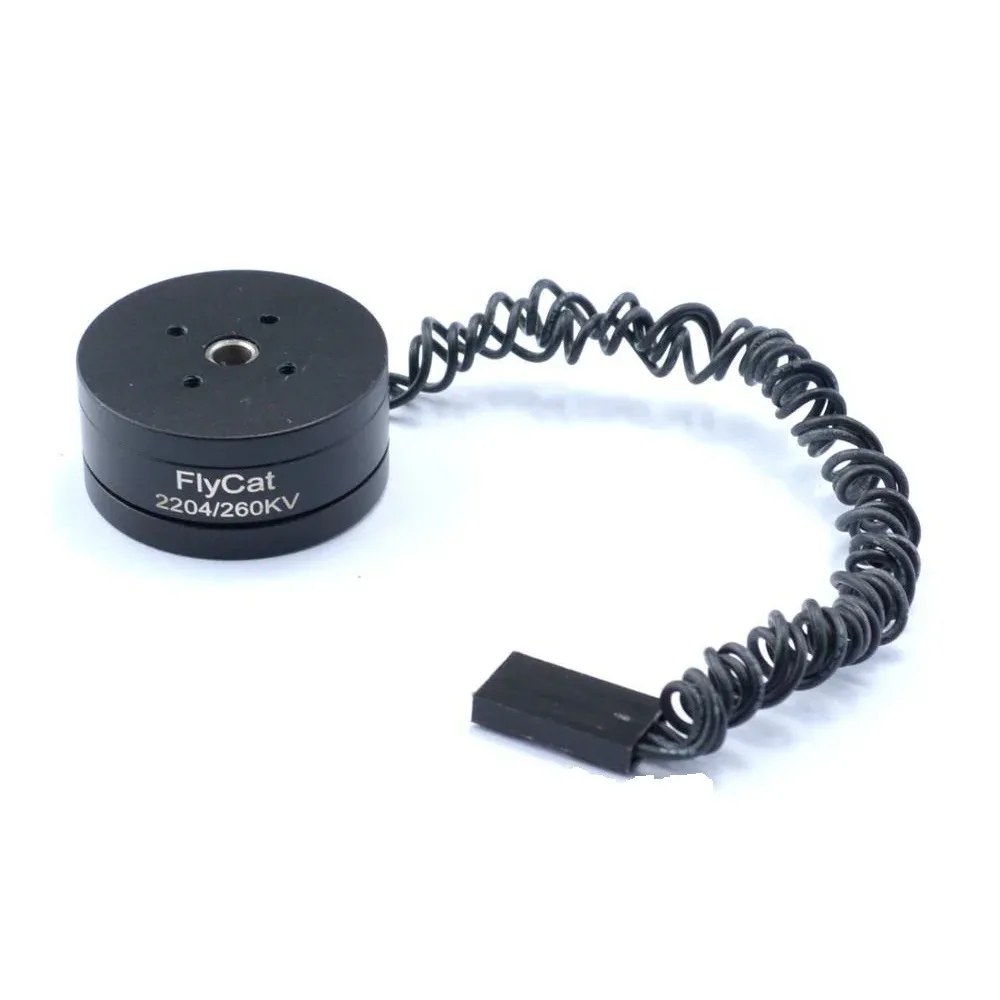
2204 260KV Brushless Gimbal Motor
A 2204-size low-KV brushless motor designed for precision gimbal control. Also suitable as a heavy-lift motor for larger UAV frames where slow, precise rotation is needed.
Thrust-to-Weight Ratio
The thrust-to-weight ratio (TWR) determines how responsive and agile your drone feels:
- TWR 2:1 — minimum for stable hover; sluggish, used in heavy-lift builds
- TWR 3:1 to 4:1 — good for cinematic drones and beginner freestyle
- TWR 6:1 to 8:1 — racing and aggressive freestyle; punchy throttle response
- TWR 10:1+ — extreme racing quads; difficult to tune, very twitchy
How to calculate:
Total hover thrust = Drone all-up weight (AUW) × 2 to 4
Per-motor hover thrust = Total hover thrust ÷ 4 (for quadcopter)

Example: AUW = 400g, TWR = 4
Required thrust = 400 × 4 = 1600g total
Per-motor at hover = 1600 ÷ 4 = 400g thrust per motor
Check motor thrust data sheets (typically 50–100% throttle measurements) to verify the motor produces your required per-motor thrust at a reasonable current (ideally 50–60% throttle at hover).
Matching Propellers to Motors
Propeller selection is inseparable from motor selection. The key specifications are:
- Diameter — larger diameter = more thrust at same RPM, but requires more torque (lower KV motor)
- Pitch — distance the prop would advance in one revolution. Higher pitch = faster theoretical speed, more current draw
- Blade count — more blades = more thrust per diameter but higher drag, reduced efficiency
Quick matching guide:
- 5-inch, 2207, 1750–2400KV → 5×4.3×3 tri-blade or 5×4.5×3
- 5-inch, 2306, 1700KV → 5×5×3 for efficiency, 5×4.5×3 for freestyle
- 7-inch, 2806, 1300KV → 7×3.5×3 or 7×4×3
- 10-inch, 3110, 900KV → 10×4.5×3 or 10×3×3 for efficiency
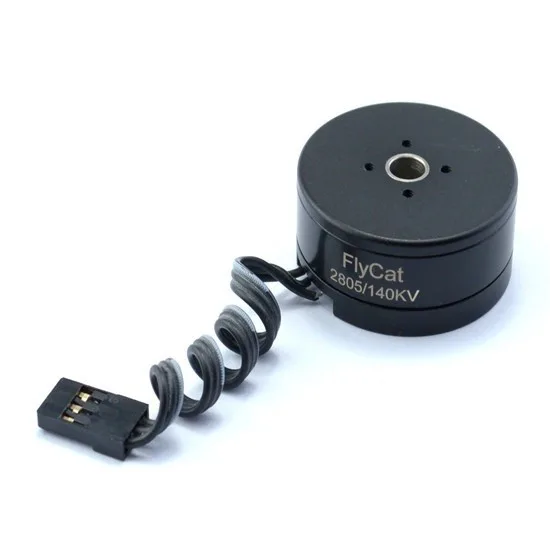
2805 140KV Gimbal Brushless Motor
Ultra-low KV brushless motor ideal for heavy-lift drone frames and large propeller applications. Delivers high torque at low RPM for maximum efficiency on 6–10 inch props.
Efficiency, Current Draw & Power
Motor efficiency is measured in grams of thrust per watt of electrical power consumed (g/W). Typical values:
- 3–5 g/W — inefficient (racing at full throttle, oversized props)
- 6–8 g/W — average freestyle / cinematic
- 10–15 g/W — efficient long-range build at cruise throttle
Calculating power consumption:
Power (W) = Voltage × Current

Example: 4S LiPo = 14.8V
Motor draws 20A at full throttle
Power = 14.8 × 20 = 296W per motor
Total for 4 motors at full throttle = 1,184W

Hover current (~40% throttle): ~8A per motor
Hover power: 14.8 × 8 × 4 = 473W
Flight time estimate: (Battery Wh ÷ Average power) × 60 minutes
A 4S 1500mAh LiPo has 22.2Wh. At 473W average hover draw that is about 2.8 minutes — which is why real flights averaging 30–50% throttle get 4–7 minutes on a 5-inch racing quad.
ESC Selection for Brushless Motors
The ESC must be rated for at least the motor’s maximum continuous current, with a 20–30% overhead:
- If the motor peaks at 30A, use a 35A or 40A ESC
- For 5-inch freestyle quads, 30–40A individual ESCs or a 4-in-1 ESC stack are standard
- Use BLHeli_S or BLHeli_32 firmware for reliable DSHOT protocol support
- Match ESC voltage rating to LiPo cell count (3S = 11.1V, 4S = 14.8V, 6S = 22.2V)
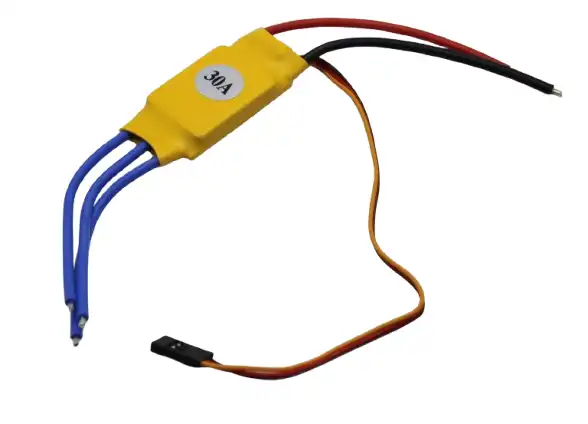
30A BLDC ESC Brushless Electronic Speed Controller
A reliable 30A ESC suitable for 2204–2207 brushless motors on 3S–4S setups. Plug-and-play compatibility with standard signal inputs and BEC output for servos.
Motor Recommendations by Frame Size
| Frame Size | Motor | KV | Battery | Prop |
|---|---|---|---|---|
| 2–3 inch | 1106–1306 | 3000–6000 | 2S–3S | 2.5–3 inch |
| 4 inch | 1806 | 2400–3000 | 3S–4S | 4 inch |
| 5 inch (racing) | 2207 | 2400–2700 | 4S | 5×4.3×3 |
| 5 inch (freestyle) | 2207–2208 | 1750–2000 | 4S–6S | 5×4.5×3 |
| 7 inch (LR) | 2806–3110 | 900–1300 | 4S–6S | 7 inch |
Frequently Asked Questions
What does KV mean in a drone motor and does higher KV mean more power?
KV is the RPM-per-volt constant — it tells you how fast the motor spins per volt applied, at no load. Higher KV does not mean more power. Power is determined by KV combined with stator size and voltage. A high KV motor with a small propeller can produce the same thrust as a low KV motor with a large propeller, but at different efficiency levels.
How do I calculate the maximum current draw of a brushless motor?
Use the motor manufacturer’s thrust data table — it lists current draw at various throttle percentages with a specific propeller and voltage. At full throttle, most 5-inch 2207 motors draw 30–45A. Always choose an ESC rated 20–30% higher than the motor’s peak current.
Can I use a brushless motor on 3S instead of 4S?
Yes. Running a 4S-rated motor on 3S reduces maximum RPM (lower voltage = fewer RPM via KV formula) and reduces peak current draw. The motor runs cooler but produces less thrust. You may need to compensate with slightly larger or higher-pitch propellers to maintain the same thrust output.
Why does my drone motor get hot after a few minutes of flight?
Overheating usually means the motor is under-powered for the load (propeller too large or too much pitch), winding resistance is too high (cheap windings), or the KV-propeller combination is drawing more current than the stator can dissipate. Check your ESC telemetry for current draw and compare with the motor’s specification sheet. Switching to a slightly smaller pitch propeller often resolves overheating.
What is the best brushless motor for a beginner 5-inch drone build in India?
For a first 5-inch build, a 2205 or 2207 motor in the 2300–2400KV range on 4S is an excellent starting point. These motors are forgiving of prop and ESC mismatches, widely available, and produce plenty of thrust for a beginner build without being too aggressive. Pair with a 30A ESC and 5×4.5×3 propellers.
Build Your Drone with Quality Motors
Find brushless motors, ESCs, and all the drone build components you need at Zbotic.in. We stock a wide range of BLDC motors suitable for everything from micro whoops to 7-inch long-range builds — with delivery across India.


Add comment