
Choosing between the Wemos D32 vs DOIT Devkit ESP32 India is one of the most common dilemmas faced by hobbyists and engineers in the Indian maker community. Both boards are built around Espressif’s powerhouse ESP32 chip, both cost roughly the same, and both are widely available from Indian electronics stores like Zbotic. Yet the two boards have meaningful differences in form factor, features, and ideal use cases. In this detailed comparison, we break down every spec, pinout difference, battery support, and community ecosystem factor so you can make an informed choice for your next project.
Board Overview: Wemos D32 and DOIT DevKit V1
The Wemos D32 (also marketed as LOLIN D32) is produced by Wemos Electronics and is essentially the ESP32 successor to their wildly popular D1 Mini ESP8266 board. It retains the compact, breadboard-friendly form factor of the D1 Mini family but upgrades the core to an ESP32. The hallmark feature is its built-in LiPo battery connector with integrated charging circuitry — a huge plus for portable and battery-powered IoT applications.
The DOIT ESP32 DevKit V1 (also called the ESP32 Dev Module) is arguably the most popular ESP32 development board in the world. It is manufactured by DOIT (Doit.am), a Chinese maker-focused company, and is used as the reference design by most ESP32 tutorials online. It is slightly larger than the D32, based on the ESP32-WROOM-32 module, and exposes nearly all GPIO pins on two rows of headers that span across a standard breadboard.
Both boards are extremely popular in India’s growing DIY electronics community, stocked by most Indian components stores, and both are officially supported in the Arduino IDE, PlatformIO, and MicroPython environments.
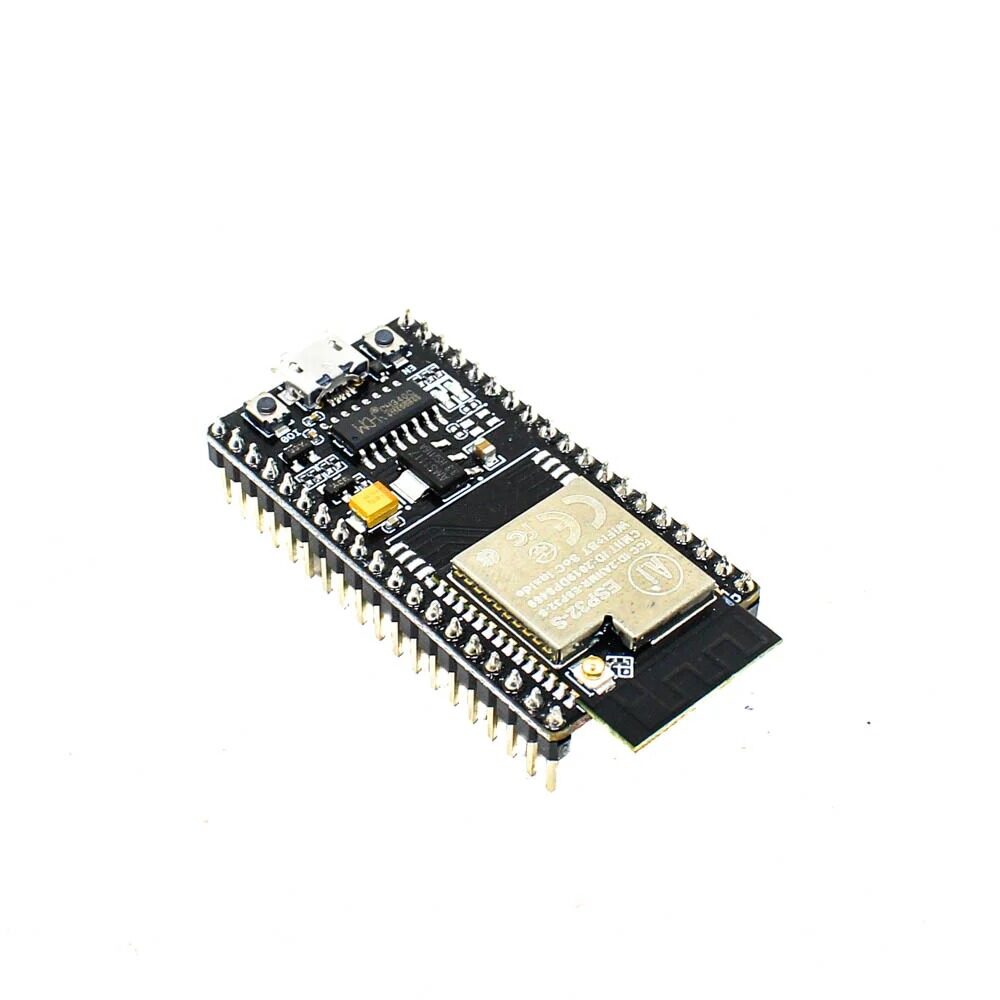
Ai Thinker NodeMCU-32S ESP32 Development Board – IPEX Version
A solid alternative to both boards with IPEX antenna connector for extended WiFi range, popular for Indian IoT projects.
Side-by-Side Specifications Comparison
Before diving into the nuances, here is a clean technical comparison of the two boards:
| Feature | Wemos D32 (LOLIN D32) | DOIT DevKit V1 |
|---|---|---|
| Core Chip | ESP32-WROOM-32 | ESP32-WROOM-32 |
| CPU | Dual-core Xtensa LX6 @ 240MHz | Dual-core Xtensa LX6 @ 240MHz |
| RAM | 520KB SRAM | 520KB SRAM |
| Flash | 4MB | 4MB |
| Board Size | 58mm x 25.5mm | 51.4mm x 28.3mm |
| GPIO Pins | 22 usable GPIO | 30 GPIO (38 total on headers) |
| LiPo Battery | Yes (JST PH2.0 connector + charger) | No |
| USB-to-Serial | CH340C | CP2102 or CH340 |
| USB Port | Micro USB | Micro USB |
| Operating Voltage | 3.3V (5V tolerant input via USB) | 3.3V (5V tolerant via 3V3 pin) |
| WiFi | 802.11 b/g/n 2.4GHz | 802.11 b/g/n 2.4GHz |
| Bluetooth | BT 4.2 + BLE | BT 4.2 + BLE |
| Breadboard Friendly | Yes (single strip per side) | Tight fit — blocks one column each side |
| Price in India (approx) | ₹350–₹450 | ₹250–₹350 |
Both boards share the same ESP32 silicon, so raw compute performance, WiFi range, and Bluetooth capability are identical. The differences are primarily in board-level features — pins exposed, power management, and physical dimensions.
GPIO Pinout and Usable Pins
Pin count is one of the most practically important differences. The DOIT DevKit V1 exposes 30 GPIO pins across 38 header pins (some are power, GND, and EN pins). This gives you access to virtually every ESP32 peripheral simultaneously: UART, SPI, I2C, DAC, ADC channels, capacitive touch, and PWM. The wider 30-pin layout does, however, straddle a standard 830-point breadboard with headers touching the outer columns, leaving no accessible rows on either side without jumper wires.
The Wemos D32 exposes fewer GPIO — approximately 22 usable pins — but its narrower profile sits cleanly on a breadboard, leaving free columns on both sides for direct component connections. For the vast majority of IoT sensor projects with DHT11, BMP280, or a few actuators, 22 GPIO is more than sufficient. Only high pin-count projects like driving large LED matrices or running many servos simultaneously will hit this limit.
One important D32 pin caveat: GPIO 0 is used internally and should generally be avoided for sensors. GPIO 34, 35, 36, and 39 on both boards are input-only pins — they have no internal pull-up/pull-down resistors, so external resistors are required when connecting switches or sensors to these pins.
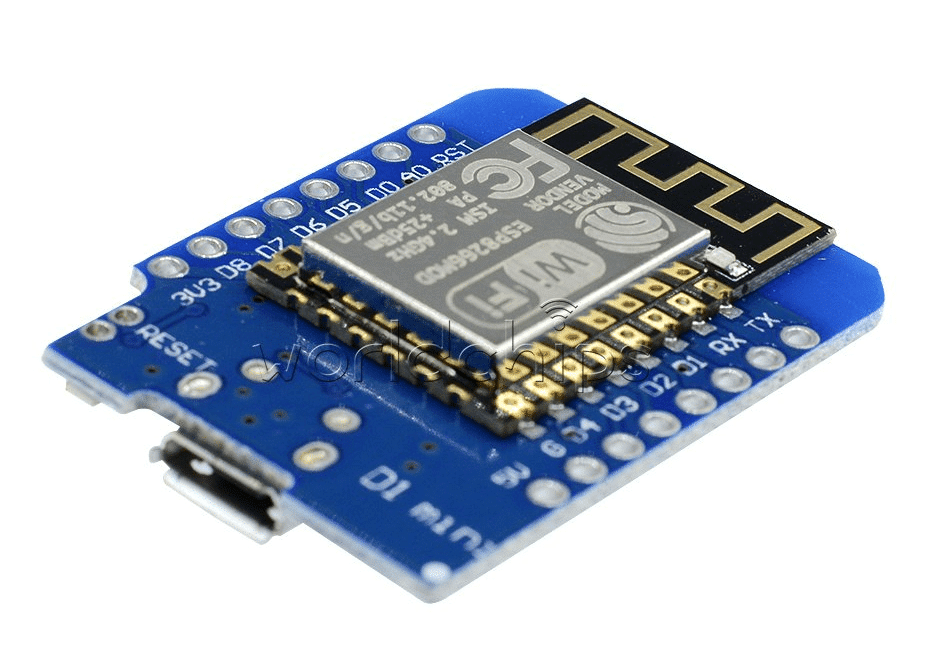
D1 Mini V2 NodeMCU 4M Bytes Lua Wi-Fi IoT Development Board (ESP8266)
The original D1 Mini based on ESP8266 — a great low-cost option for simpler WiFi projects that don’t need Bluetooth or dual-core processing.
Battery Support and Power Management
This is where the Wemos D32 truly separates itself. The board has a JST PH 2.0mm connector for a single-cell LiPo (3.7V) battery, with an on-board TP4054-based charging IC that charges the battery at 500mA when USB is connected. A MAX17043 fuel gauge IC is optionally populated on some revisions, enabling battery percentage reading via I2C. This makes the D32 the go-to board for any project that needs to run from a battery — weather stations, wearables, remote sensors, asset trackers, and more.
The DOIT DevKit has no on-board battery support whatsoever. You can still power it with a LiPo battery through an external battery shield or TP4056 module connected to the 3.3V or 5V pins, but you lose the elegance of an integrated solution. For projects already requiring a battery, this adds extra components and complexity.
In terms of deep sleep current, both boards are similar — the ESP32 chip draws roughly 10µA in deep sleep — but the D32’s charging circuit draws some quiescent current even with no battery attached. For ultra-low-power deployments, bypass the charger with direct LiPo connection to the 3.3V rail after voltage regulation.
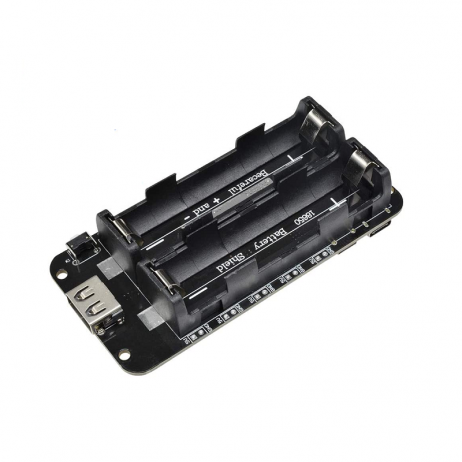
2 x 18650 Lithium Battery Shield for Arduino, ESP32, ESP8266
Adds dual 18650 battery support to the DOIT DevKit — ideal for extended run time on battery-powered ESP32 projects.
Software, Libraries, and Community Support
Since both boards use the ESP32-WROOM-32 module, software compatibility is identical at the chip level. The Arduino IDE’s esp32 by Espressif Systems board package supports both. In the Arduino IDE, select “WEMOS LOLIN32” for the D32 or “DOIT ESP32 DEVKIT V1” for the DOIT board — the main difference is the default upload baud rate and partition scheme, easily adjusted.
Community support strongly favors the DOIT DevKit. The vast majority of ESP32 tutorials, YouTube guides, and GitHub example projects explicitly target the DOIT pinout. If you are a beginner following tutorials, the DOIT DevKit minimizes the need to mentally remap pin labels. The Wemos ecosystem has its own strong following, especially in the battery-powered project community and among users upgrading from the D1 Mini.
For PlatformIO users, both boards are first-class citizens. The platform identifier is espressif32 for both, with board identifiers lolin32 and esp32doit-devkit-v1 respectively.
Best Use Cases for Each Board
Choose the Wemos D32 if:
- Your project is battery-powered (wearables, field sensors, portable gadgets)
- Space is constrained and you need a compact footprint
- You are upgrading from a D1 Mini project and want to retain the form factor
- You plan to use the D32 with Wemos shield ecosystem accessories
- Clean breadboard layout matters for your prototyping workflow
Choose the DOIT DevKit V1 if:
- You are a beginner following online tutorials (most use DOIT pinout)
- You need maximum GPIO count for complex multi-peripheral projects
- Your project is mains or USB powered and battery is not a concern
- Budget is the top priority (DOIT is typically ₹50–100 cheaper in India)
- You want the best-documented, most community-tested board available
Price and Availability in India
In India, both boards are readily available from online sellers and electronics component stores. The DOIT DevKit V1 typically lands between ₹250 and ₹350 depending on the USB-to-serial chip (CP2102 variants are preferred over CH340 for Windows driver simplicity). The Wemos D32 or LOLIN D32 runs slightly higher at ₹350–450, reflecting the added LiPo circuitry.
For Indian projects involving IoT automation, home automation, or student engineering projects, both boards offer extraordinary value — far exceeding their price tags. The ESP32’s combination of dual-core processing, integrated WiFi and Bluetooth, deep sleep capability, and rich peripheral set makes either board the best microcontroller value in India at this price range.

30Pin ESP32 Expansion Board with Type-C USB and Micro USB Dual Interface
Perfect companion for the DOIT DevKit — provides easy screw terminal access to all 30 pins for faster prototyping and breadboard-free wiring.
Frequently Asked Questions
Q1. Can I use the same Arduino code on both Wemos D32 and DOIT DevKit?
Yes, since both boards use the identical ESP32-WROOM-32 module, your Arduino/PlatformIO code is fully compatible. The only thing you may need to adjust is pin numbers if your project uses specific GPIO references, as the two boards label their pins slightly differently in silk screen. The core functionality — WiFi, Bluetooth, I2C, SPI, ADC — works the same on both.
Q2. Which ESP32 board is best for beginners in India?
The DOIT ESP32 DevKit V1 is recommended for beginners because the vast majority of ESP32 tutorials worldwide use its pinout. Finding solved problems, sample code, and video guides specific to the DOIT board is very easy. Zbotic stocks multiple ESP32 variants — check their IoT category for current availability and prices.
Q3. Does the Wemos D32 support deep sleep with LiPo battery?
Yes. The D32 is an excellent choice for deep-sleep battery projects. In deep sleep the ESP32 draws approximately 10µA. Combined with a 1000mAh LiPo and a typical 5-second wake cycle every 15 minutes, you can achieve weeks of runtime on a single charge. The on-board charging circuit recharges the battery when USB is connected, making solar + battery setups very convenient.
Q4. Is the DOIT DevKit V1 the same as NodeMCU-32S?
They are similar but not identical. The NodeMCU-32S is Ai Thinker’s ESP32 board and uses a different PCB layout. The DOIT DevKit V1 is specifically from DOIT and has its own distinctive 30-pin dual-row header arrangement. Both use the ESP32-WROOM-32 module and are functionally equivalent for most projects.
Q5. What is the best ESP32 board for IoT sensor projects with I2C sensors in India?
Either board works perfectly for I2C sensors like BME280, DHT11, or DS18B20. Both expose SDA and SCL pins. For a clean breadboard setup with multiple I2C sensors, the Wemos D32’s narrower profile is more convenient. For maximum pin availability across SPI, I2C, and UART simultaneously, the DOIT DevKit V1 is better.
Final Verdict
The bottom line: both are excellent boards and neither is objectively better — it depends entirely on your use case. Buy the Wemos D32 when your project runs on a battery or you need a compact form factor. Buy the DOIT DevKit V1 when you want the widest tutorial ecosystem, maximum GPIO, and the lowest price point.
For Indian makers, both boards are stocked at Zbotic at competitive prices with fast shipping. The smartest approach for serious hobbyists is to have at least one of each in your drawer — use the DOIT for breadboard prototyping and the D32 for battery-powered field deployments.
Shop ESP32 Boards at Zbotic
Browse the full range of ESP32 development boards, shields, and accessories available with fast delivery across India.




Add comment