
Noise Figure in RF Amplifiers: Low Noise Design Principles
The noise figure of an RF amplifier is arguably the most critical specification in weak-signal reception systems — whether you are building a software-defined radio (SDR) receiver, an amateur radio preamplifier, a GPS receiver front-end, or a satellite signal decoder. Yet it remains one of the least understood concepts among Indian electronics hobbyists venturing into RF design. This guide demystifies noise figure, explains the Friis noise formula, and gives you practical low-noise amplifier (LNA) design principles you can apply immediately to real projects.
Thermal Noise: The Fundamental Floor
Every resistor — and by extension, every real electronic component — generates noise due to the random thermal motion of electrons. This is called Johnson-Nyquist noise or thermal noise. It is the fundamental noise floor that no passive component can go below.
The noise power available from a resistor at temperature T over bandwidth B is:
P_noise = k × T × B
Where:
- k = Boltzmann’s constant = 1.38 × 10⁻²³ J/K
- T = temperature in Kelvin (room temperature: 290K or about 17°C)
- B = bandwidth in Hz
At room temperature (290K) and 1 MHz bandwidth: P_noise = 1.38×10⁻²³ × 290 × 10⁶ = 4×10⁻¹⁵ W = -144 dBm
This number (-144 dBm/MHz, or -174 dBm/Hz at 290K) is the thermal noise floor. Any signal below this level is undetectable. Any amplifier you add will introduce additional noise above this floor — quantified by its noise figure.
In India’s typical ambient temperature of 35–40°C (308–313K), the thermal noise floor is about 0.3 dB higher than the standard 290K reference — a small but real difference when designing for the most sensitive receivers.
Noise Figure and Noise Temperature Defined
Noise Figure (NF) is a measure of how much noise an amplifier (or any two-port network) adds to a signal passing through it. It is defined as the degradation in signal-to-noise ratio (SNR) caused by the amplifier:
NF (dB) = SNR_in (dB) – SNR_out (dB)
Or equivalently, using the noise factor F (linear):
F = SNR_in / SNR_out = (S/N)_in / (S/N)_out
NF = 10 × log10(F)
Key points:
- An ideal (noiseless) amplifier has NF = 0 dB (F = 1). Real amplifiers always have NF > 0 dB.
- A 1 dB NF amplifier barely affects the signal quality. A 10 dB NF amplifier degrades SNR by 10 dB — reducing receiver sensitivity significantly.
- NF is independent of amplifier gain — a high-gain amplifier can still have a terrible noise figure.
Noise Temperature
An alternative expression used in radio astronomy and satellite communications is equivalent noise temperature (T_e):
T_e = T_0 × (F – 1) = 290 × (10^(NF/10) – 1) Kelvin
A 1 dB NF amplifier has T_e = 290 × (1.259 – 1) = 75 K. A 3 dB NF amplifier has T_e = 290 × (2 – 1) = 290 K — it adds as much noise as a room-temperature resistor.
The Friis Noise Formula for Cascaded Stages
When multiple amplifier stages, filters, cables, and attenuators are cascaded in a receiver chain, their noise figures combine in a specific way described by the Friis formula:
F_total = F1 + (F2-1)/G1 + (F3-1)/(G1×G2) + (F4-1)/(G1×G2×G3) + …
Where F1, F2, F3… are the linear noise factors and G1, G2, G3… are the linear power gains of each stage.
This formula reveals a critical insight: the first stage dominates the system noise figure. If G1 is large (say, 20 dB = factor 100), then (F2-1)/G1 becomes negligibly small. This is why the LNA (placed first in the chain, directly after the antenna) is the most important component for receiver sensitivity.
Friis Formula Example — SDR Receiver Chain
| Stage | Component | Gain (dB) | NF (dB) |
|---|---|---|---|
| 1 | Coax cable (2m, RG58) | -1.0 | 1.0 |
| 2 | Bandpass filter | -2.0 | 2.0 |
| 3 | SDR dongle receiver | +30 | 6.0 |
Without LNA — System NF ≈ 1.0 + 2.0 + 6.0/(0.794×0.631) ≈ 15 dB (very poor)
| Stage | Component | Gain (dB) | NF (dB) |
|---|---|---|---|
| 1 | LNA (at antenna) | +20 | 0.8 |
| 2 | Coax cable (2m, RG58) | -1.0 | 1.0 |
| 3 | Bandpass filter | -2.0 | 2.0 |
| 4 | SDR dongle receiver | +30 | 6.0 |
With LNA first — System NF ≈ 0.8 + (F2-1)/G1 + … ≈ 1.1 dB (excellent)
Adding a 0.8 dB NF, 20 dB gain LNA at the antenna reduces the system noise figure from 15 dB to 1.1 dB — a dramatic 14 dB improvement in receiver sensitivity. This translates to being able to receive signals that are 14 dB weaker than before.
Low Noise Amplifier Design Principles
Principle 1: First Stage Determines Everything
As shown by the Friis formula, optimise the first amplifier’s noise figure above all else. A mediocre first-stage amplifier cannot be compensated by any amount of subsequent stages. Place the LNA as close to the antenna as physically possible — before any cable, filter, or switch.
Principle 2: Gain-Noise Trade-Off
More gain reduces the noise contribution of later stages, but excessive gain causes its own problems: increased inter-modulation distortion, potential oscillation, and overloading the following stages with large interfering signals. In a well-designed receiver, the first LNA should have 15–25 dB of gain — enough to dominate the system noise but not so much that strong adjacent-channel interferers cause non-linear distortion.
Principle 3: Noise Matching ≠ Power Matching
The impedance that minimises transistor noise (Γ_opt) is generally different from the impedance that maximises power gain (Γ_ms) or provides a conjugate match (Γ_in*). The designer must choose between these trade-offs — typically accepting slightly less gain to achieve near-minimum noise figure. This is done using the noise parameter circles on a Smith chart.
Principle 4: Bias Point Optimisation
Transistor noise figure varies significantly with bias current. For most RF transistors, there is an optimal collector/drain current for minimum noise figure — typically 1–10 mA for small-signal RF transistors. Too low: noise rises due to shot noise. Too high: noise rises due to thermal effects. Always check the transistor’s measured noise figure vs bias current curves in its datasheet.
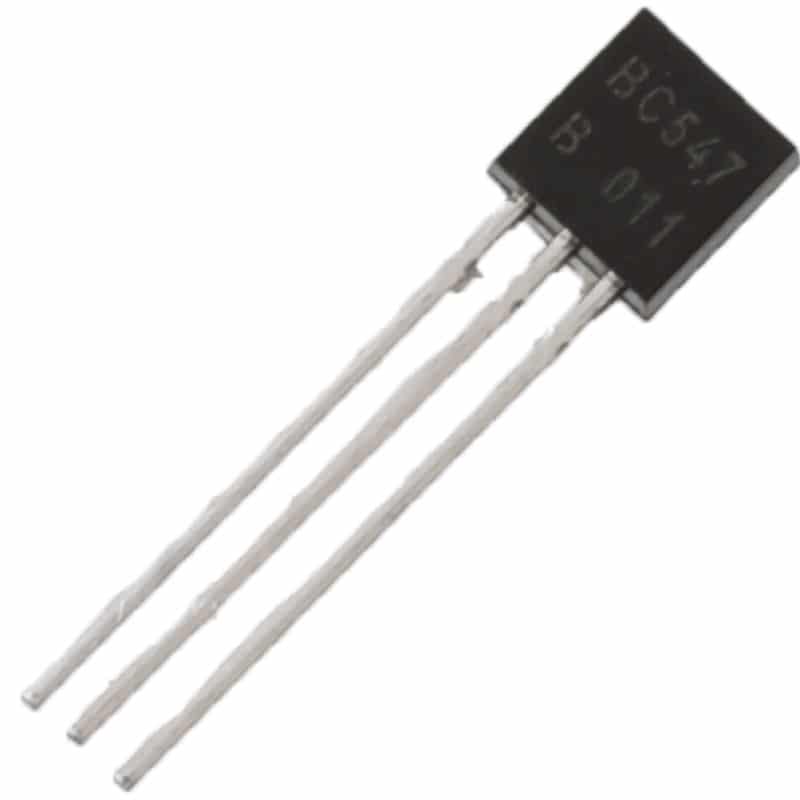
BC547 NPN 100mA Transistor TO-92 (Pack of 10)
General-purpose NPN transistors for audio-frequency low-noise amplifier circuits. Study bias point effects on noise figure with this affordable pack.
Transistor Selection for Low Noise
Not all transistors are created equal for low-noise applications. The key transistor specifications that affect noise figure are:
Key Noise Parameters
- NF_min: Minimum achievable noise figure with optimal source impedance. Lower is better.
- Γ_opt: The source reflection coefficient (impedance) that achieves NF_min.
- R_n: Noise resistance — how quickly NF degrades as source impedance moves away from Γ_opt. Lower R_n means easier matching.
- f_T (transition frequency): Should be at least 3–5× the operating frequency for good noise performance.
Recommended Transistors for RF LNA (Available in India)
| Part | Type | NF_min at Freq | f_T | Best For |
|---|---|---|---|---|
| BF998 | N-channel MOSFET | 0.7 dB @ 200 MHz | 700 MHz | VHF/UHF front end |
| BFR93A | NPN BJT | 1.2 dB @ 900 MHz | 5 GHz | GSM/cellular bands |
| ATF-54143 | pHEMT | 0.5 dB @ 2 GHz | >30 GHz | WiFi, GPS, satellite |
| SPF-5122Z | GaAs pHEMT | 0.4 dB @ 5.8 GHz | >40 GHz | 5 GHz WiFi, VSAT |
| BC547 | NPN BJT | ~2 dB @ 10 MHz | 300 MHz | HF (shortwave) LNA |
For the Indian hobbyist getting started with SDR (RTL-SDR, HackRF), the SPF5189Z-based LNA modules imported from China (available via IndiaMART or AliExpress) offer NF of 0.6–1.0 dB across 50 MHz–4 GHz at a cost of ₹300–500 — an excellent starting point before designing your own.
Impedance Matching for Minimum Noise
In RF design, all interfaces are standardised at 50 Ω (or 75 Ω for broadcast). Transistors rarely present a 50 Ω impedance at their input. An input matching network transforms the 50 Ω source to the transistor’s optimal noise impedance (Γ_opt).
Common Matching Network Topologies
1. L-Network (Two Component)
Simplest matching network — one shunt and one series reactive element (L or C). Good for narrowband matching. Can provide simultaneous noise and power matching if Γ_opt happens to be near the conjugate input impedance.
2. π-Network and T-Network
Three-element networks that provide more flexibility — they can match a wider range of impedances and offer some filtering as a bonus. Commonly used in HF and VHF LNA designs.
3. Inductive Source Degeneration
Adding a small series inductor (typically a bond wire inductance in MMIC designs, or a discrete inductor in discrete designs) at the transistor source/emitter simultaneously improves noise figure AND helps match input impedance closer to 50 Ω. This is the standard technique in nearly all integrated LNA designs for cellular and WiFi applications.
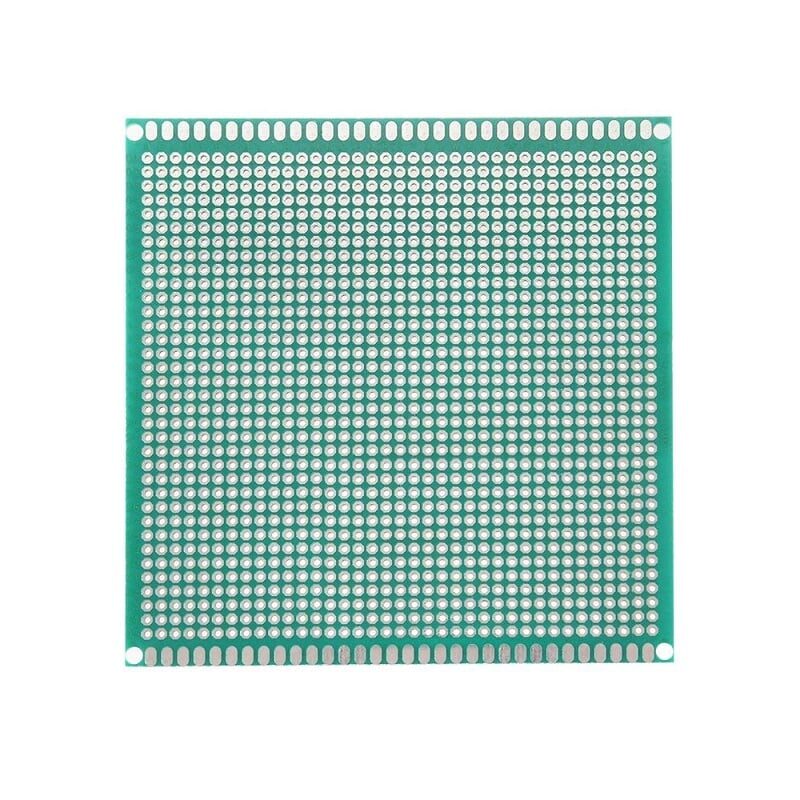
10 x 10 cm Universal PCB Prototype Board Single-Sided
Build and experiment with LNA matching networks on this versatile PCB board — ideal for HF and lower VHF frequency LNA prototype circuits.
Practical PCB Layout Tips for LNA
Even perfect circuit design can be ruined by poor PCB layout. These rules apply for any RF PCB above 30 MHz:
1. Use a Solid Ground Plane
The entire bottom layer (or a dedicated ground layer in multilayer PCB) should be an unbroken copper pour connected to ground. Via stitching along the edges of the board reduces ground inductance and shields the signal layer from noise.
2. Minimise Signal Path Length
Every millimetre of trace adds inductance (approximately 0.7 nH/mm for microstrip). Route signal paths as short as possible. Place bypass capacitors within 1–2 mm of the transistor’s power supply pin.
3. Separate Input and Output Traces
Never route the output trace back near the input trace — this creates feedback that causes oscillation or degrades noise figure. Use a physical 180° layout where input and output are on opposite sides of the transistor.
4. Use Bypass Capacitors at Multiple Values
A single bypass capacitor has a self-resonant frequency above which it becomes inductive. Use two or three capacitors in parallel (e.g., 100 nF + 1 nF + 10 pF) to maintain low impedance to ground across a wider frequency range.
5. Shield the LNA
A small tin or copper enclosure (shield can) over the LNA dramatically reduces susceptibility to external interference. For a fixed installation (rooftop antenna, etc.), this is especially important.

0.1µF Ceramic Capacitor (Pack of 50)
High-quality 100nF ceramic capacitors for RF bypass and decoupling in LNA designs — low ESL makes them effective up to 100+ MHz.
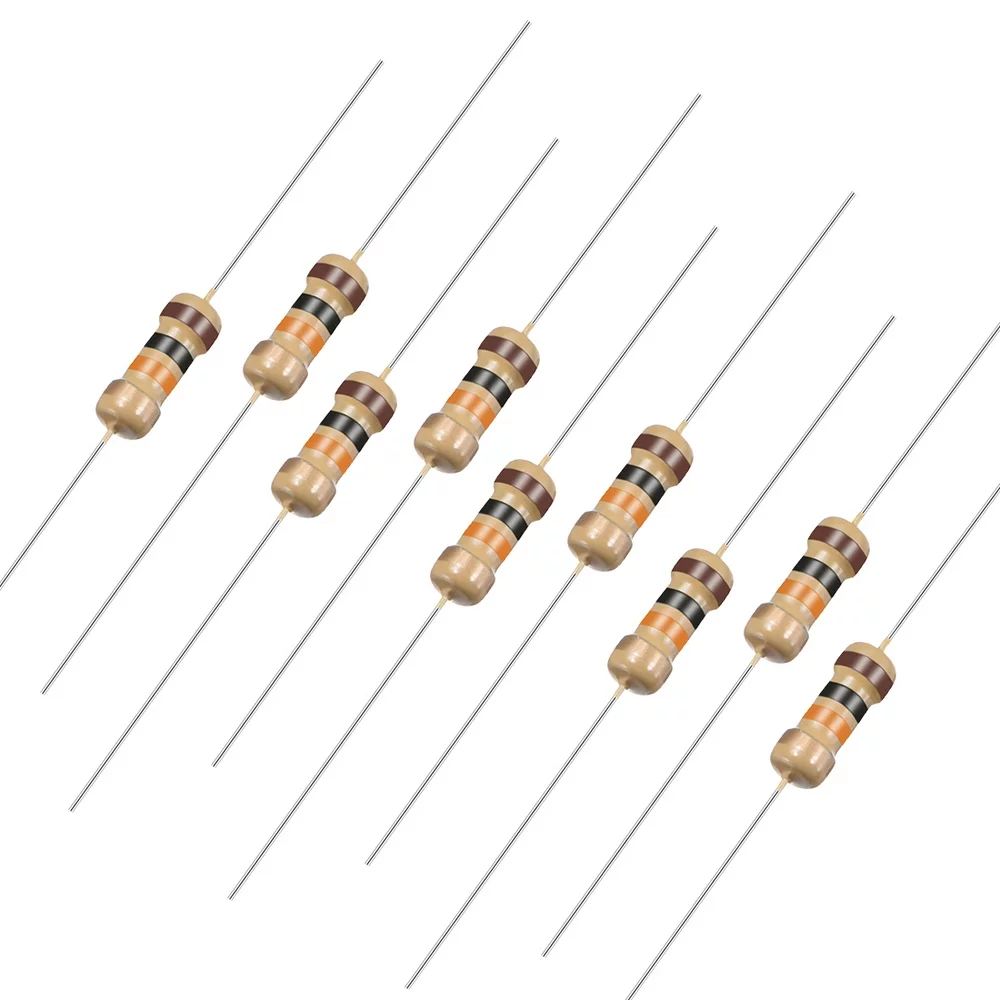
10 Ohm 0.25W Carbon Film Resistor (Pack of 50)
Use low-value resistors for bias stabilisation and emitter degeneration in your RF LNA designs. Pack of 50 keeps your prototyping stock well-stocked.
Frequently Asked Questions
Q: What is a good noise figure for an SDR receiver LNA?
For most hobbyist SDR applications — weather satellite reception (137 MHz), ADS-B aircraft tracking (1090 MHz), NOAA APT images, FM DX — an LNA with NF below 1.5 dB and gain of 15–20 dB is excellent. The popular SPF5189Z-based modules achieve this and cost under ₹500. For extreme weak-signal work (radio astronomy, EME moon bounce), NF below 0.5 dB is desirable but requires cryogenic cooling or specialised GaAs/InP devices.
Q: Does higher gain always improve receiver sensitivity?
Only up to a point. Adding gain reduces the noise contribution of later stages, but once the first-stage gain is sufficient (typically 15–20 dB), additional gain provides diminishing returns. Excess gain causes strong local signals to overdrive the receiver — creating intermodulation products that block weak signals. Always pair high-gain LNAs with appropriate bandpass filtering.
Q: How do I measure the noise figure of my LNA without a noise analyser?
The Y-factor method using a noise source is the professional technique, but requires a calibrated noise source. For hobbyists, a practical approach is comparative testing: measure the SNR of a known weak signal with and without the LNA in-line using your SDR software’s waterfall display. The improvement in dB approximates your system NF improvement. Alternatively, online tools like SDR Console report estimated noise floor that can be compared before and after adding an LNA.
Q: What causes a transistor’s noise figure to be higher than specified?
Several factors: operating at incorrect bias current, using a non-optimal source impedance (not matching to Γ_opt), operating far above the transistor’s useful frequency range, poor PCB layout adding parasitic ground inductance, supply voltage noise coupling into the circuit, or working at elevated temperature (higher ambient temperature in India increases thermal noise as described earlier).
Q: Can I build a useful LNA for amateur radio from components available in India?
Absolutely. For HF (1–30 MHz): a simple common-emitter stage using BFR84 or 2N5179 with a tuned LC matching network achieves NF of 2–4 dB — perfectly adequate for HF DX work. For VHF/UHF (100–500 MHz): BF998 dual-gate MOSFETs are occasionally available in India and achieve 0.7–1.5 dB NF. For microwave frequencies, import pHEMT ICs like SPF5189Z or MGA-16116 from Chinese suppliers via IndiaMART.
Zbotic stocks transistors, capacitors, resistors, and PCB prototyping materials to get your RF projects off the ground. Shop online and get components delivered to your door anywhere in India.



Add comment