
The N20 micro gear motor is one of the most popular choices for robotics and miniature automation projects in India. Compact enough to fit in a matchbox yet capable of delivering useful torque at precisely controlled speeds, the N20 has become a go-to component for hobbyists, students, and professional engineers alike. In this comprehensive guide, we cover everything you need to know — from internal specifications and RPM variants to wiring, control, and the best hands-on projects you can build today.
What Is an N20 Micro Gear Motor?
The N20 is a miniature DC gear motor defined primarily by its rectangular metal gearbox — typically measuring 10 mm × 12 mm in cross-section with a total length ranging from 20 mm to 32 mm depending on the gear ratio and encoder option. The “N20” designation comes from the motor can diameter (approximately 20 mm) used internally before the gearhead is attached.
These motors integrate a small brushed DC motor (usually 6 V or 12 V rated) directly coupled to a precision planetary or spur gearbox. The result is a device that trades raw speed for usable mechanical torque — exactly what robotic wheels, pan-tilt mechanisms, and dispensing systems need.
N20 motors are available from many manufacturers across a wide voltage (1.5 V–12 V) and speed (10 RPM–2000 RPM) range, making them extraordinarily flexible for prototyping. They are particularly popular in Indian DIY communities because of their low cost, easy availability, and compatibility with standard motor-driver ICs.
Internal Construction & How It Works
Understanding the internals helps you choose the right variant and troubleshoot problems:
- DC Motor Core: A small coreless or iron-core brushed DC motor. Coreless variants (often marked “precious metal brushes”) offer lower noise and longer brush life — ideal for camera sliders or medical devices. Iron-core versions are cheaper and handle higher stall currents.
- Gearbox: Usually a single-stage or multi-stage spur gearbox housed in a steel or zinc alloy casing. The gear ratio is stamped on the motor — e.g., 1:100 means one output shaft rotation for every 100 motor rotations.
- Output Shaft: Typically 3 mm diameter, available in D-shaped or round profiles. D-shaft variants are better for press-fitting wheels and hubs without set screws.
- Optional Encoder: Some N20s include a magnetic Hall-effect encoder on the motor shaft rear, adding two extra signal wires (A and B phases) for closed-loop position and speed control.
Key Specifications at a Glance
While specifications vary between manufacturers, the following table covers typical values for a standard 6 V N20 micro gear motor in popular RPM variants:
| Parameter | Typical Value |
|---|---|
| Operating Voltage | 3 V – 12 V (commonly 6 V) |
| No-Load Current | 30 mA – 60 mA |
| Stall Current | 0.5 A – 1.5 A |
| Stall Torque | 0.5 kg·cm (100 RPM) to 6 kg·cm (30 RPM) |
| Shaft Diameter | 3 mm (D-type or round) |
| Gearbox Material | Steel or zinc alloy |
| Motor Dimensions (approx.) | 10 × 12 × 26 mm |
| Weight | 9 g – 15 g |
RPM Options: Choosing the Right Speed
N20 motors are manufactured in an impressive range of gear ratios, which translate directly to output shaft speed. Common RPM variants (at 6 V) and their ideal applications include:
- 10–30 RPM: Very slow, very high torque. Perfect for clock mechanisms, rotating display platforms, and automatic seed dispensers.
- 50–100 RPM: The sweet spot for small robot wheels (30–40 mm diameter), giving ground speeds of 0.1–0.2 m/s — comfortable for tabletop robots and sumo bots.
- 150–200 RPM: Good for conveyor belts, vending-machine turrets, and camera pan-tilt platforms where moderate speed and decent torque are both needed.
- 300–500 RPM: Faster motion but reduced torque. Suitable for fan impellers, small stirrers, and toy cars.
- 1000–2000 RPM: Essentially using the gearbox as minimal reduction — high speed, low torque. Rarely the first choice; a plain DC motor is usually better here.
Quick selection rule: Estimate the force your application needs, calculate the torque at the wheel/arm, then pick an RPM variant whose stall torque is at least 3× your required running torque. This gives you a comfortable safety margin and prevents the motor from running hot.
Torque vs. Speed Trade-off Explained
All DC motors follow a linear torque-speed curve. At zero load (no torque demanded), the motor spins at maximum free-run speed. As mechanical load increases, speed drops proportionally until — at stall — the shaft stops completely but maximum torque is delivered.
In the N20’s gearbox, every doubling of the gear ratio halves the output speed while roughly doubling the output torque (gearbox efficiency ~70–85%). This is why a 30 RPM N20 can lift a small robot’s chassis while a 300 RPM version cannot — even though they use the same internal DC motor core.
For best efficiency, operate the motor at 40–60% of its stall torque. This is where the power curve peaks and heat generation is minimised.
Wiring & Powering the N20 Motor
The basic N20 (without encoder) has just two wires — motor positive and motor negative. Reversing polarity reverses the direction; there is no polarity-sensitive component inside.
Power Supply Requirements
- Use a regulated supply at the motor’s rated voltage (most hobby N20s are 6 V).
- Budget for stall current on the supply — 1.5 A per motor is a safe ceiling for driver selection.
- Never power the N20 directly from an Arduino 5 V pin. The stall current will brown out the microcontroller.
- Add a 100 µF electrolytic capacitor across the motor terminals and a 100 nF ceramic capacitor close to the driver IC to suppress commutation noise.
Encoder Wiring (for encoder versions)
Encoder N20s have 6 wires: M+ and M− for the motor, plus VCC, GND, ENC-A, and ENC-B for the encoder. Connect VCC to 3.3 V or 5 V (check datasheet), ENC-A and ENC-B to interrupt-capable pins on your microcontroller, and use the quadrature signals to read position and direction.
Controlling Speed & Direction
N20 motors need a motor driver IC between them and your microcontroller. Never connect the motor directly to GPIO pins.
PWM Speed Control
Apply a PWM signal (typically 1–20 kHz) to the driver’s enable or IN pins. A duty cycle of 50% delivers approximately half the rated voltage to the motor, resulting in roughly half the no-load speed. Most motor driver ICs accept standard 3.3 V or 5 V logic levels.
Recommended Driver ICs
- DRV8833: Best for N20. 1.5 A per channel, 2.7–10.8 V, very low RDS(on), minimal heat on small loads. Two channels let you drive two N20s independently.
- TB6612FNG: 1.2 A continuous per channel, 4.5–13.5 V motor voltage, 3.3/5 V logic compatible. Excellent for battery-powered robots.
- L298N: Works but wastes ~2 V in internal dropout — not ideal for 6 V N20 motors as effective voltage drops to ~4 V.
- MX1508 / L9110S: Ultra-cheap dual-channel options rated 1.5 A — fine for light loads and breadboard experiments.

25GA-370 12V 12RPM DC Reducer Gear Motor
A robust 12 V DC gear motor in the same spirit as the N20 — ideal when you need higher torque and a 12 V supply in your project.
Best Projects to Build with N20 Motors
1. Line-Following Robot
A classic first robotics project. Use two 100–150 RPM N20 motors mounted on a small chassis, IR line sensors, and an Arduino Uno or Nano. A TB6612 or DRV8833 driver handles motor control. The compact size of N20 motors keeps the robot small and agile, making it easy to navigate tight curves on the track.
2. Micro Sumo Robot
Sumo robots need maximum torque to push opponents out of the ring. Choose 50–80 RPM N20s on rubber-tyred wheels. Pair with ultrasonic or IR sensors for opponent detection. The low RPM provides the pushing force needed to outmuscle heavier competitors.
3. Automated Pan-Tilt Camera Mount
N20 motors at 30–60 RPM with encoder feedback allow smooth, precise pan and tilt motion. Use a PID loop in firmware to hold position against vibrations. This is an excellent project for learning closed-loop control fundamentals.
4. Miniature Conveyor Belt
A 100 RPM N20 with a D-shaft pulley and an elastic band creates a tiny but functional conveyor. Add a weight sensor to count items — useful for automated sorting or a candy-dispensing machine.
5. Differential-Drive Balancing Robot
Two 200–300 RPM N20s with encoders, an MPU-6050 IMU, and a PID controller on an Arduino can produce a self-balancing robot. This is an advanced project that teaches control theory, sensor fusion, and real-time firmware design.
6. Automatic Plant Watering Robot
A slow 30 RPM N20 drives a threaded rod to position a water nozzle over different pots. A small submersible pump delivers water. Arduino + RTC module automates the schedule. The motor’s self-holding torque at stall keeps the nozzle positioned without constant power.
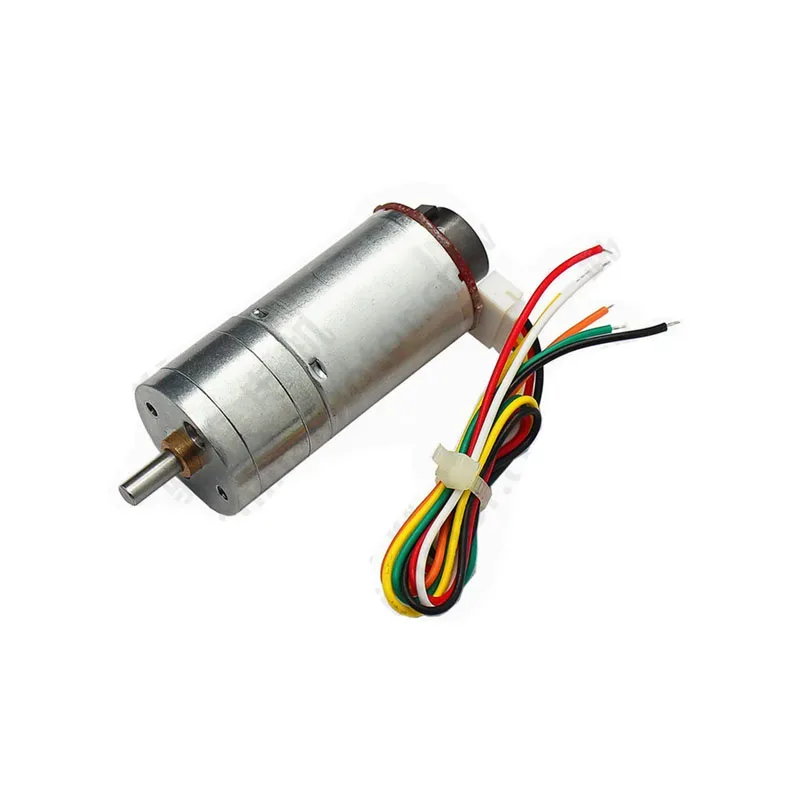
25GA-370 12V 12RPM DC Reducer Gear Motor with Encoder
When your N20-class project needs closed-loop feedback, this gear motor with built-in encoder is the natural next step.
Buying Tips & What to Watch Out For
- Verify the voltage rating: N20s are sold at 1.5 V, 3 V, 6 V, and 12 V. Running a 3 V motor at 6 V will destroy it quickly. Running a 12 V motor at 6 V halves its speed — sometimes intentional.
- Check gear ratio labelling: Some sellers label by output RPM, others by ratio. Confirm which you are buying.
- Inspect the shaft type: D-shaft is strongly preferred for wheel attachment. Round shafts require set-screws or adhesive, which can slip.
- Metal vs plastic gears: Plastic gear N20s exist and are cheaper but wear out under repeated stall conditions. Metal gearbox variants last far longer in robotics applications.
- Encoder resolution: Common options are 7 CPR, 12 CPR, and 16 CPR (counts per motor revolution). After gearbox multiplication, a 100-RPM motor with a 1:100 ratio and 12 CPR encoder gives 1200 counts per output shaft revolution — plenty of resolution for position control.
- Buy extras: At their price point, it makes sense to buy 2–4 spare motors. Brush wear and accidental stall damage can take motors out unexpectedly mid-project.

25GA-370 12V 1360RPM DC Reducer Gear Motor
Need higher output RPM from a gear motor? This 1360 RPM variant suits conveyor belts, mixers, and faster rolling robots.
Frequently Asked Questions
What voltage should I use for an N20 motor?
Always use the rated voltage printed on the motor or its datasheet — most hobby N20s are rated 6 V. Running slightly below (e.g., 5 V for a 6 V motor) reduces speed and torque proportionally but is safe. Running above the rated voltage increases speed but significantly shortens brush and gearbox life.
Can I control an N20 motor directly with Arduino?
No. Arduino GPIO pins are rated for 40 mA maximum, while N20 motors draw 30–60 mA at no load and up to 1.5 A at stall. Always use a dedicated motor driver IC such as the DRV8833, TB6612, or L298N between the Arduino and the motor.
What is the difference between a plain N20 and an encoder N20?
A plain N20 provides no position feedback — you can only control it open-loop via PWM duty cycle. An encoder N20 adds a magnetic Hall-effect sensor that generates quadrature pulses, enabling closed-loop speed and position control with a PID algorithm.
Why does my N20 motor get hot?
Heat is normal under load but excessive heat indicates the motor is running near or at stall continuously. Ensure your load torque is well below the stall torque, or switch to a lower RPM (higher torque) variant. Also check that your supply voltage matches the motor rating.
Can I run N20 motors from a LiPo battery?
Yes. A single-cell LiPo (3.7 V nominal, 4.2 V fully charged) is compatible with 3 V–6 V rated N20 motors. For 6 V motors, a 2S LiPo (7.4 V nominal) is slightly above rating — a motor driver with current sensing or a regulated 6 V step-down is safer.
How long do N20 motors last?
Metal-gear N20 motors with carbon brushes typically last 100–500 hours of run time under normal loads. Precious-metal brush variants extend this to 1000+ hours. Gearbox life depends heavily on lubrication — apply a tiny amount of silicone grease to the gear teeth during assembly if you open the gearbox.
Which N20 RPM is best for a line-following robot?
100–150 RPM at 6 V is the most common choice for 40 mm diameter wheels. This yields a ground speed of around 0.2–0.3 m/s — fast enough to be interesting but slow enough to allow the PID controller to make corrections without overshooting.



Add comment