
Table of Contents
- Why Frame Material is the Most Important Build Decision
- Carbon Fiber Drone Frames: The Gold Standard
- Nylon and Glass-Fibre Reinforced Frames
- PCB Frames: The Integrated Electronics Approach
- Full Comparison Table
- Which Frame for Which Use Case?
- Cost Reality Check for Indian Builders
- Repairability and Long-Term Maintenance
- Top Drone Frames from Zbotic
- Frequently Asked Questions
Every drone build starts with the frame — and the material you choose determines not just the weight and durability of your aircraft, but its entire flight character. A 200g carbon fibre freestyle quad feels completely different from a 450g nylon quadcopter with identical electronics, even with the same motors, ESCs, and props. Choose wrong and you will be fighting the frame for the entire life of your build.
In India’s growing drone hobbyist scene, builders face a unique challenge: import duties make carbon fibre frames significantly more expensive than in Western markets, while locally available nylon injection-moulded frames have improved dramatically in quality. This guide cuts through the marketing hype and gives you the real picture on each material — so you can make the right choice for your build, your budget, and your flying goals.
Why Frame Material is the Most Important Build Decision
The frame is the skeleton on which every other component depends. It determines:
- Total weight: Directly controls flight time, agility, and thrust-to-weight ratio
- Vibration transmission: Affects gyroscope readings and PID loop stability
- Crash survivability: How many crashes you get before replacing parts
- Thermal management: How well heat from ESCs and motors dissipates
- Electromagnetic compatibility: Carbon fibre is conductive; PCB frames have copper traces everywhere
- Repairability: Whether you can fix a broken arm for ₹200 or must replace the entire frame for ₹4,000
Unlike motors or ESCs which can be upgraded independently, your frame choice affects every single aspect of the drone’s performance and ownership experience.
Carbon Fiber Drone Frames: The Gold Standard
Carbon fibre reinforced polymer (CFRP) has dominated competitive drone building since 2014 for very good reasons. It offers an extraordinary stiffness-to-weight ratio that no other material at a reasonable price can match.
How Drone-Grade Carbon Fibre is Made
Drone frames use woven carbon fibre cloth impregnated with epoxy resin and cured under heat and pressure. The result is a sheet material that is machined (CNC cut) to shape. The key properties are:
- Specific stiffness: Carbon fibre is 3–4x stiffer than aluminium per unit weight. This means thinner, lighter arms that resist flex under load.
- Tensile strength: ~3,500 MPa compared to ~270 MPa for structural aluminium. Enormously strong in tension.
- Low density: 1.6 g/cm³ versus 2.7 g/cm³ for aluminium and 1.13 g/cm³ for nylon
Grades of Carbon Fibre in Drone Frames
Not all carbon fibre sold as drone frame material is equal. The market has several grades:
- 3K weave carbon fibre: Three bundles of 1,000 filaments per weave point. Standard in most mid-range frames. Good stiffness and strength, clearly visible weave pattern.
- 12K weave: Coarser weave, slightly lower stiffness per thickness but still excellent. Often used in thicker structural plates.
- Unidirectional carbon fibre: Fibres run in a single direction — maximises stiffness along that axis. Used in premium frame arms for exceptional rigidity.
- Cheap carbon fibre lookalikes: Some frames use fibreglass with a thin carbon fibre layer laminated on top for appearance. These have fibreglass mechanical properties (much more flexible, heavier). Look for frames specifying T300 or T700 carbon fibre grade from verifiable brands.
Carbon Fibre Frame Advantages
- Lowest weight for a given stiffness — critical for agility and flight time
- Minimal vibration transmission to the flight controller — cleaner gyro data
- Excellent heat management — carbon fibre wicks heat away from motor mounts
- Professional aesthetic — the standard look for racing and professional drones
- Easier to achieve sub-250g weight class builds
Carbon Fibre Frame Disadvantages
- Cost: In India, quality CF frames start at ₹2,500 and can exceed ₹15,000 for professional builds
- Conductivity: Carbon fibre is electrically conductive. A bare frame that touches exposed solder joints can cause shorts. All solder joints must be properly insulated.
- Shatters under severe impact: While strong, carbon fibre is brittle rather than ductile. A hard enough crash (especially on hard surfaces) will crack or shatter arms.
- Carbon dust hazard: Machining or sanding carbon fibre produces carcinogenic micro-fibre dust. Always wear N95 masks and eye protection when working with it.
- Difficult to repair: A cracked carbon fibre arm typically means replacement, not repair
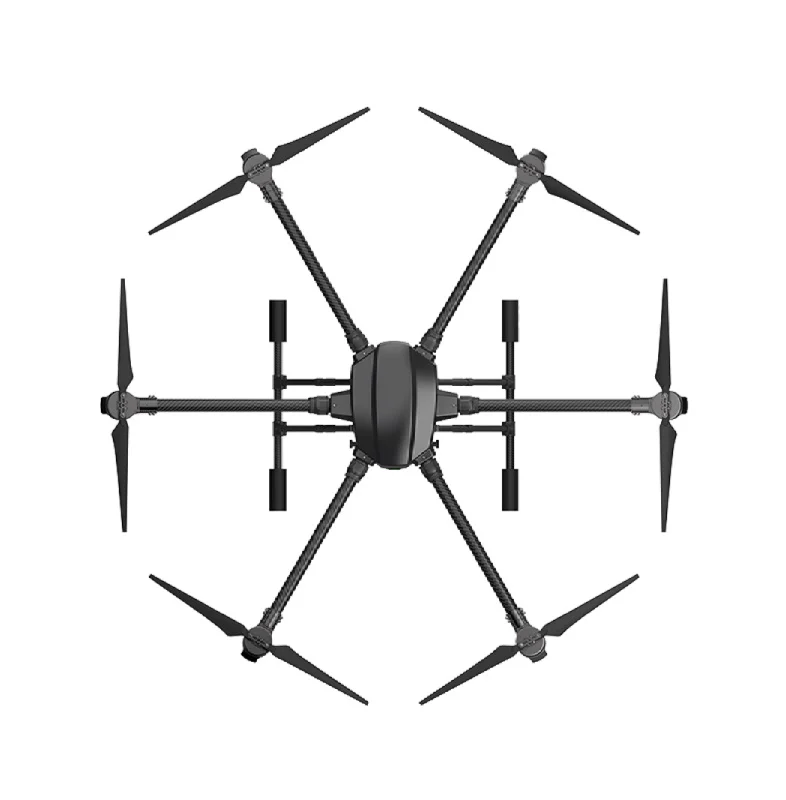
EFT 6120 Multifunction Surveillance Drone Frame
A professional hexacopter frame with carbon fibre construction, designed for surveillance and inspection applications requiring maximum payload capacity and structural reliability.
Nylon and Glass-Fibre Reinforced Frames
Injection-moulded nylon frames, sometimes reinforced with glass fibre (GF) or carbon fibre short-cut particles, represent the majority of budget and mid-range drone frames sold in India. They dominated the market before carbon fibre became affordable and still have compelling advantages for specific use cases.
Types of Nylon Composites Used in Drone Frames
- Pure PA66 Nylon: Standard engineering nylon. Tough, flexible, and absorbs impact rather than cracking. The flexibility that makes it crash-tolerant also makes it flexible under load — not ideal for high-performance builds.
- GF30 (30% Glass Fibre Nylon): Much stiffer than pure nylon while retaining significant toughness. The most common material for mid-range frames. Reasonably priced and widely available.
- CF20 Nylon (20% Carbon Fibre Particle): Short carbon fibre strands mixed into nylon during moulding. Stiffer than glass fibre composites, lighter, but not as strong as woven carbon fibre sheet. A good middle ground.
Nylon Frame Advantages
- Crash resistance: Nylon absorbs impact energy through plastic deformation. Arms flex and return rather than shattering. Ideal for beginners who crash frequently.
- Cost: Injection-moulded nylon frames are dramatically cheaper than carbon fibre — budget frames start at ₹300–₹800, mid-range at ₹800–₹2,500.
- Non-conductive: No risk of electrical shorts from frame contact. Safer for prototypes and student builds.
- Repairability: Broken nylon arms can sometimes be repaired with epoxy or superglue (CA glue). Even a full replacement is cheap.
- UV and chemical resistance: PA66 nylon resists oil, petrol, and many solvents — relevant for agricultural drones that operate in pesticide environments.
- Available locally: Can be found at robotics suppliers across India’s tier-1 and tier-2 cities
Nylon Frame Disadvantages
- Weight: Nylon composite frames are significantly heavier than equivalent-size carbon fibre frames — often 30–60% heavier for the same arm length
- Flex and vibration: Nylon arms flex under motor load, creating vibration that shows up in gyro data as high-frequency noise. This makes Betaflight PID tuning harder and requires higher D-term filtering.
- Moisture absorption: Nylon absorbs atmospheric moisture, which changes its mechanical properties slightly over time. In India’s monsoon climate, outdoor nylon frames require occasional inspection.
- Not suitable for high-speed FPV: At speeds above 80 km/h, arm flex causes handling instability
PCB Frames: The Integrated Electronics Approach
PCB (Printed Circuit Board) frames are a fascinating category that blurs the line between structure and electronics. Instead of a separate frame with components mounted to it, the PCB frame IS both the structural frame AND the power distribution board — the copper traces carry battery power to the ESCs, eliminating the need for wire harnesses between the arms.
How PCB Frames Work
The centre plate (and sometimes the arm plates) of a PCB frame is a multi-layer FR4 fibreglass circuit board. The outer layers have solder pads for ESCs, motors, battery connectors, and sometimes even the flight controller. The inner copper layers carry 1–3 oz copper traces that handle motor current.
PCB frames were popular in the 2014–2017 era of micro and mini quads, exemplified by builds like the Lumenier QAV250 which used a PCB-based power distribution frame design. Modern equivalents continue in the mini quad and Toothpick (ultra-lightweight) categories.
PCB Frame Advantages
- Integrated wiring: No separate PDB needed. Motor ESC solder points are directly on the frame. Dramatically reduces build complexity and weight from wiring.
- Compact integration: Perfect for micro drones (85mm, 100mm, 115mm class) where space is extremely tight
- Weight savings: Eliminating wire harnesses saves 5–20g on small builds
- Clean aesthetics: No spaghetti wiring. Builds look professional and structured.
- Cost-effective at small scale: For micro drones, a PCB frame + PDB in one is cheaper than buying them separately
PCB Frame Disadvantages
- FR4 fibreglass is heavier and more flexible than carbon fibre: At arm lengths beyond 90mm, FR4 flex becomes problematic for performance
- Repair complexity: A cracked PCB frame arm may have broken copper traces — now you have a structural AND electrical failure simultaneously
- Current limits: Even 2 oz copper traces in PCB can only handle so much current before overheating. Most PCB frames are limited to 4S 20–30A per motor maximum
- Not suitable for large builds: PCB frames are practical for 65mm–130mm builds. Above 150mm, separate carbon fibre frames with dedicated PDBs are superior.
- Heat management: Copper traces spread heat, but FR4 is a poor thermal conductor compared to carbon fibre. Motor heat buildup can be problematic.
Full Comparison Table
| Property | Carbon Fibre | Nylon/GF | PCB Frame |
|---|---|---|---|
| Weight | Excellent | Average | Good (small builds) |
| Stiffness | Excellent | Average | Average |
| Crash Resistance | Average | Excellent | Good |
| India Cost (5″) | ₹2,500–₹8,000 | ₹400–₹2,000 | ₹600–₹2,500 |
| Vibration | Very Low | High | Medium |
| Repairability | Low | High | Low |
| Electrical Conductivity | Conductive (risk) | Insulating (safe) | Integrated (by design) |
| Best Use Case | Racing, freestyle, professional | Training, agri, large UAV | Micro drones, Toothpick |
Which Frame for Which Use Case?
FPV Racing (Competition)
Material: Carbon Fibre — mandatory
Weight and stiffness directly translate to lap times. Any flex in the frame arm changes the propeller angle under load and introduces gyro noise that PID controllers cannot fully compensate. Professional race frames (ImpulseRC Apex, TBS Source One, Armattan Marmotte) all use carbon fibre. For Indian racers, look for quality CF frames with replacement arm availability.
FPV Freestyle
Material: Carbon Fibre — strongly recommended
Freestyle quad arms take enormous stress during split-S manoeuvres, power loops, and proximity flying. Stiff arms mean predictable, precise flight dynamics. A nylon frame will feel mushy and imprecise during aggressive manoeuvres.
Aerial Photography (Beginner)
Material: Nylon — good starting point
Beginners crash frequently. The extra weight of a nylon frame is irrelevant for slow, stable aerial photography, and the crash resistance saves hundreds of rupees in broken arms. Build on nylon, learn to fly, then upgrade to carbon fibre when your flying skills improve.
Agricultural Drone Operations
Material: Carbon Fibre or GF Nylon depending on build size
Large agricultural hexacopters (6–16 litre tank capacity) use carbon fibre tubing and carbon fibre plates for their structural members — the size makes injection-moulded nylon impractical. Mid-size builds (1–3 litre) often use glass fibre nylon composites that resist agricultural chemical exposure.
Indoor Training / Educational Platforms
Material: Nylon — ideal
Nylon frames handle daily crashes in school robotics labs and training environments. Non-conductive, safe, cheap to replace. Nobody wants to maintain a fleet of carbon fibre training drones.
Micro FPV (65mm–115mm)
Material: PCB Frame or Carbon Fibre — your choice
At this size, PCB frames make sense for their integrated wiring benefits. As you move toward 115mm and beyond, purpose-made carbon fibre micro frames (Toothpick style) offer better performance.
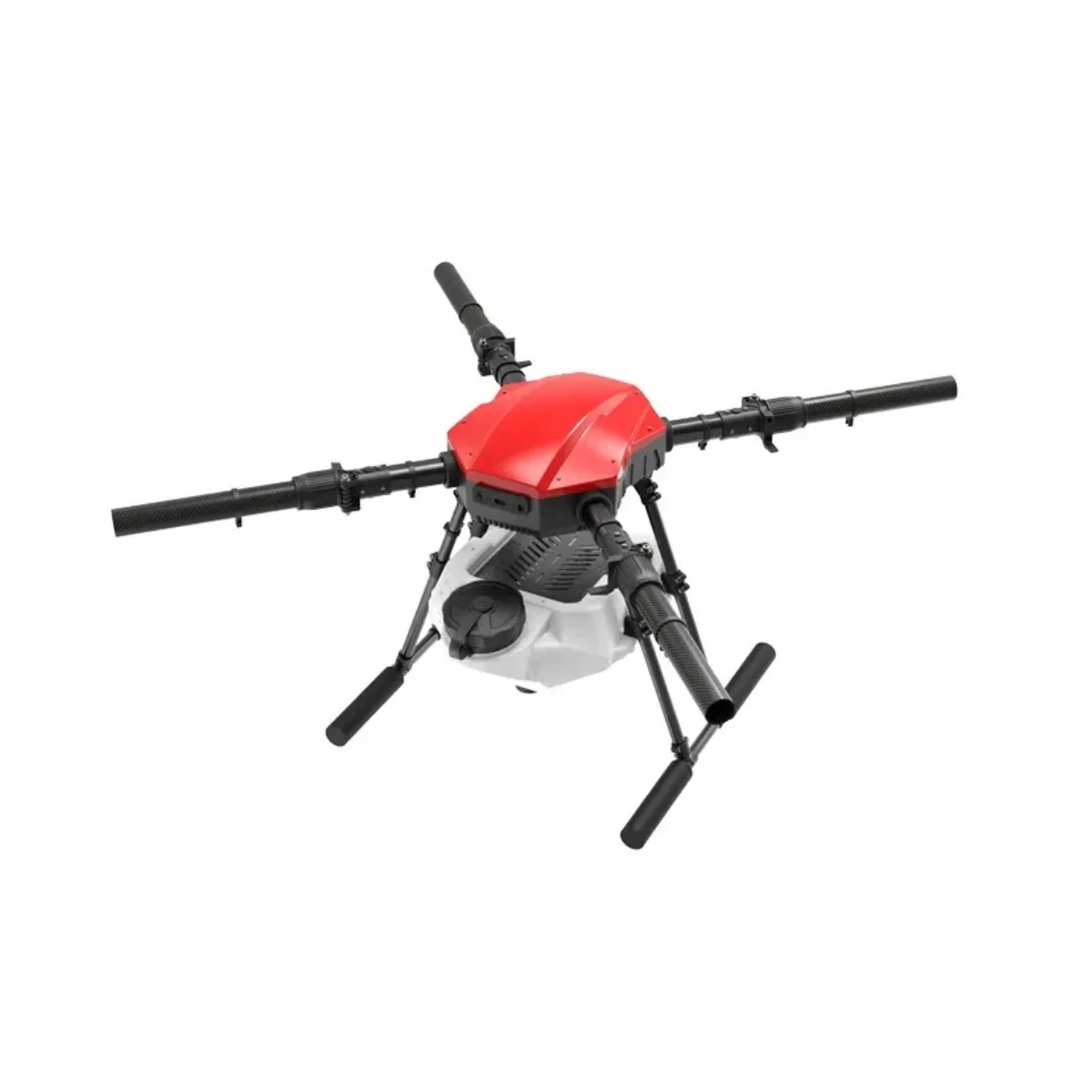
EFT E410P 10L 4-Axis Agricultural Drone Frame
A heavy-duty 10-litre agricultural spray drone frame built for field durability — combines carbon fibre structural members with reinforced joints for chemical spray operations in Indian fields.
Cost Reality Check for Indian Builders
Import duties, GST, and shipping costs make drone components significantly more expensive in India than their US or EU list prices. Here is what you can realistically expect to pay:
Carbon Fibre Frames in India (2026 Prices)
- Budget CF frames (Chinese brands, 3-inch to 5-inch): ₹1,200–₹3,500 from AliExpress with India shipping
- Mid-range CF frames (Rekon, Diatone, Flywoo): ₹3,500–₹7,000 from Indian importers or Zbotic
- Premium CF frames (ImpulseRC, Armattan, TBS): ₹7,000–₹18,000 — often requiring direct import
- Large professional CF frames (hexacopter, agricultural): ₹8,000–₹35,000
Nylon Frames in India
- Budget F450/F550 style frames: ₹400–₹900
- Mid-range GF nylon frames: ₹900–₹2,500
- Quality agricultural nylon frames: ₹2,500–₹8,000
Hidden Costs to Consider
Frame cost is just the beginning. Factor in: standoffs (₹50–₹300), hardware (M2/M3 screws, nylon nuts — ₹100–₹400), vibration dampeners for FC mounting (₹50–₹200), and replacement arms. Carbon fibre arm replacements for popular frames cost ₹300–₹1,500 each. Budget for 2–3 replacement arms per year if you fly regularly.
Repairability and Long-Term Maintenance
Inspecting Your Frame After Every Crash
Regardless of material, inspect your frame after every significant crash:
- Carbon fibre: Look for cracks, chips, delamination, and white stress marks (whitening indicates fibre breakage). Run your finger along each arm — any flex that was not there before indicates structural damage.
- Nylon: Check for cracks at arm roots (highest stress area), deformed motor mounts, and elongated bolt holes. Nylon can deform plastically — a bent arm may look intact but has reduced strength.
- PCB frames: Inspect solder joints that took mechanical stress. Check for cracked PCB traces — look for dark discolouration or hairline cracks across copper traces.
When to Replace vs Repair
- Carbon fibre: Replace any arm with visible cracks or delamination. A cracked carbon arm will fail at the worst possible moment — usually at full throttle.
- Nylon: Hairline cracks can be reinforced with thick CA glue + accelerant for temporary use. Cracked motor mounts or arm roots should be replaced.
- PCB: Damaged PCB arms with broken traces should be replaced. Electrical and structural integrity are interdependent.
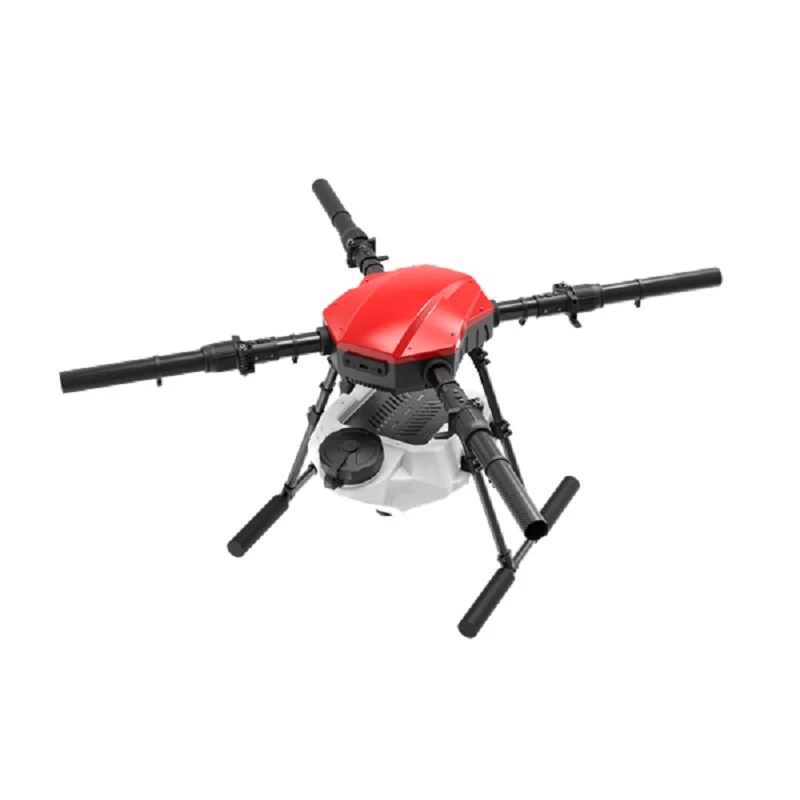
EFT E416P 16L 4-Axis Agricultural Drone Frame
A large-capacity 16-litre agricultural spray drone frame engineered for intensive field use — modular design allows individual arm replacement without disassembling the entire airframe.
Top Drone Frames from Zbotic
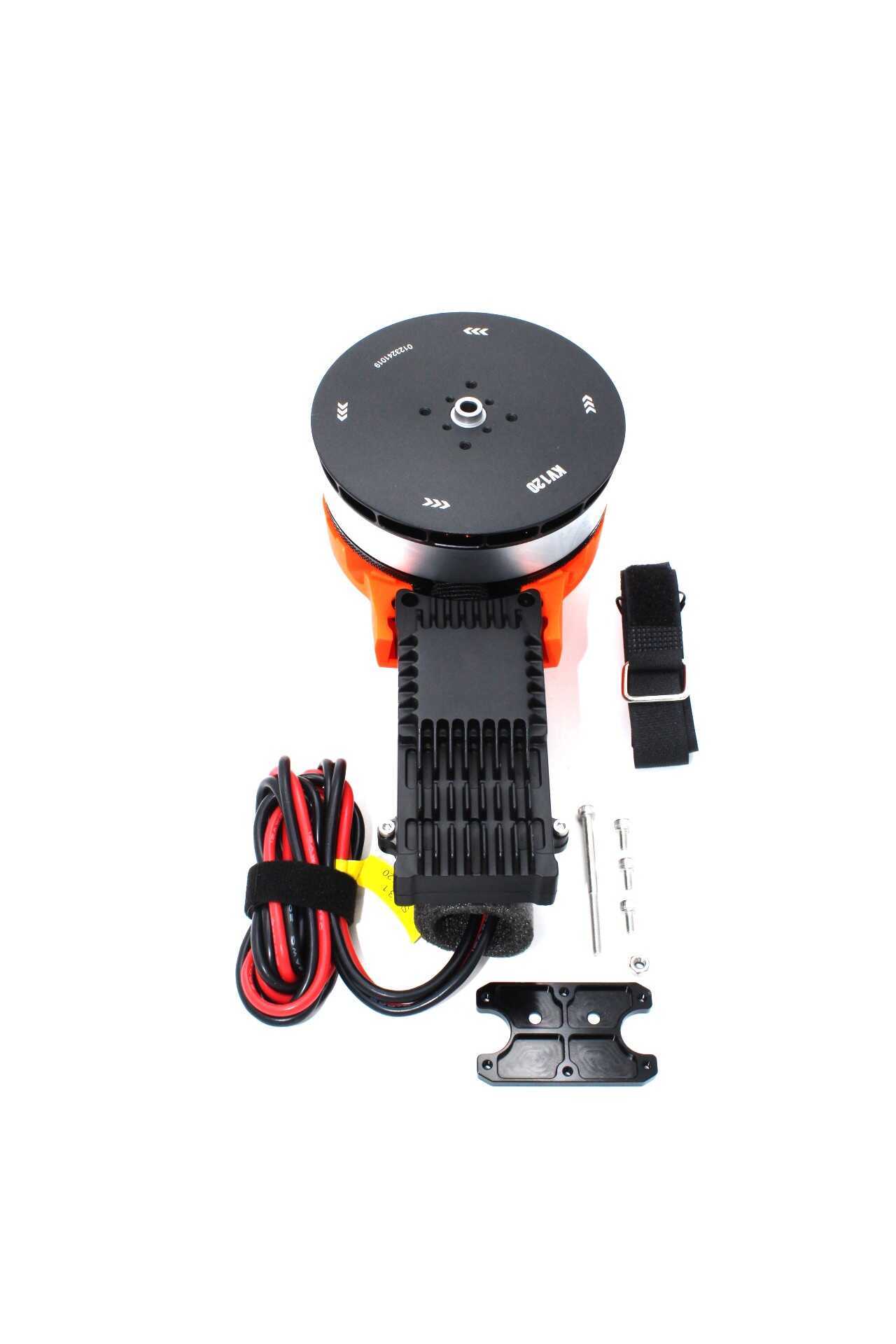
T-Motor A10-KV120-CW Modular Propulsion System
High-performance T-Motor propulsion systems designed for heavy-lift carbon fibre frames — pair with professional carbon frames for drone delivery or inspection builds.

Hobbywing X6 Plus Motor CCW
The Hobbywing X6 Plus is a premium brushless motor for large carbon fibre frames — delivering the efficiency and reliability required for professional drone operations.
Frequently Asked Questions
Is carbon fibre safe to handle in drone frames?
Finished, smooth carbon fibre panels are completely safe to handle with bare hands. The hazard arises only when machining, sanding, or drilling carbon fibre — this releases micro-fibres into the air. Always wear an N95 respirator and safety glasses when cutting or modifying carbon fibre frames. Never sand CF indoors without ventilation.
Can I use a carbon fibre frame for an agricultural drone?
Yes — professional agricultural drones use carbon fibre extensively. However, ensure all solder joints and electronic components are fully sealed with conformal coating or potting compound, as agricultural chemicals (herbicides, pesticides) can corrode exposed copper. EFT’s agricultural frames use treated carbon fibre and sealed arm interfaces for this reason.
My carbon fibre frame makes my GPS module inaccurate. Why?
Carbon fibre is not magnetic but can absorb and reflect radio waves to some extent. More importantly, motor wires running close to the carbon frame create magnetic interference that affects the magnetometer (compass) in your GPS module. Mount your GPS on a tall mast at least 10–15 cm above the frame to get it away from the CF structure and motor interference.
What is the F450 frame — is it carbon fibre or nylon?
The classic DJI F450 and its many clones use a PCB centre plate (with power distribution traces) combined with glass-fibre reinforced nylon arms. It is a hybrid design — not pure carbon fibre. The F450’s arms are GF nylon, which is why they flex under hard manoeuvres. It is an excellent beginner platform but not suitable for FPV freestyle or racing.
How do I know if my cheap carbon fibre frame is actually carbon fibre?
Real carbon fibre is electrically conductive — touch a multimeter probe to both sides of the frame and you should read low resistance (10–1000 Ω depending on thickness and weave direction). Fibreglass with a carbon surface coating will read open circuit (infinite resistance). Also, genuine CF is very dark, almost black, with a visible weave texture. If the weave looks printed rather than structural, be suspicious.
Conclusion
The right frame material depends entirely on what you are building and how you fly. Carbon fibre is the choice for performance, precision, and professional applications — pay the premium and you will not regret it. Nylon composite frames are the smart choice for learners, agricultural applications, and any scenario where crash frequency or chemical resistance matters. PCB frames occupy a clever niche in the micro drone world where integration trumps all. Understanding these trade-offs before you buy means fewer compromises and a build you will be satisfied with for years.







Add comment