
Carbon fibre composite filaments have transformed what is possible with desktop FDM printing. A part that would once require machining aluminium can now be printed in carbon fibre reinforced nylon with near-comparable stiffness at a fraction of the weight and cost. But carbon fibre filaments are not simply “stronger PLA” — they behave differently, demand specific hardware, and require a clear understanding of composite material science to use effectively. This guide covers everything you need to know.
What Is Carbon Fibre Filament?
Carbon fibre 3D printing filament is a composite material: a base polymer — most commonly PLA, PETG, ABS, Nylon, or PEEK — infused or blended with short (chopped) carbon fibre strands typically 0.1–0.5 mm long. The carbon fibres are mixed into the polymer matrix at the filament manufacturing stage, usually at 5–20% by weight.
When melted and extruded, the fibres align partially along the direction of extrusion — the X and Y travel directions — due to shear forces in the nozzle. This alignment gives printed parts significantly increased stiffness (modulus) and reduced weight compared to the base polymer alone. However, unlike woven carbon fibre cloth or continuous fibre reinforcement, chopped CF filament does not dramatically increase tensile strength (the material still breaks at roughly similar forces; it just deflects less before doing so).
Understanding this distinction is critical: carbon fibre FDM filament makes parts stiffer and lighter, not necessarily tougher or more impact-resistant. For applications demanding high stiffness with low weight — drone arms, quadcopter frames, RC car chassis, robotic links, engineering brackets — this is exactly what you need. For parts that must absorb impact without cracking, standard PETG or TPU may actually be better choices.
Types of Carbon Fibre Composite Filaments
The base polymer matters enormously, as it determines the processing conditions, post-print properties, and application suitability. Here are the major types available in India:
PLA + Carbon Fibre (CF-PLA)
The most accessible entry point. Prints at standard PLA temperatures (200–220°C hotend, 40–60°C bed) but produces parts that are stiffer than standard PLA and visually impressive with a matte, textured surface that looks genuinely carbon-fibre-like. The limitation: PLA’s low glass transition temperature (~60°C) means CF-PLA parts deform in hot environments — avoid for under-bonnet automotive use, outdoor applications in Indian summer heat, or anything near electronics that gets warm.
PETG + Carbon Fibre (CF-PETG)
A significant step up. CF-PETG prints at 230–250°C and offers improved heat resistance (HDT ~75–85°C), better chemical resistance, and lower moisture absorption than CF-PLA. This is the sweet spot for many Indian makers: manageable print temperatures, reasonable bed adhesion, and performance suitable for most indoor mechanical applications, RC parts, and electronics enclosures.
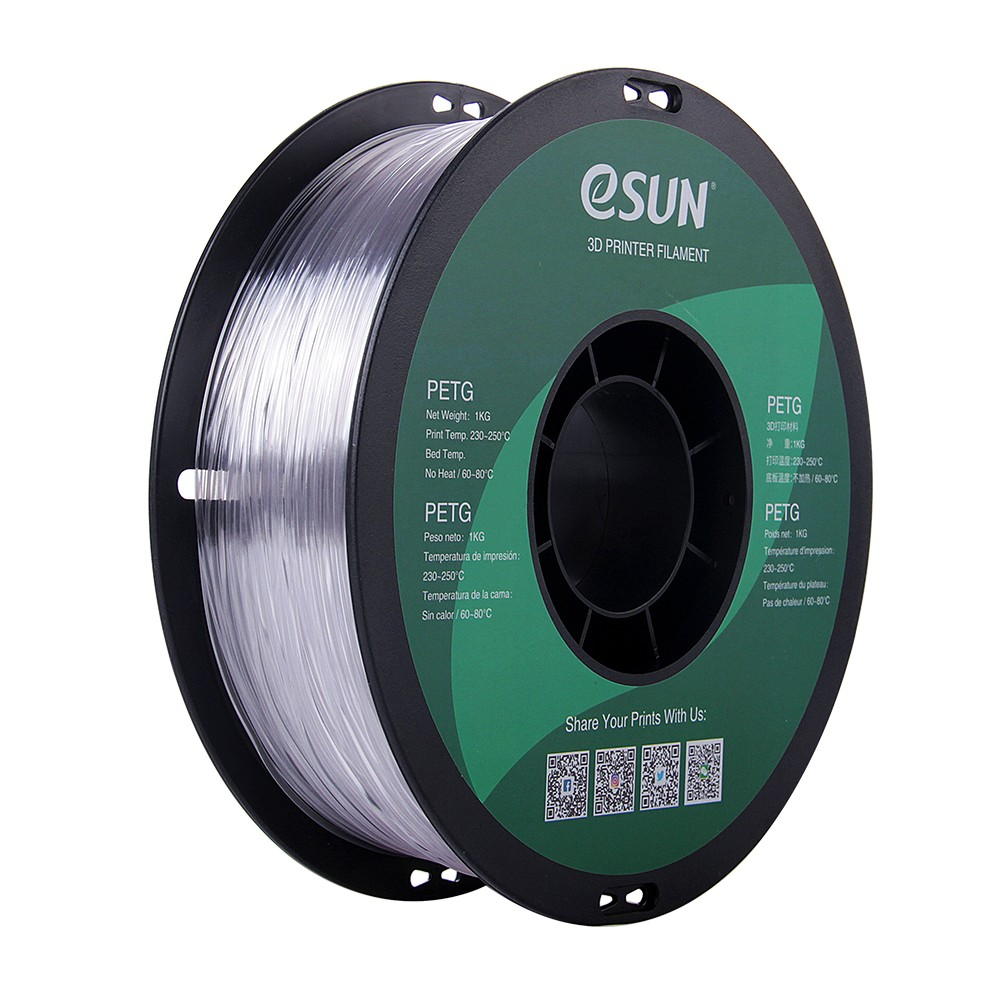
eSun PETG 1.75mm 3D Printing Filament 1kg – Clear
eSun’s PETG filament provides an excellent base material for understanding PETG printing before moving to composite variants. Great chemical resistance and layer adhesion.
ABS + Carbon Fibre (CF-ABS)
For higher temperature applications. CF-ABS prints at 240–260°C and requires an enclosure to prevent warping in India’s variable ambient temperatures. HDT can reach 100°C+, making it suitable for automotive interior components and parts that see brief high-temperature exposure.
Nylon + Carbon Fibre (CF-Nylon)
The engineering-grade choice. CF-Nylon offers the highest combination of stiffness, toughness, and temperature resistance among commonly available CF composites. HDT is typically 110–150°C depending on formulation. The catch: nylon is highly hygroscopic (absorbs atmospheric moisture aggressively), and CF-Nylon even more so. Wet CF-Nylon produces bubbling, poor layer adhesion, and rough surfaces. Filament must be dried before printing (65–80°C for 4–8 hours) and printed from a dry box. In humid Indian conditions (monsoon season in coastal cities), this is a non-trivial challenge.
PEEK / PEKK + Carbon Fibre
Extreme-performance composites used in aerospace and medical applications. Printing temperatures of 380–420°C require a specialised high-temperature printer (all-metal hotend, high-temp bed, enclosed chamber). Not practical for hobbyist use in India currently, but increasingly available for professional applications.
Mechanical Properties and Benefits
To quantify the improvement CF reinforcement brings, consider these approximate figures comparing standard filaments to their CF counterparts:
| Property | Standard PETG | CF-PETG | Standard Nylon | CF-Nylon |
|---|---|---|---|---|
| Tensile Modulus | ~2.1 GPa | ~4.5 GPa | ~1.8 GPa | ~8–12 GPa |
| Density (g/cm³) | 1.27 | 1.20 | 1.14 | 1.10 |
| HDT (°C) | 75°C | 82°C | 75°C | 130–150°C |
| Surface Finish | Glossy/semi-glossy | Matte, textured | Slightly matte | Matte, textured |
The stiffness improvement (2–5× increase in modulus) means parts resist deflection under load far better. A bracket that flexes 2 mm under a given load in standard PETG might flex only 0.5 mm in CF-PETG — a transformative difference for structural applications. The slight reduction in density also means CF parts are marginally lighter than their base polymer equivalents, which matters for drones and aircraft where every gram counts.
Hardware Requirements
This is the section most first-time CF filament buyers skip — and then regret. Carbon fibre particles are abrasive. Within 50–100 grams of CF filament, a standard brass nozzle will be measurably worn. Within 500 grams, it will be so eroded that your extrusion width will be inconsistent and part quality will deteriorate badly. Never print CF filament through a brass nozzle.
Suitable nozzle materials for carbon fibre filaments include:
- Hardened steel nozzles: The minimum requirement. Available in 0.4 mm and other diameters for most printers. Will last many kg of CF filament before showing wear.
- Ruby-tipped nozzles: Sapphire or ruby orifice insert in a brass body — extremely wear resistant, good thermal conductivity. More expensive but very long-lasting.
- Tungsten carbide nozzles: Maximum abrasion resistance for continuous production environments.
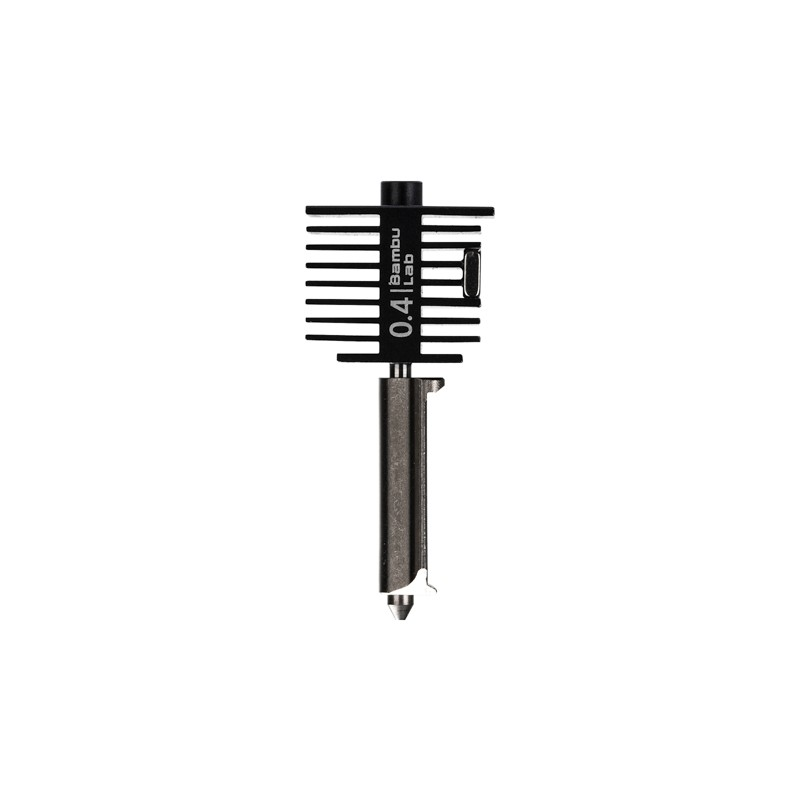
Bambu Lab Hotend with Hardened Steel Nozzle – 0.4mm
Complete hotend assembly with hardened steel nozzle — essential for printing abrasive filaments including carbon fibre, glass fibre, and glow-in-the-dark materials on Bambu Lab printers.
Beyond the nozzle, consider these hardware requirements:
- All-metal hotend: PTFE-lined hotends (e.g., basic Ender 3 hotend) limit printing temperature to around 240°C before the PTFE degrades. CF-Nylon and CF-ABS require 250°C+. Upgrade to an all-metal hotend for these materials.
- Larger nozzle diameter (0.6 mm recommended): Short CF fibres can bridge across small nozzle orifices, causing partial clogs. A 0.4 mm nozzle works but a 0.6 mm nozzle significantly reduces clog frequency with CF filaments.
- Enclosure for CF-ABS and CF-Nylon: These base polymers warp without consistent ambient temperature. A simple cardboard enclosure helps; a proper enclosure printer (Bambu Lab X1C, Voron, etc.) is better.
- Dry storage and dry box: Especially critical for CF-Nylon. Use food dehydrators or purpose-built filament dryers to pre-dry and actively dry during printing.
Print Settings for Carbon Fibre Filaments
Settings vary by brand and specific formulation, but these guidelines apply broadly:
Temperature: Print 5–10°C hotter than your base polymer’s standard setting. CF reinforcement increases viscosity slightly, requiring more thermal energy for proper flow. Start with CF-PLA at 215–225°C, CF-PETG at 240–255°C, CF-Nylon at 255–275°C.
Print Speed: Reduce to 40–60% of your standard speed for CF filaments. Faster speeds combined with increased viscosity lead to under-extrusion. Once you have reliable results, gradually increase speed.
Cooling: Reduce part cooling fan speed significantly or disable entirely for CF-ABS and CF-Nylon. Strong cooling creates inter-layer stress and reduces layer bonding. CF-PLA tolerates moderate cooling.
Layer Height: Keep layer height at 0.5× nozzle diameter or less. At 0.6 mm nozzle + 0.3 mm layers, you get good fibre alignment and layer adhesion. Going thicker risks delamination under load.
Retraction: Reduce retraction distance (1–2 mm for direct drive, 3–5 mm for Bowden) and retraction speed. CF filaments are less elastic than standard filaments, and aggressive retraction can cause fibres to jam in the nozzle throat.
Flow Rate: Calibrate with a flow rate tower specific to your CF filament. CF composites often require 95–100% flow (slightly lower than standard due to fibre content), but this varies by brand.
Infill Pattern: For structural parts, use gyroid or cubic infill patterns. These distribute load isotropically and provide better support to fibres than grid or lines patterns. For maximum stiffness in a known load direction, lines infill aligned with the load direction can outperform isotropic patterns.
Chopped vs Continuous Carbon Fibre
Most consumer CF filaments use chopped (short-fibre) reinforcement. Markforged’s proprietary Continuous Fibre Fabrication (CFF) technology is the primary exception, using a separate print head to lay down continuous carbon fibre tow inside a nylon matrix. The difference in mechanical properties is dramatic:
- Chopped CF filament: 8–12 GPa tensile modulus, ~40–60 MPa UTS (unidirectional)
- Continuous CF (Markforged): 60+ GPa tensile modulus, ~700+ MPa UTS in fibre direction
Continuous fibre printing approaches the performance of machined aluminium but costs significantly more per part. For Indian hobbyists and SME manufacturers, chopped CF filament on a hardened-nozzle FDM printer remains the practical, accessible choice. Continuous fibre systems from Markforged start at $3,000+ for the printer and use proprietary (expensive) materials.
A middle ground gaining traction in India: desktop continuous fibre printers like the Bambu Lab X1C with custom Continuous Fibre upgrades (third-party modifications). Watch this space — the technology is democratising.
Best Applications in India
Carbon fibre composite printing is particularly relevant for several growing Indian industries and communities:
- Drone manufacturing startups: Frame arms, motor mounts, gimbal components — CF-Nylon or CF-PETG prints reduce weight and increase stiffness vs standard filaments. Critical for agricultural drone payload capacity.
- Automotive aftermarket: Interior trim pieces, gauge pod mounts, bracket reinforcements. CF-ABS handles the temperature range of car interiors.
- Robotics and automation: Robot arm links, end-effector brackets, cable management clips. Stiffness is critical when robots are moving heavy payloads at speed.
- Competitive RC racing: Lightweight chassis, bumpers designed to crack (absorb impact) rather than transfer force to electronics. CF-PLA body panels are impressively stiff for their weight.
- Educational engineering projects: IIT, NIT, and engineering college teams use CF filament for satellite frame prototypes, solar car components, and competition robots.
Tips, Tricks, and Common Mistakes
Tip 1 — Always dry before printing: Even CF-PETG benefits from drying at 65°C for 4 hours if the spool has been open for more than a week. Moisture causes bubbling and poor surfaces. In coastal Indian cities during monsoon, this step is non-negotiable.
Tip 2 — Use a smooth PEI build surface: CF filaments don’t adhere well to glass. Textured PEI or smooth PEI with a light coat of glue stick gives reliable adhesion for CF-PLA and CF-PETG. For CF-Nylon, use a garolite (G10) build plate or apply Magigoo PA adhesive.
Tip 3 — Orient parts for the primary load direction: FDM parts are anisotropic — strongest along the extrusion direction (XY plane) and weakest across layers (Z direction). Design or orient your model so the primary load is borne by the XY layers, not across layer boundaries.
Tip 4 — Keep nozzle warm between prints: Don’t let CF filaments cool and re-solidify in the nozzle repeatedly. During pauses, park the nozzle at a lower temperature (e.g., 180°C standby) rather than letting it fully cool. Cold solidified CF material in the nozzle can be hard to restart cleanly.
Common Mistake 1 — Using standard brass nozzle: As covered above, this destroys the nozzle within one spool. Always check your nozzle material before loading CF filament.
Common Mistake 2 — Expecting impact strength: CF parts are stiff but brittle. A CF-PLA bracket will snap cleanly under impact; a standard PETG bracket of the same geometry might flex and survive. For impact-prone applications, standard polymers or TPU are better choices.
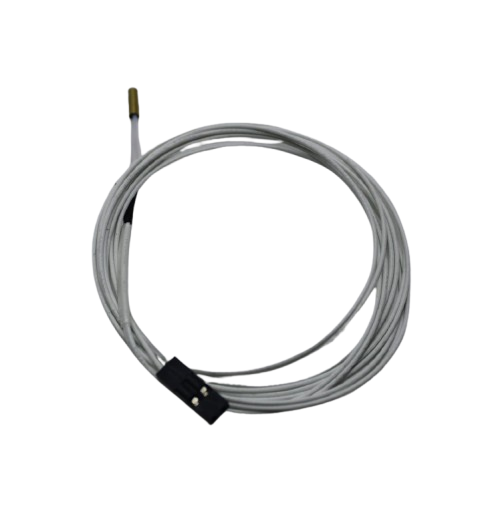
100k NTC Thermistor with Copper Tip for MK8 Extruder
Accurate temperature sensing is critical when printing high-temperature CF composites. Replace worn thermistors to maintain reliable hotend temperature control.
Buying Carbon Fibre Filament in India
The Indian market for CF filaments has matured significantly. Brands now stocked by reputable Indian retailers include eSun, Bambu Lab, Polymaker, FormFutura, and Fiberlogy. Pricing guide for 2026:
- CF-PLA (500g–1kg): ₹1,800–₹3,500 depending on brand and quantity
- CF-PETG (1kg): ₹2,800–₹4,500
- CF-ABS (1kg): ₹3,000–₹5,000
- CF-Nylon (500g): ₹2,500–₹6,000 depending on formulation
When buying, always verify the CF percentage (5–15% is typical for desktop filaments), nozzle diameter recommendation, and whether the brand provides a data sheet with tensile modulus and HDT. Brands that don’t publish data sheets are often selling lower-quality composites.
Frequently Asked Questions
Can I print carbon fibre filament on a stock Ender 3?
Only CF-PLA, and only after upgrading the nozzle to hardened steel. The stock brass nozzle will wear out very quickly. The stock hotend’s PTFE liner limits you to PLA-safe temperatures anyway. For CF-PETG or above, upgrade to an all-metal hotend before attempting.
Is carbon fibre filament toxic to breathe?
Carbon fibre particles and base polymer fumes both require ventilation. CF filaments release the same fumes as their base polymer (ABS fumes being the most concerning) plus fine carbon particulates. Always print in a well-ventilated area. An enclosure with a HEPA + activated carbon filter outlet is the safest setup for regular CF printing.
How do I prevent nozzle clogs with carbon fibre filament?
Use a 0.6 mm or larger hardened nozzle. Print at the upper end of the recommended temperature range. Reduce retraction. Keep filament dry. If a clog occurs, try an atomic pull (cold pull) with regular PLA — heat to printing temp, insert PLA, drop to 90°C, pull sharply. The PLA will drag debris from the nozzle.
Do carbon fibre 3D printed parts conduct electricity?
Most chopped CF filaments are not electrically conductive in the printed part, even though carbon fibre itself conducts. The short fibre length and random orientation means no continuous conductive path forms through the part. However, you should test with a multimeter before using CF prints in sensitive electronic applications.
What layer height should I use for maximum strength with CF filaments?
Use 50–75% of nozzle diameter as layer height for maximum inter-layer adhesion. With a 0.6 mm nozzle, 0.3 mm layers work well. Thinner layers increase print time without significantly improving strength; thicker layers reduce bond area and weaken the part.
Upgrade Your 3D Printer for Composite Filaments
Zbotic stocks hardened nozzles, hotend assemblies, thermistors, and filament accessories needed to successfully print carbon fibre composite filaments. Get your printer ready for engineering-grade materials.





Add comment