
One of the most common mistakes electronics beginners make is grabbing any capacitor with the right capacitance value without checking the voltage rating. This can work fine at first — and then cause a capacitor to fail weeks or months later, or in the worst case, fail explosively the moment the circuit is powered up.
Understanding capacitor voltage rating is not complicated, but it requires paying attention to a few key details that most online tutorials gloss over. This guide explains what the voltage rating means, how to choose it correctly, what derating is and why it matters, and what happens when you get it wrong.
What Is a Capacitor Voltage Rating?
The voltage rating of a capacitor — sometimes called the Working Voltage DC (WVDC) or simply the rated voltage — is the maximum continuous DC voltage the capacitor can withstand across its terminals without risk of breakdown of the dielectric.
This rating is stamped on the capacitor body (for through-hole types) or printed in the component datasheet. For example, an electrolytic capacitor marked 100µF 25V has a capacitance of 100 microfarads and must not be subjected to more than 25 volts across its terminals.
It is important to understand that this is the maximum rating — not the recommended operating point. Running a capacitor at exactly its rated voltage is permitted but not ideal for long life and reliability.
How Rated Voltage Is Determined
Manufacturers determine voltage ratings through accelerated life testing. They apply elevated voltages and temperatures to a batch of capacitors and observe how quickly the dielectric degrades and breakdown occurs. The rated voltage is then set conservatively below the tested breakdown threshold, with a built-in safety margin.
For electrolytic capacitors, the voltage rating corresponds to the thickness of the aluminium oxide dielectric layer, which is grown electrochemically during manufacturing. A higher-rated capacitor has a thicker oxide layer, which also means slightly larger physical size for the same capacitance value.
Ceramic capacitor dielectric breakdown voltage depends on the ceramic material and layer thickness. MLCC (multilayer ceramic) capacitors achieve high voltage ratings by stacking many thin dielectric layers in series internally.
What Happens When Voltage Rating Is Exceeded
What happens depends on the capacitor type:
Electrolytic Capacitors
When the voltage exceeds the rated value, the thin oxide dielectric layer can break down locally. This creates a conduction path, generates heat, which vaporises the electrolyte, which builds pressure inside the can. The result is typically the vent on the top of the capacitor blowing open, releasing vapour and electrolyte. In severe cases the capacitor can rupture with considerable force. In a circuit board, this can damage adjacent components and traces.
Ceramic Capacitors
Ceramic capacitors typically fail as a short circuit when their dielectric breaks down. This can cause damage to traces, ICs, or other components on the board. The failure is often quiet but destructive to the rest of the circuit.
Tantalum Capacitors
Tantalum capacitors are particularly sensitive to overvoltage. A voltage spike that exceeds the rating can cause catastrophic thermal runaway — the component can catch fire. This is the most dangerous failure mode in common passive components and is why tantalum derating is so strictly observed in professional designs.
Capacitor Derating — The Safety Margin Rule
Derating means operating a component below its maximum rated specification to improve reliability and extend service life. For capacitors, voltage derating is the most important consideration.
Industry Standard Derating Rules
Professional electronics design follows these general derating guidelines:
| Capacitor Type | Recommended Derating | Example |
|---|---|---|
| Aluminium Electrolytic | 80% of rated voltage | 25V circuit → use 35V or 50V cap |
| Tantalum | 50% of rated voltage | 5V circuit → use 16V or 25V cap |
| Ceramic (X7R, X5R) | 50–80% | 5V circuit → use 10V or 16V cap |
| Film (Polyester) | 80% of rated voltage | 230V AC → use 400V AC cap |
| Ceramic C0G/NP0 | 80% | 50V circuit → use 63V or 100V cap |
Derating is especially important in circuits where the supply voltage is not tightly regulated, or where load switching can cause voltage spikes. Always design with worst-case voltage in mind — not nominal.
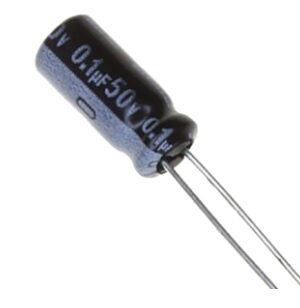
0.1µF 50V Capacitor (Pack of 50)
The 50V rating on this capacitor makes it ideal for 5V, 9V, and 12V circuits with room to spare — exactly the derating margin that keeps your circuit reliable long-term.
Voltage Rating by Capacitor Type
Electrolytic Capacitors — Common Voltage Ratings
Available voltage ratings for aluminium electrolytic capacitors: 6.3V, 10V, 16V, 25V, 35V, 50V, 63V, 100V, 160V, 200V, 250V, 400V, 450V.
For a 12V automotive or power supply application, choose 25V or 35V rated electrolytics. For a 5V microcontroller circuit, 16V or 25V is appropriate.
Ceramic Capacitors — Voltage Ratings
Ceramic capacitors come in a very wide range: 4V, 6.3V, 10V, 16V, 25V, 50V, 100V, 250V, 500V, and beyond. An important subtlety: in X7R and X5R MLCCs, the effective capacitance drops significantly when the applied DC voltage approaches the rated voltage — sometimes by 50% or more. This is called DC bias effect and is worst in small packages (0402, 0603). Always check the capacitance vs voltage curve in the datasheet for MLCC capacitors used in critical circuits.
Tantalum Capacitors — Voltage Ratings
Common tantalum ratings: 4V, 6.3V, 10V, 16V, 20V, 25V, 35V, 50V. The strict 50% derating rule is non-negotiable in any professional design. A 10V-rated tantalum on a 5V rail is standard practice.
Handling Voltage Spikes and Transients
In real-world circuits, the voltage across a capacitor is rarely perfectly smooth. Switching power supplies, motor drives, relay coils, and even microcontrollers switching GPIOs generate brief voltage spikes that can exceed the steady-state supply voltage by a significant margin.
A 12V power rail from an unregulated transformer and bridge rectifier can spike to 16–18V momentarily under light load. A 12V SMPS may have output overshoot on startup. Relay coils generate back-EMF spikes of many times the supply voltage.
Best practice: When designing circuits with these sources, calculate the worst-case peak voltage — not just the nominal voltage — and apply derating to that peak value.
For example, if a 12V rail can spike to 15V, your electrolytic bulk capacitor should be rated for at least 15V ÷ 0.8 = 18.75V → choose a 25V-rated capacitor.
AC vs DC Voltage Ratings
Most capacitor voltage ratings refer to DC voltage. When a capacitor is used in an AC circuit (which is only safe for non-polarised types — ceramic and film), the relevant specification is the AC voltage rating, which is lower than the DC rating.
The relationship is approximately: V_AC ≈ V_DC × 0.7 (i.e., AC rating ≈ 70% of DC rating).
Film capacitors used for AC mains applications (X and Y safety capacitors, motor run capacitors) are specifically rated for AC voltage and tested to much higher surge standards. Always use purpose-designed AC-rated capacitors for mains circuits — never substitute a DC-rated electrolytic.
Increasing Voltage Rating with Series Connection
If you need to use a capacitor in a higher-voltage circuit than your available parts allow, you can connect two capacitors in series. The voltage rating doubles, but the capacitance halves.
For example, two 100µF 25V electrolytics in series give a 50µF 50V combination. However, there is an important catch: electrolytic capacitors in series must be balanced with equalising resistors in parallel across each capacitor to ensure the voltage divides equally. Without these resistors, one capacitor can end up with more voltage than the other due to leakage current differences, potentially exceeding its rating.
Step-by-Step Selection Guide
- Determine the maximum voltage your circuit will ever present across the capacitor — including startup transients, overshoot, and worst-case input variation. Be conservative.
- Apply the derating factor for your capacitor type:
- Electrolytic: divide max voltage by 0.8
- Tantalum: divide max voltage by 0.5
- Ceramic/Film: divide max voltage by 0.8
- Round up to the next standard voltage rating available (e.g. 16V, 25V, 35V, 50V).
- Check physical size — higher voltage ratings mean larger packages for the same capacitance.
- Check temperature range — higher temperatures reduce effective voltage rating. Consult the datasheet for temperature derating if the component operates above 70°C.
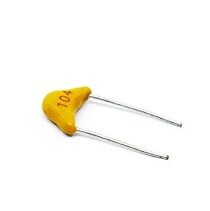
0.1/100nF Multilayer Ceramic Capacitor (Pack of 50)
A well-rated ceramic capacitor suitable for decoupling on 3.3V and 5V microcontroller boards. Non-polarised and capable of high-frequency operation — a must-have for any project.
Frequently Asked Questions
Q: Can I use a higher voltage rated capacitor than required?
A: Yes. A higher voltage rating never hurts the capacitor’s performance in a lower-voltage circuit. The only downside is that higher-rated capacitors are physically larger and cost slightly more. Using a 50V-rated capacitor on a 12V rail is perfectly fine and even slightly beneficial.
Q: My electrolytic capacitor is marked 10V but my circuit is 9V. Is that safe?
A: Technically the voltage is within the rated limit, but the margin is very thin. A nominal 9V supply can reach 10.5V or more under light load conditions. There are also startup transients to consider. Upgrade to a 16V or 25V rated capacitor — the price difference is negligible and the reliability gain is significant.
Q: Does voltage rating affect the capacitance value?
A: For electrolytic and film capacitors, no — the capacitance value is independent of the voltage rating for normal operation. However, for ceramic capacitors (especially X7R and Y5V), applying a high DC bias voltage significantly reduces the effective capacitance. A 10µF X7R ceramic at its rated voltage might measure only 5–6µF. Always check the datasheet capacitance vs voltage curves.
Q: What does “WV” mean on a capacitor?
A: WV stands for Working Voltage — this is the maximum continuous DC voltage the capacitor can handle. It is the same as the rated voltage or WVDC. Some manufacturers also print a surge voltage rating, which is a higher value permitted for brief transients.
Q: My power supply outputs 5V. What voltage rating capacitor should I use for bulk filtering?
A: At minimum 16V rated, ideally 25V. A 5V regulated supply may have startup overshoot and still has ripple. The 25V rating gives you a comfortable 5× derating factor — the capacitor will run cool and last the lifetime of the product.
Q: How do I read the voltage rating from an SMD capacitor?
A: SMD electrolytic capacitors have a stripe indicating the negative terminal and may have a printed value (e.g. “100 25V”). Tiny SMD ceramics often have no printed markings — consult the reel label or supplier datasheet for the specific part number’s voltage rating.
All capacitors on Zbotic include voltage ratings in the product specifications. Find the right capacitor for your voltage with ease — and get fast delivery across India. Browse capacitors on Zbotic →






Add comment