
Whether you are reflowing SMD components, removing BGA chips, or desoldering QFP ICs, a hot air rework station is an indispensable tool in any electronics repair or prototyping lab. In India, the market is flooded with options ranging from budget 858D clones to professional Hakko and JBC stations. This guide cuts through the noise to help you choose the best hot air rework station in India for your specific needs and budget.
What Is a Hot Air Rework Station?
A hot air rework station blows precisely controlled hot air through a nozzle to heat surface-mount components and solder paste evenly. Unlike a soldering iron that uses contact heat, hot air can heat all pads of a multi-pin SMD component simultaneously — making it possible to remove an 80-pin QFP IC cleanly in seconds, or to reflow solder paste for precise component placement.
The technology is essentially the same as a kitchen heat gun, but with critical differences: temperature accuracy (±5°C vs ±50°C), airflow control (gentle enough not to blow small 0402 components off the board), and nozzle variety (to focus heat precisely on target components).
For anyone working with modern electronics — mobile phone repair, laptop motherboard repair, LED driver repair, or custom PCB assembly — a hot air rework station is as essential as a soldering iron.
How Hot Air Rework Stations Work
Inside a hot air station, an electric heating element warms the air stream. A small electric pump or blower drives air through the element and out of the nozzle. The control circuitry measures air temperature at the nozzle exit with a thermocouple and adjusts the heater power to maintain the set temperature.
Pump-type stations use a diaphragm pump to push air. These tend to be cheaper and are common in budget 858D-type units. The pump can introduce slight pulsation in airflow, but this is rarely noticeable in practice.
Brushless turbine (fan-type) stations use a small electric motor with an impeller. These produce smoother, more consistent airflow and are generally found in mid-range and professional stations. The Hakko FR-810 and Weller WHA900 use turbine blowers.
Temperature stability is more important than peak temperature for most rework. A station that reads 350°C but swings ±20°C is less useful than one that maintains 350°C ±3°C — the latter makes repeatable, damage-free work possible.
Types and Form Factors
Standalone Hot Air Guns: A single unit with only a hot air wand. Compact and inexpensive. Suitable if you already have a separate soldering station.
Combo Rework Stations (Hot Air + Soldering Iron): One unit with both a hot air wand and a soldering iron. More desk space-efficient and cost-effective than buying two separate instruments. The popular 2-in-1 stations (858D+936 combo or 853 series) are widely sold in India.
IR Rework Stations: Use infrared heat rather than hot air. Better for certain BGA applications (less airflow to disturb surrounding components), but more expensive and less versatile.
Key Specifications to Evaluate
| Specification | What to Look For |
|---|---|
| Temperature Range | 100–480°C minimum; 480°C peak handles lead-free solder |
| Temperature Accuracy | ±5°C or better (verify with external thermocouple) |
| Airflow Range | Low: enough to not blow 0402 parts; High: enough for large QFPs |
| Airflow Control | Separate knob or digital control — finer adjustment is better |
| Heater Wattage | 600–900W for good heat-up speed |
| Nozzle Selection | Multiple nozzles included or available separately |
| Display | Digital display for both temperature and airflow is preferred |
| Auto-cool / Sleep | Auto cool-down on holder return protects heater element |
Top Hot Air Rework Stations in India
1. YIHUA 858D / 858D+ — Best Budget Option
The 858D is the most widely sold budget hot air station in India and globally. Temperature range: 100–480°C. Airflow: 120 L/min maximum. The 858D+ adds a digital display for both temperature and airflow (the original 858D uses analogue dials). Both use a pump-type blower.
Real-world performance is adequate for most hobbyist and small-scale repair tasks — removing SOT-23 transistors, SOIC ICs, and QFP chips with careful technique. The temperature accuracy on cheaper clones can drift; calibrate with an external thermocouple and adjust accordingly. Price in India: ₹1,500–₹2,500.
2. GORDAK / Aoyue 858 Combo Stations — Best Mid-Range Value
Brands like GORDAK (858A+) and Aoyue offer stations that combine a hot air wand with a soldering iron in a single chassis. These are the workhorses of small repair shops across India. Improved airflow regulation, better temperature stability, and genuine digital controls make these a step above the basic 858D. Price: ₹3,000–₹6,000.
3. QUICK 861DW — Professional Grade
The QUICK 861DW is a professional turbine-type hot air station with a brushless DC motor blower. Temperature range: 100–480°C. Airflow: continuous and stable. Preset storage, digital calibration, and auto-cool on stand return make this a genuine professional tool. Used widely in authorised mobile service centres. Price: ₹8,000–₹14,000.
4. Hakko FR-810B — Premium Choice
The Hakko FR-810B is the benchmark professional hot air station. Turbine blower, ±2°C temperature accuracy, wide nozzle range, and legendary Hakko reliability. Widely used in professional electronics manufacturing and repair. Price: ₹25,000–₹45,000 in India — premium, but justified for daily professional use.
Tips for SMD Rework Success
Even the best hot air station cannot compensate for poor technique. Here are the most important practices:
- Use flux liberally. Flux helps solder flow and prevents oxidation. Apply fresh flux to pads before reflowing or removing components. Tacky flux gel is preferred for rework.
- Protect nearby components. Use kapton tape or aluminium foil shields to protect adjacent components from heat. For dense boards, this is critical.
- Start lower than you think. Begin at 300°C for lead-free or 250°C for leaded solder and increase gradually. Rushing causes thermal shock, damaged PCB traces, and delamination.
- Match airflow to component size. Use low airflow (3–5 on a 1–10 scale) for small 0402/0603 parts. Use higher airflow for large ICs. Too much airflow blows small parts across the board.
- Keep the nozzle moving. For large ICs, slowly move the nozzle in a circular pattern across the component body to heat all sides evenly.
- Test the lift. Gently push the component with tweezers while applying heat. Do not force it — when the solder liquefies, the component will lift easily. Forcing causes damaged pads.
Recommended Accessories for SMD Rework
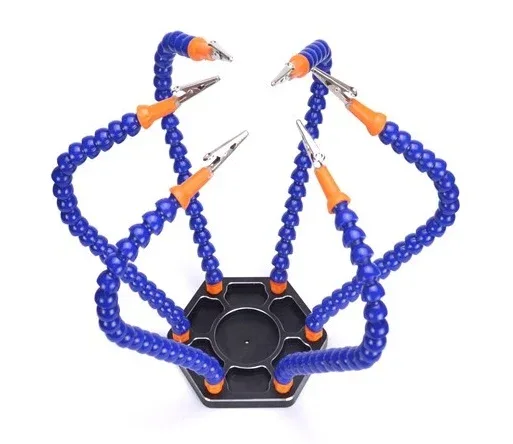
6-Arm Flexible Soldering Helping Hands Station
Holds PCBs and components securely during hot air rework — the alligator clips and flexible arms give you both hands free for nozzle and tweezer work.

0.1mm Enamelled Copper Repair Wire
Essential for repairing lifted PCB pads or bridging broken traces after hot air rework — the ultra-fine 0.1mm gauge fits even the tightest SMD layouts.

BAKON Soldering Iron Tip 900M-T-I
After hot air rework, use a fine soldering tip to touch up individual pads, add solder bridges, or clean up flux residue — the 900M-T-I series fits most budget stations.

10×10cm Universal Prototype PCB Board
Practice hot air rework technique on prototype boards before working on expensive or irreplaceable circuits — a low-cost way to build confidence and skill.
Which Station Should You Buy?
For beginners and hobbyists (budget under ₹3,000): The YIHUA 858D+ is the default recommendation. Get the + variant with digital display. Calibrate with an external thermocouple. It will handle 95% of hobbyist SMD tasks.
For small repair shops and serious hobbyists (₹3,000–₹8,000): A GORDAK or similar combo station with brushless or improved pump blower. Better temperature stability means fewer damaged boards and faster workflow.
For professional mobile/laptop repair (₹8,000–₹15,000): The QUICK 861DW or equivalent professional turbine station. The investment pays for itself quickly in saved components and reduced rework time.
For electronics manufacturing or demanding applications: Hakko FR-810B or equivalent. Non-negotiable in environments where a damaged board costs more than the station itself.
Frequently Asked Questions
What temperature should I use for removing SMD components?
For leaded solder (Sn63/Pb37), typical removal temperature is 280–320°C at the nozzle. For lead-free (SAC305), 340–380°C. Always start lower and increase gradually. The actual component temperature is lower than the nozzle temperature due to airflow cooling and PCB thermal mass.
Will a hot air gun damage nearby components?
It can if you are not careful. Use kapton tape or aluminium foil shields to protect adjacent parts. Keep the nozzle moving. Work quickly and efficiently — minimise total heat exposure time.
Can I use a hot air rework station to apply solder paste?
Yes — apply solder paste through a stencil or dispense it manually onto pads, place components, then reflow with hot air. This is how small-scale PCB assembly is done without a reflow oven.
What nozzle size should I use for SOIC-8 chips?
A medium round nozzle (6–8mm diameter) or a small rectangular nozzle that covers the IC body works well for SOIC-8. The goal is to heat all pads simultaneously without blowing the chip sideways.
Is the 858D suitable for BGA reballing?
The 858D can be used for basic BGA work with the right technique, but it is not ideal. BGA work requires very precise, even heating across the entire chip — a professional turbine station with a large flat nozzle, or an IR rework station, is more appropriate.
Build a professional SMD rework station. Zbotic stocks soldering accessories, wires, PCB boards, and components for all your electronics repair and prototyping needs. Shop Now →


Add comment