
Table of Contents
- Why Agriculture Sprayer Drones Are Transforming Indian Farming
- Sprayer System Components Overview
- Tank Selection: Capacity, Material, and Mounting
- Pump Selection: Flow Rate, Pressure and Types
- Nozzle Selection: Spray Patterns and Droplet Size
- Frame and Motor Selection for Sprayer Builds
- Flight Controller and Automation
- DGCA Regulations in India
- Build Cost Analysis
- Recommended Products
- FAQ
Agriculture is India’s backbone — over 140 million farming households depend on it for their livelihood. Yet pesticide and fertiliser application remains one of the most labour-intensive, time-consuming, and hazardous farm operations. A farm worker manually spraying pesticides spends hours in close contact with chemicals, covers limited area per day, and often does so with inconsistent coverage that wastes expensive inputs.
Agriculture sprayer drones are solving all three problems simultaneously. A properly designed sprayer drone can cover 1-2 acres per battery charge, apply precise droplet sizes for maximum efficacy with minimum chemical waste, and completely eliminate human exposure to pesticides. In states like Punjab, Haryana, Andhra Pradesh, and Maharashtra, sprayer drones are rapidly moving from pilot projects to mainstream adoption.
This buying guide focuses specifically on the spray system — the tank, pump, and nozzle combination — which is what determines actual spraying performance, regardless of the drone frame carrying it.
Why Agriculture Sprayer Drones Are Transforming Indian Farming
Efficiency Comparison
| Method | Coverage (acres/day) | Chemical Use | Labour Risk |
|---|---|---|---|
| Manual knapsack | 1-2 | High (overspraying) | High (direct exposure) |
| Tractor sprayer | 15-25 | Medium | Medium |
| 8L Sprayer Drone | 20-40 | Low (30-50% savings) | None |
| 16L Sprayer Drone | 40-80 | Low (30-50% savings) | None |
Key Advantages for Indian Conditions
- Waterlogged fields: Paddy fields in Punjab, West Bengal, and Tamil Nadu are often flooded — tractor entry is impossible but drones fly above water level without issue
- Hilly terrain: Tea and coffee plantations in Assam, Coorg, and Darjeeling are inaccessible to mechanized sprayers — drones work perfectly on slopes
- Night spraying: Some pests are active at night; drone spraying at night is practical and avoids daytime heat that accelerates chemical evaporation
- Speed during pest outbreaks: When locusts or fall armyworm strike, the speed advantage of drone coverage can mean the difference between saving and losing a crop
Sprayer System Components Overview
A drone sprayer system consists of these elements working together:
- Tank: Holds the liquid (pesticide, fertiliser, water mixture)
- Pump: Draws liquid from tank and pressurizes it to the nozzles
- Flow sensor: Monitors spray flow rate for control feedback
- Nozzles: Atomize the liquid into droplets of controlled size and spray pattern
- Spray controller: Controls pump speed (and thus flow rate) based on flight speed for consistent application rate
- Pipes and fittings: Food-grade or chemical-resistant tubing connecting everything
The relationship between these components determines your application rate (L/ha), droplet size, coverage uniformity, and chemical efficacy. Getting the balance right requires understanding each component.
Tank Selection: Capacity, Material, and Mounting
Tank Capacity
Sprayer drone tanks typically range from 5L to 30L. The right size depends on your drone’s payload capacity:
| Tank Size | Full Weight | Drone Size | Coverage per Fill |
|---|---|---|---|
| 5-8L | 5-8 kg | 4-6 axis, 800-1200mm | 0.5-1 acre |
| 10-12L | 10-12 kg | 6 axis, 1200-1400mm | 1-1.5 acres |
| 16L | 16 kg | 6 axis, 1400-1600mm | 2-2.5 acres |
| 20-30L | 20-30 kg | 8 axis, 1600mm+ | 3-4 acres |
Rule of thumb: Your drone frame and motors must support at least 3-4x the tank weight in total payload capacity for safe, manoeuvrable flight. A 16L tank (16kg full) needs a drone with 48-64kg thrust capacity — that’s a large, powerful hexacopter.
Tank Material
HDPE (High-Density Polyethylene): Most common choice. Resistant to most agricultural chemicals including organophosphates, pyrethroids, and herbicides. UV stabilised versions last 3-5 years outdoors. Lightweight and impact-resistant. This is the recommended choice for most applications.
PP (Polypropylene): Slightly lighter than HDPE, good chemical resistance, but less impact resistant. Often used for the pump housing.
Stainless Steel: Rarely used on drones due to weight, but appropriate for aggressive chemicals (strong acids, chlorine-based solutions) that would degrade plastic tanks.
Tank Design Considerations
- Centrepoint mounting: The tank must mount at the drone’s centre of gravity (CoG). An asymmetrically mounted tank causes roll bias that the flight controller must constantly compensate — wasting power and reducing stability
- Flat bottom or saddle mount: Saddle-mount tanks wrap around the drone body for a lower CoG, improving stability. Flat-bottom tanks mount below the frame on standoffs
- Wide fill opening: A minimum 80mm fill opening allows quick refilling without spills. Funnel-compatible openings are very convenient in the field
- Baffle plates inside: Large tanks need internal baffles to prevent liquid sloshing, which causes sudden CoG shifts that destabilise the drone in turns
- Level indicator: A translucent panel or float gauge lets the operator see remaining liquid without landing

EFT E410P 10L 4 Axis Agricultural Drone Frame
Purpose-built 4-axis agricultural drone frame with integrated 10L tank mount. The EFT E410P is designed for efficient field spraying with folding arms for easy transport.
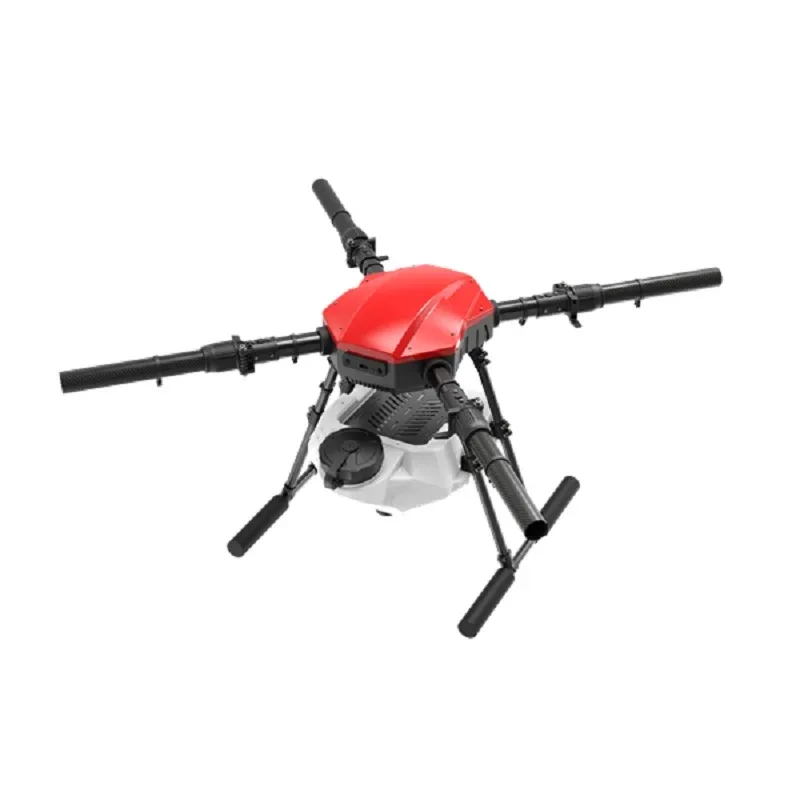
EFT E416P 16L 4 Axis Agricultural Drone Frame
Heavy-duty 16L capacity agricultural drone frame with foldable arms for storage and transport. Designed for serious commercial spraying operations covering multiple acres per day.
Pump Selection: Flow Rate, Pressure and Types
Pump Types for Agricultural Drones
Diaphragm Pump (Most Common): A motor-driven diaphragm creates pulsating pressure in the pump chamber. Self-priming, handles some particulates, good for most agricultural applications. Can run dry briefly without damage. Flow rates: 0.6-2.4 L/min per pump. Most commercial spray drones use 1-4 diaphragm pumps depending on required flow rate.
Peristaltic Pump: A rotor compresses a flexible tube to move fluid. Completely separates the liquid from the pump mechanism — ideal for highly corrosive chemicals. Very accurate flow rate at low speeds. Limitation: tube wear requires periodic replacement (every 200-500 hours depending on chemical).
Centrifugal Pump: Fast-spinning impeller pushes fluid out. High flow rates possible but requires consistent inlet pressure and doesn’t self-prime well. Rarely used on drones.
Selecting the Right Pump
Key specifications to match:
Flow Rate (L/min): Calculate required flow rate using this formula:
Flow Rate (L/min) = Application Rate (L/ha) × Flight Speed (m/s) × Swath Width (m) / 10000 × 60Example: Applying at 15 L/ha, flying at 5 m/s, 4m swath width:
= 15 × 5 × 4 / 10000 × 60 = 1.8 L/minYour pump must deliver at least this flow rate at your operating pressure.
Operating Pressure (Bar): Nozzle pressure determines droplet size. Typical agricultural spray pressure is 1.5-4 bar for flat fan nozzles. Rotary atomizer nozzles work with very low pressure (pressure is less important than RPM). Match your pump’s pressure output to your nozzle requirements.
Pump Power (W): At 2 L/min flow rate, a typical diaphragm pump draws 15-25W. At 4 L/min, expect 30-50W. This is a small fraction of total drone power consumption, but it matters in battery life calculations.
Spray Controller
A spray controller governs pump speed in real time based on GPS ground speed to maintain constant application rate. Without this, the application rate changes with flight speed — too much chemical when flying slow (turns, starts), too little at maximum speed. Options:
- ArduPilot with spray control plugin — free, sophisticated, integrated with mission planner
- Agras-compatible spray controllers — commercial products with their own displays
- Custom PWM-to-speed controllers — simple builds where constant speed is acceptable
Nozzle Selection: Spray Patterns and Droplet Size
The nozzle is the most technically important component of the spray system. It determines droplet size, spray pattern, and coverage uniformity — all of which directly affect pesticide efficacy and chemical waste.
Droplet Size Classification
| Class | VMD (microns) | Risk | Use Case |
|---|---|---|---|
| Very Fine | <100 | High drift | Not recommended for drones |
| Fine | 100-175 | Medium drift | Insecticides, some fungicides |
| Medium | 175-250 | Low drift | Most pesticide applications |
| Coarse | 250-375 | Minimal drift | Herbicides, near-crop targets |
| Very Coarse | >375 | No drift | Near water bodies |
For Indian conditions: Medium droplets (175-250 microns) work well for most applications. In windy conditions (common in Punjab and Rajasthan plains), use coarse droplets to minimise drift to adjacent crops or non-target areas.
Nozzle Types
Flat Fan Nozzle (Most Common): Produces a fan-shaped spray pattern. Available in various spray angles (80°, 110°). At correct pressure and height, overlapping fans produce uniform coverage. Best for broadcast spraying of herbicides, fungicides, and most insecticides. Works with diaphragm pumps at 2-4 bar.
Air Induction (AI) Nozzle: Mixes air into the spray stream to produce larger, air-filled droplets. Dramatically reduces drift — ideal for India’s often-windy conditions and for applications near fruit orchards or vegetable crops where drift would cause phytotoxicity. Requires slightly higher pressure (2.5-5 bar).
Rotary Atomizer (Spinning Disc): An electrically-driven spinning disc shears liquid into uniform droplets. Droplet size controlled by disc RPM (not pressure). Very consistent droplet distribution. Used on premium commercial sprayer drones. More expensive but produces excellent results for foliar applications.
Hollow Cone Nozzle: Produces a cone-shaped spray that deposits on all surfaces of the plant — excellent for fungicide and insecticide applications where underside coverage matters. Requires higher pressure (3-5 bar).
Nozzle Placement on Drone
Position nozzles:
- Below the rotor plane — nozzles should sit 20-30 cm below the prop plane to benefit from prop-driven downdraft penetrating the crop canopy
- Equal spacing along boom — typically 4 nozzles spaced evenly to match swath width
- Angled slightly outward — 5-10° outward angle gives better coverage at canopy edges without excessive drift
Frame and Motor Selection for Sprayer Builds
The frame carries everything. Agricultural sprayer frames must handle payload weights of 10-30kg plus the drone’s own weight, with adequate structural margin for maneuvering loads and emergency recoveries.
Frame Characteristics for Agriculture
- Foldable arms: Critical for transport between fields. Rigid arms create transport and storage problems
- IP54+ rating: Chemical splashing and rain are inevitable. All electronics must be sealed
- Quick-release battery: Battery swaps in the field must take less than 2 minutes
- Chemical-resistant materials: Carbon fibre arms, anodized aluminum hardware, and HDPE/PP covers resist agrochemical corrosion better than untreated steel

Hobbywing X6 Plus Motor CCW
High-efficiency Hobbywing X6 Plus motor designed for heavy-lift agricultural and commercial drones. The integrated ESC system simplifies spray drone wiring significantly.

Hobbywing X9 Plus Motor CCW
The X9 Plus delivers exceptional thrust efficiency for heavy-payload agricultural drones carrying 16-30L tanks. Suitable for large-scale commercial farming operations.

Hobbywing X9 Plus Motor CW
CW version of the Hobbywing X9 Plus for pairing with CCW counterparts. Needed in matched sets for hexacopter or octocopter agricultural drone configurations.
Flight Controller and Automation
For agricultural spraying, the flight controller must support:
- Waypoint missions: Automated flight along pre-planned spray paths for consistent coverage and no missed strips
- Variable rate spraying: Matching spray rate to flight speed for consistent application rate
- RTL (Return to Launch) on low battery: Critical safety feature to prevent loss of drone and chemical spill
- Obstacle avoidance (optional but increasingly expected)
ArduPilot (ArduCopter) with Mission Planner is the most capable free option and supports spray control natively. The flight controller running ArduPilot (typically a PixHawk or compatible) should be mounted with vibration damping to protect the barometer and IMU.
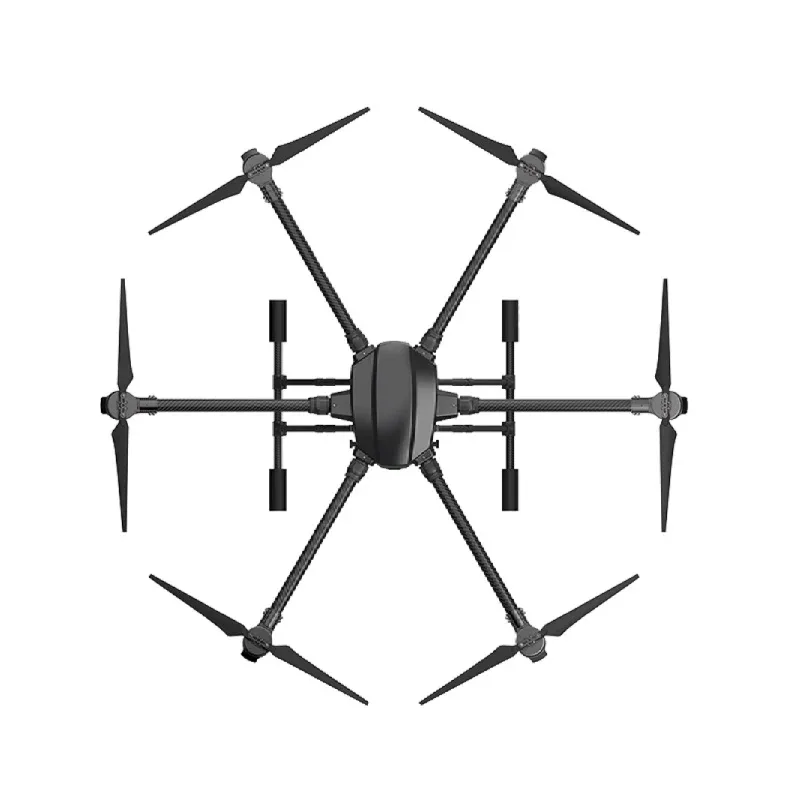
EFT 6120 Multifunction Surveillance Drone Frame
Versatile EFT 6120 frame suitable for both surveillance and agricultural payload configurations. The robust build handles the structural demands of heavy spray tank mounts.
DGCA Regulations in India
Agricultural sprayer drones in India fall under the Civil Aviation Requirements (CAR) for Remotely Piloted Aircraft Systems. Key requirements as of 2024:
- Registration: All drones above 250g must be registered on the Digital Sky portal (digitalsky.dgca.gov.in)
- Remote Pilot Certificate (RPC): Operators flying Medium (251g-25kg) or Large (25kg+) drones must hold a valid RPC from a DGCA-approved training institute
- Green Zone Operations: Most agricultural land falls in green zones where operations up to 120m AGL are permitted with standard registration, no specific permission required
- Exclusions: Stay at least 8km from airports, 5km from international borders, and avoid military areas (Red Zones)
- No Night Flying (generally): Night operations require special permissions and anti-collision lighting
- Chemical Approval: Only Central Insecticides Board-approved pesticides may be applied via drone
Subsidy opportunity: Several state governments including Punjab, Haryana, Madhya Pradesh, and Odisha offer subsidies of 40-50% on agricultural drone purchases for SC/ST farmers, small/marginal farmers, and FPOs under PM-KISAN and sub-mission schemes. Check your state agriculture department for current programs.
Build Cost Analysis
10L Quad Sprayer Build (DIY)
| Component | Approx. Cost (₹) |
|---|---|
| EFT E410P 10L Frame | 18,000-25,000 |
| 4× Heavy-lift motors (Hobbywing X6) | 40,000-60,000 |
| Spray pump + controller | 8,000-15,000 |
| Nozzles (4×) + boom | 3,000-8,000 |
| Flight controller (PixHawk) | 8,000-20,000 |
| GPS + telemetry | 5,000-10,000 |
| Batteries (2-4×) | 30,000-60,000 |
| Remote controller | 10,000-20,000 |
| Total DIY | 1.2L – 2.2L |
| Commercial equivalent (DJI Agras T10) | 4L – 5L |
DIY builds can save 50-70% compared to commercial solutions, at the cost of more time investment and technical knowledge. For professional service operators running multiple drones, the economics strongly favour DIY builds.
Frequently Asked Questions
How many acres can a 10L sprayer drone cover per day?
With a 10L tank at typical agricultural application rates (15-20 L/ha for pesticides), you cover about 0.5-0.7 ha per tank. With 8-10 battery cycles per day (each cycle ≈ one tank refill), a single drone-operator pair can cover 4-7 ha (10-17 acres) per day. With 2 spare battery sets charging simultaneously, experienced teams can achieve 12-15 ha per day.
What is the minimum wind speed for safe drone spraying?
Spraying should generally be done when winds are below 15 km/h (4 m/s). Above this threshold, medium-size droplets drift significantly. If you must spray in windier conditions, use coarse droplets (air induction nozzles) and fly lower (1-2m AGL). Most professional operators spray in early morning (6-9 AM) and late evening (4-7 PM) when winds are typically calmest in India.
Do I need a separate license to spray chemicals by drone in India?
Yes. You need a DGCA Remote Pilot Certificate (RPC) for operating medium or large drones (which includes most sprayer drones above 250g). Additionally, some states require registration as a pesticide applicator. Check with your district agriculture office for local requirements. Punjab and Haryana have the most developed regulatory frameworks as they were earliest adopters.
Can the same drone frame be used for both spraying and photography?
Technically yes, but practically it’s not recommended. Spray residue contaminates camera lenses and electronics. Chemical exposure corrodes electrical connectors and motors faster than normal. If you must dual-use, use thorough cleaning protocols between uses (dilute water wash followed by dry air) and protect all electronic connectors with silicone spray sealant.
What is the ideal flying altitude for a sprayer drone?
For most crops in India (paddy, wheat, cotton, vegetables), the optimal altitude is 1.5-3 metres above the crop canopy. At this height, prop downwash assists penetration into the canopy, and droplet drift is minimized. For tall crops like sugarcane or corn (1.5-2m tall), fly 3-5m above the ground to clear the crop with safety margin.
Build Your Agricultural Sprayer Drone
Zbotic stocks EFT agricultural frames, Hobbywing heavy-lift motors, and all the drone components you need to build a professional-grade sprayer drone. Serving drone builders and agriculture professionals across India.


Add comment