
When you first start learning electronics, one question comes up almost immediately: what is the AC vs DC current difference, and why does it matter? The distinction between Alternating Current (AC) and Direct Current (DC) is fundamental to understanding how electricity works — from the 230V supply coming from your Indian power outlet to the 5V powering your Arduino. Every maker, student, and hobbyist must understand both to work safely and effectively with electronic circuits. This comprehensive guide explains everything you need to know.
Table of Contents
- What Is Direct Current (DC)?
- What Is Alternating Current (AC)?
- Key Differences: AC vs DC Current
- AC Power in India: 230V, 50Hz Explained
- Converting AC to DC: How Power Supplies Work
- When to Use AC vs DC in Your Projects
- Safety: Working with AC and DC
- Recommended Products
- Frequently Asked Questions
What Is Direct Current (DC)?
Direct Current (DC) is electrical current that flows in one direction only, continuously and at a (ideally) constant voltage. The current flows from the positive terminal of a power source, through the circuit, and returns to the negative terminal. It does not alternate direction — it is a steady, unidirectional flow of electrons.
Common DC sources include:
- Batteries (9V PP3, AA, Li-ion 3.7V, 18650 cells) — the most familiar DC source
- DC power adapters / SMPS — convert mains AC to regulated DC (5V, 12V, 24V)
- Solar cells — generate DC from sunlight
- DC generators — dynamos that produce DC directly
- USB power banks and chargers — output 5V DC
Almost every electronic component you will use as a maker operates on DC: microcontrollers, sensors, LEDs, motor drivers, transistors, ICs, displays. The entire field of electronics as practiced by hobbyists is fundamentally DC-based, with AC appearing only at the power input stage (mains power) or in signal processing (AC signal analysis, audio, RF).
Properties of DC
- Constant polarity — positive and negative terminals are fixed
- Can be stored in capacitors and batteries
- Voltage does not vary with time (for ideal DC) or varies slowly and is regulated
- Frequency = 0 Hz (DC has no oscillation)
- Transmitted efficiently over short to medium distances at low voltages
What Is Alternating Current (AC)?
Alternating Current (AC) is electrical current that periodically reverses direction. The voltage oscillates between positive and negative values in a sinusoidal waveform. One complete oscillation (positive peak → zero → negative peak → zero → positive peak) constitutes one cycle, and the number of cycles per second is the frequency, measured in Hertz (Hz).
Unlike DC, AC has no fixed positive or negative terminal — the polarity reverses with every half-cycle. This is why AC plugs (except for polarised types) can often be inserted either way.
Common AC sources and applications:
- Mains electricity — the primary distribution medium worldwide (India: 230V, 50Hz)
- AC generators / alternators — naturally produce AC; conversion to DC requires rectification
- Transformers — only work with AC (not DC), making AC the natural choice for long-distance power transmission with step-up/step-down transformers
- Audio signals — AC waveforms at audio frequencies (20Hz–20kHz)
- RF signals — AC at radio frequencies (MHz to GHz) for wireless communication
Key AC Parameters
- Peak voltage (Vpeak): The maximum instantaneous voltage
- RMS voltage (Vrms): The effective voltage — the DC equivalent that delivers the same power. For a sinusoid, Vrms = Vpeak / √2 ≈ 0.707 × Vpeak. India’s 230V AC refers to the RMS value — the peak voltage is actually 230 × 1.414 ≈ 325V!
- Frequency (f): India uses 50Hz; USA uses 60Hz
- Period (T): T = 1/f = 20ms for 50Hz
Key Differences: AC vs DC Current
| Parameter | DC (Direct Current) | AC (Alternating Current) |
|---|---|---|
| Direction of flow | One direction only | Reverses periodically |
| Frequency | 0 Hz | 50 Hz (India), 60 Hz (USA) |
| Voltage polarity | Fixed positive/negative | Alternates between + and – |
| Storage | Can be stored in batteries/capacitors | Cannot be directly stored |
| Long-distance transmission | Less efficient (high losses) | Very efficient (step-up transformer) |
| Transformer compatible | No (only special DC-DC converters) | Yes (standard transformers) |
| Electronic components | All ICs, sensors, microcontrollers | AC motors, some heating elements |
| Safety at high voltage | Less tendency to cause muscular contraction | More dangerous at same voltage (muscle contraction) |
| India example | 5V USB, 12V adapter, 9V battery | 230V household supply |
AC Power in India: 230V, 50Hz Explained
India’s national grid delivers electricity at 230V RMS, 50Hz. This means the voltage oscillates sinusoidally at 50 complete cycles per second (each cycle taking 20 milliseconds). The peak voltage during each cycle reaches 325V (not 230V — 230V is the RMS effective value).
This 230V/50Hz standard is used across most of Asia, Europe, Africa, and Australia. The USA and Canada use a different standard: 120V, 60Hz. This is why some electronics bought from the US may require a voltage converter in India, or why some appliances are rated 100-240V, 50-60Hz to work worldwide.
Key points about India’s mains supply for makers:
- Phase conductor (Line/Live): The wire at 230V RMS (brown or red in modern wiring)
- Neutral: The return conductor, ideally at 0V relative to earth (blue or black)
- Earth: Safety conductor connected to earth electrode (green/yellow)
- The voltage between Line and Neutral is 230V RMS
- Never assume Neutral is at a safe voltage — it can rise relative to earth in a fault condition
- Always use a three-pin plug with earth connection for any project that involves mains power
India’s voltage can fluctuate significantly — in rural and semi-urban areas, it is not uncommon to see supply voltages ranging from 190V to 260V. This is why SMPS power supplies are preferred over older linear transformers — a good SMPS has a wide input range (90-265V) and maintains a stable DC output regardless of mains fluctuations.
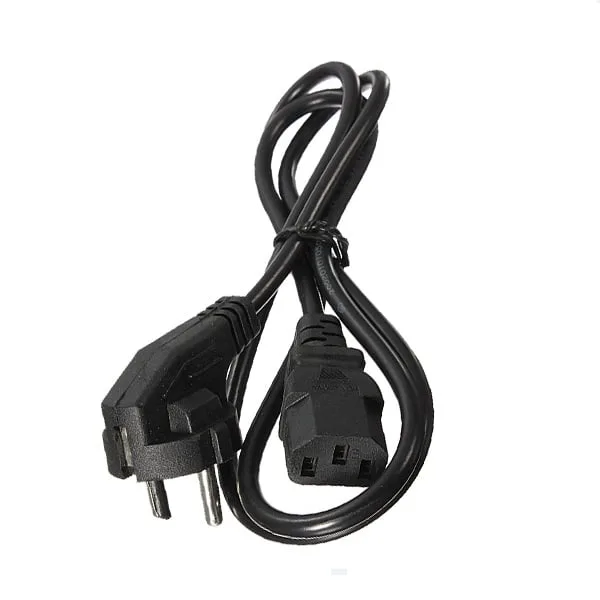
1.2M AC 10A 250V Power Supply Adapter Cord Cable EU Plug
A rated 250V AC power cord for safely connecting your SMPS or bench power supply to the mains. Properly rated for India’s 230V supply with a 10A current rating — suitable for most lab bench power supplies.
Converting AC to DC: How Power Supplies Work
Since virtually all electronic components require DC, converting the mains AC to usable DC is a fundamental task in electronics. There are two main approaches:
Linear Power Supply (Traditional)
A linear supply uses a mains transformer to step down 230V AC to a lower AC voltage (e.g., 12V AC), then a bridge rectifier to convert AC to pulsating DC, followed by a large filter capacitor to smooth the ripple, and finally a linear voltage regulator (like the 7805) to produce a stable output.
Advantages: simple, very low noise output. Disadvantages: heavy (due to the mains transformer), large, and inefficient (30-50% efficiency — the rest is lost as heat).
Switched-Mode Power Supply (SMPS)
An SMPS first rectifies the mains AC directly to high-voltage DC (~325V), then rapidly switches this DC on and off at high frequency (50kHz to 1MHz) through a small high-frequency transformer, then rectifies and filters the output. The output voltage is regulated by adjusting the switching duty cycle.
Advantages: very efficient (80-95%), compact and lightweight, wide input voltage range, multiple outputs possible. Disadvantages: generates switching noise that must be filtered, slightly more complex. For almost all modern applications including maker projects, SMPS is the preferred choice.
DC-DC Converters (Buck, Boost, Buck-Boost)
These convert one DC voltage to another — for example, a 12V input to 5V output (buck/step-down) or 3.7V input to 5V output (boost/step-up). They use the same SMPS principle but work entirely in the DC domain. Essential for projects that need multiple supply voltages from a single source.
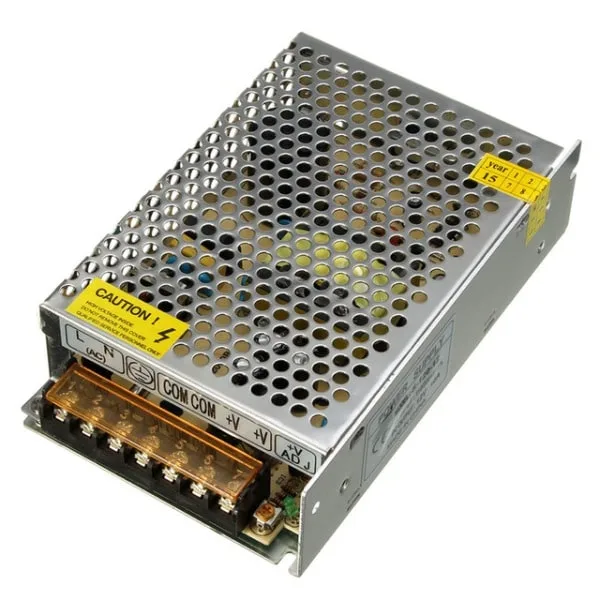
12V 10A SMPS – 120W – DC Metal Power Supply
A 120W industrial-grade SMPS that converts India’s 230V AC mains to a stable 12V DC output. Perfect for powering LED strips, motor drivers, and multi-module projects from a single reliable source.
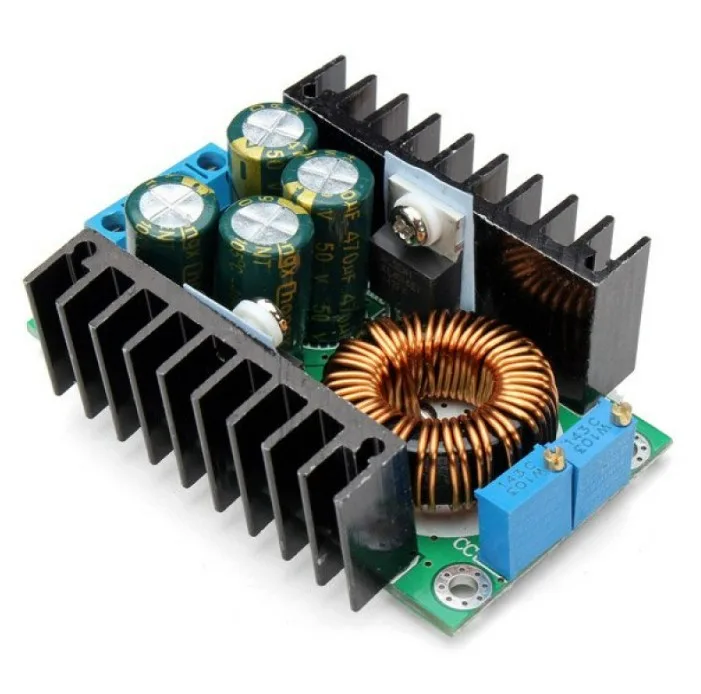
300W 10A DC-DC Step-down Buck Converter
Convert your 12V or 24V DC supply to any lower voltage with this 300W adjustable buck converter. Essential for generating multiple DC voltage rails from a single SMPS — the backbone of any multi-module project.
When to Use AC vs DC in Your Projects
Use DC for:
- All microcontroller and sensor circuits (5V, 3.3V, 12V DC)
- LED strips, LED drivers
- DC motors and servo motors
- Battery-powered portable projects
- Communication interfaces (I2C, SPI, UART, USB)
- Any circuit using semiconductors (ICs, transistors, diodes)
Use AC (or be aware of AC) when:
- Powering projects from the mains — you will need AC-to-DC conversion
- Using AC motors (fans, pumps) — controlled via triacs, SSRs, or VFDs
- Driving incandescent bulbs or resistive heating elements — can use AC directly via SSR or triac
- Designing power supplies that use standard transformers
- Measuring mains voltage (requires special precautions and isolation)
Safety: Working with AC and DC
This is critical. The safety rules for AC and DC are different, and understanding both can save your life.
DC Safety
At low voltages (under 50V DC), the risk of electric shock is generally low for a healthy person with dry skin. The currents that result from touching a 5V or 12V DC circuit through dry skin are far below the threshold that causes harm. However, at higher DC voltages (above 50V), DC is dangerous. Importantly, DC does not have the alternating characteristic that causes the muscular tetany (inability to let go) that AC causes — but at high voltages, DC can cause severe burns at the contact points due to sustained arcing.
Never treat any voltage above 50V as safe, AC or DC.
AC Safety at Mains Voltage (230V)
230V AC is lethal. A current as small as 30mA through the chest is sufficient to cause cardiac fibrillation. India’s 50Hz AC is particularly dangerous because the 50Hz frequency is near the resonant frequency of cardiac muscle, making AC more likely to cause fibrillation than DC at the same current level.
Mandatory safety practices when working with 230V AC:
- Always switch off and discharge before touching any component
- Use a three-pin earthed plug
- Use a properly rated MCB (Miniature Circuit Breaker) and ELCB/RCCB for earth leakage protection
- Never work alone on mains-connected circuits
- Use properly insulated tools rated for mains voltage
- Always use a fuse or MCB rated appropriately for your load

12V 2A Power Supply with 5.5mm DC Plug Adapter
A compact and safe AC-to-DC adapter providing 12V 2A for Arduino-based projects, sensor boards, and small LED strips. All the AC-to-DC conversion is internal — you interact only with safe 12V DC on the output.
Frequently Asked Questions
Q: Why does India use 230V AC instead of something safer like 12V?
Higher voltages allow power to be transmitted over long distances with lower current, which means thinner (cheaper) wires and lower resistive losses (P = I²R — lower current means far less heat loss). A 2kW appliance at 230V draws only 8.7A; at 12V it would draw 167A, requiring enormously thick wires. The trade-off is higher shock hazard, managed through insulation, earthing, and circuit protection.
Q: Can I use my 12V DC LED strip directly on 230V AC?
No. Absolutely not. 230V AC will instantly destroy a 12V LED strip and create a serious fire and shock hazard. Always use a 12V DC power supply (SMPS adapter) to power 12V LED strips from the mains.
Q: What is the frequency of India’s electricity supply?
India uses 50Hz — the mains voltage completes 50 full cycles per second. Each cycle takes 20 milliseconds. This is important to know when designing power factor correction circuits, filtering AC noise, or using transformers rated for specific frequencies.
Q: Why do batteries always provide DC and not AC?
Batteries store energy as chemical potential energy and convert it to electrical energy through electrochemical reactions. These reactions inherently produce a unidirectional electron flow — from the negative electrode, through the circuit, to the positive electrode. There is no mechanism to naturally reverse this direction, so batteries always produce DC.
Q: Is USB power AC or DC?
USB power is DC — specifically, 5V DC in standard USB, 5V/9V/12V/20V DC in USB Power Delivery (PD). All USB chargers convert the mains AC to DC internally. The USB connector on your device only ever sees DC.
Power your projects safely and efficiently. Browse SMPS supplies, DC adapters, buck converters, and more at Zbotic Power Supplies — trusted by makers across India for reliable DC power.



Add comment