
Choosing the wrong Battery Management System (BMS) is one of the most common and costly mistakes in DIY lithium battery pack builds. Whether you are designing a 3S Li-Ion power bank, a 4S LiFePO4 solar storage system, or a 6S e-bike pack, this BMS 3S 4S 6S selection guide will walk you through every critical parameter — from voltage compatibility and current ratings to balancing type and thermal protection — so your pack is safe, efficient, and long-lasting.
Table of Contents
- What Is a BMS and Why Is It Mandatory?
- Understanding the S-Rating (Series Cell Count)
- 3S BMS: Specifications and Use Cases
- 4S BMS: Specifications and Use Cases
- 6S BMS: Specifications and Use Cases
- Current Rating: Charge vs Discharge
- Passive vs Active Balancing
- Protection Features to Look For
- Matching BMS to Your Battery Chemistry
- BMS Wiring Guide
- FAQ
What Is a BMS and Why Is It Mandatory?
A Battery Management System (BMS) is an electronic circuit board that monitors and protects a lithium battery pack. When multiple lithium cells are connected in series, individual cell voltages diverge over time due to manufacturing tolerances, temperature differences, and usage patterns. Without a BMS:
- One cell may over-charge (above 4.2 V for Li-Ion) — causing electrolyte decomposition, gas venting, and possible fire
- One cell may over-discharge (below 2.5–3.0 V) — causing irreversible lithium plating and capacity loss
- A short-circuit or overcurrent event can cause rapid heating and thermal runaway
The BMS prevents all of these by continuously measuring per-cell voltages and cutting off charge or discharge current when any cell goes out of safe range. It also balances cell voltages so all cells age at the same rate.
Understanding the S-Rating (Series Cell Count)
The “S” in 3S, 4S, 6S refers to the number of cells connected in series. Series connection increases total voltage while keeping capacity the same.
For Li-Ion (3.6–3.7 V nominal per cell):
- 3S: 3 × 3.7 V = 11.1 V nominal (12.6 V fully charged)
- 4S: 4 × 3.7 V = 14.8 V nominal (16.8 V fully charged)
- 6S: 6 × 3.7 V = 22.2 V nominal (25.2 V fully charged)
For LiFePO4 (3.2 V nominal per cell):
- 3S: 9.6 V nominal (10.95 V full)
- 4S: 12.8 V nominal (14.6 V full) — the standard 12 V replacement
- 6S: 19.2 V nominal (21.9 V full)
The “P” designation (parallel) increases capacity. A 3S2P pack has 3 cells in series, 2 in parallel — double the capacity at the same 3S voltage. The BMS only needs to match the series count (3S, 4S, 6S), not the parallel count, for voltage protection purposes. However, parallel count affects the current rating requirement.
3S BMS: Specifications and Use Cases
A 3S BMS monitors three series cells. The most common 3S configurations are:
- 3S Li-Ion: 11.1 V nominal — classic laptop replacement voltage, small power tool batteries, portable audio packs
- 3S LiPo: Same as Li-Ion, commonly used in RC cars, drones below 6-inch size, robotic arms
- 3S LiFePO4: 9.6 V nominal — LED lighting packs, low-voltage solar applications
3S BMS Selection Parameters
- Over-charge voltage: 4.25–4.28 V per cell for Li-Ion; 3.65 V for LiFePO4
- Over-discharge cutoff: 2.5–3.0 V per cell
- Common current ratings: 10 A, 20 A, 30 A, 40 A (choose based on your load)
- Balance current: 30–100 mA passive balancing typical

18650 Type-C to 3S 12.6V 2A Booster Charging Module
All-in-one charging module for 3S Li-Ion packs. USB-C input charges your 3-cell pack up to 12.6V at 2A with integrated balancing and protection. Perfect for 3S18650 power packs, DIY power stations, and drill battery replacements.
4S BMS: Specifications and Use Cases
The 4S configuration is extremely common because it produces voltages that match popular system requirements:
- 4S Li-Ion: 14.8 V nominal — the standard for most commercial drones, power tools (18 V compatible), and medium e-bikes
- 4S LiFePO4: 12.8 V nominal — the dominant solar storage voltage. Directly replaces 12 V lead-acid batteries while providing 2.5× the cycle life
4S BMS Selection Parameters
- Over-charge voltage: 4.20 V ± 0.05 V per cell for Li-Ion; 3.65 V per cell for LiFePO4
- Over-discharge cutoff: 2.5 V per cell (Li-Ion); 2.5 V per cell (LiFePO4)
- Common current ratings: 20 A, 30 A, 40 A, 60 A, 80 A, 100 A (for larger solar storage packs)
- NTC thermistor input: Recommended for solar applications where cell temps vary widely
4S Li-Ion Pack Example: 18V Power Tool
A 4S3P pack using Samsung 30Q cells: 4 series × 3 parallel = 12 cells total. Voltage: 14.8 V nominal. Capacity: 3,000 mAh × 3 = 9,000 mAh (9 Ah). At 14.8 V × 9 Ah = 133.2 Wh. Choose a 4S BMS with at least 30 A continuous discharge for a drill or circular saw application.
4S LiFePO4 Pack Example: Solar Home UPS
4S 100 Ah LiFePO4 (four 32650 cells in parallel strings). System voltage: 12.8 V. Usable energy: 12.8 V × 100 Ah × 0.80 DoD = ~1,024 Wh. Can power a 100 W load for 10+ hours. BMS required: 4S LiFePO4, minimum 30 A continuous (sized for inverter surge current).
6S BMS: Specifications and Use Cases
6S packs produce higher voltages suitable for more powerful systems:
- 6S Li-Ion: 22.2 V nominal (25.2 V full) — performance drones (5–7 inch racing, long-range FPV), high-power e-scooters, power tools (25 V class)
- 6S LiFePO4: 19.2 V nominal — 20 V class applications, mid-range e-rickshaw auxiliary packs
6S BMS Selection Parameters
- Over-charge voltage: Same per-cell thresholds, but the BMS must monitor all 6 cells independently
- Common current ratings: 20 A, 40 A, 60 A (most hobby 6S packs draw 20–40 A continuously)
- Balancing: With 6 cells, cell imbalance accumulates faster. Active balancing or higher passive balance current (100+ mA) is beneficial
- Temperature protection: Highly recommended. At 22 V × 30 A = 660 W, thermal management is important
Current Rating: Charge vs Discharge
BMS boards have separate (or combined) current ratings for charging and discharging. Understand this distinction:
| Parameter | Explanation | Practical Guide |
|---|---|---|
| Charge current (max) | Maximum current flowing into the pack during charging | Should be ≥ your charger’s output current. E.g., 5A charger → BMS charge rating ≥ 5A |
| Discharge current (continuous) | Maximum sustained current the pack can deliver | Should be ≥ your load’s maximum continuous current draw |
| Discharge current (peak) | Short-duration burst current (usually 2–5 seconds) | Should exceed your motor startup surge. E.g., an e-bike motor may surge to 3× running current at startup |
Always size the BMS at 125–150% of your expected maximum load current to provide thermal headroom. A 20 A BMS running at 18 A continuous will overheat and fail prematurely. A 30 A BMS at the same 18 A is running comfortably.
Passive vs Active Balancing
Passive Balancing
The most common type on budget BMS boards. When any cell reaches full charge voltage, the BMS dissipates excess energy as heat through a resistor, allowing other cells to catch up. Balance current is typically 30–100 mA.
- Pros: Simple, cheap, reliable
- Cons: Slow (balancing 100 mAh imbalance at 50 mA takes 2 hours), wastes energy as heat
- Best for: Packs with good initial cell matching, used at moderate rates
Active Balancing
Energy is transferred from the highest-voltage cell to the lowest using DC-DC converters or capacitors. No energy is wasted.
- Pros: Fast balancing (1–5 A balance current possible), more efficient
- Cons: Significantly more expensive. Adds complexity.
- Best for: Large packs (24S and above), high-value applications, cells with significant initial imbalance
Protection Features to Look For
- Over-voltage protection (OVP): Mandatory. Cuts charge when any cell exceeds max voltage.
- Under-voltage protection (UVP): Mandatory. Cuts discharge when any cell drops below minimum.
- Over-current protection (OCP): Mandatory. Cuts output if current exceeds rated limit.
- Short-circuit protection (SCP): Mandatory. Near-instant cutoff on dead short.
- Over-temperature protection (OTP): Highly recommended. NTC thermistor input cuts current when pack is too hot.
- Under-temperature protection: Important if your pack operates in cold environments. Charging Li-Ion below 0°C causes lithium plating.

1S 18650 Li-ion BMS Charger Protection Board for 3.7V
Dedicated 1S protection board with both charging and discharging protection. Compact form factor fits inside 18650 cell holder space. Used in single-cell power banks, headlamps, IoT devices, and embedded portable projects.
Matching BMS to Your Battery Chemistry
This cannot be overstated: a BMS designed for Li-Ion (NMC/NCA) will not work correctly with LiFePO4 cells, and vice versa. The cutoff voltages are fundamentally different:
| Chemistry | Full Charge (per cell) | Cutoff (per cell) | BMS Label |
|---|---|---|---|
| Li-Ion / LiPo (NMC/NCA) | 4.20 V | 2.5–3.0 V | “3.7V cell” BMS |
| LiFePO4 (LFP) | 3.65 V | 2.5 V | “3.2V cell” or “LFP” BMS |
BMS Wiring Guide
General wiring for an nS BMS:
- Main terminals: B+ (battery positive stack) and B- (battery negative stack) connect to the full series pack voltage
- Load terminals: P+ or C+ (output positive) and P- (output negative) — connect your charger and load here
- Balance leads: A ribbon of thin wires that connect to each series junction. Wire from the most negative end up to the most positive. Example for 3S: Wire 0 = B-, Wire 1 = junction between cell 1 and 2, Wire 2 = junction between cell 2 and 3, Wire 3 = B+
- NTC thermistor: Two-wire thermistor placed against the cells, connected to BMS NTC pads
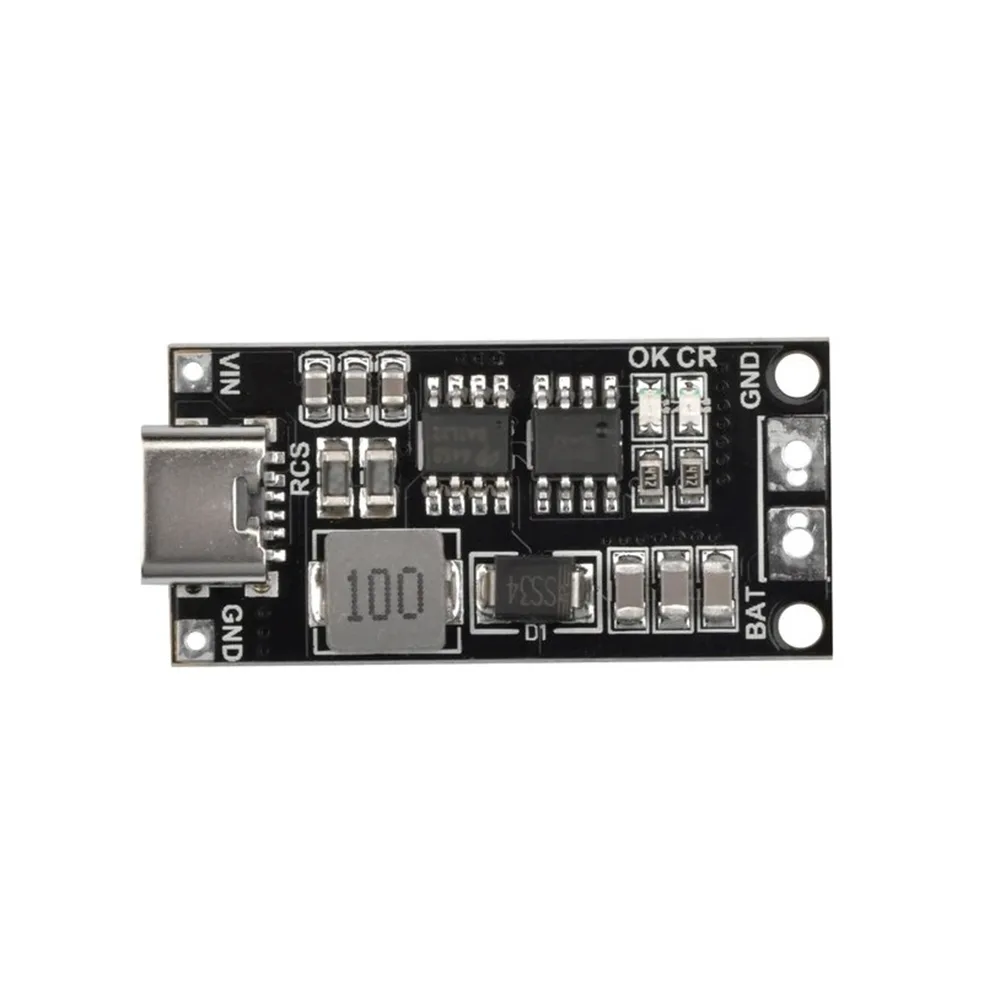
18650 Type-C to 3S 12.6V 4A Booster Charging Module
Higher-current 4A version of the 3S charging module. Fast-charges your 3S Li-Ion pack to 12.6V with integrated BMS protection and balancing. Ideal for 3S power tool packs and portable devices where faster charging matters.

1S 3.7V 2A 1MOS BMS Li-ion 18650 Battery Protection Board
Tiny single-cell protection board with 1 MOS FET design. Supports up to 2A discharge. Ultra-compact size fits easily inside battery compartments. Suitable for low-current embedded projects like Arduino sensors, IoT nodes, and wearables.
Frequently Asked Questions
Can I use a 4S BMS for a 3S pack?
No. The BMS monitors a specific number of cells via its balance leads. A 4S BMS expects 4 series cells — connecting a 3S pack will leave one balance input floating, causing erratic protection behavior and possible over-charge of cells. Always match the BMS S-rating exactly to your pack’s S-count.
My BMS keeps tripping under load — what is wrong?
This typically means your load current exceeds the BMS’s over-current protection threshold. Check your load’s actual current draw (use a clamp meter). If it exceeds the BMS rating, you need a higher-rated BMS. Also check that your balance wires are correctly connected — a missing or reversed balance wire will cause erratic protection trips even at low current.
How do I reset a BMS after it trips?
Most BMS boards auto-reset after the fault condition is cleared. For over-discharge trips: connect the charger to reset (the charge path is usually separate from the discharge path in dual-port BMS). For over-current/short-circuit trips: remove the load, wait 2–5 seconds, then reconnect. Some BMS boards require the charge voltage to be applied to reset from over-discharge lockout.
What is the difference between common-port and separate-port BMS?
Common-port BMS uses the same P+/P- terminals for both charging and discharging. Separate-port uses dedicated C+/C- for charger and P+/P- for load. Separate-port is safer (charger and load can never interact), better for high-current applications, but requires more wiring. Common-port is simpler and fine for most DIY projects.
Do I need a BMS with a built-in display?
Not strictly necessary, but a BMS with SOC (State of Charge) display or UART communication is very useful for solar systems and e-bike builds where knowing remaining capacity matters. For simple projects, a basic BMS with LED indicator or no display is sufficient and cheaper.
Find Your Perfect BMS at Zbotic
Zbotic stocks a wide range of BMS boards — from 1S protection boards for single-cell projects to multi-cell charger modules with integrated balancing. Find the right protection for every battery pack configuration.






Add comment