
Solar Battery Bank for Home: Sizing and Setup India Guide
India receives some of the highest solar irradiation in the world — an average of 4–6 peak sun hours per day across most of the country. Yet millions of Indian homes still face daily power cuts ranging from 1 to 8 hours, and electricity bills continue to climb. Building a solar battery bank for your home in India — whether to back up essential loads during outages or to shift to daytime solar energy — is more accessible than ever for the maker community. This guide covers everything from sizing your battery bank correctly to wiring it safely and choosing the right components for Indian conditions.
Table of Contents
- Why a DIY Solar Battery Bank Makes Sense in India
- Step 1: Calculate Your Load Requirements
- Step 2: Sizing the Battery Bank
- Step 3: Sizing the Solar Panel Array
- Choosing Battery Chemistry for Indian Conditions
- Wiring, BMS, and Charge Controller Selection
- Safety and Maintenance Tips for Indian Climates
- Frequently Asked Questions
Why a DIY Solar Battery Bank Makes Sense in India
The economics of solar battery storage in India have shifted dramatically. Lithium iron phosphate (LiFePO4) cell prices have fallen by over 70% in the last five years. A DIY 5kWh LiFePO4 battery bank can be assembled for approximately ₹30,000–₹45,000 in 2025, compared to ₹80,000–₹1,20,000 for equivalent commercial energy storage systems. The performance difference is minimal if you source quality cells and assemble carefully.
For makers and technically inclined homeowners in India, a DIY solar battery bank offers:
- Cost savings of 40–60% versus commercial systems
- Full customisation — size it for exactly your load, expand later
- Repairability — replace individual cells rather than the entire pack
- Learning opportunity — deep understanding of your energy system
- Backup during outages — independence from grid availability
However, it requires proper planning, quality components, and adherence to safety standards. This guide gives you the framework to do it right.
Step 1: Calculate Your Load Requirements
Before selecting a single component, you must understand how much energy you need to store. This calculation determines everything else.
Identify Your Critical Loads
For most Indian homes, the backup priority loads during outages are:
- Lights: LED bulbs (5–10W each × 4–6 bulbs = 20–60W total)
- Ceiling fans: 50–75W each × 2–4 = 100–300W total
- Mobile phone and laptop charging: 50–100W total
- WiFi router: 10–15W
- Small appliances (TV, set-top box): 50–100W
A typical Indian home running essential loads (lights, fans, phones, WiFi) during a 6-hour power cut consumes approximately 0.5–1.5 kWh per outage period.
Energy Consumption Calculation
For each load, multiply wattage by hours of use:
Energy (Wh) = Power (W) × Time (hours)
Example for a typical Indian home during an 8-hour backup period:
| Appliance | Watts | Hours | Wh |
|---|---|---|---|
| 4 × LED bulbs | 40W | 8h | 320Wh |
| 2 × Ceiling fans | 120W | 8h | 960Wh |
| WiFi + Phones | 60W | 8h | 480Wh |
| TV/Laptop | 80W | 4h | 320Wh |
| Total | 2080Wh ≈ 2.1 kWh |
Step 2: Sizing the Battery Bank
Once you know your energy requirement, size the battery bank to meet it with appropriate safety margins.
Account for Depth of Discharge (DoD)
For LiFePO4, usable capacity at 80% DoD means you need 2.1kWh / 0.8 = 2.625kWh of nominal capacity. Round up to 3kWh for safety margin and future load growth.
For lead-acid (if budget constrains you to older technology), only 50% DoD is safe, so: 2.1kWh / 0.5 = 4.2kWh nominal — and lead-acid has far shorter cycle life in India’s heat.
Account for Inverter Efficiency
Add 10–15% for inverter losses (most home inverters are 85–90% efficient at moderate loads):
3kWh × 1.12 = 3.36kWh → round to 3.5kWh nominal bank size
Voltage and Cell Configuration
Common DIY battery bank configurations:
- 12V system: 4 × LiFePO4 cells in series (4S × 3.2V = 12.8V). Works with standard 12V inverters and charge controllers. Maximum practical capacity before cables become unwieldy: about 2–3kWh (200Ah at 12V).
- 24V system: 8 × LiFePO4 cells in series (8S × 3.2V = 25.6V). More efficient for higher power loads, lower current means smaller cables. Good for 3–10kWh systems.
- 48V system: 16 × LiFePO4 cells in series (16S × 3.2V = 51.2V). Best for whole-home backup, most efficient, lowest current at a given power level. Standard for modern hybrid solar inverters.
For a 3.5kWh 48V system using 100Ah cells (common 280Ah LiFePO4 prismatic cells available from Chinese suppliers), you would need 16 cells × 280Ah = massive overkill. More practically, use 16 × 100Ah cells for 4.8kWh at 48V — a solid starter home battery system.
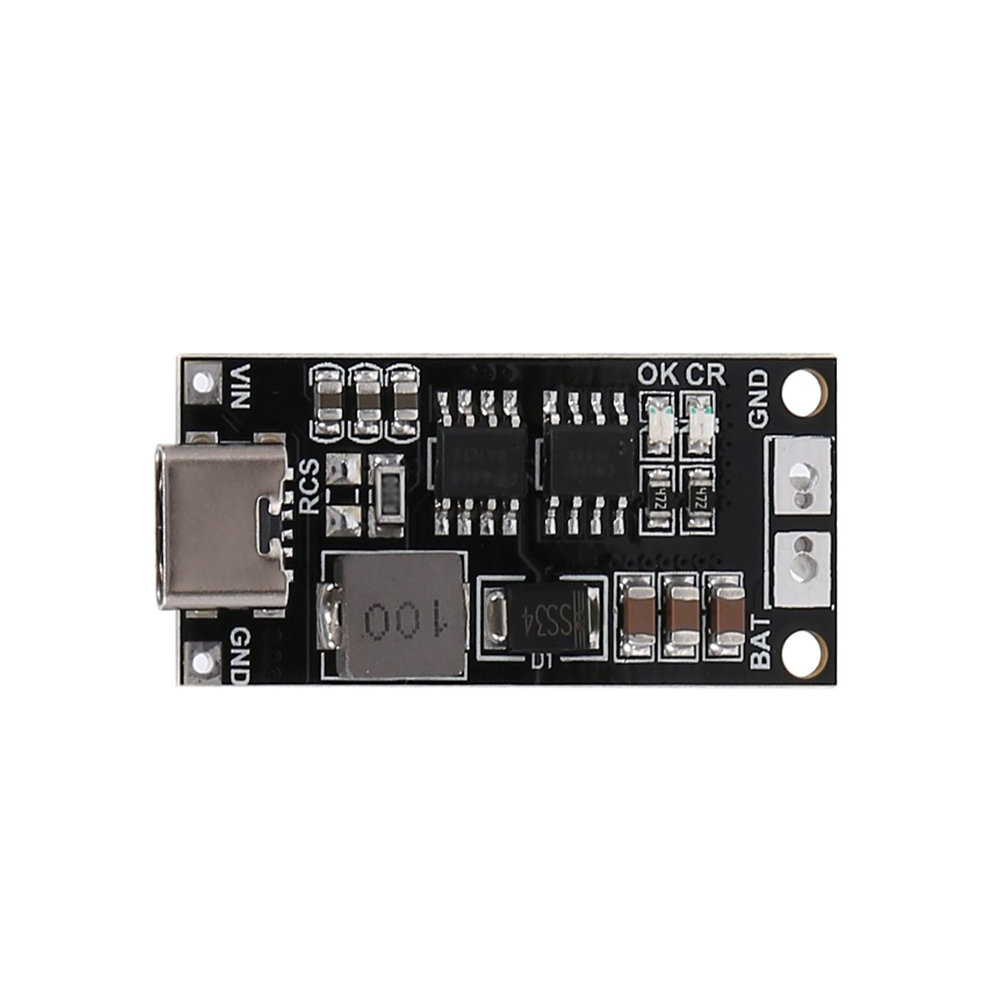
18650 Polymer Lithium Ion Charger Type C to 3S 12.6V 2A Booster Module
Ideal for small-scale 3S 12V battery bank projects — this module charges three 18650 cells in series via Type-C USB at 2A, with built-in balance charging.
Step 3: Sizing the Solar Panel Array
Your solar panels must generate enough energy to recharge the battery bank fully within a day, ideally leaving excess for direct daytime consumption.
Panel Array Sizing Formula
Panel Watts = Battery Bank Wh / (Peak Sun Hours × System Efficiency)
Using our 3.5kWh example, with 5 peak sun hours per day (typical for peninsular India) and 80% system efficiency (charge controller + wiring losses):
Panel Watts = 3500 / (5 × 0.8) = 3500 / 4 = 875W
So approximately 1000W (1kW) of solar panels is needed to reliably recharge a 3.5kWh battery bank in one day. In practice, add 20–25% margin for cloudy days and degradation: 1000W × 1.25 = 1250W → use four 320W panels or three 400W panels.
Panel Selection for India
- Use monocrystalline panels for best efficiency (19–22%) in limited roof space
- Check for BIS (Bureau of Indian Standards) certification for grid-tied systems
- Account for rooftop orientation — south-facing at 10–15° tilt is optimal for most of India
- Factor in shading from water tanks, trees, and adjacent buildings — even partial shading kills panel output dramatically
Choosing Battery Chemistry for Indian Conditions
This decision significantly affects cost, lifespan, safety, and performance:
LiFePO4 (Lithium Iron Phosphate) — Recommended for Home Storage
- Cycle life: 2000–3000+ cycles at 80% DoD
- Temperature tolerance: -20°C to 60°C (safest chemistry for hot Indian climate)
- Safety: Does not catch fire or explode even when damaged (no thermal runaway)
- Nominal voltage: 3.2V per cell
- Cost: Higher upfront than lead-acid, but far lower per kWh over lifespan
- Verdict: The best choice for home energy storage in India despite higher initial cost
NMC Li-ion (18650/21700 cells) — Good for Smaller Banks
- Higher energy density — more kWh per kilogram
- 300–500 cycle life (shorter than LiFePO4)
- More sensitive to heat — problematic for outdoor installations in India
- Good for small-scale backup banks using salvaged 18650 cells
VRLA/Lead-Acid — Avoid for New Installations
- Cheapest upfront cost
- Short cycle life (200–500 cycles at 50% DoD) in Indian heat — typically lasts only 2–3 years
- Heavy (lead-acid weighs 3–5× more per kWh than Li-ion)
- Cost-per-kWh over lifespan is actually higher than LiFePO4 when you factor replacement costs
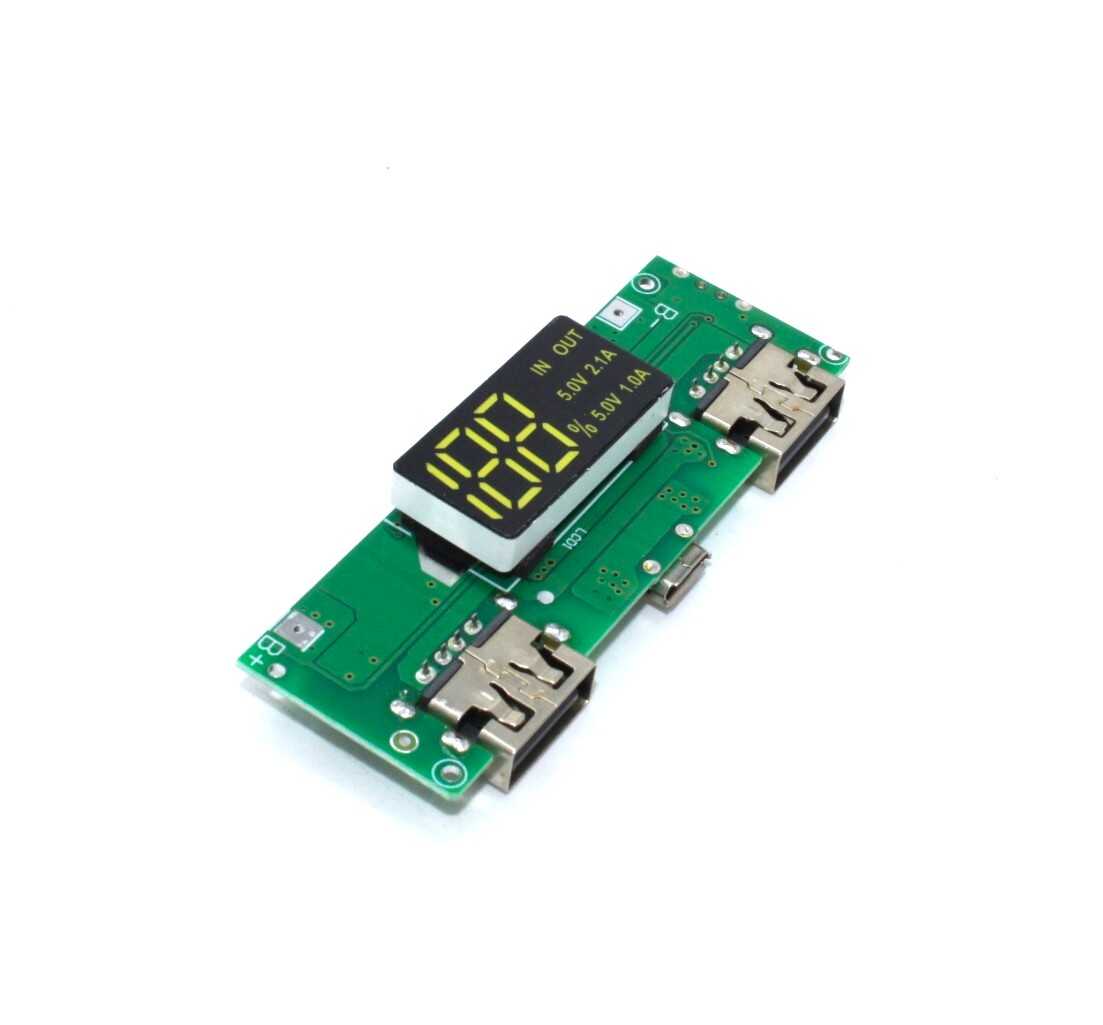
18650 5V 1A/2A Lithium Battery Digital Display & Charging Module, Dual USB Output
Build a compact 18650-based USB power bank station — great as a small solar-charged backup bank for phones and small devices during outages.
Wiring, BMS, and Charge Controller Selection
Battery Management System (BMS)
A BMS is non-negotiable for any Li-ion or LiFePO4 battery bank. For a 48V home bank, select a BMS rated for:
- Cell count: 16S for 48V LiFePO4
- Continuous current: At least 1.5× your peak load current (e.g., 60A BMS for a 2.5kW inverter at 48V: 2500W / 48V = 52A → use 60A or 80A BMS)
- Balancing: Passive balancing is standard; active balancing is better for longevity
- Communication: BMS with RS485, CAN bus, or Bluetooth is useful for monitoring
Charge Controller
Two main types for solar charging:
- PWM (Pulse Width Modulation): Cheaper, simpler, less efficient (70–75%). Suitable for small systems where panel and battery voltages are closely matched. Avoid for LiFePO4 unless specifically compatible.
- MPPT (Maximum Power Point Tracking): 20–30% more efficient than PWM, extracts maximum power from panels regardless of temperature or partial shading. Necessary for systems where panel voltage significantly exceeds battery voltage. Always specify LiFePO4 battery type when configuring an MPPT controller.
Popular MPPT controllers compatible with LiFePO4 and available in India: Victron SmartSolar, EPever Tracer A series, Epever XTRA series. For DIY builds, the EPever series offers excellent value at ₹5,000–₹15,000 for 20–60A models.
Wiring and Cables
Use appropriately rated cables — undersized cables cause voltage drop, wasted energy, and fire risk:
- At 48V, 2500W load draws 52A — use minimum 6mm² (10 AWG) cables for short runs, 10mm² for runs over 2 metres
- At 12V, the same 2500W = 208A — requires 35–50mm² cables (expensive, heavy, and a reason to prefer 48V systems)
- Use proper ring terminals, crimped (not soldered) connections for high-current battery cables
- Add a slow-blow fuse (or breaker) at the battery positive terminal, sized to protect the cable (not just the load)
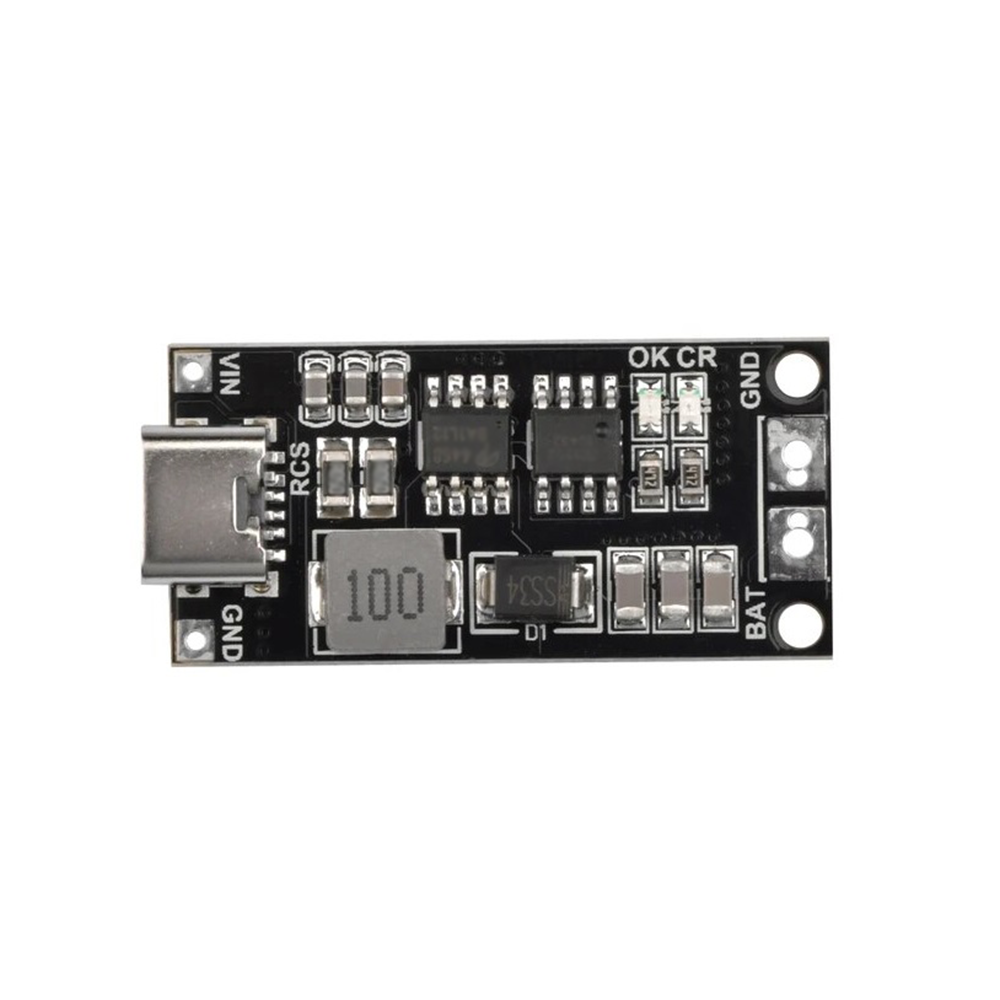
18650 Polymer Lithium Ion Charger Type C to 3S 12.6V 4A Booster Module
High-current 4A version of the 3S charging module — charges your 12V 18650-based mini solar bank twice as fast as the 2A version, ideal for quick daytime solar charging.
Safety and Maintenance Tips for Indian Climates
Thermal Management
India’s summer temperatures (40–50°C ambient in many regions) are the biggest challenge for battery banks. LiFePO4 is far more tolerant than NMC, but still degrades faster in sustained heat. Best practices:
- Install battery banks in a shaded, ventilated location — never in direct sun
- Avoid metal enclosures that trap heat; use ventilated wooden or fibreglass battery boxes
- Consider a small fan controlled by a thermal switch to blow cool air across the bank when temperatures exceed 40°C
- In very hot regions (Rajasthan, Gujarat summer), consider an insulated box or even air-conditioned battery room for maximum lifespan
Monsoon Weatherproofing
- Protect all connections from humidity — use heatshrink over terminals, silicone gel on connections, IP65-rated enclosures for outdoor installations
- Elevate the battery bank off the floor — indoor flooding is rare but possible
- Route all cable entries from the bottom of the enclosure to prevent water ingress
Regular Maintenance Schedule
- Monthly: Check BMS status, verify all cells are within 0.05V of each other (balancing working correctly)
- Quarterly: Check cable terminal tightness, inspect for corrosion or swelling
- Annually: Full capacity test — fully charge, then discharge at constant current to cutoff voltage while measuring Ah — compare to original rated capacity
Frequently Asked Questions
How much does a DIY solar battery bank cost in India?
A small 1.5kWh 24V LiFePO4 bank (8 × 3.2V 60Ah cells) costs approximately ₹18,000–₹25,000 for cells alone. Add BMS (₹3,000–₹6,000), MPPT controller (₹5,000–₹8,000), inverter (₹4,000–₹8,000 for 1kVA), and 500W solar panels (₹15,000–₹20,000). Total: ₹45,000–₹67,000 for a complete system — versus ₹80,000–₹1,20,000 for a commercial equivalent.
Can I use salvaged 18650 cells from laptop batteries for a home bank?
Technically yes, but with significant caveats. Salvaged cells vary widely in capacity (30–100% of original) and internal resistance. You must individually test and grade every cell before assembling a pack. Mismatched cells reduce pack performance and longevity. For a reliable home bank, purchasing new LiFePO4 prismatic cells from a reputable source is strongly preferred.
Is a DIY solar battery bank legal in India?
Off-grid DIY solar systems for personal use are legal and require no approvals. Grid-tied systems (where you sell power back to the grid) require DISCOM approval and NET metering registration under state solar policies. Most DIY home backup banks are off-grid and do not feed back to the grid, keeping them in a simple, regulation-free zone.
How many solar panels do I need to charge a 100Ah 12V battery bank?
A 100Ah 12V bank holds 1.2kWh. With 5 peak sun hours per day and 80% efficiency, you need 1200 / (5 × 0.8) = 300W of solar panels for full daily recharge. A single 300W or two 150W panels is sufficient for this bank size.
What inverter should I use with a DIY LiFePO4 battery bank?
Choose a pure sine wave inverter (not modified sine wave) for compatibility with sensitive electronics, fans, and motor loads. Look for inverters with adjustable battery cutoff voltage — set to 44V (for 48V bank) or 11V (12V bank) for LiFePO4. Many modern hybrid inverters have dedicated LiFePO4 settings. Luminous, Microtek, and Su-Kam all offer India-appropriate models with warranty support.
Conclusion: Energy Independence Is Within Reach for Indian Makers
Building a solar battery bank for your Indian home is one of the most rewarding and practical projects in the maker universe. It combines electrical engineering, mechanical assembly, energy systems knowledge, and real-world problem-solving — and at the end, you have a system that actually powers your home through the next power cut.
Start with the load calculation, right-size your battery and panels, choose LiFePO4 for reliability in Indian conditions, never skip the BMS, and plan your wiring for safety. A well-built DIY solar battery bank will serve your home for 10–15 years with proper maintenance — far beyond the payback period.
The Indian maker community is building these systems every day. The knowledge is freely available, the components are now accessible, and the economics make sense. There has never been a better time to start.
Find all the power components you need for your solar battery bank project at Zbotic’s Batteries, Power & Charging section — with pan-India shipping and genuine components.





Add comment