
Despite the lithium-ion revolution, NiMH (Nickel Metal Hydride) batteries remain the go-to choice for a surprising number of applications — AA and AAA cells for remotes and toys, sub-C packs for cordless tools and RC cars, and large D-cell configurations for emergency lighting and power backups. Understanding how to choose a proper NiMH battery charger and following the right care tips can dramatically extend the life and performance of these reliable, affordable, and globally available batteries. This guide covers everything an Indian maker needs to know about NiMH cells.
NiMH Battery Basics and Chemistry
NiMH batteries have a nominal cell voltage of 1.2V per cell (compared to 1.5V for alkaline and 3.6V for lithium-ion). Their chemistry is based on nickel oxyhydroxide at the positive electrode and a hydrogen-absorbing alloy (usually a combination of lanthanum, cerium, praseodymium, neodymium, and other rare earth metals) at the negative electrode.
Key parameters to understand:
- Nominal voltage: 1.2V per cell (fully charged: ~1.4–1.45V; end of discharge: ~1.0V)
- Energy density: 60–120 Wh/kg (lower than Li-ion but higher than NiCd)
- Self-discharge: Standard NiMH self-discharges at 1–3% per day. Low-self-discharge (LSD) NiMH (like Eneloop or Fujitsu) discharges at 0.1–0.3% per day — retaining 70–80% charge after one year of storage.
- Cycle life: 500–1000 cycles at standard charge rates; LSD cells can achieve 1500–2100 cycles.
- Temperature range: Works at 0°C to 45°C for charging; -20°C to 60°C for discharge. Standard NiMH charges poorly below 10°C — a relevant concern in North India’s winters.
- Memory effect: NiMH has a very mild memory effect (voltage depression) compared to NiCd. In normal use, this is not a practical concern, but occasional full discharge cycles (to 1.0V per cell, not less) help prevent it.
NiMH vs Lithium Ion: When to Choose NiMH
Given that lithium-ion cells have higher energy density and lower self-discharge, why would anyone choose NiMH? Several important reasons:
- Standard form factors: NiMH cells come in AA, AAA, C, D, and 9V standard form factors — the same as alkaline batteries. This means they work in devices designed for alkaline, without modification. There is no safe lithium equivalent in AA/AAA form (lithium AA cells exist but are non-rechargeable primary cells, not the same thing).
- Safety: NiMH cells are significantly safer than lithium-ion. They do not go into thermal runaway, do not vent toxic fluorinated gases, and can be short-circuited briefly without catastrophic failure. This makes them preferred in children’s toys, medical devices, and consumer electronics in many global markets.
- Simpler charging: NiMH doesn’t require a sophisticated BMS. A basic charger with temperature and voltage monitoring is sufficient for safe operation.
- Cost and availability: Good NiMH AA cells (2000–2500mAh) cost ₹150–300 each in India and are available everywhere. They’re recyclable and less restricted than lithium cells for shipping and air travel.
- RC cars, vintage drones, and cordless tools: Sub-C and SC-format NiMH packs are standard for many RC cars, old-generation drones, and power tool packs. Rebuilding these packs with NiMH is straightforward and cost-effective.
Types of NiMH Chargers
1. Trickle Charger (C/10 or lower)
Charges at 10% of the cell’s rated capacity. A 2000mAh cell takes 14–16 hours. These chargers are simple and don’t need termination detection — NiMH cells can tolerate trickle charging indefinitely (though it’s not ideal for longevity). The cheap phone-charger-style battery chargers sold at Indian electronics shops are almost always trickle chargers. They are safe but slow and will eventually reduce cell life through cumulative overcharge heat.
2. Fast Charger (C/3 to C/1)
Charges at 30–100% of rated capacity per hour. A 2000mAh cell charges in 1–3 hours. These chargers require a reliable termination method (see below) to avoid overcharging. Poor fast chargers without proper termination cause cells to overheat and reduce lifespan significantly.
3. Smart Charger / Analyser
These are the recommended option for any serious user. They combine multiple charging rates, proper termination detection, individual cell monitoring, refresh/reconditioning cycles, and capacity measurement. Brands like ISDT, Opus, La Crosse, Maha, and Nitecore produce excellent smart NiMH chargers. For Indian makers working with RC cars, power tools, or Arduino/ESP32 projects powered by NiMH packs, investing in a quality smart charger pays for itself in extended cell life.

ISDT A4 Air Smart Battery Charger – NiMH, NiCd, Li-Ion, LiFePO4 with Bluetooth
A premium multi-chemistry smart charger with Bluetooth connectivity. Handles NiMH, NiCd, Li-Ion, and LiFePO4 cells with proper NDV termination for NiMH, individual cell monitoring, and refresh/discharge cycles. Perfect for serious hobbyists maintaining multiple NiMH packs.
Charging Algorithms: Delta-V and NDV
NiMH cells don’t have a hard voltage limit like lithium-ion. Their termination is more subtle:
Delta-V (−ΔV) Termination
As a NiMH cell reaches full charge, the internal resistance changes slightly, causing the terminal voltage to drop by 5–15mV per cell after peaking. A quality charger detects this negative delta-V and cuts off. This is the most reliable method for fast charging (C/1 to C/2 rates) but can miss termination at low charge rates (below C/3) where the −ΔV is too small to detect reliably.
NDV (Normalized Delta-V)
A more sophisticated version that normalises the voltage change relative to the charge current. More accurate across a wider range of charge rates and cell conditions. Used in premium chargers like the ISDT range.
Temperature-Based Termination (dT/dt)
Monitors the rate of temperature rise. When the cell temperature rises faster than a threshold (typically 1°C/minute), charging stops. Used in combination with −ΔV in quality chargers for redundant termination. An important safety backstop — if −ΔV detection fails for any reason, the temperature cutoff prevents overcharging.
Absolute Temperature Cutoff
If cell temperature exceeds 45°C (charge mode) or 60°C (safety limit), charging stops regardless of other parameters. Especially important in Indian summers where ambient temperature can be 35–42°C, meaning the charger’s temperature threshold must account for ambient — a good smart charger does this automatically.
Smart Charger Features to Look For
When buying a NiMH charger for regular use in India, prioritise these features:
- Individual cell monitoring: Each cell is charged independently. A 4-cell charger that charges all cells as a series string will charge at the rate limited by the weakest cell and may overcharge stronger cells. Independent charging always produces better results.
- Charge rate selection: Choose 0.5A, 1A, and 2A at minimum. Running a 2500mAh AA at 500mA (C/5) is gentler and gives longer life than charging at 1A (C/2.5).
- Refresh/recondition mode: Discharges cells to a safe depth (1.0V/cell) then recharges. Reverses mild voltage depression and gives you an accurate capacity reading. Run this every 3–6 months on NiMH cells in regular service.
- Capacity display: Shows actual mAh delivered during charge. A 2500mAh cell that only accepts 1800mAh is telling you it needs a refresh cycle or is near end of life.
- Reverse polarity protection: A common accident that a good charger handles gracefully (detects it and shows an error rather than damaging the cell or charger).
- AC input and Indian plug compatibility: Verify the charger accepts 230V AC and comes with or is compatible with Indian Type D plugs. Many imported chargers are 110V only or come with flat US plugs requiring an adapter.
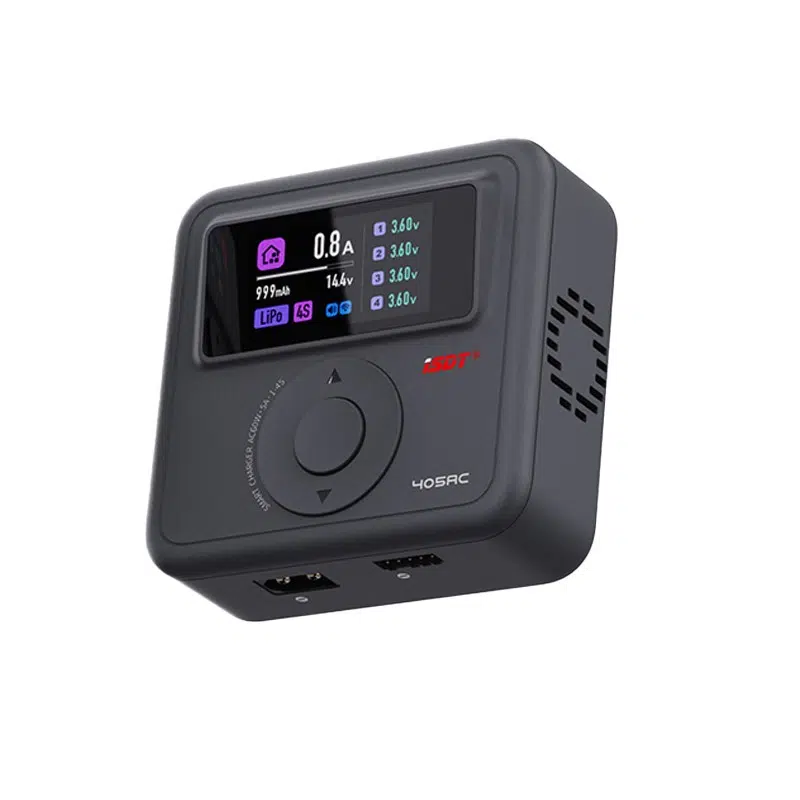
ISDT 405AC 60W AC GaN Smart Charger – 0.1–5A, 1–4S LiPo/LiHv/LiFe (XT60 Output)
A compact GaN-based AC smart charger from ISDT. While optimised for LiPo/LiFe chemistries, it pairs well with a dedicated NiMH charger in a two-charger setup for makers who work with both lithium and NiMH packs on their projects.
Care and Maintenance Tips for Longer Life
Tip 1: Charge at C/3 to C/5 for Maximum Longevity
Slower charging generates less internal heat, which is the primary cause of NiMH capacity fade. If you don’t need the cells in a hurry, charge at C/5 (e.g., 500mA for a 2500mAh cell). Research shows this can nearly double cycle life compared to C/1 charging.
Tip 2: Don’t Let NiMH Cells Sit Discharged
Unlike lithium cells that tolerate months of storage at partial charge, NiMH cells that sit fully discharged (below 1.0V/cell) can develop internal shorts from copper migration. Charge NiMH cells if they won’t be used for more than 1–2 months, and check their voltage before storage.
Tip 3: Store in the Refrigerator for Long-Term Storage
Standard NiMH cells lose 1–3% charge per day at room temperature. Storing at 5–10°C (a regular refrigerator) reduces self-discharge to under 0.5% per day. Use sealed plastic bags to prevent moisture condensation on the cells. Allow cells to reach room temperature (about 1 hour) before charging after refrigerator storage.
Tip 4: Use Matched Cells in Series Strings
For RC cars, portable lighting, or custom NiMH packs, use cells from the same batch and brand. Before building a pack, check each cell’s capacity with a charger/analyser — discard cells that differ by more than 5% from the group average. Mismatched cells in a series string will have the weakest cell depleted fastest, reducing effective pack capacity and accelerating degradation.
Tip 5: Run a Refresh Cycle Every 3–6 Months
Use your smart charger’s refresh/recondition mode to discharge cells to 1.0V/cell and then fully recharge. This equalises cells in a pack, reverses any mild voltage depression, and gives you an accurate current capacity reading. Think of it as routine maintenance — like changing engine oil.
Tip 6: Don’t Mix NiMH and Alkaline in the Same Device
NiMH cells have a nominal 1.2V vs alkaline’s 1.5V. In a 4-AA device, NiMH gives 4.8V and alkaline gives 6V. While most modern electronics tolerate NiMH fine, mixing one NiMH with three alkalines creates an imbalanced string where the NiMH cell gets reverse-charged at the end of discharge — destroying the NiMH cell.

1 x AA Battery Holder Box with Alligator Clips
A handy single-AA battery holder with alligator clip leads. Ideal for testing NiMH AA cells individually or powering small Arduino and sensor projects during development with AA NiMH cells.

1 x AAA Battery Holder Box with Wire (Pack of 2)
Compact AAA battery holders for NiMH AAA cells. Use these in prototypes, custom remotes, or low-power sensor nodes that run on AAA NiMH cells. Pack of 2 for convenient multi-cell configurations.
Frequently Asked Questions
Can I charge NiMH batteries with a USB charger designed for lithium cells?
No. Lithium chargers use a constant-current/constant-voltage (CC-CV) algorithm with a fixed termination voltage (4.2V for Li-ion). NiMH cells have a different nominal voltage (1.2V) and require −ΔV termination. Using a lithium charger on NiMH cells will either not charge them at all or overcharge them, potentially causing swelling or venting. Always use a NiMH-compatible charger.
What’s the difference between LSD NiMH and standard NiMH?
LSD (Low Self-Discharge) NiMH cells use a modified separator and electrolyte that dramatically reduces self-discharge from 1–3%/day (standard) to 0.1–0.3%/day. The trade-off is slightly lower peak capacity. For devices that are not used daily (remote controls, emergency torches), LSD NiMH is far superior — cells are still usable after sitting for a year. For RC cars or tools used weekly, standard NiMH with a smart charger is often the better value.
My NiMH pack only lasts half as long as before — what do I do?
First, run a refresh/reconditioning cycle on a smart charger. If this doesn’t restore capacity, check each cell individually — one or two bad cells are often responsible. Replace bad cells with matched cells. If all cells show significantly reduced capacity, the pack has reached end of life and should be properly recycled (NiMH cells are recyclable, unlike some other chemistries).
Is it safe to leave NiMH cells in a trickle charger indefinitely?
Most modern trickle chargers at C/20 or lower (e.g., 100mA for a 2000mAh cell) are considered safe for extended periods. However, long-term trickle charging at C/10 does reduce cell life over time due to accumulated heat. Best practice: charge to full with a smart charger, then remove from charger.
Can NiMH batteries be recycled in India?
Yes. NiMH batteries contain nickel, which is a valuable and recoverable material. Several battery recycling programs in India accept NiMH cells. Electronics stores, municipal e-waste collection points, and dedicated recycling companies (like Attero, E-Parisaraa) collect NiMH batteries. Never throw NiMH cells in regular trash — they should always be recycled.
Get the Most from Your NiMH Batteries
NiMH batteries are reliable, safe, and environmentally friendlier than many alternatives — but only if you charge and store them correctly. A good smart charger is the single biggest investment you can make to extend the life and performance of your NiMH cells. Explore Zbotic’s Batteries & Power section for smart chargers, battery holders, and all the accessories you need for NiMH and multi-chemistry battery management.





Add comment