
Phase Shift in RC and RL Circuits: Calculation Examples for Beginners
Understanding phase shift in RC and RL circuits is one of the most important concepts in AC electronics — and one that trips up many engineering students and hobbyists. When a capacitor or inductor is present in a circuit, voltage and current no longer rise and fall at exactly the same time. This timing difference, measured in degrees, is called phase shift. Mastering this concept opens the door to understanding filters, oscillators, power factor correction, and signal processing. This guide uses clear formulas and real worked examples to make phase shift intuitive for every level of maker.
What Is Phase and Phase Shift?
In AC circuits, voltage and current vary sinusoidally with time. The phase describes where in the sine cycle a signal currently sits — expressed as an angle in degrees (0° to 360°) or radians (0 to 2π).
When two sinusoidal signals of the same frequency have their peaks at different moments in time, we say there is a phase difference or phase shift between them. If signal B’s peak comes after signal A’s peak, B is said to lag A. If B’s peak comes before A’s, B leads A.
The formula relating time delay (t_d) to phase angle (φ) is:
φ (degrees) = (t_d / T) × 360° = t_d × f × 360°
Where T is the period (1/frequency). For a 1 kHz signal with a 250 µs time delay, the phase shift is 250µs × 1000 Hz × 360° = 90°.
Pure resistors have no phase shift — voltage and current are perfectly in phase (φ = 0°). Capacitors and inductors introduce phase shifts, and their magnitude depends on the component values and frequency.
Phase Shift in RC Circuits
An RC circuit (resistor and capacitor in series) acts as a frequency-dependent voltage divider. The capacitor’s opposition to current flow — its reactance — decreases as frequency increases:
X_C = 1 / (2π × f × C)
Where X_C is capacitive reactance in ohms, f is frequency in Hz, and C is capacitance in farads.
In a series RC circuit with an AC source, the current leads the source voltage because the capacitor initially allows current to flow easily before charging up. The phase angle of the total impedance is:
φ = -arctan(X_C / R) = -arctan(1 / (2π × f × R × C))
The negative sign indicates that voltage lags current by φ degrees in a capacitive circuit (or equivalently, current leads voltage).
RC Phase Shift Key Points
- At very low frequencies: X_C is huge, φ ≈ -90° (voltage lags current by 90°)
- At the cutoff frequency (f_c = 1/(2πRC)): X_C = R, φ = -45°
- At very high frequencies: X_C → 0, φ → 0° (circuit becomes purely resistive)
The cutoff frequency (also called the -3dB frequency) of an RC circuit is the frequency where the output voltage is 70.7% of the input (a 3dB reduction). This is the cornerstone of RC filter design:
f_c = 1 / (2π × R × C)
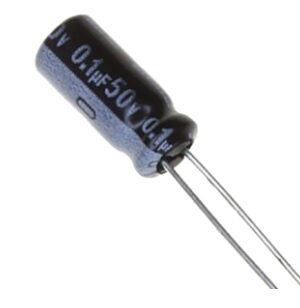
0.1µF 50V Capacitor (Pack of 50)
100nF capacitors for building RC phase shift circuits, filters, and timing circuits. Perfect for breadboard experiments with Arduino and op-amp circuits.
Phase Shift in RL Circuits
An RL circuit (resistor and inductor in series) is the dual of the RC circuit. An inductor opposes changes in current — its inductive reactance increases with frequency:
X_L = 2π × f × L
Where X_L is inductive reactance in ohms, f is frequency in Hz, and L is inductance in henries.
In a series RL circuit, the voltage across the inductor leads the current (because the inductor resists sudden current changes). The total impedance phase angle is:
φ = +arctan(X_L / R) = +arctan(2π × f × L / R)
The positive sign indicates that voltage leads current by φ degrees in an inductive circuit.
RL Phase Shift Key Points
- At very low frequencies: X_L ≈ 0, φ ≈ 0° (circuit behaves like a pure resistor)
- At the cutoff frequency (f_c = R/(2πL)): X_L = R, φ = +45°
- At very high frequencies: X_L → ∞, φ → +90° (voltage leads current by 90°)
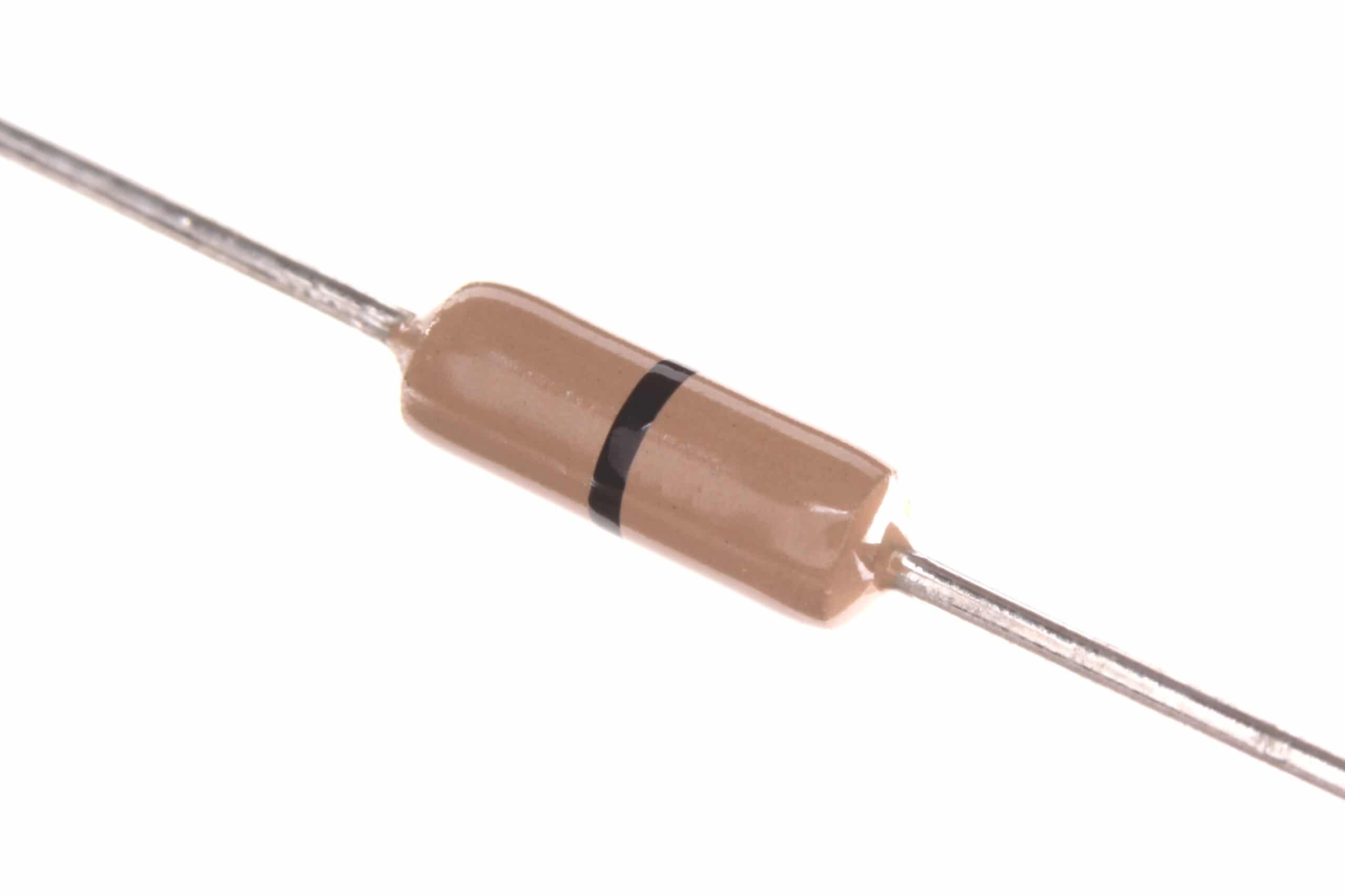
0 Ohm 0.25W Carbon Film Resistor (Pack of 100)
Use jumper resistors to selectively bypass RC timing sections in filter circuits. Essential for breadboard circuit prototyping and testing.
Worked Calculation Examples
Example 1: RC Circuit Phase Shift Calculation
Problem: An RC circuit has R = 10 kΩ and C = 100 nF. Find the phase shift at f = 200 Hz.
Step 1: Calculate capacitive reactance
X_C = 1 / (2π × 200 × 100×10⁻⁹)
X_C = 1 / (2π × 200 × 10⁻⁷)
X_C = 1 / (1.257 × 10⁻⁴)
X_C = 7,958 Ω ≈ 7.96 kΩ
Step 2: Calculate phase angle
φ = -arctan(X_C / R) = -arctan(7960 / 10000)
φ = -arctan(0.796)
φ = -38.5°
Result: At 200 Hz, the output voltage (across R) lags the source by 38.5°. The current leads the source voltage by 38.5°.
Step 3: Find the -3dB cutoff frequency
f_c = 1 / (2π × 10000 × 100×10⁻⁹)
f_c = 1 / (2π × 10⁻³)
f_c = 159.15 Hz
At this frequency (159 Hz), the phase shift is exactly -45°.
Example 2: RL Circuit Phase Shift Calculation
Problem: An RL circuit has R = 100 Ω and L = 10 mH. Find the phase shift at f = 5 kHz.
Step 1: Calculate inductive reactance
X_L = 2π × 5000 × 0.010
X_L = 2π × 50
X_L = 314.16 Ω
Step 2: Calculate phase angle
φ = +arctan(X_L / R) = +arctan(314.16 / 100)
φ = +arctan(3.14)
φ = +72.3°
Result: At 5 kHz, the voltage leads the current by 72.3°. This circuit is highly inductive at this frequency.
Step 3: Find the cutoff frequency
f_c = R / (2π × L) = 100 / (2π × 0.010)
f_c = 100 / 0.0628
f_c = 1,592 Hz
Example 3: RC Phase Shift Oscillator
A classic RC phase shift oscillator uses three RC stages in series, each providing 60° of phase shift at the oscillation frequency. Total phase shift = 180°, which with the 180° from the inverting amplifier gives 360° (360° = 0°) — satisfying the Barkhausen criterion for oscillation.
For three identical RC stages each with phase shift of 60°, the oscillation frequency is:
f_osc = 1 / (2π × R × C × √6)
For R = 10 kΩ and C = 10 nF:
f_osc = 1 / (2π × 10000 × 10×10⁻⁹ × 2.449)
f_osc = 1 / (2π × 244.9 × 10⁻⁶)
f_osc = 649 Hz
Understanding Phasor Diagrams
Phasor diagrams represent AC quantities as rotating vectors (phasors) in a 2D plane. The horizontal axis represents the in-phase component (real) and the vertical axis represents the 90° leading component (imaginary).
For a Series RC Circuit:
- Draw current I along the horizontal (reference phasor, 0°)
- Draw V_R along horizontal (in phase with current)
- Draw V_C downward (90° lagging current)
- The source voltage V_S = √(V_R² + V_C²) at angle φ = -arctan(V_C/V_R) below horizontal
For a Series RL Circuit:
- Draw current I along horizontal (reference)
- Draw V_R along horizontal
- Draw V_L upward (90° leading current)
- V_S = √(V_R² + V_L²) at angle φ = +arctan(V_L/V_R) above horizontal
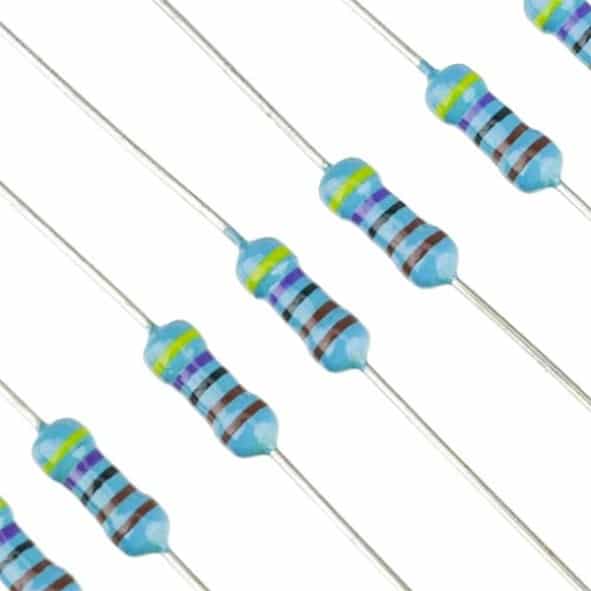
1.5 Ohm 0.25W Metal Film Resistor MFR (Pack of 100)
Precision metal film resistors with ±1% tolerance — ideal for accurate RC and RL circuit experiments where component values must be precise.
Practical Applications of Phase Shift
1. RC Low-Pass and High-Pass Filters
By measuring the output across R (in an RC circuit) or C, you get different filter responses. Output across R is a high-pass filter; output across C is a low-pass filter. The phase shift at any frequency directly tells you how far you are from the cutoff frequency.
2. Power Factor Correction
In AC power systems, inductive loads (motors, transformers) cause current to lag voltage — wasting reactive power. Power factor is cos(φ), where φ is the phase angle. Indian electricity distribution companies charge commercial customers for low power factor (below 0.9 PF). Adding capacitor banks reduces the phase shift and improves power factor.
3. Phase Shift Oscillators
The RC phase shift oscillator (discussed above) is a simple, low-cost audio frequency oscillator. It uses a transistor or op-amp as an inverting amplifier with an RC network for frequency-determining feedback. Common in electronic music projects and laboratory function generators.
4. Signal Delay and Timing
RC networks provide predictable signal delays. In digital electronics, these delays affect setup/hold timing. In analogue circuits, they control timing in monostable and astable multivibrators like the 555 timer — where the RC time constant determines on/off periods.
How to Measure Phase Shift on an Oscilloscope
To experimentally verify your RC or RL circuit phase calculations:
- Connect the input signal to Channel 1 of your oscilloscope and the output signal to Channel 2.
- Set both channels to the same volts/div and trigger on Channel 1.
- Measure the time delay (t_d) between the rising zero-crossings of the two signals using the oscilloscope’s cursor function.
- Measure the period (T) of the signal (time for one complete cycle).
- Calculate phase shift: φ = (t_d / T) × 360°
Example: If you see a 2 µs delay on a 10 kHz (100 µs period) signal: φ = (2/100) × 360° = 7.2°
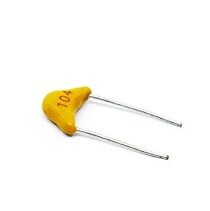
0.1/100nF Multilayer Ceramic Capacitor (Pack of 50)
100nF (0.1µF) ceramic capacitors — perfect for building RC phase shift networks, timing circuits, and filter experiments on your breadboard.
Frequently Asked Questions
Q: Why does a capacitor cause voltage to lag current?
A capacitor stores charge. When AC voltage is applied, current flows immediately to charge the capacitor — before the full voltage has built up across it. This means current peaks before voltage, so current leads (or equivalently, voltage lags) by up to 90°. The capacitor opposes sudden voltage changes, but allows current to change freely at the moment of voltage change.
Q: What is the difference between phase shift and time delay?
Phase shift is a frequency-dependent, dimensionless angle (degrees or radians) describing how far one signal is displaced from another in its cycle. Time delay is the actual time difference in seconds. They are related by frequency: a 90° phase shift at 1 kHz corresponds to 250 µs time delay, but the same 90° shift at 100 kHz corresponds to only 2.5 µs delay.
Q: How does phase shift affect audio circuits?
In audio circuits, phase shift between frequencies causes phase distortion — where different frequencies arrive at the output at different times. The human ear is largely insensitive to absolute phase but is sensitive to relative phase between channels. RC filters in crossover networks introduce phase shift that must be accounted for in speaker system design.
Q: Can an RC circuit produce exactly 90° phase shift?
Theoretically yes — but only at DC (f = 0 Hz) for a capacitive circuit or at infinite frequency for an inductive circuit. In practice, 90° is approached asymptotically. A single RC stage can produce up to about 85° phase shift at frequencies very far from its cutoff frequency.
Q: What is the time constant (τ) of an RC circuit?
The time constant τ = R × C (in seconds). It represents the time for the capacitor to charge to 63.2% of its final voltage (or discharge to 36.8%). The cutoff frequency is related by f_c = 1/(2πτ). For a 10kΩ resistor and 100nF capacitor: τ = 10000 × 100×10⁻⁹ = 1 ms, and f_c = 159 Hz.
Zbotic stocks resistors, capacitors, breadboards, and jumper wires for all your electronics experiments. Get quality components delivered anywhere in India.






Add comment