
Fixed-wing UAVs capable of flying 50 kilometres or more represent the pinnacle of amateur and professional drone engineering. These aircraft combine the efficiency of conventional airplane aerodynamics with the versatility of autonomous flight — and they are increasingly being used in India for border surveillance, pipeline inspection, wildlife monitoring, and precision agriculture. This comprehensive tutorial walks you through building, configuring, and flying a long-range fixed-wing FPV drone from scratch.
1. Why Fixed Wing for Long Range?
The fundamental physics of flight strongly favour fixed wings for efficiency. A multirotor (quadcopter/hexacopter) generates lift entirely through the downwash of its rotors, consuming enormous power just to stay aloft. A fixed-wing aircraft uses its wings for lift, with the motor providing only forward thrust — typically consuming 3–8× less power per kilometre of flight.
In practical terms, a 5000mAh 4S battery that gives a quadcopter 20 minutes of hover time will keep a well-designed fixed wing aloft for 60–90 minutes. Scaled to larger batteries, 50km+ ranges are achievable with a DIY build costing under ₹50,000.
Trade-offs: Fixed wings require a runway or hand-launch and a designated landing area. They cannot hover for inspection tasks. VTOL hybrids (tilt-rotor or tail-sitter) solve this but add mechanical complexity and cost.
2. Airframe Options: Foam, Carbon & Custom
The three main airframe categories for DIY long-range UAVs:
- EPO/EPP Foam Platforms (recommended for beginners): Models like the Reptile S800, Believer 1960, or Nimbus 1800 offer ready-to-build foam fuselages with fibreglass spars. Durable, affordable (₹5,000–15,000), and easy to repair. The Skywalker X8 flying wing is hugely popular globally for its 1.8m wingspan and efficient pusher configuration.
- Carbon Fibre Custom Builds: Maximum efficiency and durability. Custom-cut carbon fibre ribs and skins weigh 30–50% less than foam equivalents. Requires composite manufacturing skills. Used in professional applications.
- 3D Printed + Carbon Rod: Popular in the Indian maker community — print structural frames in PETG/ASA, reinforce with carbon rods, skin with Oracover film. Extremely customisable.
For a 50km range target, aim for a wingspan of 1.5–2.5m, aspect ratio of 7–10, and an all-up weight (AUW) below 2.5 kg for manageable hand-launching.
3. Flight Controller: ArduPlane vs iNAV
Two ecosystems dominate DIY fixed-wing autopilots:
| Feature | ArduPlane | iNAV |
|---|---|---|
| Primary use | Professional UAV, survey, cargo | Sport FPV, freestyle fixed wing |
| Waypoint missions | Excellent (Mission Planner) | Good (Configurator) |
| TECS (airspeed control) | Yes (very sophisticated) | Basic airspeed hold |
| Community in India | Large (ArduPilot India groups) | Growing |
| Hardware (budget) | Matek F405-Wing (₹4,000) | Matek F405-Wing (same board) |
For a serious 50km build targeting autonomous missions, ArduPlane is the clear choice. Its Total Energy Control System (TECS) manages pitch and throttle together to maintain altitude and airspeed simultaneously — critical for long-range efficiency.
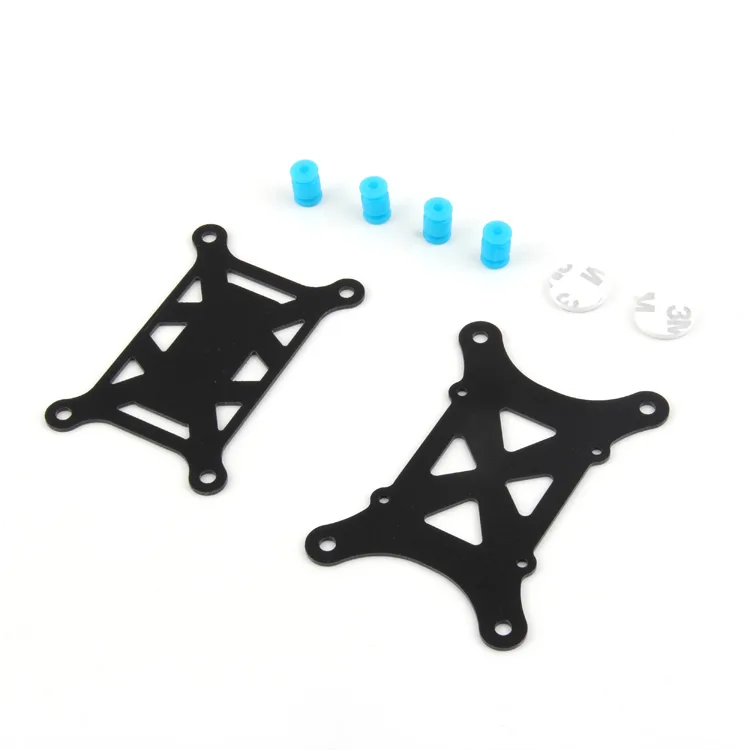
Anti-Vibration Shock Absorber for APM/KK/MWC/PixHawk
Essential vibration isolation for your Pixhawk or APM flight controller. Engine vibration causes IMU noise that degrades navigation on long flights.
4. Propulsion System Design
Fixed-wing propulsion prioritises efficiency (high static thrust per watt) over high RPM. Recommended configurations for a 1.8–2.5m wingspan UAV:
- Motor: Low-KV outrunner (700–1200KV for 3S, 400–800KV for 4S). T-Motor and SunnySky motors are excellent choices for efficiency.
- Propeller: Large diameter, low pitch (9×4.7 to 13×6.5 folding prop). Folding props are essential — they fold flat when the motor stops, dramatically reducing drag during gliding.
- ESC: 30–40A for typical fixed-wing builds. Must support low-speed operation without hunting at cruise throttle (40–60%).
- Configuration: Tractor (prop in front) for conventional designs. Pusher (prop in rear) for better CG range and unobstructed camera FOV.

30A Brushed ESC No Brake
Reliable 30A ESC suitable for fixed-wing pusher/tractor motor configurations. No-brake mode lets the prop spin down naturally for reduced drag.
5. Power System and Battery Strategy
Achieving 50km range requires careful energy budgeting. A typical 1.8m wingspan UAV at cruise speed (15 m/s) consumes approximately 80–120W. Here is the maths:
- 100W average cruise power × 45 minutes = 75Wh energy needed
- A 4S (16.8V) 10,000mAh LiPo = 67.2Wh — borderline, use 12,000mAh (80.6Wh)
- At 15 m/s cruise, 45 min × 900 m/min = 40.5 km range (with 20% safety reserve)
To reach 50km+, you need either a higher capacity battery (adding weight), a more efficient airframe, or a higher cruise speed (carefully balanced against increased drag). Many builders use two parallel batteries or extend the fuselage to accommodate extra capacity.
6. FPV System for Long Range Video
At 50km range, traditional 5.8GHz FPV video is completely insufficient (practical range: 2–3km). Long-range FPV options:
- Analog + High-power VTX + Directional Antenna: 1W VTX with 13dBi patch antenna on a tracker. 15–20km practical range. Legal issues — 1W VTX is unlicensed in India.
- Digital FPV (DJI O3/O4): 10–15km range, HD video. Excellent for medium-range FPV.
- H.264/H.265 IP Camera + LTE: Use a 4G LTE SIM card link for unlimited range FPV. Latency is 150–400ms — fine for autonomous monitoring, not ideal for manual FPV flight.
- OpenHD / WFB-NG (WiFiBroadcast): Raspberry Pi + 5.8GHz WiFi adapter in monitor mode. Extremely low latency digital FPV with 10–15km range using directional antennas.
For a true BVLOS (Beyond Visual Line of Sight) 50km+ operation, LTE video uplink is the only practical legal option in India — and it requires specific BVLOS permissions from DGCA.

1/3″ CMOS 700TVL Mini FPV Camera 2.1mm Lens
Compact analog FPV camera for fixed-wing nose mounting. Lightweight design ideal for long-range builds where every gram matters.
7. Long Range Telemetry Setup
Telemetry is the data link carrying ArduPlane’s MAVLink protocol to your ground control station. At 50km range:
- 433 MHz telemetry: Legally usable in India (ISM band). With a 500mW radio and Yagi antenna, 20–40km range is achievable.
- 915 MHz (3DR-style): Shorter range than 433 MHz at the same power due to higher frequency attenuation.
- RFD900x: The gold standard for long-range MAVLink telemetry. Up to 40km with omni antennas, further with Yagi.
- LTE/4G MAVLink: Use a Raspberry Pi on the drone with a SIM card and the ZeroTier or SiK radio simulator for unlimited range telemetry over the internet.

3DR Single TTL MINI Radio Telemetry 433MHz 500mW
Compact 433MHz, 500mW telemetry module for Pixhawk and APM flight controllers. Long-range ISM band operation suitable for extended fixed-wing missions.
8. RC Link: ELRS vs Crossfire at 50km+
The RC control link must maintain reliable command uplink for the full mission radius. At 50km:
- TBS Crossfire (915 MHz): Proven 40–60km range with stock dipole antennas. Add directional Yagi for 100km+. Very popular in the Indian long-range community.
- ExpressLRS (ELRS, 900 MHz): Open-source alternative. With a 1W ELRS transmitter module and Yagi, 50km+ is routinely demonstrated. Cheaper than Crossfire.
- DragonLink: 433 MHz system with exceptional penetration. Less popular but trusted for professional applications.
At true 50km range, you need a directional antenna tracker (AAT — Automatic Antenna Tracker) to maintain antenna pointing toward the aircraft. Build one using an ArduPilot-capable gimbal or commercial antenna trackers.
9. GPS, Compass and Navigation
Long-range navigation depends on reliable GPS. Best practices:
- Use a high-quality M9N or M10 GPS module (u-blox 10 series) — faster acquisition and better multi-constellation tracking.
- Mount GPS as high and forward on the airframe as possible, away from carbon fibre structures (which block GPS signals).
- Use an external compass if the FC’s internal compass is affected by motor/ESC interference.
- Enable GLONASS + GPS + Galileo multi-constellation in ArduPlane for redundancy.

25x25x8mm 28dB High Gain Active GPS Antenna
High sensitivity 28dB ceramic GPS antenna for NEO-6M/7M/8M modules. Better satellite lock for reliable navigation on long-range fixed-wing missions.
10. ArduPlane Configuration for Long Range
Critical ArduPlane parameters for a 50km fixed-wing mission:
- TECS_PITCH_MAX / MIN: Set based on your aircraft’s actual pitch limits (typically ±15°).
- CRUISE_SPEED: Optimal cruise speed (usually 15–20 m/s for foam wings). Find empirically — fly at different throttle settings and note power consumption.
- RTL_ALTITUDE: Set high enough to clear all terrain between the aircraft and home (critical for long-range missions over hills).
- TERRAIN_FOLLOW: Enable terrain following using SRTM data. Download terrain for your operating area in Mission Planner before the flight.
- FS_SHORT_TIMEOUT / FS_LONG_TIMEOUT: Configure failsafe behaviour — RTL on RC link loss after 5 seconds, continue mission if telemetry is lost (telemetry is non-critical).
- FENCE_ENABLE: Set a geofence that the aircraft returns home if breached — essential safety net.
11. Safety Systems and Failsafes
At 50km range, a comprehensive safety system is non-negotiable:
- Return to Launch (RTL): Triggered by RC loss, GPS loss, low battery, or geofence breach. Test this on the ground and in a short low-altitude flight before the long mission.
- Parachute system: Optional but recommended for flights over populated areas. ArduPlane supports a dedicated parachute output.
- ATC Notification: For flights in controlled airspace (near airports), file a NOTAM through the Airports Authority of India (AAI).
- Flight Log Insurance: Always record flight logs (SD card on FC). Required for incident investigation and increasingly for drone insurance in India.
12. Ground Station Setup
A proper ground station for long-range missions includes:
- Laptop or tablet with Mission Planner or QGroundControl
- Telemetry radio connected via USB
- RC transmitter with antenna tracker output
- Directional patch or Yagi antenna for both RC link and telemetry
- Portable power bank or 12V battery for all-day operations
- FPV goggles or monitor with the video receiver
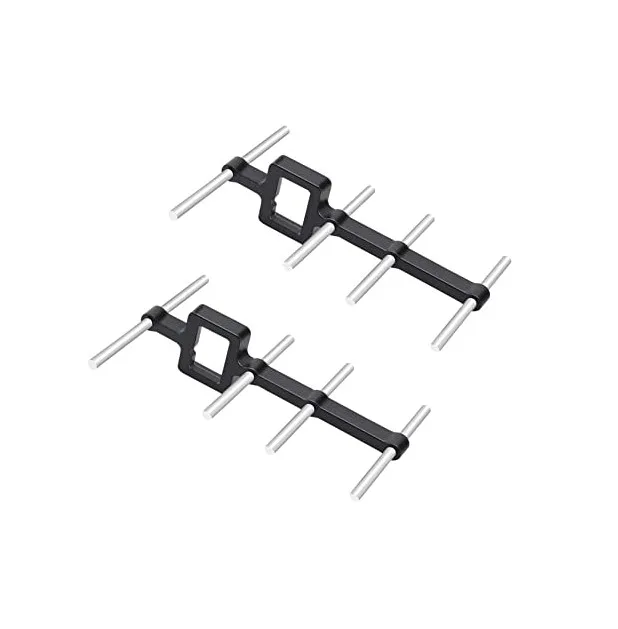
2.4GHz Yagi-UDA Drone Signal Booster
High-gain directional Yagi antenna to extend your drone RC and video signal range. Essential for long-range fixed-wing missions beyond line of sight.
13. Indian Regulations and BVLOS
Operating a fixed-wing UAV at 50km range in India involves Beyond Visual Line of Sight (BVLOS) flight, which is currently restricted:
- BVLOS operations are not permitted for general operators under Drone Rules 2021.
- BVLOS research and experimental flights require a Conditional Exemption from DGCA.
- The DGCA issued its BVLOS framework in 2023, allowing licensed operators in specific approved corridors.
- Companies like Throttle Aerospace, General Aeronautics, and Asteria Aerospace have received BVLOS approvals for specific commercial missions.
- For hobbyists: 50km range flights are legally restricted. Most enthusiasts practise medium-range VLOS missions (1–3km) and reserve long-range testing for approved sites with proper permissions.
14. Launch, Flight, and Landing Tips
- Hand launching: Hold the aircraft above your head, run into the wind, and release with a firm underarm throw. Set the launch throttle to 100% in ArduPlane’s TKOFF mode.
- Cruise altitude: Fly at 120–200m AGL for good telemetry and FPV link with less turbulence than low-level flight.
- Wind planning: Fly into the wind on the outbound leg, with the wind on the return — this maximises range and ensures you can return even if the battery is lower than expected.
- Landing: Program a loiter and descend approach. A belly landing on grass is typically fine for foam aircraft. Avoid landing in tall grass or furrows that can flip the aircraft.
FAQ: Long Range FPV Fixed Wing Drone
Is it legal to fly a 50km fixed-wing drone in India?
Not for general operators. BVLOS (Beyond Visual Line of Sight) flights require a specific Conditional Exemption from DGCA. Hobbyists are limited to VLOS operations. However, DGCA is expanding the BVLOS framework in 2026, and approved corridors are being established for commercial operators.
What RC system should I use for maximum range?
TBS Crossfire at 915 MHz with a Yagi antenna can achieve 60–100km range. ExpressLRS (ELRS) at 900 MHz with a 1W transmitter is a more affordable alternative with comparable range. Both systems must be used within India’s regulatory limits.
What is the best airframe for a 50km DIY fixed-wing UAV?
The Skywalker X8 (1.8m flying wing), Reptile S800, and Believer 1960 are the most popular platforms for this purpose. The Skywalker X8’s large battery bay and efficient pusher configuration make it ideal for 50km+ missions.
How much does a long-range fixed-wing UAV build cost in India?
A complete 50km-capable build costs approximately ₹35,000–70,000 including airframe, FC, motor, ESC, battery, GPS, telemetry, and RC system. The major variable is the telemetry and RC link choice — Crossfire adds more cost than ELRS.
Can I use ArduPlane on a Matek F405-Wing?
Yes. The Matek F405-Wing is one of the most popular ArduPlane-compatible flight controllers. It is compact, has dedicated servo rail BEC, and supports most fixed-wing configurations including conventional, flying wing, and VTOL.
Build Your Long Range Fixed-Wing UAV
Zbotic supplies all the electronic components for your long-range fixed-wing build — telemetry radios, GPS antennas, ESCs, vibration dampers, and more. All products shipped from India with fast delivery.


Add comment