
Table of Contents
- Introduction
- Understanding pH and Why It Matters
- How a pH Sensor Module Works
- Popular pH Sensor Modules Available in India
- Buying Guide: What to Look For
- Wiring pH Sensor to Arduino
- Arduino Code for pH Reading
- Calibration Step-by-Step
- Temperature Compensation
- Applications in India
- Probe Maintenance & Storage
- Frequently Asked Questions
- Conclusion
Introduction
pH measurement is critical in hydroponics, aquaculture, water treatment plants, swimming pools, soil quality analysis, and chemical manufacturing. For Arduino hobbyists, students, and engineers in India who want to add pH monitoring to their projects, the availability of low-cost pH sensor modules has made this formerly industrial measurement accessible to everyone.
This guide covers everything from the electrochemistry behind pH sensing to the practical matter of which module to buy in India, how to wire it to your Arduino, write the reading code, and perform a proper two-point calibration using buffer solutions — the step most tutorials skip that makes the difference between garbage readings and ±0.1 pH accuracy.
Understanding pH and Why It Matters
pH is a logarithmic scale measuring the concentration of hydrogen ions (H⁺) in a solution. The scale runs from 0 (highly acidic) to 14 (highly alkaline), with 7 being neutral (pure water at 25°C).
- pH 0–3: Strong acids (battery acid, stomach acid)
- pH 4–6: Weak acids (vinegar pH 2.4, black coffee pH 5, rainwater pH 5.6)
- pH 7: Neutral (pure water)
- pH 8–11: Weak bases (sea water pH 8, baking soda pH 9)
- pH 12–14: Strong bases (bleach pH 12.5, caustic soda pH 14)
In hydroponics, plants grow best at pH 5.5–6.5. Aquarium fish need pH 6.5–8.5 depending on species. Drinking water standards in India (BIS IS 10500) specify pH 6.5–8.5. Even a small pH deviation can cause nutrient lockout in plants, fish stress, or chemical corrosion in industrial piping.
How a pH Sensor Module Works
A pH sensor has two main components: the glass electrode (the probe) and the signal conditioning board (the module).
The pH Probe
The probe contains a pH-sensitive glass membrane. Across this membrane, a Nernst potential develops proportional to the difference in H⁺ concentration between the test solution and a reference solution sealed inside the probe. The voltage generated is approximately 59.16 mV per pH unit at 25°C (this is the Nernst factor). A solution at pH 7 produces 0 mV (the isopotential point). pH 6 produces +59 mV, pH 8 produces −59 mV.
The Signal Conditioning Board
The probe output is a very high-impedance millivolt signal that cannot drive an Arduino ADC directly. The module board contains a high-impedance op-amp (input impedance >10 GΩ) that buffers and amplifies this signal to a 0–5 V range suitable for Arduino’s analogRead. Most modules also include an offset adjustment potentiometer for calibration.
Popular pH Sensor Modules Available in India
1. Gravity Analog pH Sensor (DFRobot)
The most popular choice for serious maker projects. It uses the DFRobot BNC-to-BNC connector system, comes with a calibration buffer solution (pH 7.0 and pH 4.0), and has an excellent Arduino library. Price in India: ₹1,200–₹1,800 for the kit. The probe is replaceable, making the module a long-term investment.
2. Generic BNC pH Sensor Module
Widely available from Indian suppliers at ₹350–₹700. These are PCB clones of the DFRobot design, typically using a BNC female connector and a similar op-amp circuit. Quality varies — some work excellently, others have poor temperature compensation or drifty op-amps. Always check the seller’s reviews.
3. SEN0161-V2 (DFRobot Industrial Grade)
The V2 version adds improved temperature compensation, a wider supply voltage range (3.3–5.5 V), and better noise rejection. Recommended for datalogger and IoT projects where the sensor runs 24/7 outdoors.
4. Electrode-Only Probes (BNC type)
If you already have a signal conditioning board (or are designing your own PCB), you can buy just the glass electrode probe. The E-201-C BNC probe is commonly available in India and is the probe type compatible with most conditioning boards.
Buying Guide: What to Look For
Buying a pH sensor in India requires more care than buying a temperature sensor. Here is your checklist:
- Probe connector type: BNC is the standard. Avoid modules that use proprietary connectors — replacement probes are hard to find.
- Board supply voltage: 5 V modules work directly with Arduino Uno. 3.3 V versions work with ESP32/ESP8266 without level shifting.
- Does it include buffer solutions? Buffer solutions (pH 4.0 and pH 7.0 sachets) are essential for calibration. Buying them separately adds ₹200–₹400. Prefer kits that include them.
- Probe quality: Cheap probes use thin glass that cracks easily. Look for probes rated to at least 1 million measurements or with a stated lifespan of 1 year in continuous use.
- Output range: The module should output 0–3.5 V linearly across pH 0–14. Check the datasheet — some clone boards have a compressed output range (e.g., 1–3 V) that reduces resolution.
- Temperature range: Most probes are rated 0–60°C. For high-temperature liquids (hot springs monitoring, industrial processes), look for pH probes rated to 100°C+.
Wiring pH Sensor to Arduino
| pH Module Pin | Arduino Pin |
|---|---|
| V+ (VCC) | 5V |
| GND | GND |
| Po (Analog Out) | A0 |
| BNC Connector | → pH probe |
Important grounding note: pH sensor circuits are extremely sensitive to ground loops and electrical noise. Always power the Arduino and pH module from the same power source. Keep the probe cable away from power lines, motors, and relay switching. A dedicated analog ground plane on a custom PCB dramatically improves noise performance.
Arduino Code for pH Reading
// pH Sensor Reading with Temperature Compensation
// Zbotic.in Tutorial

#define PH_PIN A0
#define TEMP_PIN A1      // Optional LM35 temperature sensor

// Calibration values — update after your two-point calibration
float pH4_voltage  = 3.20;   // Voltage reading in pH 4 buffer
float pH7_voltage  = 2.53;   // Voltage reading in pH 7 buffer
// Slope in pH units per volt
float slope = (7.0 - 4.0) / (pH7_voltage - pH4_voltage);
// Intercept
float intercept = 7.0 - slope * pH7_voltage;

float readVoltage(int pin, int samples = 20) {
  long sum = 0;
  for (int i = 0; i < samples; i++) {
    sum += analogRead(pin);
    delay(10);
  }
  return (sum / samples) * 5.0 / 1023.0;
}

void setup() {
  Serial.begin(9600);
  Serial.println("pH Sensor Ready");
}

void loop() {
  float voltage = readVoltage(PH_PIN);
  float pH = slope * voltage + intercept;
  pH = constrain(pH, 0.0, 14.0);

  // Temperature from LM35 (optional)
  float tempVoltage = analogRead(TEMP_PIN) * 5.0 / 1023.0;
  float temperature = tempVoltage * 100.0; // LM35: 10mV/°C

  Serial.print("Voltage: "); Serial.print(voltage, 3); Serial.print(" V");
  Serial.print(" | pH: "); Serial.print(pH, 2);
  Serial.print(" | Temp: "); Serial.print(temperature, 1); Serial.println(" C");
  delay(1000);
}
Calibration Step-by-Step
This two-point calibration is the single most important step for accurate pH measurement. Do not skip it.
- Prepare buffer solutions: You need pH 4.00 and pH 7.00 standard buffer solutions (sachets widely available from lab supply shops and some electronics stores in India). These solutions have a known, certified pH value at 25°C.
- Rinse the probe: Rinse the glass tip with distilled water (not tap water — tap water affects readings). Gently blot dry with a soft tissue — do not rub.
- Measure pH 7 buffer: Immerse the probe in the pH 7 buffer. Wait 1–2 minutes for the reading to stabilise. Note the voltage from your Serial Monitor. This is
pH7_voltage. - Rinse again with distilled water.
- Measure pH 4 buffer: Immerse in pH 4.00 buffer. Wait 1–2 minutes. Note the stabilised voltage. This is
pH4_voltage. - Update constants: Enter both voltage values into the code constants. The code automatically calculates slope and intercept.
- Verify: Re-measure both buffers after updating constants. You should read pH 4.00 ± 0.05 and pH 7.00 ± 0.05.
Calibration frequency: pH probes drift over time. Recalibrate every 2–4 weeks for critical applications, or whenever you notice readings drifting more than 0.1 pH from expected values.
Temperature Compensation
The Nernst factor (59.16 mV/pH at 25°C) changes with temperature. At 10°C it is 56.18 mV/pH; at 40°C it is 62.16 mV/pH. For applications where liquid temperature varies significantly (outdoor ponds, hydroponics in varying climates), temperature compensation is essential.
The correction formula:
pH_corrected = 7 + (pH_measured - 7) × (298.15 / (273.15 + T_celsius))
where T_celsius is the current liquid temperature.
Add an LM35 or DS18B20 temperature probe in your liquid alongside the pH probe for automatic compensation. The LM35 is particularly convenient — it outputs 10 mV/°C and connects directly to another analog pin.

LM35 Temperature Sensor
Pair your pH sensor with LM35 for automatic temperature compensation — essential for accurate pH measurement across the Indian seasons.
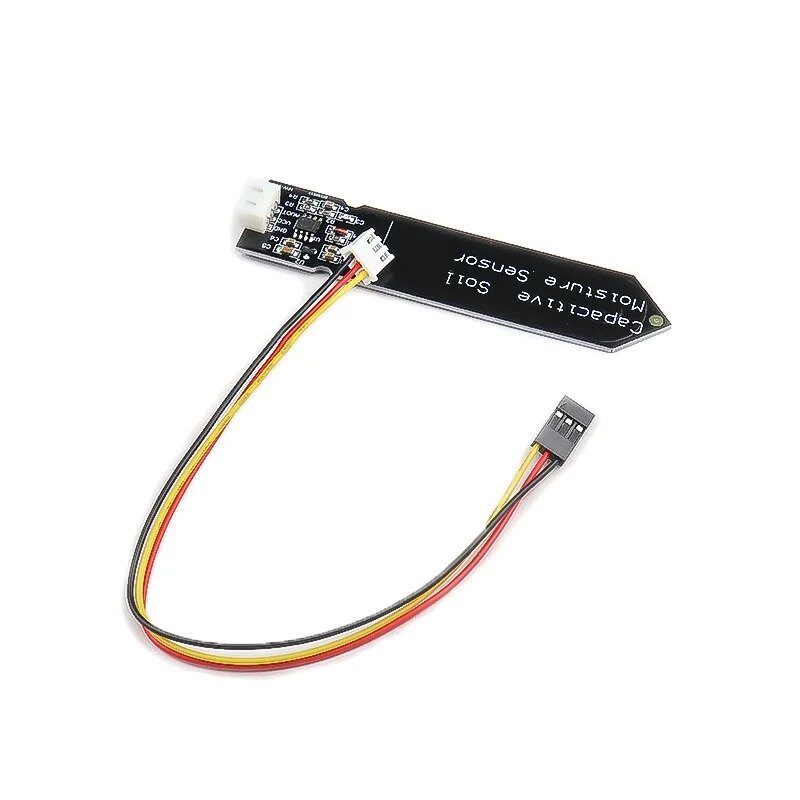
Capacitive Soil Moisture Sensor
Build a complete soil monitoring station — combine pH sensing with capacitive soil moisture measurement for smart agriculture projects.
Applications in India
Hydroponics & Vertical Farming
India’s controlled-environment agriculture sector is booming. pH control in nutrient solution is non-negotiable — most crops fail outside pH 5.5–6.5. An Arduino-based automatic pH controller that reads pH, compares to setpoint, and triggers a pH-up or pH-down dosing pump is a practical commercial project.
Aquaculture & Fish Farming
Prawn and fish farms in coastal India need continuous pH monitoring. pH drops can signal ammonia toxicity or CO2 buildup. An automated alert system using GSM module + Arduino + pH sensor can save an entire batch of fish.
Drinking Water Quality Testing
Rural community water testing projects and NGO-funded water quality monitoring units in India use Arduino-based pH meters as low-cost alternatives to commercial instruments costing ₹50,000+.
Swimming Pool Management
Club pools and apartment complexes need pH between 7.2–7.8 for safe chlorine effectiveness. An automated system with pH + chlorine sensing and automatic chemical dosing reduces manual labour and chemical waste.
Probe Maintenance & Storage
- Storage solution: When not in use, keep the probe tip submerged in pH 7 buffer or a 3 M KCl storage solution. NEVER store in distilled water — it leaches electrolytes from the reference junction.
- Conditioning new probes: Soak a new probe in pH 7 buffer for 30 minutes before first use to hydrate the glass membrane.
- Cleaning: If coated with organic matter (algae, oils), clean gently with a cotton swab dampened in isopropyl alcohol. Rinse with distilled water before use.
- Probe lifespan: Expect 1–2 years for a quality probe with good maintenance, 3–6 months for budget probes. Budget for replacements in your project cost.
- Signs of a dead probe: Reading is stuck at a fixed voltage regardless of solution, or calibration gives a slope of less than 50 mV/pH (the probe membrane is cracked or dehydrated).
Frequently Asked Questions
Q1: Can I use tap water instead of distilled water for rinsing?
No. Tap water in India typically has dissolved minerals (TDS 100–500 ppm) that contaminate the reference junction and shift readings. Use distilled water or DI water only.
Q2: My pH readings are stable for 5 minutes but then drift. Why?
The glass membrane needs time to equilibrate in the new solution — especially when moving from a low-pH buffer to a high-pH solution or vice versa. Allow 2–3 minutes after immersion, and ensure the reference junction is fully submerged. If drift continues beyond 5 minutes, the probe may be old or dehydrated.
Q3: Can I use one pH sensor module with an ESP32 for IoT?
Yes. Use a 3.3 V compatible module (or add a voltage divider on the analog output line). The ESP32’s ADC is 12-bit (0–4095), giving even finer resolution. Use the Blynk or MQTT library to stream pH data to the cloud for remote monitoring.
Q4: How accurate can a ₹500 pH sensor get?
With proper two-point calibration and fresh buffer solutions, a ₹500 pH module with a decent probe can achieve ±0.1 to ±0.2 pH accuracy — sufficient for hydroponics, aquaculture, and water quality monitoring. For pharmaceutical or research-grade accuracy (±0.01 pH), you need a laboratory pH meter.
Q5: How do I prevent electrical interference in my pH circuit?
Use shielded cable for the probe, ground the shield at the module end only (not both ends — that creates a ground loop). Power the Arduino from a linear power supply or battery for lowest noise. Keep the pH module far from relays and motor drivers on the same board.
Conclusion
A pH sensor module paired with an Arduino is one of the most practical tools you can add to an environmental monitoring, hydroponics, or water quality project. The key to success is understanding the electrochemistry (so you know why calibration matters), performing a proper two-point calibration with certified buffer solutions, and maintaining your probe correctly.
Whether you are automating a home hydroponic setup in Pune, building an aquarium controller in Chennai, or developing a low-cost water quality tester for rural communities, pH sensing with Arduino is accessible and affordable in India. Explore Zbotic’s sensor collection to find the right components for your project.

Add comment