
Wireless Sensor Network: Architecture & Protocol Selection Guide
Designing a reliable wireless sensor network architecture guide is the foundation of any successful IoT deployment, whether you are building a farm monitoring system, a smart factory floor, or a campus-wide environmental monitoring network. Choosing the wrong protocol or topology can lead to packet loss, battery drain, and scalability nightmares. This comprehensive guide covers everything Indian engineers and makers need to know — from fundamental architectures to protocol comparisons and real-world hardware recommendations.
What is a Wireless Sensor Network?
A Wireless Sensor Network (WSN) is a distributed system of spatially separated sensor nodes that collect, process, and transmit environmental or physical data to a central point (gateway or server) without physical wiring. Each node typically consists of a microcontroller, one or more sensors (temperature, humidity, gas, motion, etc.), a wireless transceiver, and a power source (battery, solar, or wired).
WSNs are used across many industries:
- Agriculture: Soil moisture, temperature, and crop disease monitoring across large fields
- Smart Buildings: HVAC control, occupancy sensing, energy metering
- Industrial IoT: Predictive maintenance via vibration and temperature sensors on machinery
- Healthcare: Patient monitoring and wearable sensor data aggregation
- Environmental monitoring: Air quality, water quality, flood detection
WSN Architecture Types
The physical and logical organization of sensor nodes defines the network architecture. There are four primary types:
1. Star Topology
All sensor nodes communicate directly with a central gateway or hub. This is the simplest architecture — every node must be within radio range of the gateway. Ideal for small-scale deployments (a single room or small field). Protocols: Wi-Fi, NRF24L01, Bluetooth.
Pros: Simple to set up, low latency, easy to debug.
Cons: Limited scalability, gateway is a single point of failure, range limited by the weakest node-to-gateway link.
2. Mesh Topology
Nodes can communicate with each other and relay messages towards the gateway. This extends range significantly and provides redundancy — if one node fails, data finds an alternate path. Protocols: Zigbee, Z-Wave, Thread, Wi-Fi Mesh (ESP-MDF).
Pros: Excellent scalability, self-healing, long aggregate range.
Cons: Higher complexity, increased power consumption for routing nodes, latency can grow with hop count.
3. Cluster-Tree Topology
Nodes are organized into clusters. Each cluster has a Cluster Head (CH) that aggregates data from child nodes and forwards it to the next level. This is a hybrid between star and tree structures and is commonly used in large WSN deployments. Protocols: Zigbee (coordinator/router/end-device model), LoRaWAN.
Pros: Good balance of scalability and power efficiency, hierarchical management.
Cons: Cluster head nodes consume more power, failure of a CH affects its entire cluster.
4. Peer-to-Peer (P2P) / Flat Topology
Every node is equal and can communicate with any other node within range. Used for ad-hoc networks and mobile sensor deployments. Less common for fixed infrastructure IoT.
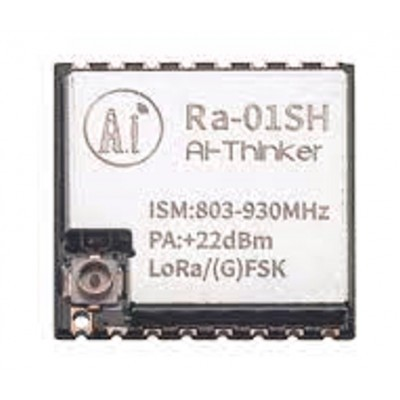
Ai Thinker LoRa Ra-01SH Spread Spectrum Wireless Module
Ideal for cluster-tree WSN deployments. LoRa’s kilometre-range spread-spectrum technology allows sensor nodes spread across large areas to communicate reliably with a central gateway.
Protocol Comparison: Wi-Fi vs Zigbee vs LoRa vs NRF24L01
| Feature | Wi-Fi (ESP32) | Zigbee | LoRa | NRF24L01 |
|---|---|---|---|---|
| Frequency | 2.4 / 5 GHz | 2.4 GHz / 868/915 MHz | 865–867 MHz (India) | 2.4 GHz |
| Range (open) | 50–100 m | 10–100 m | 2–15 km | 100 m – 1 km (PA) |
| Data Rate | Up to 150 Mbps | 20–250 kbps | 0.3–50 kbps | 250 kbps – 2 Mbps |
| Power Use | High (50–500 mA active) | Very Low (<30 mA active) | Very Low (<40 mA TX) | Low (<12 mA active) |
| Network Size | ~255 nodes/AP | 65,000 nodes | Thousands (LoRaWAN) | 6 pipes per node |
| Mesh support | Yes (ESP-MDF) | Yes (native) | Limited | Yes (RF24Mesh) |
| Cost per node | ₹100–300 | ₹300–800 | ₹400–900 | ₹80–250 |
| License (India) | Unlicensed ISM | Unlicensed ISM | 865–867 MHz unlicensed | Unlicensed ISM |
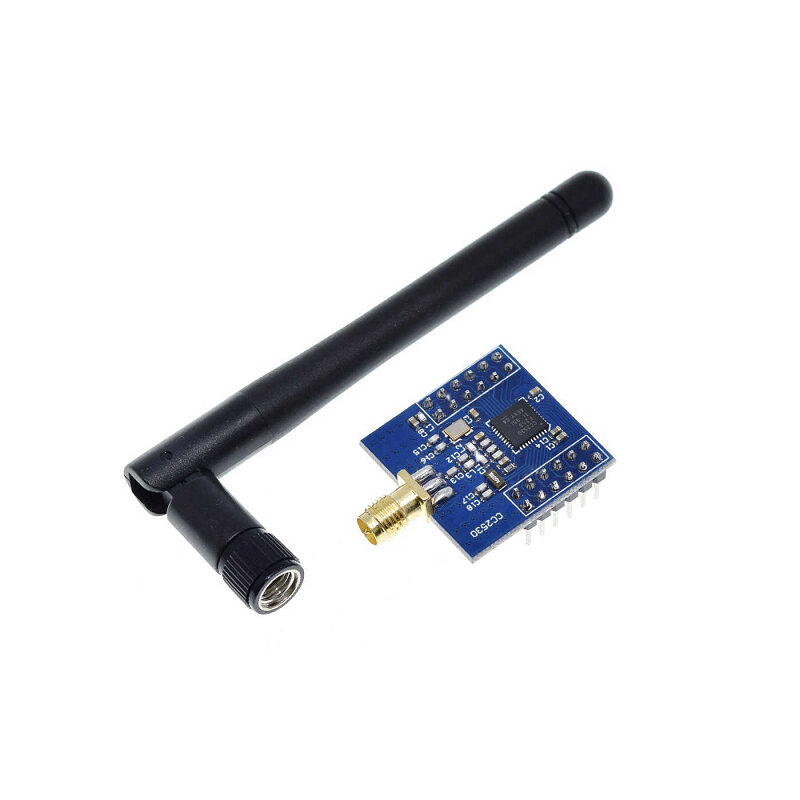
CC2530F256 Zigbee UART Wireless Core Development Board
The CC2530 is the industry-standard Zigbee chip for large mesh sensor networks. Supports up to 65,000 nodes, very low power, and robust mesh routing — ideal for smart building and industrial WSN deployments.
How to Select the Right Protocol
Use this decision framework when designing your wireless sensor network:
Choose Wi-Fi (ESP32/ESP8266) when:
- You need high data throughput (video, audio, large data files)
- Nodes are mains-powered
- You need direct HTTP/MQTT cloud connectivity without a separate gateway
- You are building a home automation hub
Choose Zigbee when:
- You need a large, self-healing mesh (dozens to hundreds of nodes)
- Nodes are battery-powered and need multi-year life
- You want an industry-standard protocol with wide ecosystem support (works with Zigbee2MQTT, Home Assistant)
- Indoor range of 10–50 metres per hop is sufficient
Choose LoRa / LoRaWAN when:
- Nodes are spread over a large area (farm, campus, city)
- Data volume is low (sensor readings every few minutes)
- Extreme battery life is critical (years on a single cell)
- You want to connect to The Things Network (TTN) or build your own LoRaWAN gateway
Choose NRF24L01 when:
- Budget is the primary constraint
- You need fast data exchange in a small to medium area
- You are building an RC vehicle, wireless controller, or short-range sensor hub
- Using the RF24Network/RF24Mesh libraries for a small custom mesh
Energy Management in WSN
Power consumption is the most critical challenge in battery-powered WSNs. Here are the key strategies:
Duty Cycling: The node sleeps for most of the time and wakes up periodically to sample sensors and transmit. ESP32 deep sleep can reduce power from 240 mA to just 10 µA. A node waking every 10 minutes and transmitting for 200 ms can run for over a year on a 3000 mAh 18650 battery.
Data Aggregation: Instead of transmitting each sensor reading immediately, accumulate multiple readings locally and send a batch. Fewer transmissions = dramatically lower energy use since radio TX is the most power-hungry operation.
Adaptive Transmission Power: Use the minimum PA level needed to reach the next node. Every 6 dB reduction in TX power roughly halves power consumption.
Solar Harvesting: For permanently deployed outdoor nodes, a small 1–5W solar panel with a LiPo battery and MPPT charge controller can provide indefinite operation.
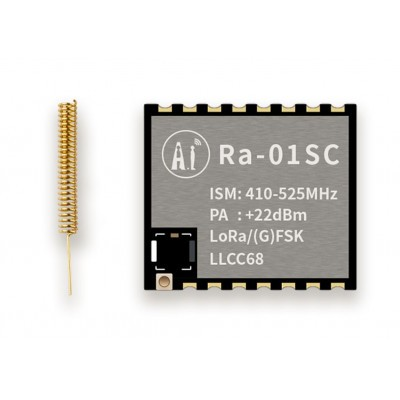
Ai Thinker LoRa Ra-01SC Module
Ultra-low sleep current LoRa module — ideal for battery-powered WSN nodes. The Ra-01SC supports duty-cycled operation and kilometre-scale range for agricultural and outdoor deployments.
Security Considerations
WSN security is often neglected in hobbyist projects but is critical for production deployments:
- Encryption: LoRaWAN uses AES-128 end-to-end encryption by default. Zigbee 3.0 uses AES-128 with network and application keys. For NRF24L01 and custom protocols, implement AES or ChaCha20 encryption in your application layer.
- Authentication: Prevent rogue nodes from injecting false data. Use pre-shared keys and message authentication codes (HMAC).
- Physical security: Outdoor nodes should be tamper-evident. An attacker with physical access can replace firmware or clone node credentials.
- Firmware OTA updates: Ensure you can update sensor node firmware remotely to patch vulnerabilities. ESP32 supports OTA natively; LoRaWAN supports FUOTA (Firmware Update Over The Air) in v1.0.4+.
WSN Deployment in India: Real-World Considerations
India presents unique challenges and opportunities for WSN deployments:
Frequency regulations: In India, 2.4 GHz ISM (Wi-Fi, Zigbee, NRF24L01, Bluetooth) is unlicensed. LoRa operates in the 865–867 MHz band which is also unlicensed under WPC guidelines for short-range devices. The 433 MHz band is technically restricted in India and should be avoided for LoRa deployments.
Heat and humidity: Many parts of India experience temperatures above 45°C and very high humidity. Use industrial-grade sensors rated for the environment, conformal-coat PCBs for outdoor nodes, and IP65+ enclosures.
Power availability: In rural areas with frequent power cuts, solar-plus-battery nodes are essential. ESP32 deep sleep + solar is a proven combination for agricultural WSNs.
Connectivity: In areas without reliable internet, a local LoRa gateway writing to a Raspberry Pi or ESP32 running a local MQTT broker + InfluxDB + Grafana stack provides a fully offline WSN dashboard.
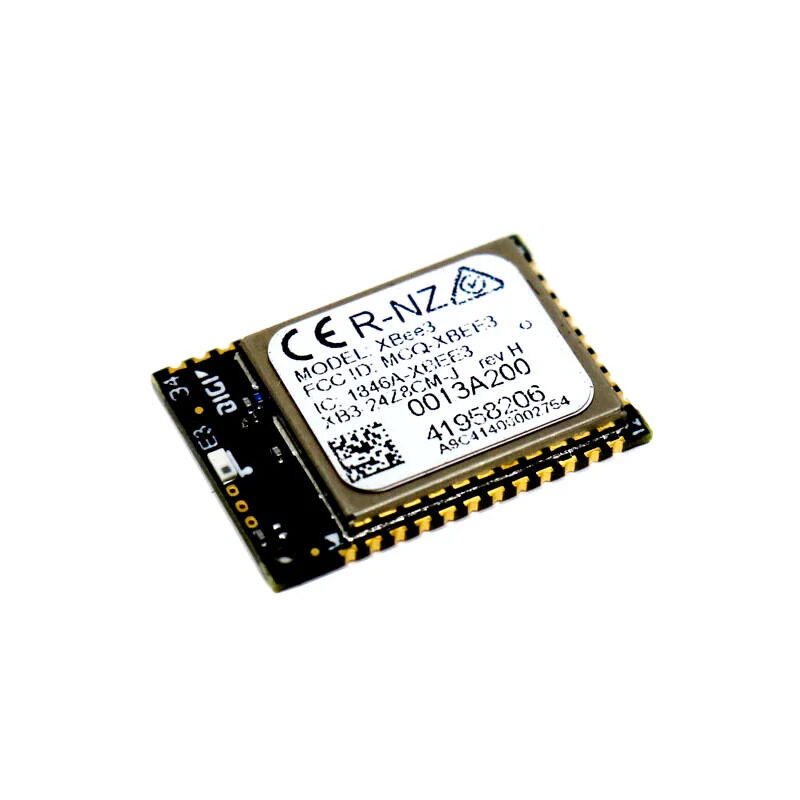
DigiKey Zigbee 3.0 Module XB3-24Z8CM
Certified Zigbee 3.0 module for professional WSN deployments. Supports mesh networking with up to 65,000 nodes — perfect for smart buildings and industrial sensor networks in India.
Frequently Asked Questions
What is the difference between a wireless sensor network and IoT?
A WSN is a subset of IoT. WSN specifically refers to networks of sensor devices that collect and transmit physical/environmental data. IoT is the broader concept encompassing all internet-connected devices, including actuators, cameras, wearables, and consumer electronics. Every WSN is an IoT system, but not every IoT system is a WSN.
How many sensor nodes can one LoRa gateway support?
A single-channel LoRa gateway can practically support around 100–500 nodes depending on message frequency and spreading factor. A standard 8-channel LoRaWAN gateway (like the RAK7258) can handle thousands of nodes. With appropriate duty cycle settings (each node transmitting for less than 1% of the time), a LoRaWAN network can scale to city-level deployments.
Is Zigbee compatible with Wi-Fi?
Zigbee and Wi-Fi are not directly compatible protocols, but they can coexist in the same network. A Zigbee gateway (coordinator) connected to a Wi-Fi router bridges the two networks. Products like Zigbee2MQTT convert Zigbee messages to MQTT topics that any Wi-Fi/Ethernet device can consume.
What is the best protocol for battery-powered outdoor sensor nodes in India?
LoRa (865–867 MHz) is the best choice for battery-powered outdoor nodes in India. It offers kilometre-scale range, very low active current (40 mA TX, 12 mA RX), and sleep currents below 1 µA. Combined with a small solar panel, a LoRa node can run indefinitely. For shorter ranges where solar is not available, Zigbee with coin cell or AA batteries can last 2–5 years.
Can I mix different protocols in the same WSN?
Yes, multi-protocol WSNs are common in complex deployments. For example: battery-powered outdoor nodes use LoRa, while indoor nodes near power outlets use Wi-Fi (ESP32), and both connect to a central MQTT broker. Protocol bridges/gateways handle the translation between protocol domains.
Start Building Your Wireless Sensor Network
Zbotic stocks LoRa modules, Zigbee boards, ESP32 modules, and all the components you need for your WSN project. Get expert-selected hardware with fast shipping across India. Browse our Communication & Wireless Modules collection today.




Add comment