
Battery Holder vs Connector: Best Approach for Your Projects
Every electronics project needs power, and how you connect your batteries to your circuit makes a bigger difference than most beginners realize. The debate over battery holder vs connector best approach projects comes up constantly in Indian maker communities — on forums, at hackathons, in college labs. Do you snap in AA cells with a plastic holder, wire up an 18650 with a spring-contact case, solder directly, or crimp a professional XT60 connector? This guide breaks down every option so you can make the right choice for your specific project.
Types of Battery Connections: An Overview
Battery connections in electronics projects fall into four broad categories:
- Battery holders — plastic or metal enclosures with spring contacts that grip standard cylindrical or button cells (AA, AAA, C, D, 9V, 18650, etc.)
- Connectors — plug-and-socket pairs permanently attached to the battery and the circuit (XT60, JST-PH, JST-XH, Deans/T-plug, EC3, XT30, barrel jacks)
- Direct solder or spot weld — wire attached permanently to the battery terminals by soldering or resistance spot welding
- Battery clips — spring-loaded clips that attach to battery terminals without any permanent connection (common for 9V snap connectors, crocodile clips)
Each category has distinct tradeoffs in terms of convenience, contact resistance, current capacity, replaceability, safety, and cost. Most experienced Indian hobbyists end up using different approaches for different project types — holders for prototyping, connectors for deployed projects, and spot welding for high-current permanent packs.
Battery Holders: When They Are the Right Choice
Battery holders are the go-to choice for prototyping and projects that use standard alkaline or NiMH cells. They offer several important advantages:
Advantages of Battery Holders
- Easy battery replacement: No tools, no desoldering. Just pop out the old cells and insert new ones. This is invaluable for projects that get field-tested or deployed in locations where soldering is impractical.
- Mixed chemistry compatibility: The same holder can accept alkaline, NiMH, and even lithium AA cells without modification — just insert the appropriate cell type for your application.
- No heat exposure for cells: Holders avoid the thermal stress of soldering, which is important for cells that could be damaged by heat.
- Standardized form factors: Holders for 1x AA, 2x AA, 4x AA, 1x 18650, 2x 18650, 4x 18650 are widely available and interchangeable across projects.
- Cost effective: AA/AAA holders cost Rs. 10-30 in India; 18650 holders cost Rs. 30-80. They are reusable across many projects.
Disadvantages of Battery Holders
- Contact resistance: Spring contacts have inherently higher resistance than soldered connections. For low-power projects (microcontrollers, sensors) this is irrelevant. For high-current loads (motors, LEDs, solenoids) the voltage drop across the contacts can be significant.
- Contact degradation: Over time, especially in India’s humid climate during monsoon season, spring contacts oxidize and corrode. This increases contact resistance further and can cause intermittent power failures.
- Limited current capacity: Most plastic battery holders are rated for 1-3 A maximum. 18650 holders vary widely — some low-quality versions fail at sustained 3 A loads.
- Physical looseness: Cells that are slightly smaller than the holder bore diameter can rattle and cause intermittent contact loss under vibration — a significant problem for robot or drone applications.
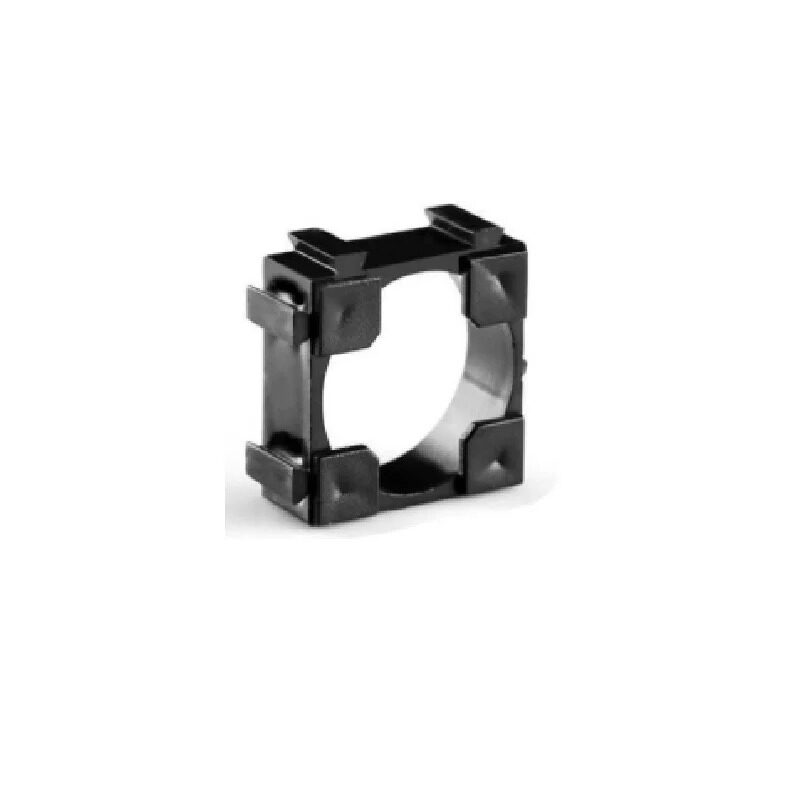
1 x 18650 Battery Holder with 18.4MM Bore Diameter (Pack of 4)
18.4 mm bore diameter fits standard 18650 cells snugly. Wide spring contacts for reliable connections in prototypes and deployed projects alike.
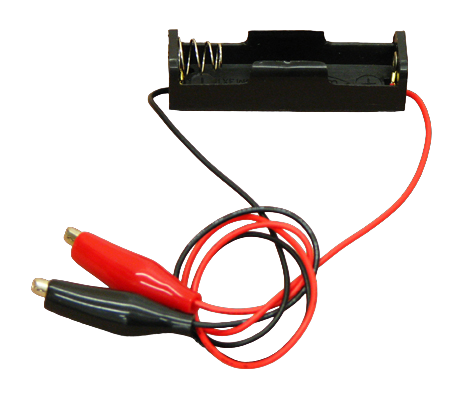
1 x AA Battery Holder Box with Alligator Clips
Perfect for breadboard prototyping and lab experiments. Alligator clips connect directly to any component or test point without soldering.
Battery Connectors: XT60, JST, Dean’s and More
Connectors are the right choice when the battery is a dedicated, replaceable unit — like a LiPo pack in a drone or an 18650 module in a robot — but you need to be able to swap batteries quickly in the field. Here is a breakdown of the most common connector types used in Indian maker projects:
XT60 Connectors
The XT60 is the dominant connector in the drone and RC vehicle world. Rated for 60 A continuous (hence the name), it uses gold-plated banana-style pins in a keyed housing that prevents reverse connection. Its large surface area and gold plating give it very low contact resistance. XT30 (30 A) and XT90 (90 A) variants exist for lower and higher power applications. Nearly every LiPo pack above 1000 mAh used in India’s drone community comes with an XT60 connector.
JST-PH and JST-XH Connectors
JST (Japan Solderless Terminal) makes a family of small connectors used for balance leads and low-power battery packs. JST-PH (2 mm pitch) is common on small single-cell LiPo packs (200-1000 mAh) used in small RC planes, Arduino projects, and ESP32 sensor nodes. JST-XH (2.5 mm pitch) is the standard for balance connectors on 2S-6S LiPo packs. These connectors are rated for 3 A, making them unsuitable for high-current loads.
Dean’s T-Plug (T-Connector)
The T-plug was the dominant RC battery connector before XT60 took over. Rated for approximately 30 A, it is still widely found on older LiPo packs and some budget products. It is harder to mate and unmate than XT60 and more prone to arcing during hot-plug events. Many Indian RC hobbyists are in the process of converting older packs from Deans to XT60.
Barrel Jack (DC Power Jack)
The 5.5 mm / 2.1 mm barrel jack is nearly universal for 9-12 V DC powered devices — routers, Arduino Uno, bench power supplies, most wall adapters. For battery-powered projects, it is convenient but not designed for repeated mating cycles (typically rated for 500-1000 insertions) and has higher contact resistance than XT60. Use it for moderate-current applications (under 3 A) where convenience matters more than ultra-low resistance.
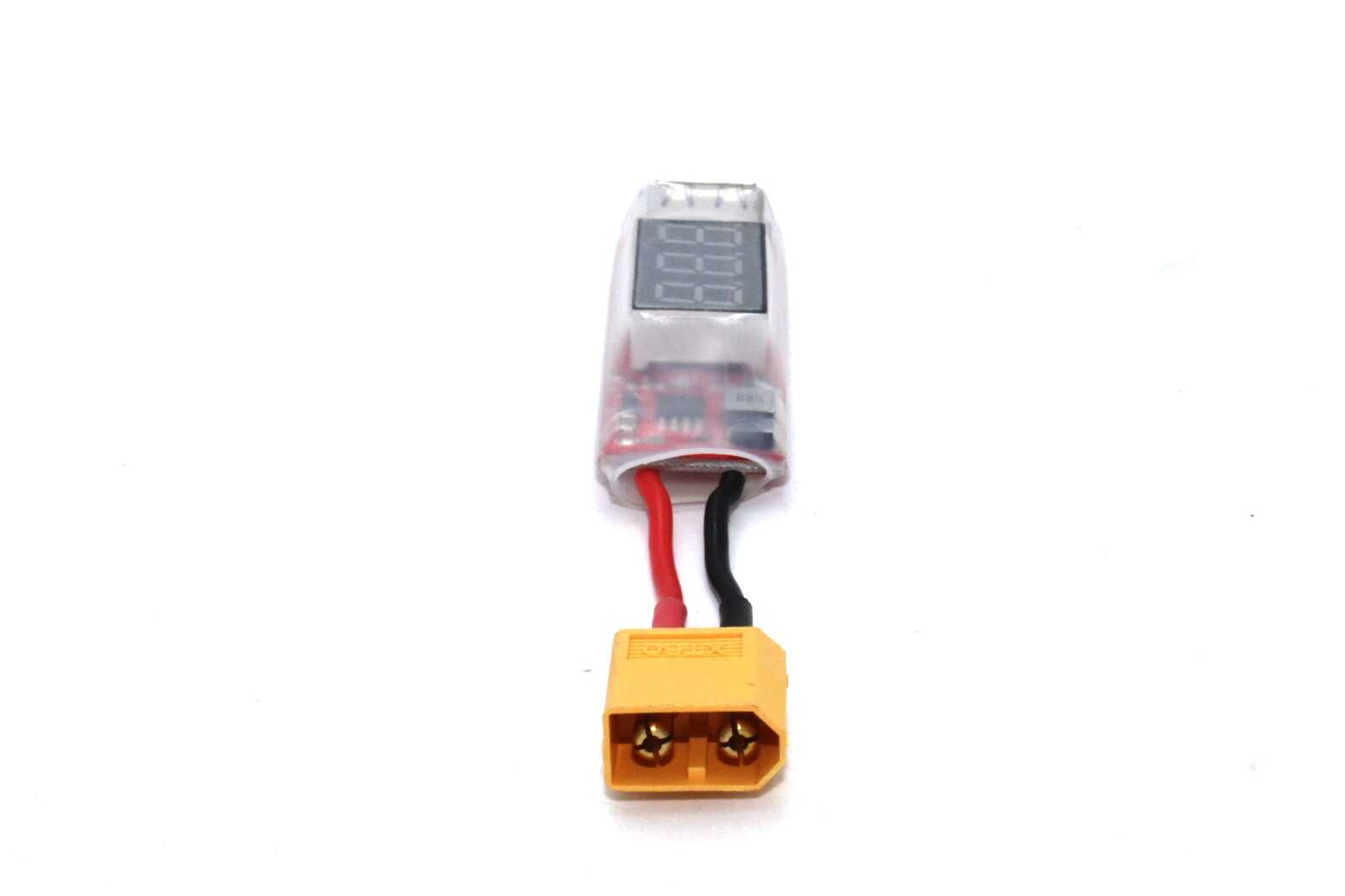
2S-6S LiPo Battery XT60 to USB Adapter with Voltage Display
A practical XT60-to-USB adapter that showcases the connector ecosystem — use your LiPo pack via XT60 as a USB power source with integrated voltage monitoring.
Direct Soldering and Spot Welding
For the lowest possible contact resistance and the most permanent connection, direct soldering (for low-current applications) and spot welding (for high-current packs) are the professional approaches.
Direct Soldering to Batteries
Soldering directly to a battery terminal is possible but requires technique and caution. The biggest risk is heat damage to the cell: lithium cells are especially sensitive to prolonged heat, and soldering too slowly can raise the cell temperature enough to cause internal damage or even electrolyte vaporization. Best practices:
- Use a high-wattage iron (60-80 W) at a relatively low tip temperature (300-330 degrees C) — more power means faster heat transfer to the solder joint and shorter dwell time at the battery terminal
- Tin the wire and the battery terminal separately before joining them
- Complete the joint in under 2 seconds — if it is not flowing in 2 seconds, remove the iron, let the cell cool, and try again
- Never solder to the side of a cylindrical cell — only the flat top (positive) and bottom (negative) terminals
Spot Welding (Resistance Welding)
Spot welding uses a brief, intense pulse of current to fuse thin nickel strips to battery terminals. It creates a connection with extremely low resistance (under 1 milliohm) and no heat penetration into the cell. This is the method used in commercial battery packs and by serious Indian battery pack builders. A basic spot welder suitable for 18650 packs is available in India for Rs. 2000-5000 and is worth the investment if you build more than two or three multi-cell packs per year.
Head-to-Head Comparison for Common Project Types
| Project Type | Best Approach | Why |
|---|---|---|
| Breadboard prototyping | Battery holder with alligator clips or wire leads | No soldering needed, quick cell swap |
| Arduino / ESP32 project | 18650 holder + JST connector or bare wire leads | Moderate current, easy replacement |
| FPV drone | XT60 on LiPo pack | High current, fast pack changes, polarized |
| Robotics / sumo bot | XT30 or XT60 + spot-welded cell pack | Vibration resistance, low resistance, high current |
| Portable sensor node | AA holder or 18650 holder | Low current, field replaceable cells |
| DIY power bank | 18650 holder + JST or micro-USB charging board | User replaceable cells, moderate current |
| RC car | Deans/T-plug or XT60 | High current, secure under vibration |
Contact Resistance: Why It Matters More Than You Think
Contact resistance is the resistance at the interface between two conductors — in this case, the battery terminal and the spring contact or connector pin. Even small contact resistances cause voltage drop and power loss at high currents.
A spring contact holder with 50 milliohm contact resistance at each end of a cell causes a voltage drop of I x R = 3 A x 0.1 ohm = 0.3 V at 3 A load. For a 3.7 V lithium cell, that is an 8% voltage loss before the electricity even reaches your circuit. Worse, P = I squared x R = 9 x 0.1 = 0.9 W of heat generated right at the spring contact — which can cause plastic holders to soften or melt under sustained high-current loads.
By contrast, a well-soldered joint has contact resistance in the range of 0.1-1 milliohm, and an XT60 connector pair measures approximately 0.5-1 milliohm. The difference in voltage drop at 3 A is 0.003 V versus 0.3 V — a 100x improvement.
The lesson: for low-current circuits (under 500 mA), contact resistance from holders and connectors is negligible. For anything above 1 A sustained, choose low-resistance connectors or direct wiring.
How to Choose the Right Approach for Your Project
Use this decision framework:
- What is the maximum current? Under 500 mA: any holder or connector works. 500 mA to 2 A: use a quality 18650 holder or JST-XH connector. Above 2 A: use XT60 or direct wiring.
- How often will cells be swapped? Frequent swaps (field deployment, recharging): holder or connector. Permanent installation: direct solder or spot weld.
- Will the project experience vibration? Yes (robots, drones, vehicles): connector or spot-welded pack with mechanical strain relief. No: holder acceptable.
- Is this a prototype or final product? Prototype: holder (quick iteration). Final product: connector or direct wiring (more robust).
- What is the budget? Holders: Rs. 10-80. Connectors: Rs. 20-150 per pair. Spot welding setup: Rs. 2000-5000 one-time investment.
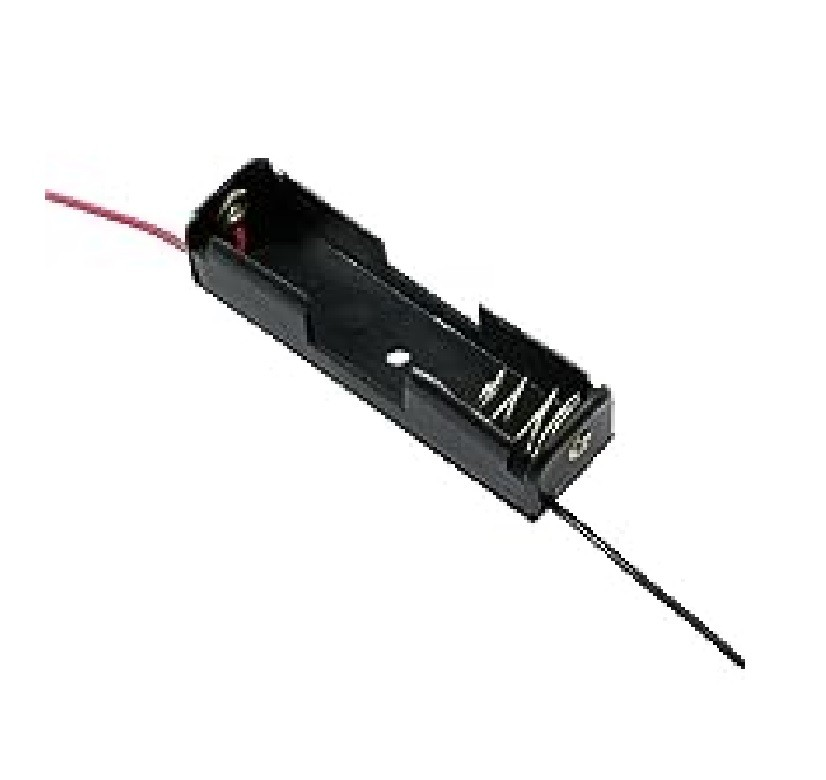
1 x AAA Battery Holder Box with Wire without Cover (Pack of 2)
Open-face design allows easy cell insertion and removal. Pre-attached wire leads plug directly into breadboards or prototype PCBs — ideal for quick prototyping.
Frequently Asked Questions
Can I use a 9V battery clip connector instead of a holder for my Arduino?
Yes, 9V snap connectors are very common for Arduino projects. They are convenient for the breadboard stage, but be aware that standard 9V alkaline batteries have low capacity (around 500 mAh) and high internal resistance, making them a poor long-term power source for any project that runs continuously. For deployed projects, consider an 18650 cell in a holder with a 9 V boost module for much longer runtime.
Is it safe to solder wires directly to 18650 cells?
It is possible but requires care. Keep dwell time under 2 seconds per joint, use a hot iron for fast heat transfer, and never solder to the side of the cell. For any build with more than 2-3 cells, invest in a spot welder instead — it is faster, safer for the cells, and produces lower-resistance joints. Direct soldering is acceptable for prototype builds but not recommended for production or high-cycle use.
My battery holder makes intermittent contact. How do I fix it?
Intermittent contact is usually caused by oxidized spring contacts. Try cleaning the springs and cell terminals with a pencil eraser or fine sandpaper, then apply a small amount of contact cleaner spray. If the springs are weak or corroded beyond recovery, it is usually faster and cheaper to replace the holder than to repair it. In the future, store holders in sealed bags with silica gel during storage to prevent oxidation in India’s humid climate.
Which connector polarity is standard for JST connectors?
JST-PH and JST-XH connectors do not have a universal polarity standard in the hobby electronics world — different manufacturers and different products use different pin assignments. Always check the polarity of a JST connector with a multimeter before connecting it to a new circuit. A reversed polarity JST connection to a lithium charging module can destroy the module and potentially damage the battery.
What is the best connector for a homemade LiPo pack above 3S?
For packs above 3S intended for high-current applications (RC vehicles, drones), the XT60 is the industry standard and the recommended choice. For very high current applications above 60 A (large brushless motors), use XT90. Ensure your wiring gauge matches the connector rating — use at least 12 AWG silicone wire for XT60 connections and 10 AWG or thicker for XT90.
Find the Right Battery Holders and Connectors at Zbotic
From simple AA holders for breadboard prototypes to quality 18650 holders for deployed projects, Zbotic stocks a wide range of battery connection solutions. Fast delivery across India means your project does not have to wait.







Add comment