
TBS Crossfire vs ExpressLRS: Which Long Range System to Buy in India?
The battle for the best long-range RC link has never been more competitive. TBS Crossfire dominated the scene for years as the gold standard in long-range FPV flying, but ExpressLRS (ELRS) — an open-source alternative — stormed in with higher packet rates, lower latency, and dramatically lower prices. For Indian FPV pilots and drone builders, choosing between the two is one of the most debated decisions in the hobby.
This guide breaks down everything you need to know — technology, range, latency, cost in India, receiver ecosystem, and real-world performance — so you can make an informed buying decision.
1. Overview: TBS Crossfire & ExpressLRS
TBS (Team BlackSheep) Crossfire launched in 2016 as a commercial long-range RC link system designed specifically for FPV drone pilots who wanted to push beyond the 1–2km limits of traditional 2.4GHz systems. It uses 900MHz frequency which has excellent penetration through obstacles. TBS is a Swiss company selling a fully proprietary, premium product.
ExpressLRS (ELRS) started as an open-source project around 2020, driven by community developers. It runs on cheap, widely available SX127x and SX128x radio chips, operates on both 900MHz and 2.4GHz, and has seen explosive adoption since hardware manufacturers like Radiomaster, BetaFPV, and Happymodel started producing ELRS-compatible gear at affordable prices.
Both systems serve the same core purpose: give you a rock-solid, low-latency control link at ranges far beyond standard AFHDS or DSM systems. The question is which one suits your flying style, budget, and technical comfort level.
2. Technology & How They Work
TBS Crossfire Technology
Crossfire operates exclusively at 900MHz (868/915MHz band) using FHSS (Frequency Hopping Spread Spectrum). The system uses a proprietary protocol developed by TBS with the following features:
- Adaptive data rate — automatically switches between 150Hz and 50Hz based on link quality
- Diversity receiver design on the Nano RX
- CRSF protocol (over UART) for communication with flight controller — now adopted by ELRS too
- TBS Agent software for firmware management
- Crossfire module fits into JR bay on most transmitters, or use TBS Tango 2 radio
ExpressLRS Technology
ELRS is a fully open-source protocol built on top of SX127x (900MHz) and SX128x (2.4GHz) radio ICs. Key technological differentiators:
- Extremely fast packet rates: up to 500Hz at 2.4GHz and 200Hz at 900MHz
- FLRC modulation at 2.4GHz delivers ultra-low latency
- Open source — community develops features continuously, no proprietary lock-in
- CRSF protocol output — compatible with Betaflight, iNav, ArduPilot out of the box
- Firmware flashing via WiFi, USB, or UART (using Betaflight passthrough)
3. Range Comparison
Range is the headline metric for both systems, though real-world range depends heavily on antenna placement, RF environment, and power output.
| System | Frequency | Max TX Power | Tested Range |
|---|---|---|---|
| TBS Crossfire | 900MHz | 1W (30dBm) | 40km+ (world records) |
| ELRS 900MHz | 900MHz | 1W (30dBm) | 30–50km+ |
| ELRS 2.4GHz | 2.4GHz | 500mW (27dBm) | 10–20km |
For practical VLOS flying (up to 500m) — both are massively overkill. For BVLOS or extreme range missions (which require DGCA approval in India), ELRS 900MHz and Crossfire are on par. The 900MHz advantage is penetrating urban RF clutter, vegetation, and light obstacles — important for flying in Indian cities or forested terrain.
The 2.4GHz Yagi-UDA Signal Booster available at Zbotic can further extend your 2.4GHz ELRS link range significantly when directional gain is needed for a fixed ground station setup:
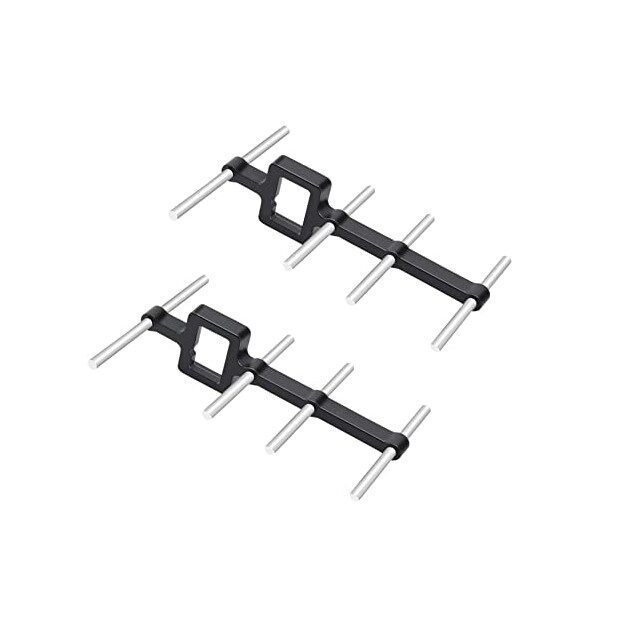
2.4GHz Yagi-UDA Drone Signal Booster
High-gain directional Yagi antenna to massively boost your 2.4GHz RC link or video transmitter range. Ideal for ELRS 2.4GHz ground station setups needing extended coverage.
View on Zbotic4. Latency & Packet Rate
This is where ELRS 2.4GHz absolutely dominates.
| System | Packet Rate | Latency (one-way) | Best Use Case |
|---|---|---|---|
| TBS Crossfire 150Hz | 150Hz | ~6.7ms | Long range |
| TBS Crossfire 50Hz | 50Hz | ~20ms | Max range mode |
| ELRS 900MHz 200Hz | 200Hz | ~5ms | Long range + smooth |
| ELRS 2.4GHz 500Hz | 500Hz | ~2ms | Racing / proximity |
For racing and freestyle at local fields (well within range), ELRS 2.4GHz at 500Hz gives you the most responsive, locked-in feel of any RC link available. At this packet rate, your sticks feel virtually instant. For long-range cruisers where you’re staying within 5–10km, ELRS 900MHz at 200Hz is perfect. Crossfire 150Hz is also excellent for long range but can’t match ELRS on pure latency.
5. Hardware Ecosystem
TBS Crossfire Hardware
- TBS Crossfire TX Micro — JR module for existing transmitters (~₹7,500–9,000)
- TBS Tango 2 — integrated radio with Crossfire built in (~₹15,000+)
- Nano RX — tiny receiver for micro builds (~₹2,500)
- Diversity Nano RX — improved signal with dual antenna (~₹3,500)
- Limited receiver variety — TBS controls the whole ecosystem
ExpressLRS Hardware
- Radiomaster Ranger TX module — 2.4GHz + 900MHz capable (~₹4,500–6,000)
- BetaFPV ELRS receivers — some of the smallest available, 0.36g (!)
- Happymodel receivers — EP1, EP2, diversity options
- Radiomaster RP receivers — reliable, widespread
- Many receiver manufacturers — competitive pricing, huge variety
- Radiomaster Boxer, TX16S Mk2, Pocket all have ELRS built-in or are easily upgraded
The ELRS hardware ecosystem is vastly larger and more competitive. You can get a perfectly capable ELRS receiver for under ₹800 whereas the cheapest Crossfire nano RX is 2–3x more expensive.
6. Cost Comparison in India
This is often the deciding factor for Indian pilots. Import duties, GST, and limited local availability make a big difference.
| Component | TBS Crossfire (approx.) | ExpressLRS (approx.) |
|---|---|---|
| TX Module | ₹7,500–12,000 | ₹3,500–6,000 |
| Receiver (basic) | ₹2,500–3,500 | ₹700–1,500 |
| Complete starter set | ₹10,000–15,000 | ₹4,000–8,000 |
For a pilot building multiple quads, the ELRS receiver cost savings add up fast. Equipping 5 drones with ELRS receivers costs roughly the same as buying a single Crossfire TX module.
7. Setup & Configuration Complexity
TBS Crossfire Setup
Crossfire is plug-and-play compared to ELRS:
- Install TX module in JR bay
- Connect receiver to FC UART (TX/RX swap)
- In Betaflight, set UART to CRSF and enable serial RX
- Bind using TBS Agent or via long-press button sequence
- Done — usually works first try
ExpressLRS Setup
More powerful but slightly more involved — especially firmware flashing:
- Flash TX module to latest ELRS firmware (via WiFi or UART)
- Flash receiver firmware (via WiFi provisioning or Betaflight passthrough)
- Set matching binding phrase on both TX and RX (the security/bind method)
- Configure in Betaflight: UART → CRSF, enable serial RX
- Set packet rate in ELRS Lua script on your radio
The binding phrase system is elegant — no traditional binding button needed. However, first-time users can struggle with firmware flashing. The ELRS community on Discord and Reddit is extremely active and helpful for Indian pilots.
8. Reliability & Community Support
TBS Crossfire Reliability
Crossfire has a proven multi-year track record. It’s used extensively in professional FPV cinematography, long-range flying, and military-grade applications. TBS provides official firmware updates, has a stable hardware platform, and their proprietary protocol is well-optimised. Support comes through TBS’s official channels.
ExpressLRS Reliability
ELRS has matured enormously since 2021. Version 3.x is rock-solid. The open-source nature means rapid bug fixes and feature additions. The community is the support system — Discord, GitHub Issues, and forums. Hardware quality varies by manufacturer, so stick to reputable brands (Radiomaster, BetaFPV, Happymodel).
A key concern for Indian pilots: ELRS firmware updates occasionally break backward compatibility between TX and RX firmware versions. Always update both TX and RX together to the same major version.
9. Which Should You Buy?
Choose TBS Crossfire if:
- You are a professional FPV cinematographer or aerial surveyor who needs maximum reliability and minimum setup friction
- You primarily fly long-range (beyond 5km) in challenging RF environments (urban India, dense forests)
- You prefer a fully commercial, supported product over open source
- Budget is not the primary concern
- You already own a TBS Tango 2 or have a JR-bay transmitter
Choose ExpressLRS if:
- You are budget-conscious — especially relevant for Indian pilots where import costs add up
- You fly racing, freestyle, or close-range FPV where 500Hz 2.4GHz gives you the best feel
- You want to equip multiple drones without breaking the bank on receivers
- You enjoy the open-source ecosystem and community-driven development
- You’re already using a Radiomaster radio (TX16S, Boxer, Pocket) — ELRS is a natural fit
Our Verdict for Indian Pilots
For most Indian FPV pilots in 2024, ExpressLRS is the better choice. The combination of lower cost, outstanding performance, huge hardware variety, and an incredibly active community makes it the smart pick. Unless you specifically need the Crossfire pedigree for professional commercial work, ELRS 2.4GHz at 500Hz or ELRS 900MHz for long range delivers everything you need.

35A V2.1 2-5S 4-in-1 Brushless ESC for FPV Racing
Compact 4-in-1 ESC stack for FPV racing builds. 35A per motor with BLHeli_S firmware, compatible with Betaflight. Pairs perfectly with ELRS for a complete racing setup.
View on Zbotic
1/3″ CMOS 700TVL Mini FPV Camera 2.1mm Lens
Lightweight mini FPV camera in PAL/NTSC for racing and freestyle builds. Low latency video feed to complement your ELRS or Crossfire control link.
View on ZboticFrequently Asked Questions
Q: Can I use TBS Crossfire receivers with an ELRS transmitter or vice versa?
No. Crossfire and ELRS are completely incompatible protocols. You cannot mix Crossfire receivers with ELRS transmitters or vice versa. Each system requires its own TX/RX pair.
Q: Is 900MHz ELRS legal to use in India?
The 868/915MHz ISM band legality in India falls under WPC (Wireless Planning & Coordination Wing) regulations. For hobbyist RC use, check current WPC rules. Many pilots use 2.4GHz ELRS to stay clearly within the globally accepted ISM band. Always verify local regulations before using 900MHz equipment.
Q: Does ExpressLRS work with all RC transmitters?
ELRS works with any transmitter that has a JR-compatible module bay (most Radiomaster, FrSky, Jumper radios). Radiomaster TX16S Mk2, Boxer, and Pocket have ELRS built-in (2.4GHz internal). For 900MHz ELRS, you need an external module.
Q: What is the CRSF protocol and why does it matter?
CRSF (Crossfire Serial Protocol) is a high-speed UART serial protocol originally developed by TBS for Crossfire. ELRS also uses CRSF output. In Betaflight, you configure your UART to receive CRSF data from either system identically. It carries up to 16 channels with telemetry return data at very high update rates.
Q: Which is better for agricultural survey drones?
For agricultural applications with ArduPilot autonomous missions, both work well. ELRS 900MHz at 50Hz or 100Hz provides excellent range with low power consumption. Crossfire is also excellent. For autonomous missions where low latency isn’t critical, either system at a lower packet rate gives you maximum range with better penetration through crop canopy.
Q: Can I switch to ELRS if I’m currently using a different RC system?
Yes, ELRS is a great upgrade path from older systems like FlySky AFHDS, FrSky D8/D16, or Spektrum DSM. You’ll need a compatible TX module and new ELRS receivers on all your drones. The performance improvement — especially in latency and range — is immediately noticeable.
Build Your Ultimate FPV Drone
Shop FPV racing components, ESCs, cameras, and antennas at Zbotic. Fast shipping across India, curated selection of quality drone parts for beginners and professional pilots alike.
Shop FPV Components at Zbotic






Add comment