
Ohm’s Law Practice Problems: Beginner Electronics Exercises
If you are just getting started with electronics, mastering Ohm’s law practice problems for beginner electronics is the single most important skill you can develop. Ohm’s Law — V = I × R — is the foundation of every circuit you will ever build, from a simple LED flasher to a complex motor controller. In this guide, we walk through dozens of worked examples and exercises designed for Indian hobbyists and students, complete with practical tips, component recommendations, and the confidence to tackle real breadboard circuits.
What Is Ohm’s Law? The Three Variables Explained
Ohm’s Law states that the current (I) flowing through a conductor is directly proportional to the voltage (V) across it and inversely proportional to its resistance (R). The three forms of the equation are:
- V = I × R — Use when you know current and resistance, need voltage
- I = V / R — Use when you know voltage and resistance, need current
- R = V / I — Use when you know voltage and current, need resistance
Units: Voltage is measured in Volts (V), Current in Amperes (A) or milliamperes (mA), Resistance in Ohms (Ω) or kilohms (kΩ). The law applies to resistors and most passive components under normal operating conditions at constant temperature.
The easiest way to remember this is the VIR triangle: draw a triangle with V on top, I and R on the bottom. Cover the variable you want and the remaining two show the formula.
Basic Practice Problems: Voltage, Current, Resistance
Let’s solve 10 fundamental problems. Work through each before checking the solution.
Problem Set 1: Finding Voltage
Problem 1: A resistor of 470 Ω carries a current of 10 mA. What is the voltage across it?
Solution: V = I × R = 0.010 A × 470 Ω = 4.7 V
Problem 2: A 1 kΩ resistor passes 5 mA. Find the voltage.
Solution: V = 0.005 × 1000 = 5 V
Problem 3: A 220 Ω resistor carries 20 mA. Calculate V.
Solution: V = 0.020 × 220 = 4.4 V
Problem Set 2: Finding Current
Problem 4: A 9 V battery is connected across a 1 kΩ resistor. How much current flows?
Solution: I = V / R = 9 / 1000 = 9 mA
Problem 5: 5 V is applied across a 330 Ω resistor. Find I.
Solution: I = 5 / 330 = 15.15 mA
Problem 6: A 3.3 V logic circuit drives a 100 Ω load. Find I.
Solution: I = 3.3 / 100 = 33 mA
Problem Set 3: Finding Resistance
Problem 7: A 12 V source drives 24 mA through a resistor. Find R.
Solution: R = V / I = 12 / 0.024 = 500 Ω
Problem 8: 5 V produces 10 mA. What is R?
Solution: R = 5 / 0.010 = 500 Ω
Problem 9: 3.3 V causes 6.6 mA to flow. Find R.
Solution: R = 3.3 / 0.0066 = 500 Ω
Problem 10: A 5 V LED circuit with a 2 V LED needs 20 mA. What resistor limits current?
Solution: Voltage across resistor = 5 − 2 = 3 V; R = 3 / 0.020 = 150 Ω (use 150 Ω or nearest standard value 180 Ω)
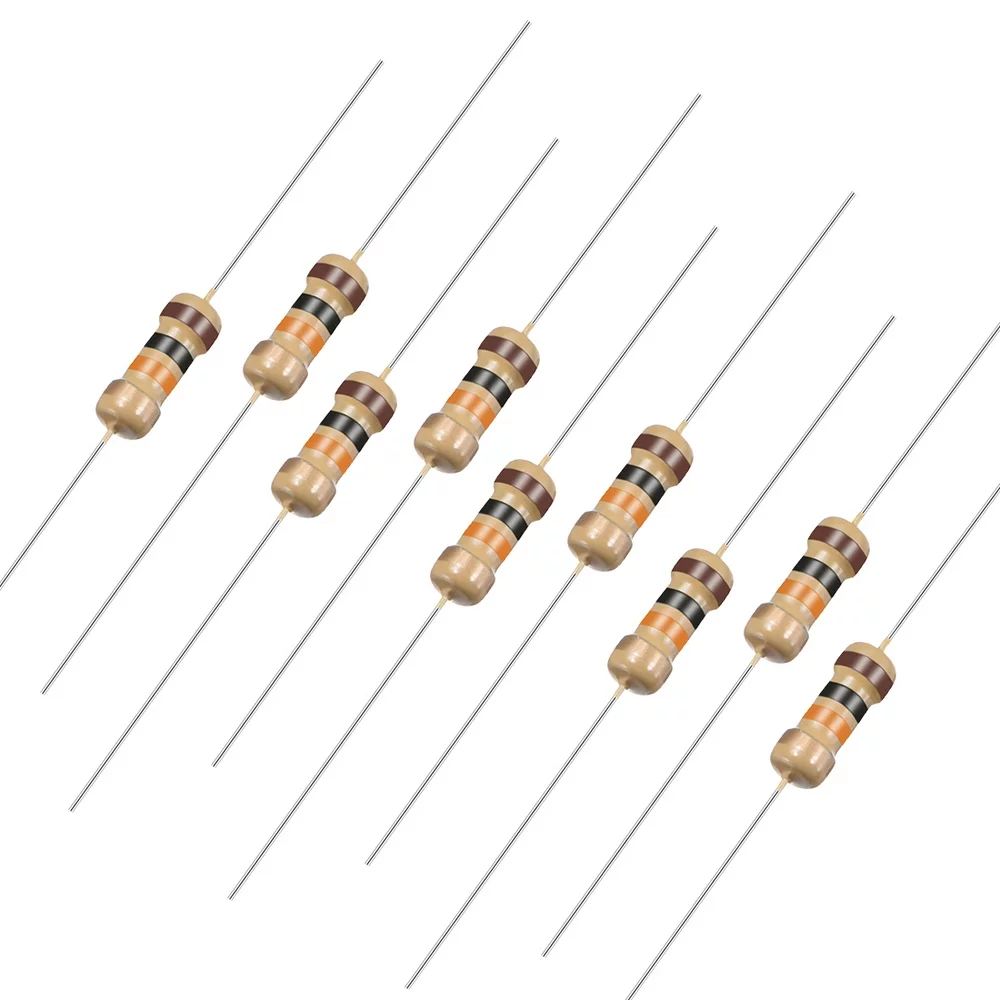
10 Ohm 0.25W Carbon Film Resistor (Pack of 50)
Perfect for Ohm’s Law experiments — build physical circuits to verify every calculation you make on paper. Pack of 50 gives you enough to try dozens of configurations.
Series Circuit Problems with Step-by-Step Solutions
In a series circuit, the same current flows through all components, and resistances add directly: R_total = R1 + R2 + R3 + …
Problem 11: Two Resistors in Series
A 9 V battery powers two resistors in series: R1 = 100 Ω, R2 = 200 Ω.
Step 1: R_total = 100 + 200 = 300 Ω
Step 2: I = 9 / 300 = 30 mA
Step 3: V_R1 = 0.030 × 100 = 3 V; V_R2 = 0.030 × 200 = 6 V
Check: 3 + 6 = 9 V ✓
Problem 12: Three Resistors in Series
A 12 V supply powers R1 = 47 Ω, R2 = 100 Ω, R3 = 150 Ω in series.
R_total: 47 + 100 + 150 = 297 Ω
I: 12 / 297 = 40.4 mA
V across each: V1 = 1.9 V, V2 = 4.04 V, V3 = 6.06 V
Check: 1.9 + 4.04 + 6.06 ≈ 12 V ✓
Problem 13: Finding a Missing Resistor
Two resistors in series across 5 V draw 10 mA. R1 = 220 Ω. Find R2.
R_total: 5 / 0.010 = 500 Ω
R2: 500 − 220 = 280 Ω (use 270 Ω standard)
Practical tip: Build each of these circuits on a breadboard using jumper wires and verify with a multimeter. This bridges the gap between theory and hands-on electronics, which is critical for Indian engineering students preparing for GATE or competitive exams.
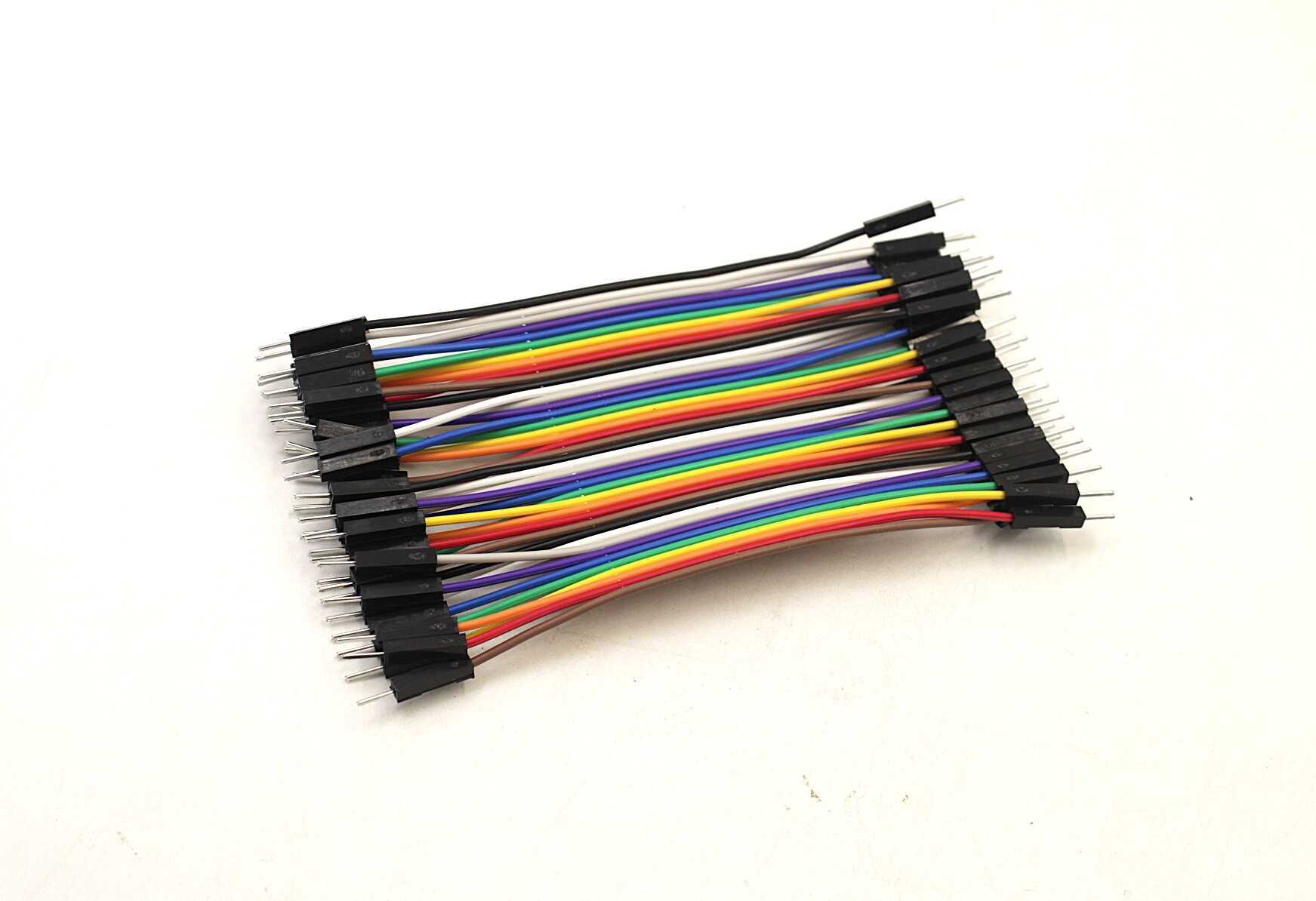
10CM Male To Male Breadboard Jumper Wires 2.54MM – 40Pcs
Build your Ohm’s Law circuits on a breadboard with these reliable 10cm M-M jumper wires. Essential for beginner experiments without soldering.
Parallel Circuit Problems for Beginners
In a parallel circuit, voltage is the same across all branches. The total resistance is calculated as: 1/R_total = 1/R1 + 1/R2 + …
Problem 14: Two Resistors in Parallel
R1 = 100 Ω and R2 = 100 Ω in parallel across 5 V.
R_total: 1/R = 1/100 + 1/100 = 2/100; R_total = 50 Ω
I_total: 5 / 50 = 100 mA
I through each: 5 / 100 = 50 mA each
Check: 50 + 50 = 100 mA ✓
Problem 15: Different Parallel Resistors
R1 = 200 Ω, R2 = 300 Ω in parallel across 6 V.
R_total: (200 × 300)/(200 + 300) = 60000/500 = 120 Ω
I_total: 6 / 120 = 50 mA
I1: 6/200 = 30 mA; I2: 6/300 = 20 mA; Total = 50 mA ✓
Problem 16: Three Parallel Branches
R1 = 1 kΩ, R2 = 2 kΩ, R3 = 3 kΩ in parallel across 12 V.
1/R_total: 1/1000 + 1/2000 + 1/3000 = 6/6000 + 3/6000 + 2/6000 = 11/6000
R_total: 6000/11 = 545.5 Ω
I_total: 12 / 545.5 = 22 mA
Problem 17: Mixed Series-Parallel
R1 = 100 Ω in series with the parallel combination of R2 = 200 Ω and R3 = 200 Ω across 9 V.
R_parallel: 200/2 = 100 Ω
R_total: 100 + 100 = 200 Ω
I: 9 / 200 = 45 mA
V_R1: 45 mA × 100 Ω = 4.5 V
V_parallel section: 9 − 4.5 = 4.5 V; I per branch = 4.5/200 = 22.5 mA each
Power Calculation Problems Using P = V × I
Power (P) in watts = V × I. Combined with Ohm’s Law, we get: P = I² × R = V² / R. These are critical for choosing the right wattage resistor so it doesn’t burn out.
Problem 18: A 470 Ω resistor carries 30 mA. What is the dissipated power?
P = I² × R = (0.030)² × 470 = 0.0009 × 470 = 0.423 W — use a 0.5 W or 1 W resistor.
Problem 19: 12 V is across a 100 Ω resistor. Find power.
P = V²/R = 144/100 = 1.44 W — use a 2 W resistor minimum.
Problem 20: A circuit draws 500 mA at 5 V. Find power.
P = 5 × 0.5 = 2.5 W
Important: Always select a resistor with a wattage rating at least twice the calculated power dissipation for safe operation. Most basic circuit resistors are 0.25 W (1/4 W) which is fine for currents below ~20 mA in typical 5 V circuits.

1.5 Ohm [0.25W] 1/4W Metal Film Resistor MFR (Pack of 100)
High-precision metal film resistors with tighter tolerance than carbon film — ideal for accurate Ohm’s Law experiments where measurement precision matters.
Real-World Applications: LEDs, Motors, and Sensors
Let’s apply Ohm’s Law to real components you will use in your projects:
LED Current Limiting Resistor
A red LED has a forward voltage (Vf) of 2 V and needs 20 mA. Your supply is 5 V.
Resistor needed: R = (5 − 2) / 0.020 = 150 Ω. Use 150 Ω or 180 Ω standard value.
Arduino Pin Current
An Arduino digital output pin provides 5 V and can source up to 40 mA safely (20 mA recommended). If you want only 15 mA through an LED (Vf = 2 V):
R = (5 − 2) / 0.015 = 200 Ω
DHT11 Sensor Pull-up
The DHT11 data line needs a pull-up resistor to 3.3 V or 5 V. Typical value is 4.7 kΩ to 10 kΩ. At 5 V with 10 kΩ: I_pullup = 5/10000 = 0.5 mA — minimal drain, good for battery operation.
Transistor Base Resistor
A BC547 transistor has hFE = 100 and needs 10 mA collector current. Base current needed = 10/100 = 0.1 mA. With 5 V base drive and 0.7 V Vbe:
R_base = (5 − 0.7) / 0.0001 = 43,000 Ω — but to ensure saturation, reduce this by 10×: use 4.7 kΩ base resistor for reliable switching.
SMPS Power Supply Calculations
A 12 V 10 A SMPS can deliver up to 120 W. If you connect a 10 Ω resistive load: I = 12/10 = 1.2 A, P = 12 × 1.2 = 14.4 W — well within the supply’s rating.
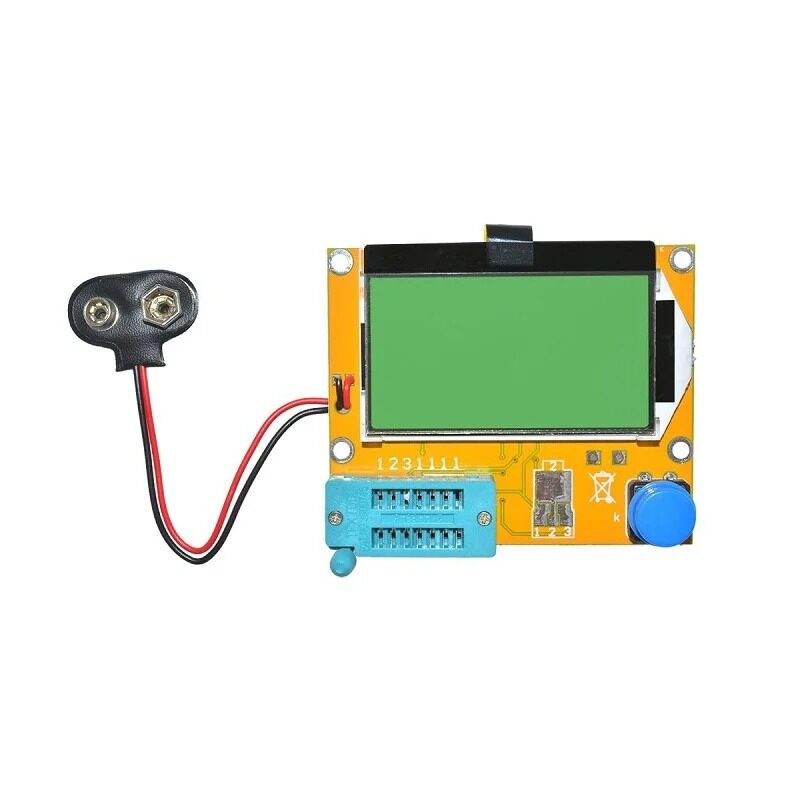
9V Battery Operated LCR-T4 Graphical Transistor & Component Tester
Verify resistor values instantly with this graphical component tester — perfect companion for Ohm’s Law exercises to confirm actual resistance before building circuits.
Tools and Components You Need to Practice
To turn these paper problems into real circuit experience, here is what every beginner needs:
- Breadboard — for quick, solder-free circuit assembly
- Jumper wires — M-M, M-F, and F-F for flexibility
- Resistor assortment — 10 Ω to 1 MΩ carbon or metal film
- Digital multimeter — to measure voltage, current, and resistance
- Power supply — 5 V USB or 9 V battery or bench SMPS
- Component tester — to verify resistor color codes and actual values
Build the habit of always calculating before connecting. Write down V, I, and R for every component in your circuit before powering it on. This one habit prevents burnt components, failed experiments, and frustration.
Recommended practice sequence:
- Solve 3 problems on paper each day for a week
- Build at least 2 physical circuits to verify your calculations
- Measure voltage across each component with a multimeter
- Compare measured vs calculated values — aim for less than 5% error
- Progress to mixed series-parallel networks by week 2
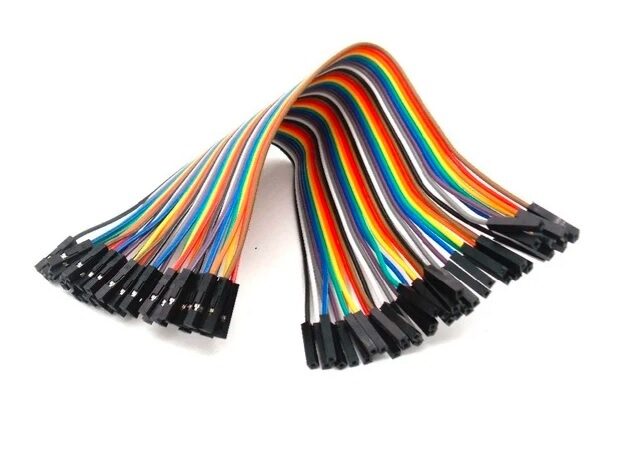
10CM Female To Female Breadboard Jumper Wires 2.54MM – 40Pcs
Complete your jumper wire kit with F-F wires — great for connecting sensor modules and breakout boards directly to your breadboard circuits.
Frequently Asked Questions
Q1: Does Ohm’s Law apply to all electronic components?
No. Ohm’s Law applies specifically to ohmic (linear) components like resistors. It does not apply to diodes, LEDs, transistors, or capacitors in their normal operating modes, where the V-I relationship is non-linear.
Q2: Why do my measured values differ from calculated values?
Resistors have a tolerance (±5% for carbon film, ±1% for metal film). Multimeters have their own measurement accuracy. Contact resistance in breadboard connections also adds a small error. Differences under 10% are normal and expected.
Q3: How do I remember the Ohm’s Law formula in an exam?
Use the VIR triangle: draw a triangle, put V at the top, I and R at the bottom. To find any variable, cover it — the remaining two show you the formula. V is above the line (multiplication), I and R are below (division).
Q4: What is the difference between 0.25W and 0.5W resistors?
A 0.5 W resistor can safely dissipate twice the power of a 0.25 W resistor. Always calculate P = I² × R for your circuit and use a resistor rated at least 2× that power. For most Arduino/microcontroller circuits with currents under 20 mA, 0.25 W is sufficient.
Q5: Can I use Ohm’s Law for AC circuits?
For pure resistive AC circuits, yes. However, when inductors or capacitors are present, you need impedance (Z) instead of resistance. The formula becomes V = I × Z, and Z combines resistance and reactance using vector math.
Ready to practice for real? Get your resistor kits, jumper wires, and a component tester from Zbotic.in — India’s trusted online electronics store with fast delivery across Mumbai, Delhi, Bangalore, Hyderabad, and all major cities. Build circuits, measure values, and see Ohm’s Law in action today!





Add comment