
If there is one fundamental concept every electronics enthusiast must understand, it is Ohm’s Law. It is the single most important equation in basic electronics, and once you truly understand it, a huge range of circuit behaviour — from LED brightness to motor power draw to voltage regulator design — suddenly makes sense.
This guide explains Ohm’s Law from the ground up, with real-world examples, practical calculations, and worked examples relevant to the components you actually use in hobby and DIY electronics projects in India.
What Is Ohm’s Law?
Ohm’s Law describes the relationship between three fundamental electrical quantities: voltage (V), current (I), and resistance (R). It states that the current flowing through a conductor is directly proportional to the voltage across it, provided temperature and other physical conditions remain constant.
It was formulated by German physicist Georg Simon Ohm in 1827, after extensive experimentation with resistors and voltage sources. The law is foundational because it applies to virtually every passive component in electronics — resistors, heating elements, wire, and many other materials behave in this predictable, linear way.
Understanding Voltage, Current, and Resistance
Before diving into the formula, let us build clear mental models of these three quantities.
Voltage (V) — The Pressure
Voltage is the electrical potential difference between two points. Think of it as water pressure in a pipe — the higher the pressure, the more force pushing water through. In electronics, voltage is the “push” that drives electrons through a circuit. It is measured in Volts (V) and always exists between two points (you cannot have voltage at a single point — only between two points).
Common voltages you will encounter: 1.5V (AA battery), 3.7V (Li-Ion cell), 5V (USB, Arduino), 9V (PP3 battery), 12V (car system, SMPS), 230V (Indian mains AC).
Current (I) — The Flow
Current is the rate at which electric charge flows past a point in a circuit. Continuing the water analogy, it is like the flow rate (litres per second). Current is measured in Amperes (A). In hobby electronics, you will commonly work in milliamperes (mA, where 1A = 1000mA).
A typical LED needs 10–20mA. An Arduino consumes about 50mA. A servo motor might draw 200–500mA. A 12V DC motor for robotics might draw 1–5A under load.
Resistance (R) — The Opposition
Resistance is the opposition to the flow of current. It converts electrical energy into heat (and sometimes light or sound). The water pipe analogy: a narrow pipe offers more resistance to flow than a wide one. Resistance is measured in Ohms (Ω). Higher resistance means less current flows for the same voltage. This is exactly what current-limiting resistors do for LEDs — they limit how much current flows through the LED to protect it from burning out.
The Formula: V = I × R
Ohm’s Law is expressed as:
V = I × R
Where:
- V = Voltage in Volts
- I = Current in Amperes
- R = Resistance in Ohms
This one equation can be rearranged to solve for any of the three quantities:
- To find Voltage: V = I × R
- To find Current: I = V / R
- To find Resistance: R = V / I
The Ohm’s Law Triangle
A helpful memory trick is the Ohm’s Law Triangle. Draw a triangle and place V at the top, I at the bottom left, and R at the bottom right. To find any quantity:
- Cover V → what remains is I × R (V = I × R)
- Cover I → what remains is V / R (I = V / R)
- Cover R → what remains is V / I (R = V / I)
This visual trick is genuinely useful in the field — many experienced engineers still think of it this way when doing quick mental calculations.
Practical Examples with Real Components
Example 1: Choosing a Current-Limiting Resistor for an LED
This is the most common Ohm’s Law calculation in hobby electronics. Suppose you want to run a red LED from a 5V Arduino pin. The LED has a forward voltage of 2V and needs 20mA (0.02A) of current.
The voltage across the resistor = Supply voltage − LED forward voltage = 5V − 2V = 3V
Required resistance: R = V / I = 3V / 0.02A = 150Ω
Use the nearest standard value — a 150Ω or 220Ω resistor. The slightly higher 220Ω will reduce current to about 13.6mA, which is perfectly fine and actually extends LED life.
Example 2: Calculating Current Through a Resistor
You connect a 470Ω resistor to a 5V supply. How much current flows?
I = V / R = 5 / 470 = 0.0106A = 10.6mA
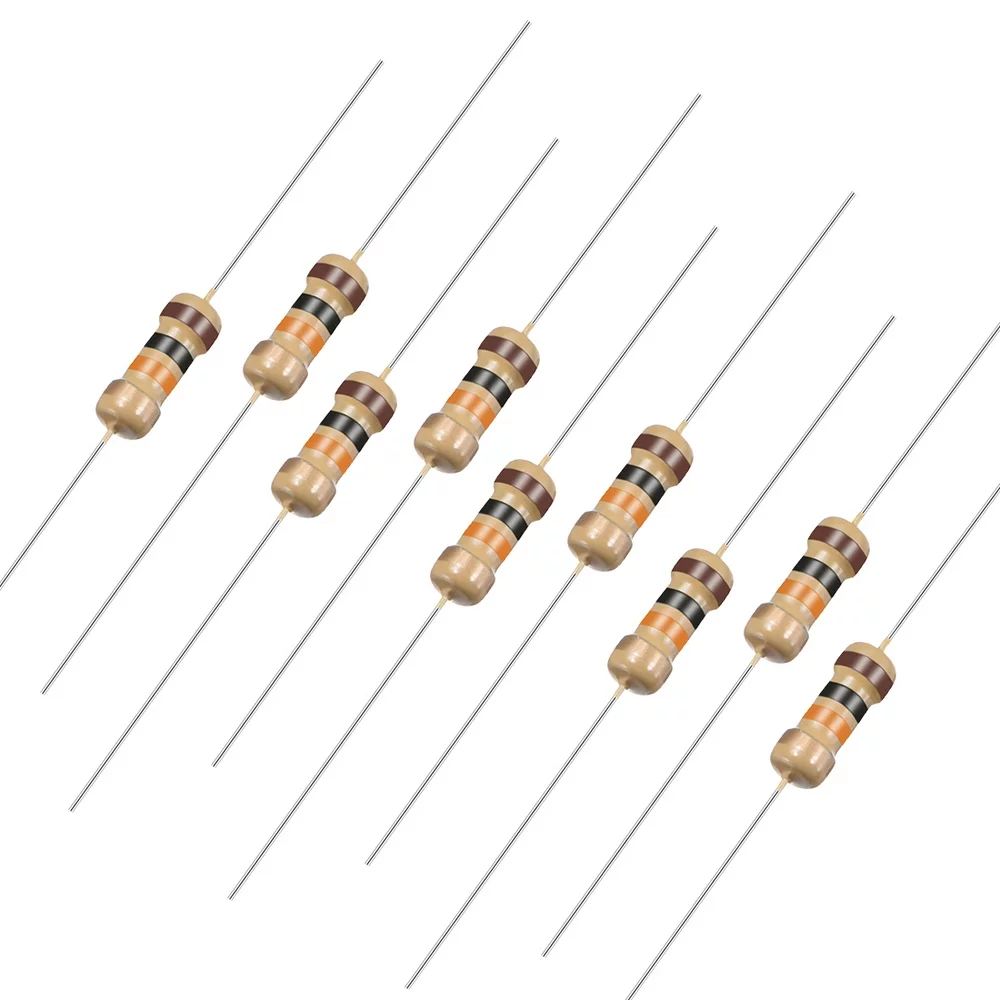
10 Ohm 0.25W Carbon Film Resistors (Pack of 50)
From current limiting to voltage dividers and pull-down applications — resistors are the most fundamental component in every circuit. Stock up with this 50-pack.
Example 3: Checking a Power Supply Load
Your 12V 2A power supply feeds a circuit with a total resistance of 24Ω. Is the current within the supply’s rating?
I = V / R = 12 / 24 = 0.5A
Yes, 0.5A is well within the 2A rating — the supply will handle it easily.
Example 4: Calculating Voltage Drop Across a Resistor
A 1kΩ pull-up resistor has 5mA flowing through it (perhaps a GPIO line pulling the signal low). What voltage appears across the resistor?
V = I × R = 0.005A × 1000Ω = 5V
This confirms that when the GPIO pulls the line to GND through 1kΩ, the full supply voltage drops across the resistor — which is exactly what pull-up resistors are designed to do.
Ohm’s Law and Power: The Watt Equation
Closely related to Ohm’s Law is the Power Law:
P = V × I
Where P is power in Watts (W). Combined with Ohm’s Law, you get two more useful forms:
- P = I² × R (given current and resistance)
- P = V² / R (given voltage and resistance)
Why this matters for resistors: Every resistor has a power rating (usually 0.25W or 0.5W for common carbon film types). If the power dissipated in the resistor exceeds this rating, it will overheat and fail — sometimes spectacularly.
Example: You use a 10Ω resistor in a circuit where 200mA flows. P = I² × R = 0.2² × 10 = 0.04 × 10 = 0.4W. A standard 0.25W resistor would be overloaded. You need a 0.5W or 1W rated resistor.

1.5 Ohm 0.25W Metal Film Resistor (Pack of 100)
Metal film resistors offer better tolerance (1%) and lower noise than carbon film — ideal for precision circuits where accurate resistance values matter for Ohm’s Law calculations.
Ohm’s Law in Series and Parallel Circuits
Series Circuits
In a series circuit, the same current flows through all components. The total resistance is the sum of individual resistances:
Rtotal = R1 + R2 + R3 + …
Voltage divides across the components proportionally to their resistance. Apply V = I × R to each component individually using the series current to find the voltage drop across each one.
Parallel Circuits
In a parallel circuit, all components share the same voltage. The reciprocal of total resistance equals the sum of reciprocals of individual resistances:
1/Rtotal = 1/R1 + 1/R2 + 1/R3 + …
For just two resistors in parallel: Rtotal = (R1 × R2) / (R1 + R2). The total current from the supply equals the sum of currents through each branch (I = V / R for each branch).
Key insight: Parallel circuits have lower total resistance than any individual branch. Series circuits have higher total resistance than any individual component.
Reading Resistor Values Quickly
To apply Ohm’s Law in practice, you need to read the value of resistors. The colour band system is the standard for through-hole components:
- Black = 0, Brown = 1, Red = 2, Orange = 3, Yellow = 4
- Green = 5, Blue = 6, Violet = 7, Grey = 8, White = 9
- The 3rd band (multiplier): multiply the first two digits by 10^(band value)
- 4th band (tolerance): Gold = ±5%, Silver = ±10%, none = ±20%
Example: Yellow-Violet-Red-Gold = 4, 7, ×100 = 4700Ω = 4.7kΩ at ±5% tolerance.
If reading colour bands is tricky, a component tester can measure resistance automatically and display the exact value.

LCR-T4 Component Tester — Resistance, Capacitance, ESR
Instantly measure resistance, capacitance, and inductance — stops the guesswork on unlabelled or hard-to-read components and verifies Ohm’s Law calculations on the bench.
Where Ohm’s Law Applies in Real Projects
Here are practical scenarios where you will use Ohm’s Law regularly:
LED circuits:
Calculating the current-limiting resistor value every time you use an LED. Formula: R = (Vsupply − Vforward) / ILED.
Pull-up and pull-down resistors:
Choosing the right value for GPIO lines on Arduino, ESP32, or Raspberry Pi. A 10kΩ pull-up with 3.3V pulls the line to 3.3V with only 0.33mA — low enough not to affect the GPIO but high enough to hold the line steady.
Voltage dividers:
Scaling a 5V signal down to 3.3V for an ESP32 input. Two resistors in series from 5V to GND — you tap the junction. Ohm’s Law tells you the output voltage at the junction.
Power supply sizing:
Calculating the total current draw of your project to choose the right power supply. Add up the current of each component (each calculated using I = V / R or taken from the datasheet), and choose a supply rated at 1.5–2× the total.
Motor driver design:
Understanding why a 10A motor connected to a 12V supply draws 10A through the wire — and choosing wire thick enough to handle it without overheating (wire has resistance too, and P = I² × R applies to the wiring itself).
Limitations of Ohm’s Law
Ohm’s Law is powerful but not universal. It applies to ohmic (linear) materials — components whose resistance stays constant regardless of voltage or current. Many components are non-ohmic and do not follow this simple relationship:
- LEDs and diodes: Their resistance changes dramatically with voltage. They are not ohmic devices. Ohm’s Law still applies after you account for the fixed forward voltage drop, but you cannot simply use R = V / I across the diode alone.
- Transistors: In amplifier mode, the current-voltage relationship is non-linear and controlled by the base/gate voltage.
- Thermistors: Their resistance changes with temperature, so R is not constant.
- Capacitors and inductors: These are reactive components — they oppose changes in voltage or current rather than maintaining a simple V/I ratio. AC circuit analysis requires impedance (Z), which extends Ohm’s Law into the frequency domain.
Despite these exceptions, Ohm’s Law remains the starting point for analysing nearly every circuit you will encounter as a hobbyist or engineer.
Frequently Asked Questions
What is the simplest way to remember Ohm’s Law?
The easiest method is the Ohm’s Law triangle: draw a triangle with V at the top, I at the bottom-left, and R at the bottom-right. Cover the quantity you want to find, and the remaining two show you the calculation — I×R gives V, V/R gives I, and V/I gives R. Another common mnemonic is “Very Intense Resistance” for V = I × R.
Does Ohm’s Law apply to AC circuits?
In a modified form, yes. For AC circuits, resistance is replaced by impedance (Z), which includes the effects of capacitors and inductors along with resistance. The formula becomes V = I × Z, where Z is a complex number representing both magnitude and phase. For purely resistive AC circuits (like heating elements), Ohm’s Law with simple resistance still applies directly.
How do I calculate the resistor for any LED?
Use the formula R = (Vsupply − Vforward) / Iforward. The forward voltage is typically 2.0–2.2V for red/yellow/green LEDs and 3.0–3.5V for blue/white LEDs. The forward current is usually 20mA (0.02A) for standard LEDs, though running at 10–15mA is fine and extends lifetime. Always use the next higher standard resistor value from your calculation.
What happens if resistance is zero in Ohm’s Law?
If resistance is zero, Ohm’s Law predicts infinite current (I = V / 0 = ∞). In practice, this is a short circuit — the supply delivers as much current as its internal resistance allows, causing extreme heating, fuse blowing, or component destruction. This is why short circuits are dangerous. Superconductors approach zero resistance but operate at near-absolute-zero temperatures and are not encountered in hobby electronics.
How is Ohm’s Law used in choosing a power supply?
Add up the current draw of every component in your circuit (from datasheets or by calculating I = V / R for each resistive load). The total is your minimum current requirement. Choose a power supply rated at 1.5 to 2 times this total to allow headroom and prevent the supply from running at its thermal limit. For the voltage, choose a supply matching your circuit’s operating voltage.
Master Ohm’s Law and Everything Else Falls Into Place
Ohm’s Law is not just a formula to memorise — it is a lens through which you understand all of electronics. Once V = I × R becomes second nature, you will find yourself mentally calculating current draw, voltage drops, and resistor values while looking at any schematic. Combined with the power equation P = V × I, you have the tools to design safe and functional circuits from scratch.
Start applying these formulas to every component you use. Calculate before you connect. Your components will last longer, your circuits will work first time, and your confidence as an electronics builder will grow rapidly.







Add comment