
When choosing a wireless protocol for low-power, wide-area IoT deployments in India, the NB-IoT LoRa Sigfox LPWAN protocol comparison is the most critical decision you will make. These three technologies — NB-IoT (Narrowband IoT), LoRa (Long Range), and Sigfox — are the dominant LPWAN (Low Power Wide Area Network) options, each with distinct trade-offs in range, data rate, power consumption, cost, and infrastructure availability. This comprehensive guide will help you choose the right protocol for your specific application.
What is LPWAN and Why Does It Matter?
Traditional wireless technologies present a trade-off: Wi-Fi and Bluetooth offer high data rates but short range and high power consumption, while 4G/LTE provides long range but at the cost of significant power draw and data plan costs. LPWAN fills the gap between these extremes — offering kilometer-scale range, years of battery life, and very low cost, at the price of low data rates (typically bytes to kilobytes per day).
LPWAN is ideal for applications that need to send small amounts of data infrequently over long distances:
- Smart metering (electricity, water, gas)
- Agricultural sensor networks
- Asset tracking and logistics
- Smart city infrastructure (parking, streetlights, waste bins)
- Industrial equipment monitoring
- Environmental monitoring networks
For India specifically, LPWAN is transformative. The country has millions of agricultural and rural monitoring use cases where running power cables and Wi-Fi infrastructure is impractical. LPWAN networks can cover entire districts from a single gateway or base station.
NB-IoT: Cellular-Based LPWAN
NB-IoT (Narrowband IoT) is a cellular standard defined by 3GPP (Release 13, 2016). It operates in licensed spectrum — the same spectrum used by 4G/5G cellular networks — and is deployed by telecom operators alongside their existing LTE infrastructure. In India, Jio and Airtel have both conducted NB-IoT trials and offer commercial services in select cities.
NB-IoT Key Technical Specifications
- Frequency: Licensed spectrum (B1, B3, B5, B8, B20, B28 etc.) — same as LTE
- Bandwidth: 200 kHz (downlink), 3.75/15 kHz (uplink)
- Data rate: ~250 kbps downlink, ~20 kbps uplink
- Range: 1-10 km urban, 10-40 km rural
- Power: PSM (Power Saving Mode) and eDRX enable 10+ year battery life
- Penetration: 20 dB better than GSM — can reach deep underground
- Message size: Up to 1600 bytes
- Latency: 1.6-10 seconds (not suitable for real-time control)
NB-IoT Strengths
NB-IoT’s biggest advantage is that it uses existing cellular infrastructure — no gateway deployment needed. If your operator has NB-IoT coverage, your devices work immediately with a SIM card. Security is handled at the network level (SIM authentication, AES-128 encryption). It supports QoS (Quality of Service) guarantees and guaranteed message delivery, unlike LoRa.
NB-IoT Weaknesses
NB-IoT requires operator subscription and SIM cards, adding recurring costs. Coverage in India is still limited to metro cities. The uplink is particularly slow and limited — sending large payloads takes many seconds. Roaming between operators is not straightforward for NB-IoT.
LoRa and LoRaWAN: The Open Standard
LoRa (Long Range) is a proprietary radio modulation technique developed by Semtech, but LoRaWAN — the network layer protocol built on top of LoRa — is an open standard managed by the LoRa Alliance. This combination is what most people mean when they say “LoRa” in the context of IoT networks.
LoRa/LoRaWAN Key Technical Specifications
- Frequency: Unlicensed ISM band — 865-867 MHz in India (different from Europe’s 868 MHz)
- Bandwidth: 125 kHz, 250 kHz, or 500 kHz
- Data rate: 0.3 kbps to 50 kbps (depends on Spreading Factor)
- Range: 2-5 km urban, 10-20 km rural, 100+ km line-of-sight
- Power: 10-15 years battery life with optimized duty cycling
- Message size: 1-222 bytes payload
- Latency: 1-5 seconds typical for Class A devices
- Cost: No spectrum fees; gateway costs Rs. 8,000-50,000
Spreading Factor and the Range-Rate Trade-off
LoRa’s unique Chirp Spread Spectrum (CSS) modulation allows configuring the Spreading Factor (SF7 to SF12). Higher SF = longer range, slower data rate, and more airtime. Lower SF = faster data rate, shorter range. This flexibility is LoRa’s biggest technical advantage.
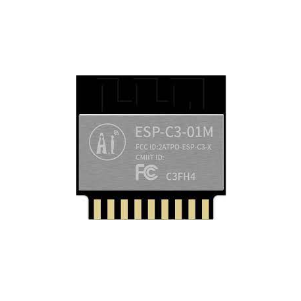
Ai Thinker ESP32-C3-01M Wi-Fi + BLE Module
Use the ESP32-C3 as the host microcontroller for LoRa radio modules in LPWAN projects, with excellent deep sleep power management for battery-operated nodes.
LoRaWAN Network Architecture
A LoRaWAN deployment consists of end nodes, gateways, a network server, and an application server. Anyone can deploy a LoRaWAN gateway and connect it to The Things Network (TTN) — a global free community network. TTN has coverage in Bangalore, Mumbai, Delhi, Pune, Hyderabad, and growing. For private deployments, use ChirpStack (open source) as the network server.
Sigfox: The Ultra-Narrowband Network
Sigfox is a French company that has deployed a global IoT network using Ultra-Narrowband (UNB) technology. Unlike LoRa where you can deploy your own gateway, Sigfox is a closed operator network — similar to cellular but specifically designed for IoT.
Sigfox Key Technical Specifications
- Frequency: 865-867 MHz (India), unlicensed ISM band
- Bandwidth: 100 Hz (ultra-narrow)
- Data rate: 100 bps uplink, 600 bps downlink
- Range: 3-10 km urban, 30-50 km rural
- Message size: 12 bytes uplink, 8 bytes downlink
- Messages per day: Limited to 140 uplink, 4 downlink
- Power: Among the lowest of all LPWAN — ideal for coin cell battery operation
Sigfox Status in India
Sigfox coverage in India as of 2024 is limited and patchy. WeGo (formerly TATA Communications’ Sigfox network) had some presence, but the broader Sigfox network has faced financial difficulties globally. For new deployments in India, Sigfox is generally not recommended due to coverage uncertainty. LoRa or NB-IoT are better choices for Indian projects today.
Head-to-Head Comparison Table
| Feature | NB-IoT | LoRa/LoRaWAN | Sigfox |
|---|---|---|---|
| Spectrum | Licensed (cellular) | Unlicensed ISM | Unlicensed ISM |
| Max Range | 40 km rural | 20 km+ rural | 50 km rural |
| Data Rate | ~250 kbps DL | 0.3-50 kbps | 100 bps |
| Max Payload | 1600 bytes | 222 bytes | 12 bytes |
| Battery Life | 10+ years (PSM) | 10-15 years | 10-20 years |
| Infrastructure | Operator required | Self-deploy or TTN | Operator required |
| India Coverage | Major metros | Deploy anywhere | Very limited |
| Bi-directional | Yes (full duplex) | Yes (half duplex) | Very limited DL |
| Security | SIM-based (strong) | AES-128 (good) | Device-level (limited) |
| Roaming | Limited | Gateway-dependent | Global (where active) |
| Cost per node/year | Rs. 200-500/SIM | Gateway amortized | Rs. 500-1000 |
LPWAN Coverage in India: 2024 Status
Understanding actual coverage in India is critical before committing to a technology:
NB-IoT in India
Jio launched commercial NB-IoT services in 2022 in select smart city projects (Ahmedabad, Surat, Pune). Airtel has conducted trials in Delhi, Mumbai, and Bangalore. As of 2024, NB-IoT is commercially available in major metro areas but coverage in Tier-2/Tier-3 cities and rural areas is sparse.
LoRa in India
LoRa is the most flexible option in India because you control the infrastructure. TATA Communications operated an IoT network, and The Things Network has community gateways in Bangalore, Mumbai, Delhi, Pune, Hyderabad, Chennai, and Jaipur. Private LoRaWAN deployments using a Rs. 10,000-20,000 gateway can cover an entire village or industrial estate. This makes LoRa the most practical choice for most Indian IoT projects today.
Sigfox in India
Sigfox coverage in India is unreliable. The global Sigfox company faced bankruptcy proceedings in 2022 and was acquired by UnaBiz. Network activity in India is minimal. Avoid Sigfox for new projects until the coverage situation stabilizes.
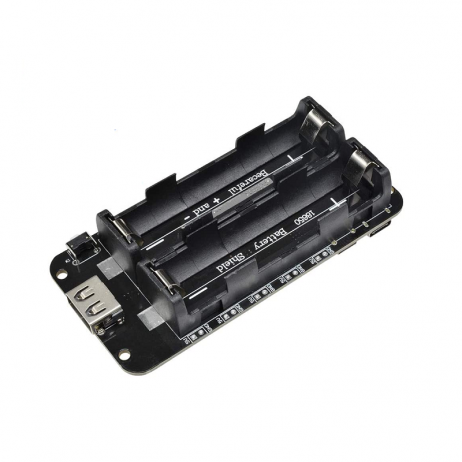
2 x 18650 Lithium Battery Shield for Arduino/ESP32/ESP8266
Power your LoRaWAN or NB-IoT sensor node with this dual 18650 battery shield, supporting years of operation when combined with deep sleep modes.
How to Choose the Right LPWAN Protocol
Use this decision framework based on your project requirements:
Choose NB-IoT if:
- Your deployment area has confirmed NB-IoT operator coverage
- You need guaranteed message delivery (SLA from operator)
- Device needs deep indoor/underground penetration (meters, manhole sensors)
- You require larger payloads (>200 bytes per message)
- Managed connectivity and billing per device is acceptable
Choose LoRa/LoRaWAN if:
- You are deploying in rural areas without NB-IoT coverage
- You want to own your infrastructure and avoid recurring operator fees
- You have multiple application requirements with varying data rates
- Community network (TTN) coverage exists in your target area
- You want to start experimenting today with minimal investment (a few LoRa modules + Raspberry Pi gateway)
Choose Sigfox if:
- You are building a product for European or South American markets where Sigfox coverage is established
- For Indian deployments: avoid Sigfox until coverage improves
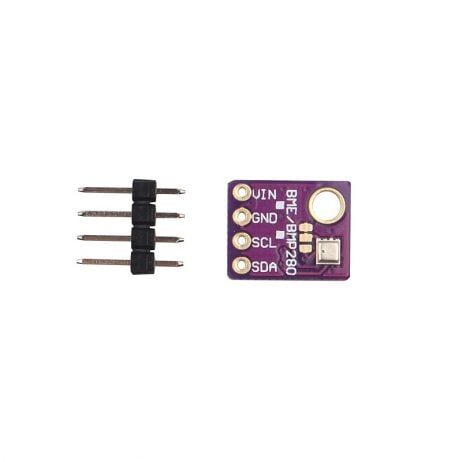
GY-BME280-5V Temperature and Humidity Sensor
A compact environment sensor perfect for LoRaWAN or NB-IoT nodes, measuring temperature, humidity, and pressure in a tiny package for battery-operated field deployments.
Frequently Asked Questions
Can I use LoRa without a LoRaWAN network server?
Yes — you can implement a point-to-point LoRa link (no LoRaWAN protocol stack) between two LoRa modules for simple sensor-to-gateway applications. This is simpler to set up and works well for private, single-owner deployments. LoRaWAN (with network server) is needed when you want to connect to a public network like TTN or when you have many devices spread across a wide area.
What is the difference between LoRa and LoRaWAN?
LoRa is the physical layer radio modulation technology (proprietary to Semtech). LoRaWAN is the Media Access Control (MAC) and network layer protocol built on top of LoRa radio. LoRaWAN defines the device classes (A, B, C), activation methods (OTAA, ABP), message format, and security. Most IoT deployments use LoRaWAN over LoRa radio.
Is NB-IoT available on Jio network in India?
Jio has announced NB-IoT services and has demonstrated deployments in smart city projects. However, as of 2024, commercial NB-IoT coverage is concentrated in select metros and smart city areas. Contact Jio Enterprise directly for the latest coverage maps and IoT SIM plan pricing. National coverage is expected to expand with Jio’s 5G rollout which includes NB-IoT/LTE-M support.
What is the maximum range of LoRa in open field conditions in India?
In line-of-sight conditions using SF12 and high-gain antennas, LoRa has achieved 700+ km range in record-breaking balloon experiments. Practically, in flat agricultural terrain of India (Punjab plains, Rajasthan), 20-40 km is achievable with a well-placed gateway antenna at 5-10m height. In typical urban Indian conditions with buildings, expect 1-3 km range per gateway.
Can LoRa handle firmware updates (FUOTA) for IoT devices?
LoRaWAN 1.0.4 and later supports Firmware Update Over The Air (FUOTA) via the LoRaWAN application layer. However, given LoRa’s low data rates (typically 125-5,000 bytes per second), a 100 KB firmware image can take hours to transmit. FUOTA is possible but should be planned carefully to minimize network load and device downtime.
Build Your LPWAN IoT Node Today
Get all ESP32 modules, sensors, and battery shields for your LoRa or NB-IoT project at Zbotic.in — India’s go-to electronics components store.





Add comment