
LiFePO4 Battery: Safer Chemistry for Solar Storage India
If you are building an off-grid solar system in India, one question comes up more than any other: which battery chemistry should you use? Lead-acid has been the traditional choice for decades, but LiFePO4 batteries — lithium iron phosphate — are rapidly becoming the preferred option for solar energy storage across India. With a combination of exceptional safety, long cycle life, and stable performance in Indian climate conditions, LiFePO4 for solar storage in India makes compelling technical and economic sense. This buying guide explains everything you need to know before investing in a LiFePO4 solar battery system.
What Is LiFePO4 Chemistry?
LiFePO4 stands for Lithium Iron Phosphate, a specific cathode material used in lithium batteries. The chemical formula of the active cathode material is LiFePO₄, and it belongs to the olivine phosphate family of materials. Compared to other lithium-ion cathode chemistries (NMC, NCA, LCO), the phosphate oxygen bond in LiFePO4 is significantly stronger. This strong bond is the key to its exceptional thermal stability and safety.
Key specifications of a LiFePO4 cell:
- Nominal voltage: 3.2V per cell (vs 3.6–3.7V for Li-ion NMC)
- Fully charged voltage: 3.65V
- Minimum discharge voltage: 2.5V
- Typical specific energy: 90–160 Wh/kg (less than NMC at 150–220 Wh/kg)
- Cycle life: 2,000–6,000 cycles at 80% DoD (vs 500–1,000 for NMC, 300–500 for lead-acid)
- Operating temperature range: -20°C to +60°C (charging: 0°C to +45°C)
- Self-discharge rate: 1–3% per month (vs 3–5% for NMC)
A 12V LiFePO4 battery is built from four 3.2V cells in series (4S = 12.8V nominal). Similarly, a 24V pack uses 8S and a 48V pack uses 16S — making LiFePO4 compatible with standard solar charge controller voltages without conversion.
Why LiFePO4 Is the Safest Lithium Battery Chemistry
Battery safety is paramount in any Indian household or commercial installation. The news regularly carries stories of e-bike fires and substandard battery pack failures. LiFePO4 addresses these concerns at the chemical level:
Thermal stability: NMC and NCA batteries undergo a dangerous exothermic reaction (thermal runaway) when overheated or punctured, releasing oxygen that feeds the fire. LiFePO4 does not release oxygen when overheated because the iron-phosphate bond remains stable up to 270°C before any decomposition begins. This means a LiFePO4 cell will vent or crack under extreme abuse but will NOT catch fire or explode in the way a Li-ion NMC cell can.
Abuse tolerance tests (IEC 62133 and UN38.3):
- Nail penetration: NMC ignites and burns vigorously. LiFePO4 may vent and swell but does not ignite.
- Overcharge to 200%: NMC can explode. LiFePO4 shows moderate heating only.
- Short circuit: NMC generates sustained heat. LiFePO4 temperature rise is far lower.
- Crush test: NMC frequently catches fire. LiFePO4 rarely does.
No cobalt: LiFePO4 contains no cobalt (unlike NMC and NCA), which eliminates both the ethical supply chain concerns and the chemical instability that cobalt compounds introduce at high temperatures.
For Indian solar installations — often in utility rooms, under staircases, or in outdoor sheds — this thermal safety is not just a theoretical advantage. It is the reason insurance companies and fire departments prefer LiFePO4 for stationary storage applications.

ISDT A4 Air Smart Battery Charger – Supports LiFePO4 with Bluetooth
A professional charger with native LiFePO4 chemistry support. Use it for characterising your cells and verifying balance quality before assembling your solar storage pack. Bluetooth monitoring via the ISDT app.
LiFePO4 Performance in Indian Climate Conditions
India’s geography means wildly different operating conditions: humid coastal cities like Mumbai and Chennai, dry desert heat in Rajasthan (peak summer 50°C+), humid tropical conditions in Kerala, and cold northern winters in Himachal Pradesh and Uttarakhand. How does LiFePO4 hold up?
High temperature performance (30–50°C ambient): LiFePO4 handles high temperatures better than NMC. Capacity retention at 45°C is typically 95–100% of nominal capacity. Calendar life (shelf life at high temperature) is significantly better than NMC — estimated 15+ years at 35°C for LiFePO4 vs 8–10 years for NMC. For Rajasthan or Gujarat solar installations, this is a major advantage.
Monsoon / high humidity: LiFePO4 cells themselves are sealed, but your BMS and wiring need IP65+ rated enclosures in coastal areas. The cells tolerate humidity well, but condensation on electronics causes corrosion. Use proper enclosures with silica gel desiccant packs in high-humidity zones.
Cold weather charging: This is LiFePO4’s Achilles heel in northern India. Do NOT charge LiFePO4 cells below 0°C — lithium plating on the anode causes permanent capacity loss. For Himachal Pradesh or Ladakh installations, you need a self-heating BMS or a temperature-controlled battery enclosure. Discharge at low temperatures is fine (down to -20°C), but charging requires ambient temperature above 0°C.
Cycle life in Indian solar applications: A typical Indian rooftop solar system cycles the battery once per day. At 2,000–4,000 cycles for LiFePO4, this translates to 5.5–11 years of daily cycling before the battery reaches 80% of original capacity — far outlasting the 2–3 years of a lead-acid battery under similar conditions.
LiFePO4 vs Lead-Acid for Solar Storage: Full Comparison
| Parameter | LiFePO4 | Lead-Acid (VRLA/AGM) |
|---|---|---|
| Usable capacity (DoD) | 80–95% | 40–50% |
| Cycle life at 80% DoD | 2,000–4,000 cycles | 300–500 cycles |
| Weight (per kWh) | ~7 kg/kWh | ~25–30 kg/kWh |
| Charging efficiency | ~98% | ~80–85% |
| Self-discharge/month | 1–3% | 5–15% |
| Upfront cost (India, per kWh) | ₹15,000–25,000 | ₹6,000–10,000 |
| 10-year total cost | 1× replacement | 3–4× replacements |
| Fire safety | Excellent | Good (no thermal runaway but H₂ gas emission) |
| Maintenance | None | Periodic topping (flooded), none (sealed) |
The economics strongly favour LiFePO4 over a 10-year horizon. While the upfront cost is 2–3× higher, the longer cycle life and higher usable capacity mean you get 4–6× more usable energy per rupee invested over the system’s lifetime.
LiFePO4 vs Standard Li-Ion for Solar Applications
Many makers wonder: can I just use standard 18650 NMC cells for my solar storage instead of LiFePO4 prismatic cells? The answer is technically yes, but practically problematic for most solar storage scales:
- Safety: NMC 18650 cells have caused fires in DIY power walls. For a system storing 5–20kWh in your home, the fire risk is unacceptable without commercial-grade BMS and cell-level fusing.
- Cycle life: NMC 18650 cells typically deliver 500–800 cycles at 80% DoD before dropping to 80% capacity. Daily solar cycling would wear them out in 1.5–2 years.
- Cost: Individual 18650 cells at scale are not significantly cheaper than LiFePO4 prismatic cells when you factor in holder hardware, nickel strip, spot welding equipment, and BMS costs.
- LiFePO4 winner: For any solar storage above 500Wh, LiFePO4 is the correct choice for Indian makers. For small portable projects under 100Wh where energy density matters (drones, wearables, portable speakers), NMC wins on weight.
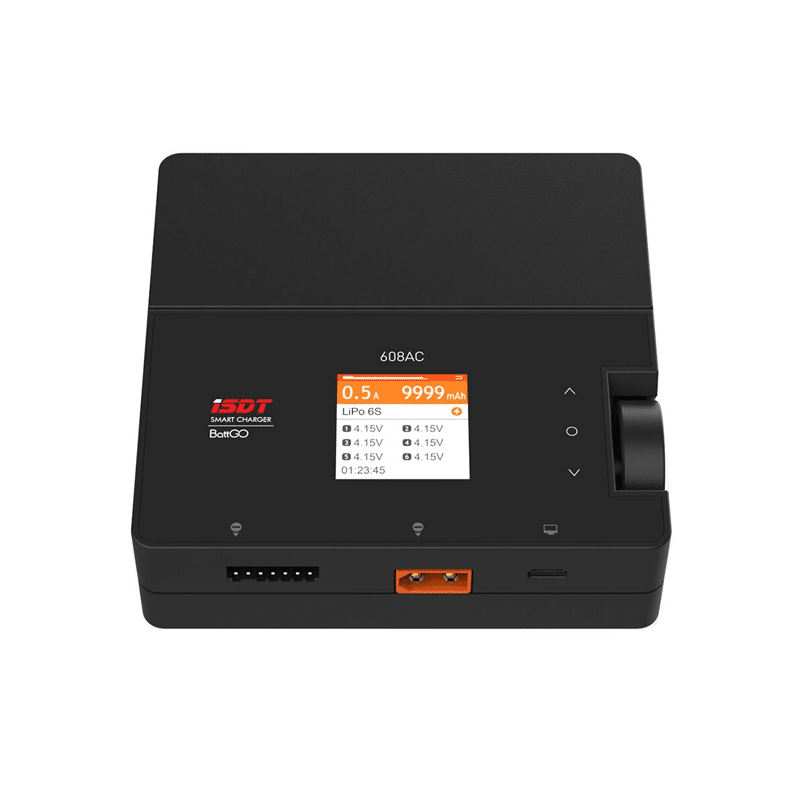
ISDT 608 AC LiPo Charger – AC 50W/DC 200W Dual Mode Charger/Discharger
A professional dual-mode charger and discharger for characterising LiFePO4 cells before building your solar pack. Measure actual capacity and internal resistance of each cell for matched pack assembly.
BMS Requirements for LiFePO4 Solar Packs
Even the safest battery chemistry needs a Battery Management System. For LiFePO4 solar packs, the BMS must handle several specific requirements:
Cell balancing: LiFePO4’s flat voltage curve makes passive balancing less effective than for NMC (because there is minimal voltage difference between cells even at different SoC states). Active balancing is preferred for large packs. At minimum, your BMS should support passive top-balancing and have millivolt-level cell voltage monitoring.
SoC estimation: As discussed in our SoC guide, voltage-based SoC is nearly useless for LiFePO4. Your BMS must use coulomb counting with periodic recalibration at the fully-charged and fully-discharged endpoints.
Protection thresholds for LiFePO4:
- Over-voltage protection: 3.65V per cell (hard limit), 3.60V per cell (soft limit)
- Under-voltage protection: 2.8V per cell (hard limit), 3.0V per cell (soft limit)
- Over-current protection: set at 1.5–2× the BMS rated continuous current
- Low-temperature charge inhibit: disable charging below 0°C (use NTC thermistor on cell)
- High-temperature protection: disconnect load above 60°C cell temperature
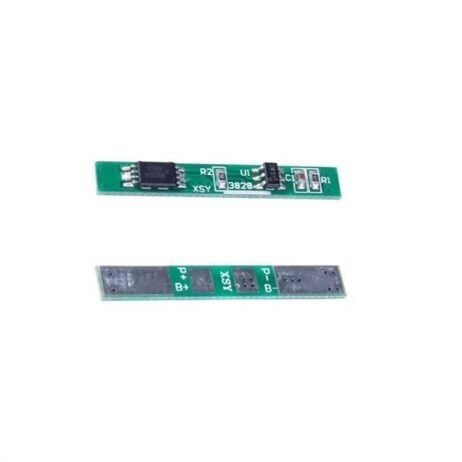
1S 3.7V 2A BMS Li-Ion 18650 Battery Protection Board
A compact single-cell BMS protection board — excellent for prototyping small LiFePO4 or Li-ion cells with over-voltage, under-voltage, and short-circuit protection built in.
Frequently Asked Questions
Q1: Can I replace my existing lead-acid solar battery with LiFePO4 directly?
Usually yes, but you need to reprogram your solar charge controller. Lead-acid charging profiles (bulk, absorption, float voltages) are different from LiFePO4 profiles. Most modern MPPT charge controllers (EPever, Victron, etc.) have a user-defined lithium profile. Set absorption voltage to 14.2V (for 12V/4S pack) and float to 13.6V. Do not use the lead-acid float voltage of 13.8V — it will cause continuous overcharging of LiFePO4.
Q2: How many years will a LiFePO4 battery last in an Indian solar setup?
At one full cycle per day and 80% Depth of Discharge, a quality LiFePO4 pack rated for 3,000 cycles will last approximately 8–9 years before reaching 80% remaining capacity. With lighter cycling (50% DoD or less), 15+ years is achievable. This compares to 2–3 years for lead-acid VRLA batteries under the same conditions.
Q3: Is it safe to install LiFePO4 batteries indoors in India?
Yes — LiFePO4 is the recommended chemistry for indoor installations. Unlike flooded lead-acid (hydrogen gas emission) and NMC lithium (fire risk), LiFePO4 does not off-gas during normal operation and has excellent thermal abuse tolerance. Install in a ventilated enclosure, away from direct sunlight, with minimum 5cm clearance on all sides for air circulation.
Q4: What size LiFePO4 battery do I need for a typical Indian home?
A typical Indian urban home uses 3–8 kWh per day. For 4–6 hours of backup covering essential loads (lights, fans, one AC), a 5kWh LiFePO4 pack is adequate. Pair it with 2–3kW of solar panels and a 40–60A MPPT charge controller. For rural setups with only lights and mobile charging, 1–2kWh suffices.
Q5: Where can I buy LiFePO4 cells and BMS boards for DIY solar packs in India?
Prismatic LiFePO4 cells (EVE, CATL, CALB brands) are available from importers and online marketplaces. For BMS boards, charging modules, and testing equipment, Zbotic stocks a range of quality power electronics suited for DIY solar battery projects. You can also source individual components for custom pack configurations.
Build Your LiFePO4 Solar Storage System
Whether you are building a small 100Wh portable power station or a whole-home 10kWh solar storage system, Zbotic has the charging modules, BMS boards, and battery hardware you need. Start your solar storage project today with quality components from India’s maker community store.



Add comment