
IoT security TLS SSL ESP32 MQTT connection is a topic that every serious IoT developer in India must master before deploying devices in production. Whether you are building a smart home controller, an industrial monitoring system, or a connected agriculture sensor, leaving your MQTT data unencrypted is a critical security risk. In this comprehensive guide, you will learn how to implement TLS 1.2/1.3 encryption on your ESP32’s MQTT communication — from obtaining certificates to writing production-ready Arduino code.
Why TLS/SSL Matters for ESP32 MQTT
MQTT over plain TCP (port 1883) sends all data, including device credentials and sensor readings, in clear text. Anyone on the same network — or an attacker who can intercept Wi-Fi packets — can read your data, inject fake messages, or impersonate your devices. In India, with the rapid growth of smart home and industrial IoT deployments, this risk is very real.
TLS (Transport Layer Security, the successor to SSL) solves this by:
- Encryption: All data is encrypted in transit — no eavesdropping possible
- Authentication: Both client and server verify each other’s identity using certificates
- Integrity: A message authentication code (MAC) ensures data is not tampered with in transit
MQTT over TLS uses port 8883 by default. The ESP32’s hardware-accelerated AES and SHA engines make TLS operations fast enough for real-time IoT applications while keeping power consumption low.
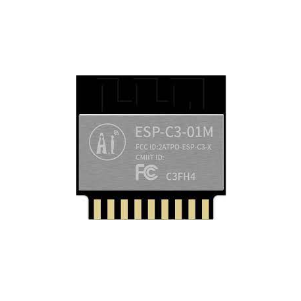
Ai Thinker ESP32-C3-01M Wi-Fi + BLE Module
The ESP32-C3 supports hardware-accelerated TLS, making it ideal for secure MQTT IoT nodes. Its compact size suits always-on IoT deployments across India.
TLS/SSL Basics: Certificates and Keys
Before touching any code, you need to understand the certificate model. TLS uses asymmetric (public-key) cryptography to establish a secure channel:
| File | Purpose | Who Has It |
|---|---|---|
| CA Certificate (ca.crt) | Root certificate authority — used to verify the broker | ESP32 client |
| Client Certificate (client.crt) | Identifies this specific ESP32 device | ESP32 client + broker |
| Client Key (client.key) | Private key — never leave the device | ESP32 client only |
| Server Certificate (server.crt) | Identifies the MQTT broker | Broker only |
For a homelab or private deployment, you can create your own Certificate Authority (CA) using OpenSSL. For cloud brokers like HiveMQ Cloud or AWS IoT Core, they provide their own CA certificates.
Generate your own CA and certificates using these OpenSSL commands on Linux/Mac:
# Generate CA key and certificate
openssl genrsa -out ca.key 2048
openssl req -new -x509 -days 1826 -key ca.key -out ca.crt
  -subj "/CN=MyIoT-CA/O=Zbotic/C=IN"

# Generate server key and CSR
openssl genrsa -out server.key 2048
openssl req -new -key server.key -out server.csr
  -subj "/CN=mqtt.yourdomain.in/O=Zbotic/C=IN"
openssl x509 -req -days 365 -in server.csr
  -CA ca.crt -CAkey ca.key -CAcreateserial -out server.crt

# Generate client key and certificate
openssl genrsa -out client.key 2048
openssl req -new -key client.key -out client.csr
  -subj "/CN=esp32-device-001/O=Zbotic/C=IN"
openssl x509 -req -days 365 -in client.csr
  -CA ca.crt -CAkey ca.key -CAcreateserial -out client.crt
MQTT Broker Setup: Mosquitto with TLS
Mosquitto is the most popular open-source MQTT broker and is free to run on any Linux server, Raspberry Pi, or cloud VM. Here is the configuration for enabling TLS with mutual authentication:
# /etc/mosquitto/conf.d/tls.conf
listener 8883
protocol mqtt

cafile /etc/mosquitto/certs/ca.crt
certfile /etc/mosquitto/certs/server.crt
keyfile /etc/mosquitto/certs/server.key

# Require client certificates (mutual TLS)
require_certificate true
use_identity_as_username true

tls_version tlsv1.2

# Disable plain text port for security
listener 1883
allow_anonymous false
Restart Mosquitto after editing: sudo systemctl restart mosquitto
Test the TLS connection from your server before deploying to ESP32:
mosquitto_pub -h mqtt.yourdomain.in -p 8883
  --cafile ca.crt --cert client.crt --key client.key
  -t test/hello -m "TLS works!" -d
ESP32 Arduino Code: WiFiClientSecure + PubSubClient
The Arduino ESP32 core includes WiFiClientSecure, which provides TLS support using the Mbed TLS library bundled in ESP-IDF. Combined with the PubSubClient library, you get a complete secure MQTT client.
First, install PubSubClient via Arduino Library Manager (search for “PubSubClient” by Nick O’Leary).
Here is a complete, production-ready sketch:
#include <WiFi.h>
#include <WiFiClientSecure.h>
#include <PubSubClient.h>

// Wi-Fi credentials
const char* ssid     = "YourWiFiSSID";
const char* password = "YourWiFiPassword";

// MQTT Broker
const char* mqtt_broker = "mqtt.yourdomain.in";
const int   mqtt_port   = 8883;
const char* mqtt_topic  = "sensors/temperature";
const char* device_id   = "esp32-device-001";

// Certificates (stored in program memory)
const char* ca_cert =
"-----BEGIN CERTIFICATE-----n"
"MIIDazCCAlOgAwIBAgIUXXXXXXXXXXXXXXXXXXXXXXXXXXXn"
// ... (full CA cert here)
"-----END CERTIFICATE-----n";

const char* client_cert =
"-----BEGIN CERTIFICATE-----n"
// ... (full client cert here)
"-----END CERTIFICATE-----n";

const char* client_key =
"-----BEGIN RSA PRIVATE KEY-----n"
// ... (full private key here)
"-----END RSA PRIVATE KEY-----n";

WiFiClientSecure espClient;
PubSubClient mqttClient(espClient);

void connectWiFi() {
  WiFi.begin(ssid, password);
  Serial.print("Connecting to WiFi");
  while (WiFi.status() != WL_CONNECTED) {
    delay(500);
    Serial.print(".");
  }
  Serial.println(" Connected!");
  Serial.println(WiFi.localIP());
}

void connectMQTT() {
  espClient.setCACert(ca_cert);
  espClient.setCertificate(client_cert);
  espClient.setPrivateKey(client_key);

  mqttClient.setServer(mqtt_broker, mqtt_port);
  mqttClient.setCallback(messageCallback);

  while (!mqttClient.connected()) {
    Serial.print("Connecting to MQTT broker...");
    if (mqttClient.connect(device_id)) {
      Serial.println(" Connected!");
      mqttClient.subscribe("commands/esp32-001");
    } else {
      Serial.print(" Failed, rc=");
      Serial.print(mqttClient.state());
      Serial.println(" Retrying in 5s");
      delay(5000);
    }
  }
}

void messageCallback(char* topic, byte* payload, unsigned int length) {
  Serial.print("Message on topic: "); Serial.println(topic);
  String msg = "";
  for (int i = 0; i < length; i++) msg += (char)payload[i];
  Serial.println(msg);
}

void setup() {
  Serial.begin(115200);
  connectWiFi();
  connectMQTT();
}

void loop() {
  if (!mqttClient.connected()) connectMQTT();
  mqttClient.loop();

  static unsigned long lastPublish = 0;
  if (millis() - lastPublish > 10000) {
    lastPublish = millis();
    float temp = 27.5; // Replace with real sensor reading
    String payload = String(temp);
    mqttClient.publish(mqtt_topic, payload.c_str());
    Serial.print("Published: "); Serial.println(payload);
  }
}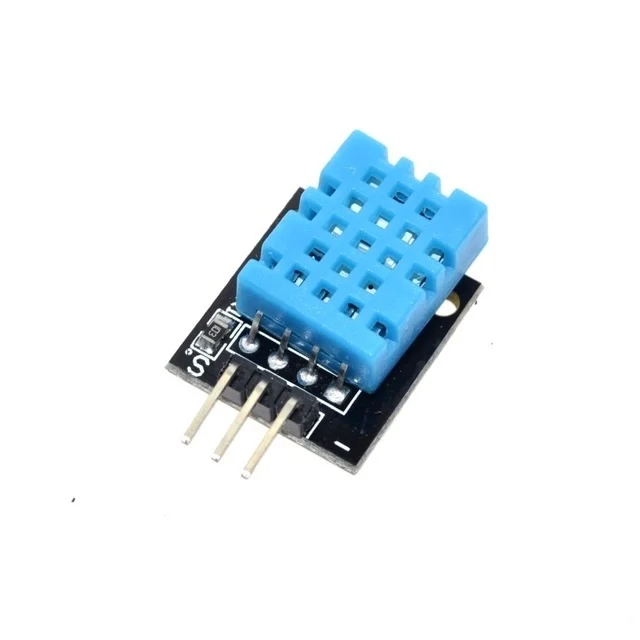
DHT11 Digital Relative Humidity and Temperature Sensor Module
Pair this DHT11 with your ESP32 to publish real temperature and humidity data securely over TLS/MQTT to your IoT dashboard or cloud broker.
Storing Certificates Safely on ESP32
Embedding certificates as C string literals in your sketch is convenient for prototyping but not ideal for production. Here are better approaches for Indian IoT product developers:
SPIFFS / LittleFS Storage
Store certificate files on the ESP32’s flash filesystem and read them at runtime:
#include <LittleFS.h>

String readFile(const char* path) {
  File f = LittleFS.open(path, "r");
  if (!f) return "";
  String content = f.readString();
  f.close();
  return content;
}

// In setup():
LittleFS.begin(true);
String caCert     = readFile("/ca.crt");
String clientCert = readFile("/client.crt");
String clientKey  = readFile("/client.key");
espClient.setCACert(caCert.c_str());
espClient.setCertificate(clientCert.c_str());
espClient.setPrivateKey(clientKey.c_str());
Upload the certificate files using the Arduino LittleFS Data Upload Tool (available as a plugin for Arduino IDE 1.x or a standalone script for IDE 2.x).
NVS (Non-Volatile Storage)
For maximum security, store the private key in ESP32’s NVS partition, which can be encrypted using ESP32’s flash encryption feature. This prevents physical extraction of the private key even if someone reads the flash chip directly.
Connecting to Cloud MQTT Brokers (HiveMQ, AWS IoT)
HiveMQ Cloud (Free Tier): HiveMQ offers a free cloud MQTT broker that is popular with Indian hobbyists. It uses standard TLS with a public CA (no client certificates required for the free tier):
// HiveMQ Cloud — server-only TLS (no client cert)
espClient.setInsecure(); // OR load the ISRG Root X1 CA cert
mqttClient.setServer("your-cluster.hivemq.cloud", 8883);
mqttClient.connect("esp32-001", "your-username", "your-password");
AWS IoT Core: AWS IoT uses mutual TLS with per-device certificates issued by AWS. Download the root CA (Amazon Root CA 1), device certificate, and private key from the AWS IoT Console, then use the same WiFiClientSecure + PubSubClient pattern shown earlier. Set the MQTT endpoint to your unique xxxxxx.iot.ap-south-1.amazonaws.com endpoint on port 8883.
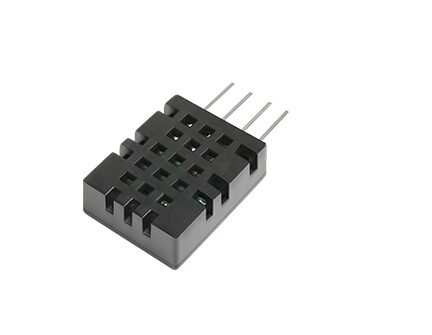
DHT20 SIP Packaged Temperature and Humidity Sensor
The DHT20 offers better accuracy than DHT11 and is perfect for publishing environmental data securely over TLS/MQTT to AWS IoT Core or any cloud broker.
Common TLS Errors and How to Fix Them
| Error | Cause | Fix |
|---|---|---|
-0x2700 MBEDTLS_ERR_X509_CERT_VERIFY_FAILED |
Wrong or expired CA certificate | Replace ca.crt with correct CA; check cert expiry with openssl |
-0x7200 SSL_PEER_CLOSE_NOTIFY |
Broker closed connection — often wrong client cert or key | Verify client.crt was signed by the same CA as broker expects |
| Connection timeout on port 8883 | Firewall blocking port 8883, or wrong broker hostname | Open port 8883 in UFW/iptables; verify DNS from ESP32 network |
| Heap allocation failure / stack overflow | TLS handshake needs ~40KB RAM — insufficient free heap | Free up memory: remove unused libraries, increase stack size |
time() returning 0 |
System time not set — TLS cert validation fails | Add NTP sync before MQTT connect: configTime(0,0,"pool.ntp.org") |
The NTP sync issue is particularly important: TLS certificate validation checks the current date against the certificate’s validity period. If the ESP32’s clock is wrong (it has no real-time clock by default), all TLS connections will fail with certificate errors. Always sync time via NTP at startup:
configTime(19800, 0, "pool.ntp.org", "time.nist.gov"); // IST = UTC+5:30 = 19800s
struct tm timeinfo;
getLocalTime(&timeinfo); // Block until time is synced
Frequently Asked Questions
Do I always need mutual TLS (client certificates) for ESP32 MQTT?
No. Mutual TLS (where both server and client authenticate with certificates) is the most secure option but also the most complex. For many deployments, server-only TLS (ESP32 verifies the broker’s certificate, but the broker does not require a client cert) combined with strong username/password authentication is sufficient. Cloud services like HiveMQ Cloud use this model. Only use mutual TLS when you need strong device-level identity verification — for example, when each ESP32 should only be able to publish to its own topic.
How much extra memory does TLS use on ESP32?
The TLS handshake requires approximately 40–60 KB of free heap memory. After the handshake is complete and the session is established, ongoing memory overhead is about 15–20 KB. The ESP32 typically has 300+ KB of free heap after booting, so TLS is feasible. However, if you are running BLE + WiFi + TLS + a large application, memory can become tight. The ESP32-S3 with its larger RAM (512 KB SRAM) is better suited for such demanding applications.
Can ESP8266 (D1 Mini) also use TLS/SSL MQTT?
Yes, but with significant limitations. ESP8266 has only 80 KB of usable heap, which makes TLS extremely tight. The BearSSL library (used by ESP8266 Arduino core) can do TLS, but you must use setCACert() with fingerprint verification or a minimal cipher suite to reduce memory usage. For new projects requiring TLS security, use ESP32 instead — it has much more RAM and hardware crypto acceleration.
How do I rotate certificates on deployed ESP32 devices?
Certificate rotation on deployed devices is a major challenge. Best practices: (1) Use OTA (Over-the-Air) updates to push new firmware with updated embedded certificates before the old ones expire. (2) Store certificates in SPIFFS/LittleFS and provide an OTA mechanism specifically for certificate files. (3) Set certificate validity to 2–5 years and schedule updates well in advance. (4) AWS IoT Core and similar platforms provide certificate rotation mechanisms through their device management APIs.
Is setInsecure() safe to use on ESP32?
espClient.setInsecure() disables certificate verification entirely. The data is still encrypted (so eavesdropping is prevented), but you lose server authentication — a man-in-the-middle attack could impersonate your broker and intercept all data. Use setInsecure() only for initial testing and never in production devices deployed in the field, especially in security-sensitive applications like smart locks, alarm systems, or financial IoT devices.
Build Secure IoT Projects with Zbotic
Get ESP32 modules, sensors, and all the hardware you need to build secure, production-ready IoT systems. Zbotic ships across India — Mumbai, Delhi, Bangalore, Hyderabad, Chennai, Pune and beyond.


Add comment