
IoT Power Management: Battery Runtime Calculator for ESP32
Effective IoT power management and battery runtime calculation for ESP32 projects is the difference between a device that needs weekly recharging and one that runs for six months or more on a pair of AA batteries. For Indian engineers and hobbyists deploying IoT sensors in remote agricultural fields, water tanks, solar energy systems, and smart meters, maximising battery life is not just a convenience — it is a fundamental design requirement. In this comprehensive guide, we cover the power consumption modes of the ESP32, how to calculate expected battery runtime, and the practical techniques to dramatically extend the life of your battery-powered project.
ESP32 Power Modes and Current Consumption
Understanding the ESP32’s power consumption across its different operating modes is the foundation of any battery life calculation. The ESP32 has five distinct power modes, each with dramatically different current draw:
| Power Mode | CPU | WiFi/BLE | Typical Current |
|---|---|---|---|
| Active (WiFi TX) | Running | Transmitting | 240–400 mA (peaks) |
| Active (WiFi idle) | Running | Connected, idle | 70–100 mA |
| Modem Sleep | Running | Off | 20–30 mA |
| Light Sleep | Paused | Off | 0.8–1.0 mA |
| Deep Sleep | Off | Off | 10–150 µA (RTC only) |
The numbers above are for the ESP32 chip alone. The actual current draw on a development board (like the NodeMCU-32S or WROOM-based boards) is higher because of the USB-to-UART chip, voltage regulator, and LEDs. On a bare ESP32 module with an efficient power supply, deep sleep current can be as low as 5 µA. On a development board, the same deep sleep state may draw 1-5 mA due to peripheral components that cannot be powered down.
Critical insight for Indian field deployments: The temperature also affects battery capacity significantly. At 45°C (common in Indian summers), lithium batteries lose 5-15% capacity. At 0°C (winter in north India), they can lose 20-30%. Factor this into your runtime estimates.
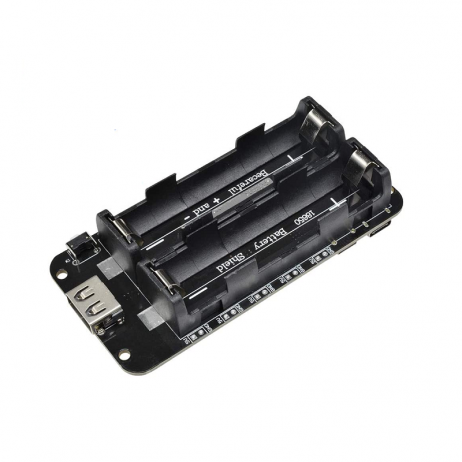
2 x 18650 Lithium Battery Shield for Arduino, ESP32, ESP8266
A dual 18650 battery shield with integrated charging — ideal for ESP32 battery projects requiring 3.7V-5V regulated power with protection circuits.
Battery Basics: Capacity, Voltage, and C-Rating
Before calculating runtime, you need to understand battery specifications:
- Capacity (mAh or Ah): The total charge a battery can deliver. A 2000 mAh battery can theoretically supply 2000 mA for 1 hour, or 200 mA for 10 hours, etc. In practice, efficiency losses and usable depth-of-discharge reduce this.
- Nominal voltage: Li-Ion/LiPo: 3.7V nominal (4.2V full, 3.0V cutoff). NiMH AA: 1.2V nominal. Alkaline AA: 1.5V (drops to 0.9V cutoff).
- Depth of Discharge (DoD): How much of the capacity you use before recharging. Using only 80% of capacity (DoD=80%) extends cycle life significantly for Li-Ion.
- Self-discharge: Li-Ion self-discharges at ~2% per month. Alkaline at ~1% per month. NiMH at ~20% per month (higher with standard NiMH, lower with eneloop-type low-self-discharge variants).
Common battery options for Indian ESP32 projects:
| Battery Type | Capacity | Voltage | Cost (approx India) | Best For |
|---|---|---|---|---|
| 18650 Li-Ion | 2000-3500 mAh | 3.7V | ₹150-300/cell | Medium-high power, rechargeable |
| LiPo pouch | 500-10000 mAh | 3.7V | ₹200-800 | Compact devices, wearables |
| AA Alkaline (2x) | 2000-3000 mAh | 3.0V (via booster) | ₹20-40/cell | Remote locations, no charger available |
| 18650 pack (2x) | 4000-7000 mAh | 3.7V (parallel) | ₹300-600 | Long-term unattended deployments |
The Battery Runtime Calculation Formula
The battery runtime formula for a deep-sleeping IoT device (the most common pattern) is:
Runtime (hours) = (Battery_Capacity_mAh × DoD) / Average_Current_mA
Where:
- I_active = current during active phase (WiFi on, sensor reading, data sending)
- T_active = duration of active phase in seconds
- I_sleep = deep sleep current in mA
- T_sleep = duration of sleep phase in seconds
- DoD = depth of discharge (use 0.8 for Li-Ion to preserve cycle life)
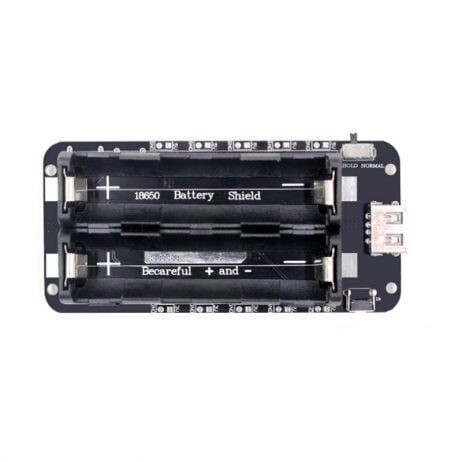
2 x 18650 Lithium Battery Shield V8 5V/3A for ESP32
The V8 shield provides clean 5V/3A output with USB charging — perfect for ESP32 projects where you need reliable power regulation and easy recharging in the field.
Practical Examples: Soil Sensor, Water Level Monitor
Example 1: Agricultural Soil Moisture Sensor (Reports Every 15 Minutes)
Setup: ESP32 bare module + DHT20 sensor, powered by two 18650 cells (5000 mAh total at 3.7V via LDO to 3.3V)
- Active time: 8 seconds (boot + WiFi connect + read sensor + send MQTT + disconnect)
- I_active: 80 mA average (includes WiFi connection peaks)
- Deep sleep time: 15 minutes × 60 = 900 seconds
- I_sleep: 0.01 mA (10 µA — bare module, no dev board peripherals)
Calculation:
Average I = (80 mA × 8s + 0.01 mA × 900s) / (8s + 900s)
           = (640 + 9) / 908
           = 649 / 908
           = 0.715 mA

Runtime = (5000 mAh × 0.8) / 0.715 mA
        = 4000 / 0.715
        = 5594 hours
        = ~233 days (approximately 7.7 months)
Example 2: Urban Water Tank Level Monitor (Reports Every Hour)
Setup: ESP32 dev board (NodeMCU-32S) + JSN-SR04T ultrasonic sensor, powered by single 3000 mAh 18650
- Active time: 10 seconds
- I_active: 120 mA (dev board has onboard LDO, USB chip drawing ~10 mA during sleep too)
- Deep sleep time: 3600 seconds
- I_sleep: 2 mA (dev board — USB chip and LDO quiescent)
Average I = (120 mA × 10s + 2 mA × 3600s) / (10s + 3600s)
           = (1200 + 7200) / 3610
           = 8400 / 3610
           = 2.33 mA

Runtime = (3000 mAh × 0.8) / 2.33 mA
        = 2400 / 2.33
        = 1030 hours
        = ~43 days
This illustrates a critical point: a dev board drawing 2 mA in sleep consumes roughly 200x more sleep power than a bare module drawing 10 µA. For deployments beyond a few weeks, always use bare ESP32 modules or remove/disable the onboard USB-UART bridge.
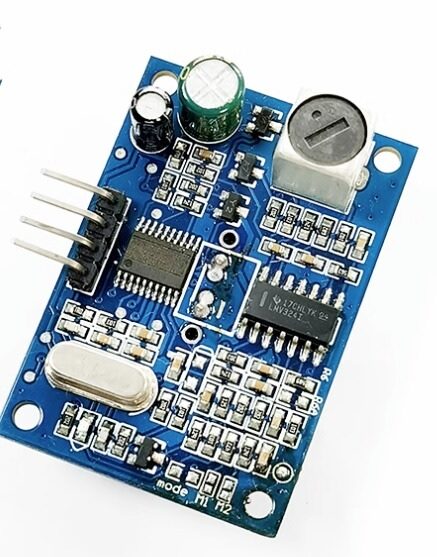
A86 JSN-SR04T Waterproof Ultrasonic Rangefinder Module Version 3.0
This waterproof ultrasonic module is ideal for water tank level monitoring projects — power it only during active measurements to maximise battery life.
Power Optimization Techniques
1. Use Deep Sleep with Timer Wakeup
#include <esp_sleep.h>

#define SLEEP_SECONDS 900 // 15 minutes

void setup() {
  // Do work: read sensor, send data...
  // Then go to sleep:
  esp_sleep_enable_timer_wakeup(SLEEP_SECONDS * 1000000ULL);
  esp_deep_sleep_start();
}
void loop() {} // Never reached
2. Minimise WiFi Connection Time
WiFi association (DHCP + TCP handshake) takes 2-5 seconds and dominates the active current. Use static IP to skip DHCP (saves ~1 second). Store the WiFi channel number in RTC memory to skip channel scanning (saves another 0.5 seconds). Use WiFi.setAutoReconnect(false) and WiFi.persistent(false) to avoid unnecessary NVS writes.
3. Power-Gate External Sensors
Many sensors draw current continuously even when not actively measuring. Use a GPIO pin through a P-channel MOSFET or a load switch IC to completely power down sensors between measurements. A DHT20 draws 0.36 mA continuously — over a 15-minute sleep cycle, this adds 0.36 mA to your sleep budget, roughly 36x more than the ESP32’s own sleep current.
4. Use 4x 18650 Battery Pack for Long Deployments
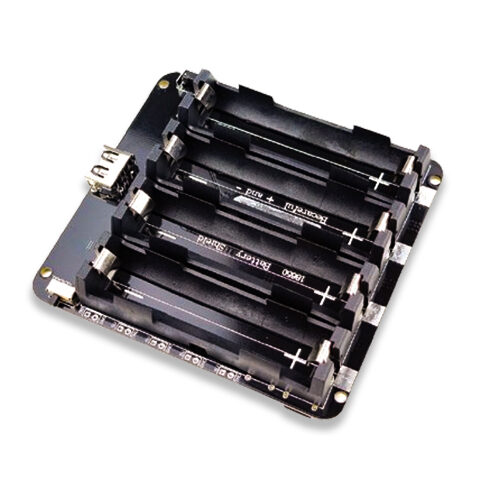
4 x 18650 Lithium Battery Shield V8 V9 for Arduino ESP32 ESP8266
For deployments exceeding 6 months, the 4-cell battery shield provides up to 14,000 mAh capacity — enough for a well-optimised ESP32 sensor node to run for over a year.
Battery Selection Guide for Indian IoT Projects
For most outdoor Indian deployments, the 18650 lithium cell is the preferred choice due to its availability, capacity, and temperature performance. Here is a quick selection guide:
- Under 30 days, easily accessible location: Single 18650 (3000 mAh) or LiPo 2000 mAh — dev board is fine
- 30-90 days, remote location: 2x 18650 in parallel (6000 mAh) — bare module recommended, power-gate all sensors
- 6+ months, agricultural field: 4x 18650 pack + small solar panel (5V 1W) — nearly indefinite operation with proper sleep optimisation
- No recharging possible: D-cell alkaline batteries (12,000–18,000 mAh each) with a boost converter — extreme low-power mode only (<1 mA average)
Frequently Asked Questions
Q: Why does my ESP32 draw much more current in deep sleep than the datasheet says?
A: The datasheet specifies current for the bare ESP32 chip or module. On a development board, the CP2102 or CH340 USB-UART bridge IC typically draws 2-8 mA continuously even when the ESP32 is in deep sleep. To achieve datasheet-level deep sleep current, use a bare ESP32 module and power it directly (not through the dev board’s USB port) or cut/disable the USB bridge power supply.
Q: Can I charge 18650 batteries using solar power with ESP32 projects?
A: Yes. Use a TP4056-based solar charging module with the 18650 battery shield. A 5V 1W solar panel (about 200 mA in full sunlight) will keep most well-optimised ESP32 sensor nodes topped up indefinitely. Pair with a protection circuit to prevent over-discharge during cloudy multi-day periods common in Indian monsoon season.
Q: What is the difference between light sleep and deep sleep on ESP32?
A: In light sleep, the CPU is paused but RAM is maintained and peripherals remain powered. The device wakes up very quickly (<1 ms) and resumes execution. Current draw is ~0.8-1 mA. In deep sleep, everything except the RTC (Real Time Clock) module and optionally ULP coprocessor is powered down. RAM is lost (code restarts from setup()), but current drops to 10-150 µA. Deep sleep is used when the sleep period is long (seconds to hours); light sleep for sub-second intervals.
Q: How do I measure actual current draw in my ESP32 project?
A: Use a digital multimeter in series with the battery positive lead for average current (works well above 1 mA). For detailed transient analysis, use a current probe with an oscilloscope or a dedicated tool like the Nordic Power Profiler Kit II (PPK2). Never trust the theoretical calculation alone — always measure on the actual hardware.
Power Your ESP32 Projects the Smart Way
Zbotic.in stocks 18650 battery shields, ESP32 modules, sensors, and all the components you need to build long-lasting battery-powered IoT devices. Fast delivery across India.



Add comment