
Table of Contents
- Why Your E-Bike Battery Needs a BMS
- 36V vs 48V — Choosing Your Pack Voltage
- BMS Specifications Explained
- Wiring a 36V (10S) Lithium Pack with BMS
- Wiring a 48V (13S) Lithium Pack with BMS
- Charging Your E-Bike Lithium Pack
- Recommended Products
- FAQ
Building or rebuilding an e-bike battery pack is one of the most rewarding electronics projects for Indian makers — and one of the most consequential if done incorrectly. A proper e-bike battery BMS wiring guide for 36V and 48V lithium packs is not optional: the Battery Management System (BMS) is the circuit that stands between a functional e-bike and a lithium fire. This guide covers everything from choosing the right BMS for your pack voltage, to the exact wiring sequence, to charging safely — without shortcutting any safety step.
Why Your E-Bike Battery Needs a BMS
Unlike lead-acid or NiMH batteries, lithium cells have very narrow safe operating windows:
- Maximum charge voltage: 4.20V per cell (4.35V for LiHV). Exceeding this causes electrolyte decomposition and eventual thermal runaway.
- Minimum discharge voltage: 2.5V per cell. Going below this causes lithium plating and permanent capacity loss.
- Maximum charge/discharge current: Depends on cell rating but must be respected to prevent heat buildup.
- Temperature limits: Charge only above 0 C; discharge only above -20 C.
A BMS monitors each cell group’s voltage continuously and cuts off charge or discharge when any limit is exceeded. It also detects short circuits and over-temperature conditions, triggering an instant cutoff. On an e-bike, which can draw 20-40A continuously at high speed, this protection is critical. No BMS = one wiring mistake or one weak cell away from a serious incident.
36V vs 48V — Choosing Your Pack Voltage
The two most common e-bike battery voltages in India map to two lithium cell configurations:
| Parameter | 36V Pack (10S) | 48V Pack (13S) |
|---|---|---|
| Cell configuration | 10 cells in series | 13 cells in series |
| Nominal voltage | 36V (10 x 3.6V) | 46.8V (13 x 3.6V) |
| Full charge voltage | 42V (10 x 4.2V) | 54.6V (13 x 4.2V) |
| Cutoff voltage | 30V (10 x 3.0V) | 39V (13 x 3.0V) |
| Typical motor power | 250W-500W | 500W-1000W |
| Common use | City e-bikes, pedelecs | Mountain, cargo, speed e-bikes |
Choose 36V if your motor controller is rated for 36V. Choose 48V for 48V controllers. Mixing voltages — running a 48V pack on a 36V controller — will damage or destroy the controller immediately. Always match the pack voltage to the controller’s rated input.
Cell count in parallel (P) determines capacity: 10S3P means 10 groups in series, each group with 3 cells in parallel. Total cells = 30. Capacity = 3 x single cell capacity. Common builds: 10S4P (36V, 10-12 Ah), 13S4P (48V, 10-12 Ah).
BMS Specifications Explained
When shopping for an e-bike BMS, you will encounter several key parameters:
Cell count (S rating)
Must exactly match your series cell count. A 10S BMS for a 36V pack; a 13S BMS for a 48V pack. Using the wrong S rating means wrong voltage thresholds — it will either fail to protect or cut off prematurely.
Continuous discharge current (A)
Must exceed your motor’s maximum continuous current draw. A 500W motor at 36V draws 500/36 = ~14A continuous. A 1000W motor at 48V draws ~21A. Size your BMS at 1.5x minimum: 20A BMS for a 500W/36V setup, 35A for a 1000W/48V setup. Peak BMS current must cover starting current, which can be 2-3x continuous.
Charge current (A)
Determines how fast the charger can charge. A 10A charger through a BMS rated for 5A maximum charge current will not work correctly. Match the BMS charge current to your charger’s output.
Balance function
E-bike packs run hundreds of cycles — balancing is mandatory. Always choose a BMS with integrated passive balancing. The balance current should be at least 100 mA.
Communication (optional)
Some premium BMS boards include UART or CAN communication for reading state-of-charge, temperature, and per-cell voltage via Bluetooth or display. Useful for advanced builds but not required for basic operation.
Wiring a 36V (10S) Lithium Pack with BMS
This section covers the exact wiring sequence for a 10S (36V) pack using 18650 cells and a common 10S BMS module.
Cell group assembly (10S4P example)
- Arrange 4 cells in parallel for each of 10 groups. Spot-weld positive ends together and negative ends together per group using nickel strip. Each group reads approximately 3.6-4.2V depending on charge state.
- Connect 10 groups in series. Negative of group 1 connects to positive of group 2, and so on. Total pack reads 36-42V.
- Bring out a balance tap wire from each cell group junction: B0 (overall negative), B1, B2, B3… B10 (overall positive). These go to the BMS balance connector.
BMS connection
- Connect the balance wires to the BMS balance port (B0 through B10). The pinout is typically B0 on one end, counting up to B10. Verify with your specific BMS datasheet.
- Connect the main pack negative (B-) to the BMS B- terminal using 12-14 AWG wire.
- Connect the main pack positive (P+ or B+) directly to the motor controller positive terminal and charger positive terminal.
- Connect the BMS P- terminal (protected output negative) to the motor controller negative terminal.
- Connect the BMS C- terminal (charge negative, if separate) to the charger negative terminal. If your BMS has a common port, C- and P- are the same terminal.
Verification before first use
- Measure voltage between P+ and P-: should read pack voltage (36-42V).
- Measure voltage at each balance tap relative to B0: B1 = ~3.6-4.2V, B2 = ~7.2-8.4V, and so on incrementally.
- Connect charger first (not the motor). Verify charge current flows and BMS does not cut off immediately.
- Then connect motor controller with no throttle. Verify the BMS does not cut off at rest.
- Run at light load first (flat ground, low speed) before attempting hill climbs or heavy loads.
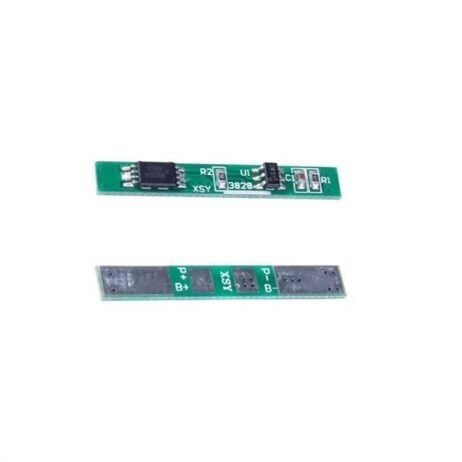
1S 3.7V 2A 1MOS BMS Li-ion 18650 Protection Board
Understand BMS fundamentals on a single cell before scaling to 10S or 13S. Study the circuit topology, test protection cutoffs, and build confidence before tackling your e-bike pack.
Wiring a 48V (13S) Lithium Pack with BMS
The 48V 13S wiring follows the same approach as 36V 10S, with two key differences:
- You have 13 cell groups in series instead of 10, producing 46.8V nominal and 54.6V fully charged.
- The BMS balance connector has 14 wires (B0 through B13).
- Wire ratings must be higher if the motor draws more current. Use 10-12 AWG for packs supplying 30A+ continuous.
Additional tips for 48V builds:
- At 54.6V, voltages are high enough to cause a painful and dangerous shock. Always disconnect the pack before any wiring work.
- Use appropriately rated connectors. XT90 or AS150 connectors are suitable for 48V e-bike power levels. XT60 connectors are rated for 60A but only for cells not at 48V in some housing configurations — check the connector’s voltage rating, not just current.
- Add a pre-charge resistor on the motor controller connection if your controller has large input capacitors. A brief inrush current without pre-charge can weld or damage the BMS MOSFETs on first connection.

1S 18650 Li-ion BMS Charger Protection Board 3.7V
Per-cell protection with integrated charge control. Use as a learning reference for the protection topology that your multi-cell e-bike BMS scales up from.
Charging Your E-Bike Lithium Pack
Use only a charger designed for your exact pack voltage. A 42V charger for 10S (36V), a 54.6V charger for 13S (48V). These are standard e-bike charger voltages widely available in India.
Key charging guidelines:
- Never charge below 0 C. Lithium plating from low-temperature charging is irreversible. In winter, bring the bike indoors for 30 minutes before charging.
- Standard charge rate is 0.5C. For a 10 Ah pack, that is 5A. Most included e-bike chargers are 2A or 3A — slower but easier on cells.
- Do not charge to 100% for daily use. Stopping at 80% (40V for 10S, 52V for 13S) significantly extends cell life. Many e-bike chargers have a switch or setting for 80% charging.
- Allow charger to complete the CV phase. During the constant-voltage phase at the end of charge, the BMS passive balancer works. Leave the charger connected for 30-60 minutes after the green light appears for balancing to complete.
- Always charge in a fire-safe location. Use a tile or concrete floor, not a wooden surface. Never charge unattended overnight until you have verified your BMS and charger operate correctly over several sessions.
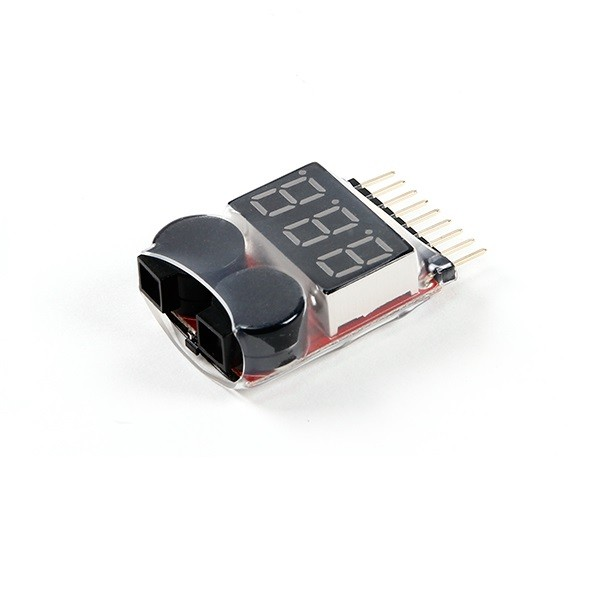
1-8S LiPo Battery Voltage Tester (No Alarm)
Check per-cell voltage balance across your full e-bike pack via the balance connector. Indispensable for diagnosing BMS issues and verifying the pack is balanced before long rides.
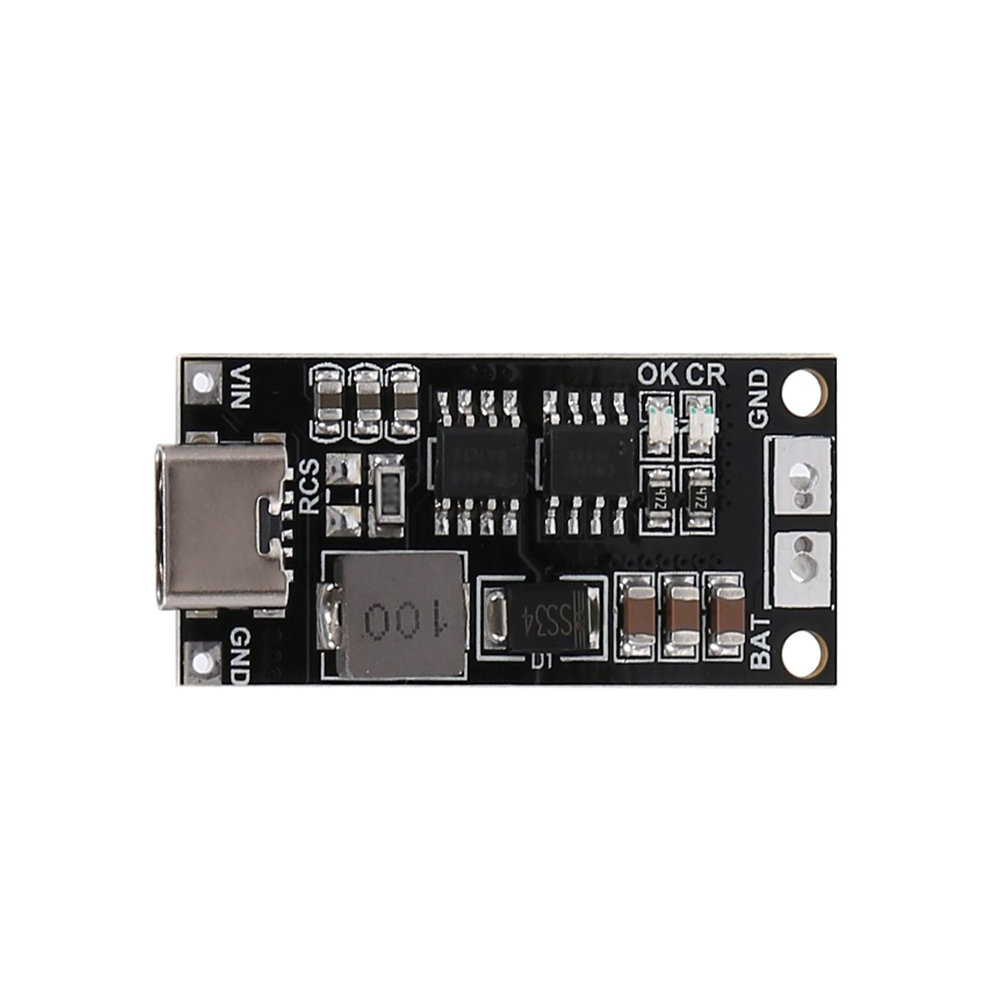
18650 Type-C to 3S 12.6V 2A Booster Charger Module
Charge your auxiliary 3S lithium accessories pack (for lights, GPS, phone charging on your e-bike) via any USB-C PD charger. A clean solution for secondary power on touring e-bikes.
Frequently Asked Questions
Can I use a 36V charger on a 48V battery by mistake?
No — a 36V charger (42V output) will undercharge a 48V pack (needs 54.6V). The BMS will accept the charge but cells will only reach partial SoC. The reverse — a 48V charger on a 36V pack — will overcharge cells and the BMS will cut off, but if the BMS fails or is bypassed, it is a fire hazard. Always verify charger voltage before connecting.
Why does my BMS cut off under load even though the battery is not empty?
This usually means the BMS current rating is too low for your motor’s peak current demand. The BMS trips its overcurrent protection during hard acceleration. Solution: replace with a higher-rated BMS or add a separate high-current MOSFET bypass for the discharge path (advanced build). Also check for a weak cell in the pack that drags the group voltage down during high-current demand, triggering the BMS’s low-cell-voltage cutoff.
How many 18650 cells do I need for a 48V 15 Ah e-bike battery?
48V = 13S configuration (13 cells in series). 15 Ah target with 3000 mAh cells: 15,000 / 3000 = 5P (5 cells in parallel per group). Total cells = 13 x 5 = 65 cells. At typical Indian 18650 pricing of Rs.200-300 per cell, that is Rs.13,000-19,500 for cells alone, plus BMS, nickel strip, and housing.
Do I need a BMS if I use LiFePO4 cells?
Yes — all lithium chemistries including LiFePO4 require a BMS for cell protection and balancing. LiFePO4 is more tolerant of overcharge than Li-ion (no thermal runaway at moderate overcharge) but still needs protection for long-term pack health and warranty compliance.
Can I rebuild an old e-bike battery that has some dead cells?
Yes, but replace ALL cells, not just the dead ones. Mixing old and new cells in a pack creates immediate imbalance because old cells have higher internal resistance. The new cells will carry disproportionate current, age faster, and the pack will behave unpredictably. A full cell replacement gives you a known baseline and maximum longevity.
Build Your E-Bike Pack Right the First Time
Following a proper e-bike battery BMS wiring guide for 36V and 48V lithium packs is not just about efficiency — it is about safety. A correctly built pack with a quality BMS, matched cells, and the right charger will serve you reliably for hundreds of cycles and thousands of kilometres. Zbotic stocks BMS protection boards, 18650 holders, voltage testers, and smart chargers to help Indian e-bike builders get every detail right. Start with good components and your lithium pack will reward you with years of clean, quiet, emission-free riding.



Add comment