
Choosing the right wireless module can make or break your IoT or remote-control project. If you have been searching for a comparison of the CC1101 FSK module vs NRF24L01, you are not alone — this is one of the most common dilemmas for Indian makers building long-range sensor networks, home automation systems, or low-power remote devices. Both modules are affordable and widely used with Arduino and other microcontrollers, but they serve quite different use cases. This guide breaks down the key differences so you can pick the right transceiver for your next build.
What Is the CC1101 FSK Module?
The CC1101 is a low-cost, single-chip sub-GHz RF transceiver from Texas Instruments. It operates across multiple frequency bands — primarily 315 MHz, 433 MHz, 868 MHz, and 915 MHz — making it ideal for applications that need to pass through walls, cover long distances, or operate in the ISM (Industrial, Scientific, Medical) band without license requirements in India.
The module communicates with a host microcontroller via SPI interface and supports multiple modulation schemes: 2-FSK, GFSK, ASK/OOK, 4-FSK, and MSK. It features a built-in packet handler with address filtering, forward error correction (FEC), and data whitening. The CC1101 is commonly found on small breakout boards paired with a helical or wire antenna, available for under ₹150 in India.
Key features of the CC1101:
- Operating voltage: 1.8V – 3.6V (NOT 5V tolerant — use level shifters with Arduino Uno)
- Frequency range: 300–928 MHz
- Max output power: +10 dBm (configurable)
- Receive sensitivity: –116 dBm at 0.6 kbps
- Data rate: 0.6 kbps to 500 kbps
- SPI interface up to 10 MHz
- 64-byte RX and TX FIFOs
What Is the NRF24L01?
The NRF24L01 from Nordic Semiconductor is arguably the most popular low-cost wireless module in the maker community. Operating at 2.4 GHz, it offers high data rates and supports up to six simultaneous data pipes (multi-point networking), making it perfect for RC controllers, game pads, and sensor-to-gateway setups where multiple nodes talk to one receiver.
The NRF24L01+ (enhanced version with PA+LNA) can reach impressive distances with the right antenna. Like the CC1101, it uses SPI and runs at 3.3V logic, though it is generally more forgiving. Libraries like RF24 are mature and very well documented, which lowers the learning curve significantly for beginners.
Key features of the NRF24L01:
- Frequency: 2.400 – 2.525 GHz (125 channels, 1 MHz spacing)
- Max data rate: 2 Mbps (also 1 Mbps and 250 kbps modes)
- Transmit power: 0 dBm (standard), up to +20 dBm (PA+LNA variant)
- Receive sensitivity: –94 dBm at 250 kbps
- Multi-point: up to 6 data pipes (ShockBurst protocol)
- Operating voltage: 1.9V – 3.6V
- Auto-ACK and auto-retransmit built-in
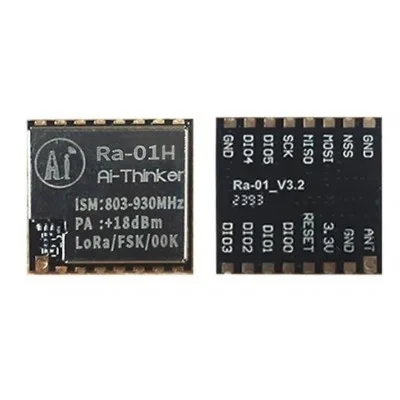
Ai Thinker LoRa Ra-01H Module
Sub-GHz LoRa module based on SX1276/SX1278 — perfect complement to CC1101-style projects needing ultra-long range in the 470 MHz band.
Frequency Bands: Sub-GHz vs 2.4 GHz
This is the single biggest difference between the CC1101 FSK module and the NRF24L01, and it affects practically every other aspect of performance.
Physics of lower frequencies: Radio waves at 433 MHz or 868 MHz have longer wavelengths than 2.4 GHz. This means they diffract around obstacles more easily, penetrate walls and concrete with less attenuation, and travel farther at the same transmit power. If you are building a sensor that needs to communicate from inside a basement, through multiple floors, or across a large open field, sub-GHz is the clear winner.
2.4 GHz congestion: The 2.4 GHz band is heavily used in India — WiFi, Bluetooth, microwave ovens, and dozens of IoT devices all compete in this spectrum. The CC1101 operating at 433 MHz or 868 MHz faces far less interference, especially in residential and semi-urban environments.
Regulatory note for India: The 433 MHz ISM band (433.05–434.79 MHz) is license-free in India for low-power devices under the WPC (Wireless Planning and Coordination) rules. The 868 MHz band is less commonly used in India (more popular in Europe). Stick to 433 MHz for maximum regulatory clarity in Indian projects.
Range and Power Consumption Compared
Range comparisons between wireless modules are notoriously difficult to pin down because they depend on antenna quality, transmit power settings, environment, and data rate. That said, here are realistic expectations:
| Parameter | CC1101 (433 MHz) | NRF24L01+PA+LNA |
|---|---|---|
| Open field range | 500m – 1.5 km | 700m – 1 km (PA+LNA) |
| Indoor range (walls) | 50–200m | 20–80m |
| TX current (max power) | ~30 mA | ~115 mA (PA+LNA) |
| RX current | ~14 mA | ~12.3 mA |
| Sleep current | ~0.2 µA | ~0.9 µA |
The CC1101 wins on indoor/obstructed range due to its sub-GHz frequency. For battery-powered remote sensor nodes that send a reading every few minutes and sleep in between, the CC1101’s extremely low sleep current of 0.2 µA is exceptional. A coin cell can power a CC1101 node for months.
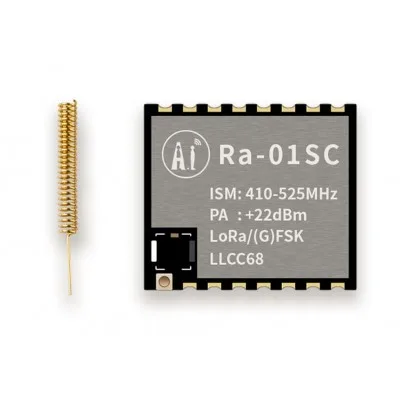
Ai Thinker LoRa Ra-01SC Module
Sub-GHz LoRa module for extended-range, low-power IoT sensor networks — ideal for makers exploring beyond CC1101 capabilities.
Modulation Schemes and Data Rates
The CC1101 supports multiple modulation types — 2-FSK (two-frequency shift keying), GFSK (Gaussian FSK), ASK/OOK, 4-FSK, and MSK — giving it tremendous flexibility. This is why the CC1101 is used in everything from cheap remote controls to professional industrial telemetry. With OOK mode, you can even decode signals from commercial 433 MHz remotes and weather stations, making the CC1101 useful for reverse-engineering or home automation hubs.
The NRF24L01 uses a proprietary Enhanced ShockBurst protocol over GFSK modulation and offers three fixed data rates: 250 kbps, 1 Mbps, and 2 Mbps. The 2 Mbps mode is excellent for streaming sensor data rapidly or for RC vehicle control where low latency matters. However, higher data rates mean shorter range — at 2 Mbps, indoor range drops considerably.
Practical recommendation: If your project involves fast bi-directional communication with multiple nodes — like a drone, RC car, or a gaming controller — NRF24L01 is simpler and faster. If you need to cover large distances, pass through obstacles, or interface with existing 433 MHz devices, choose the CC1101.
Wiring Both Modules to Arduino
Both the CC1101 and NRF24L01 use SPI communication. The critical difference is that neither module is 5V tolerant — both require 3.3V logic. When using with an Arduino Uno (5V logic), you must use a logic level converter or voltage divider on the data lines. The Arduino’s 3.3V pin can power both modules only for testing — for reliable operation, use a dedicated 3.3V regulator with adequate current capacity.
CC1101 to Arduino Uno pinout:
| CC1101 Pin | Arduino Uno |
|---|---|
| VCC | 3.3V |
| GND | GND |
| MOSI | D11 (via level shifter) |
| MISO | D12 |
| SCK | D13 (via level shifter) |
| CSN | D10 (via level shifter) |
For the NRF24L01, the pinout is similar (MOSI/MISO/SCK/CSN/CE). A common beginner mistake is powering the NRF24L01 from Arduino’s 3.3V pin — this causes random disconnections because the pin can only supply ~50 mA and the NRF24L01+PA+LNA can draw up to 115 mA. Always use an external 3.3V source or add a 10 µF capacitor across VCC and GND right at the module.
Libraries to use:
- CC1101:
ELECHOUSE_CC1101orSmartRC-CC1101-Driver-Lib(Arduino Library Manager) - NRF24L01:
RF24by TMRh20 (extremely well-maintained, ESP32/ESP8266 compatible too)

CC2530F256 Zigbee UART Wireless Core Development Board
Texas Instruments CC2530 Zigbee module for mesh networking — the next step up from point-to-point CC1101 for complex sensor networks.
Which Module to Use for Your Project?
Here is a simple decision guide for Indian makers:
Choose the CC1101 FSK module when:
- You need to communicate through concrete walls, floors, or over long distances outdoors
- Your nodes are battery-powered and need to run for months or years on a single charge
- You want to decode or emulate existing 433 MHz devices (weather stations, car alarms, remotes)
- You are building a smart agriculture sensor network across a large farm or field
- Interference from WiFi/Bluetooth is a concern in your deployment environment
Choose the NRF24L01 when:
- You need high data throughput (sensor streaming, audio, fast telemetry)
- You want to connect 2–6 nodes in a star topology with one master receiver
- You are building an RC vehicle, drone controller, or robotics remote
- You are a beginner and want a large community, abundant tutorials, and simple library
- Your nodes are close together (same room, same building) with clear line-of-sight

Ai Thinker LoRa Ra-01SH Spread Spectrum Module
For applications needing even more range than CC1101, the Ra-01SH LoRa module offers kilometers of range with LoRaWAN compatibility.

Ai Thinker ESP32-CAM Development Board
ESP32-CAM combines WiFi + Bluetooth with a camera — a great gateway device to receive data from CC1101 or NRF24L01 sensor nodes and push to the cloud.
Frequently Asked Questions
Can I use the CC1101 with an ESP32 or ESP8266?
Yes. The CC1101 communicates via SPI and works with any 3.3V microcontroller including ESP32, ESP8266, STM32, and Arduino (with level shifting). The ELECHOUSE library supports all these platforms.
Is the 433 MHz band legal to use in India without a license?
Yes, the 433 MHz ISM band is license-free in India for short-range, low-power devices as per WPC regulations. Keep transmit power within the allowed limits (typically 10 mW ERP) and avoid continuous transmission.
Why does my NRF24L01 keep dropping connection?
The most common cause is insufficient power supply. The NRF24L01+PA+LNA can draw up to 115 mA during transmission, which exceeds what Arduino’s onboard 3.3V pin can supply. Use a dedicated 3.3V regulator and add a 10–100 µF capacitor right at the module’s VCC pin.
Can the CC1101 receive signals from commercial 433 MHz remotes?
Yes! In OOK or ASK mode, the CC1101 can receive and decode signals from many commercial 433 MHz devices including car key fobs, gate remotes, and weather sensors. This makes it a popular choice for home automation hubs.
Which is cheaper in India — CC1101 or NRF24L01?
Both are extremely affordable. A basic NRF24L01 module costs around ₹60–90, while the CC1101 breakout board is typically ₹100–150. The NRF24L01+PA+LNA with external antenna costs ₹150–200. For most projects, the price difference is negligible compared to the performance tradeoffs.
Whether you choose a CC1101 FSK module for long-range sub-GHz links or an NRF24L01 for fast 2.4 GHz multi-node networks, Zbotic has everything you need. Explore our full range of Communication & Wireless Modules — all shipped fast across India with expert support.


Add comment