
Table of Contents
- What is a Supercapacitor?
- Why Use a Supercapacitor UPS for MCU Projects?
- Supercapacitor vs Battery: Key Differences
- How to Build a Supercap UPS for Arduino/ESP32
- Calculating Holdup Time
- Recommended Products from Zbotic
- Practical Tips for Indian Makers
- Frequently Asked Questions
If you’ve ever lost sensor data or corrupted a config file on your Arduino or ESP32 because of a sudden power cut, you know how frustrating it can be. A supercapacitor UPS energy storage MCU projects solution can save the day — giving your microcontroller just enough juice to finish writing to EEPROM or SPIFFS, transmit a last packet, or gracefully shut down before power disappears completely. In India, where power fluctuations and brief outages are common, a supercap-based UPS is one of the most practical additions to any embedded project.
What is a Supercapacitor?
A supercapacitor (also called an ultracapacitor or EDLC — Electric Double Layer Capacitor) is an energy storage device that bridges the gap between conventional capacitors and batteries. While a regular electrolytic capacitor might store microfarads to a few thousand microfarads, a supercapacitor stores energy in the range of 1 Farad to thousands of Farads at voltages typically between 2.5V and 5.5V per cell.
The key distinction is how they store energy. Conventional capacitors use a dielectric medium between two plates — an electrostatic process. Supercapacitors use electrostatic double-layer capacitance and pseudocapacitance at the electrode-electrolyte interface, which allows them to achieve energy densities 10–100x higher than traditional capacitors, though still lower than lithium batteries.
Common supercapacitor specifications you’ll encounter:
- Capacitance: 1F, 10F, 100F, 500F, 3000F (yes, 3000 Farads in one component!)
- Voltage rating: 2.5V, 2.7V, 5.0V, 5.5V per cell; series combinations for higher voltage
- ESR (Equivalent Series Resistance): milliohms to a few ohms — lower is better for high current bursts
- Cycle life: 500,000 to 1,000,000 cycles (vs 300–1000 for lithium batteries)
- Temperature range: -40°C to +70°C typically
For MCU backup applications, a 1F–10F supercapacitor rated at 5.0V or 5.5V is usually more than sufficient.
Why Use a Supercapacitor UPS for MCU Projects?
The most common alternative for power backup is a small lithium battery or a coin cell. So why choose a supercapacitor instead?
Instant Response
Supercapacitors respond to load changes in microseconds. When mains power drops, a well-designed supercap UPS circuit can switch over in under 1ms — much faster than any relay-based battery switcher.
No Battery Management Complexity
Lithium cells require BMS circuits, charge controllers, and careful voltage management. A supercapacitor can be connected directly across your 3.3V or 5V rail (via a diode or ideal-diode circuit) with minimal additional circuitry.
Long Service Life
A supercapacitor installed in your project today will likely outlive the project itself. With cycle lives exceeding 500,000 charge/discharge cycles and no chemical degradation issues, maintenance is essentially zero.
Wide Operating Temperature
In Indian industrial or outdoor IoT deployments where temperatures routinely cross 45°C, supercapacitors maintain performance far better than lithium cells.
Safety
No flammable electrolyte, no thermal runaway, no special shipping restrictions. Supercapacitors are safe for prototyping on your bench.
Supercapacitor vs Battery: Key Differences
| Parameter | Supercapacitor | Li-Ion Battery |
|---|---|---|
| Charge time | Seconds to minutes | 30 min to several hours |
| Cycle life | 500,000+ | 300–1000 |
| Energy density | Low (5–10 Wh/kg) | High (100–250 Wh/kg) |
| Power density | Very high (up to 10 kW/kg) | Moderate (100–500 W/kg) |
| Self-discharge | High (loses charge in days/weeks) | Low (months) |
| Complexity | Simple circuit | Needs BMS, charge controller |
| Safety | Excellent | Requires care |
| Best use case | Short backup, high peak current | Long runtime, portable devices |
The conclusion is clear: for MCU projects that just need a few seconds to a few minutes of backup (enough to save data and shut down gracefully), a supercapacitor is the ideal choice. For projects that need hours of runtime, a battery is still king.
How to Build a Supercap UPS for Arduino/ESP32
Building a basic supercapacitor UPS is straightforward. Here’s a practical design that works for 5V MCUs (Arduino Uno, Nano) and with a small boost converter for 3.3V MCUs (ESP32, ESP8266).
Components Needed
- 1F–10F, 5.0V or 5.5V supercapacitor (EDLC)
- 1N5819 Schottky diode (low forward voltage drop) or an ideal diode IC like LTC4412
- 100Ω–220Ω current-limiting resistor (to limit inrush current during initial charge)
- Optional: 3.3V LDO or boost converter if your MCU runs on 3.3V
- Optional: voltage supervisor IC (like MCP100 or TPS3840) to signal the MCU before power drops too low
Basic Circuit (5V Systems)
The simplest possible circuit:
- Connect your 5V supply through a Schottky diode (anode to supply, cathode to MCU Vcc and supercap positive terminal)
- Place a 100Ω resistor in series with the supercap to limit inrush current at startup
- Connect supercap negative to GND
- That’s it! When main power fails, the supercap discharges through the Schottky diode to keep Vcc up
Important note: A Schottky diode drops about 0.2–0.4V. If your supply is exactly 5V, your MCU will see 4.6–4.8V — usually fine. If you need a cleaner solution, use an ideal diode IC which has near-zero voltage drop.
For ESP32 (3.3V Systems)
ESP32 runs at 3.3V. Options:
- Use a 5.5V supercap + boost converter that accepts down to 2V input and outputs regulated 3.3V. This maximizes holdup time since you can discharge the supercap from 5V all the way down to 2V.
- Or use two 2.7V supercaps in series (5.4V total) with a 3.3V LDO — simpler but less efficient
Adding a Power Fail Signal
To give your MCU advance warning before power completely disappears, add a voltage supervisor or use a simple resistor divider to an analog input pin. When voltage drops below a threshold (say 4.5V), trigger an interrupt, save critical data to EEPROM/SPIFFS, and go to deep sleep. The entire save sequence on an ESP32 takes under 50ms — well within the holdup time of even a 1F cap.
Calculating Holdup Time
This is where the math comes in. The energy stored in a capacitor is:
E = ½ × C × (V₁² − V₂²)
Where V₁ is the initial voltage and V₂ is the minimum usable voltage.
The holdup time at a constant current load I is:
t = C × (V₁ − V₂) / I
Example: 10F supercap, charged to 5V, minimum usable voltage 3.5V, load current 100mA (ESP32 active):
t = 10 × (5.0 − 3.5) / 0.1 = 150 seconds
That’s 2.5 minutes — plenty of time to save data and shut down gracefully! With a 1F cap and the same parameters, you get 15 seconds — still enough for most emergency save routines.
For ESP32 in deep sleep (drawing ~10µA), even a 1F cap gives you hours of standby.
Tip for Indian makers: Power outages in India often last just a few seconds before a generator kicks in or the UPS activates. A 10F supercap at 5V with a 250mA load gives you 60 seconds — enough to bridge most brief interruptions.
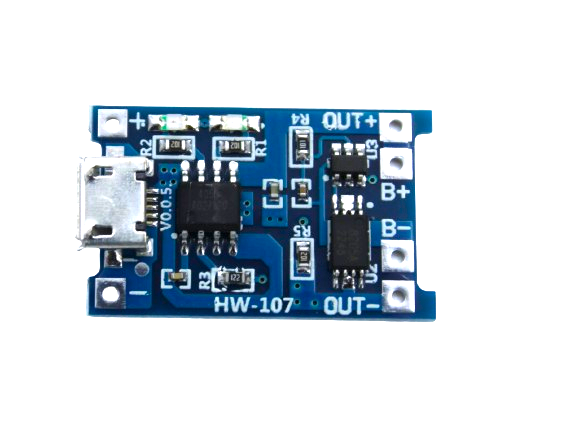
TP4056 1A Li-Ion Battery Charging Board Micro USB with Current Protection
A reliable charging module for your backup energy storage cells. Great for hybrid supercap + Li-Ion UPS designs.
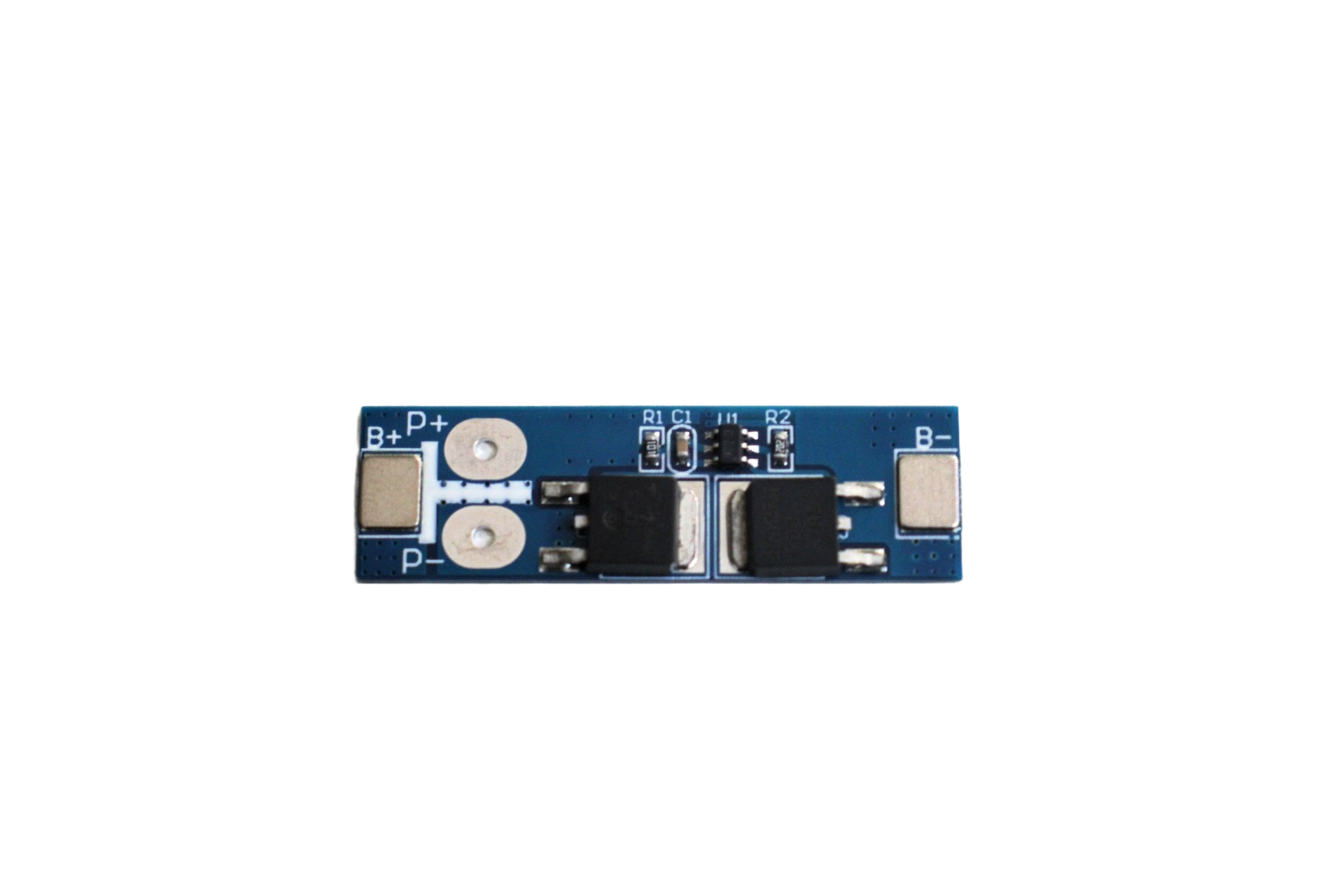
1S 12A 3.6V BMS Battery Protection Board for Li-Ion Cell
Essential protection board for hybrid MCU power backup circuits combining supercapacitors with Li-Ion cells.
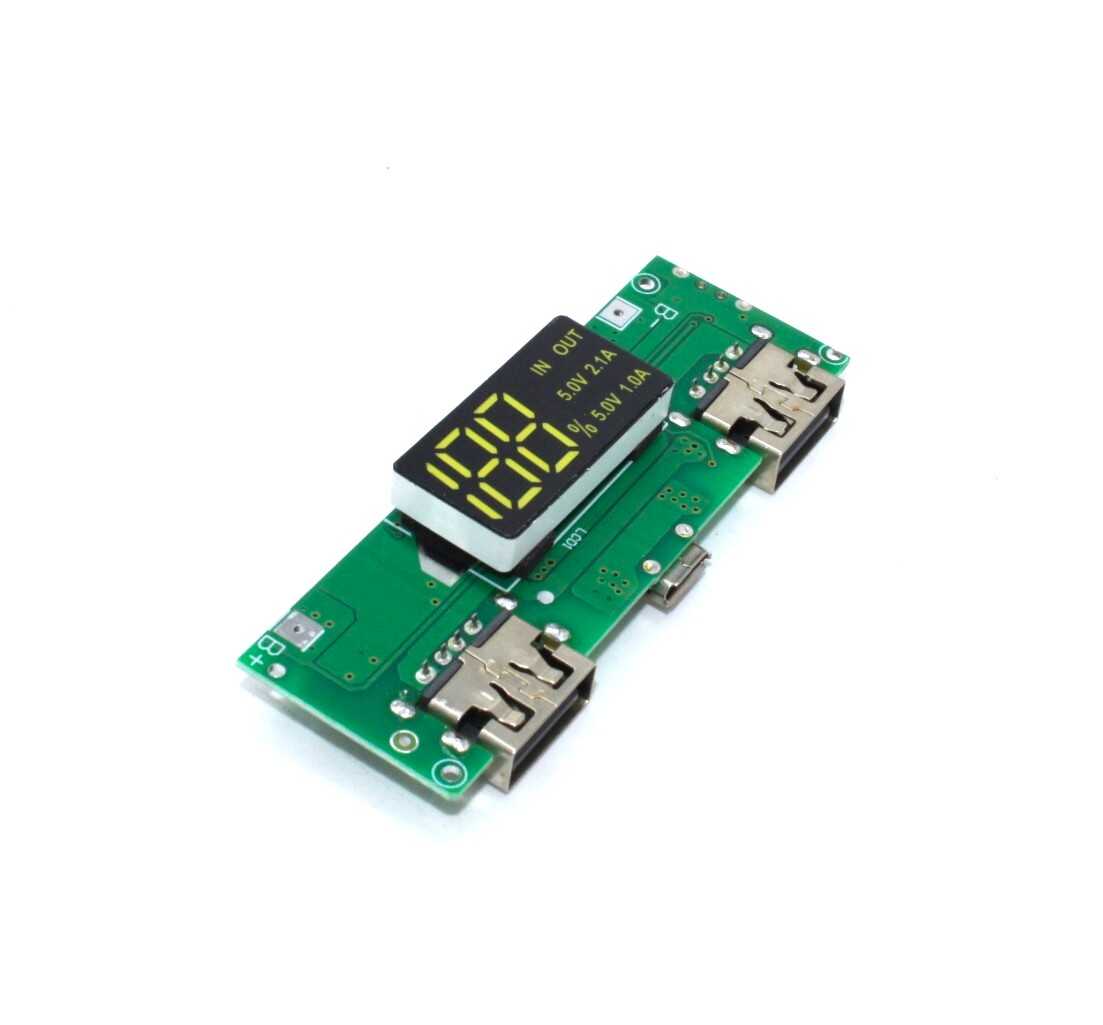
18650 5V 1A/2A Lithium Battery Digital Display Charging Module, Dual USB Output
Perfect for building MCU power banks with display. Use alongside supercapacitors for a robust two-tier backup system.
Practical Tips for Indian Makers
Source Quality Supercapacitors
Cheap Chinese supercapacitors sold on local marketplaces often have wildly overstated capacitance. A cap labelled 100F might measure only 30–50F. Buy from reputable distributors. The ESR also matters enormously — a high-ESR supercap loses most of its energy to internal resistance when discharging at the currents typical MCUs draw during radio transmissions (ESP32 WiFi peak: up to 500mA).
Inrush Current at Startup
A discharged supercap looks like a short circuit at startup. Always include a current-limiting resistor (100Ω–470Ω) or a dedicated supercap charger IC (like the CAP-XX SPC1001 or generic NCP360) to limit inrush current that would otherwise blow your voltage regulator or trip a fuse.
Self-Discharge Consideration
Supercapacitors self-discharge within days to weeks. If your project sits unpowered for extended periods, the supercap won’t provide backup until it’s recharged — which happens within seconds once power is restored, but keep this in mind for field deployments.
Voltage Balancing for Series Configurations
If you need higher voltage (e.g., 12V systems), you’ll need multiple supercaps in series with balancing resistors or active balancing circuits. Without balancing, one cell can be overcharged while another is undercharged, drastically reducing lifespan.
Integration with BMS Modules
For longer holdup times, consider a two-tier backup: supercapacitor for the first few seconds (instant response), followed by a small LiPo with a BMS for extended backup. The supercap absorbs the initial load spike while the battery comes online.
Frequently Asked Questions
Q: Can a supercapacitor completely replace a battery in an MCU project?
A: For most projects, no. Supercapacitors have much lower energy density than batteries. They’re ideal for short-duration backup (seconds to a few minutes) or peak current buffering. For projects needing hours of standalone operation, batteries are still necessary.
Q: What size supercapacitor do I need for ESP32 deep sleep backup?
A: For deep sleep backup, even a 0.1F–1F capacitor can provide hours of standby. The ESP32 draws only 10µA in deep sleep. Use the formula t = C × (V₁ − V₂) / I. For active backup (WiFi transmission), size for at least 1F–10F.
Q: Can I charge a supercapacitor from a USB 5V source?
A: Yes, but always include a current-limiting resistor or a dedicated charger IC. A 5.0V or 5.5V rated supercapacitor can be charged from USB 5V directly. Never exceed the supercapacitor’s voltage rating — overvoltage dramatically reduces lifespan.
Q: Are supercapacitors safe to prototype with on a breadboard?
A: Yes, supercapacitors are much safer than lithium batteries for bench work. There’s no risk of thermal runaway. However, be careful of polarity (they’re polarized) and ensure you don’t exceed the voltage rating. A shorted supercap can deliver very high currents — always include a fuse or current limiter in your circuit.
Q: Where can I buy supercapacitors in India?
A: Supercapacitors are available through online electronics stores. Look for EDLC supercapacitors in the 1F–100F range rated at 5.0V or 5.5V for MCU backup applications. Always verify capacitance and ESR specifications before purchasing.
Get Started with Your Supercap UPS Build
A supercapacitor-based UPS is one of the most rewarding additions to any MCU project. It’s simple to implement, virtually maintenance-free, and solves the real-world problem of power fluctuations that every Indian maker has experienced. Whether you’re building an IoT sensor node that saves data to SPIFFS, a home automation controller that needs graceful shutdown, or an industrial monitoring device that must survive brief power outages, a supercap UPS is your answer.
Start with a 10F, 5.0V supercapacitor and a Schottky diode — the simplest circuit possible — and scale up from there. Explore the power and battery components at Zbotic’s Batteries & Power section to find everything you need for your build.
Happy making!







Add comment