
Table of Contents
- What is a BEC? Understanding Battery Eliminator Circuits
- Linear vs Switching BEC: Which One for Your Drone?
- Power Distribution: From Battery to Every Component
- Power Distribution Boards (PDB) Explained
- Managing Multiple Voltage Rails on a Drone
- Wiring Best Practices for Clean Power
- Noise Filtering and Capacitors
- Common Power System Failures and How to Prevent Them
- Recommended Power Components from Zbotic
- Frequently Asked Questions
The power system is the heart of every drone — and yet it is one of the most misunderstood aspects of drone building, especially for beginners in India who are learning from fragmented online resources. A poorly designed power system causes brownouts mid-flight, servo jitter, FPV video interference, and in worst cases, complete in-flight failures. Get it right and your drone will fly reliably, your FPV image will be clean, and your electronics will last for years.
This guide covers everything from what a BEC actually does to how to wire a complete power distribution system for a multi-rotor drone — with practical advice calibrated for the components and LiPo batteries available in India.
What is a BEC? Understanding Battery Eliminator Circuits
The term BEC stands for Battery Eliminator Circuit. The name dates back to the early days of RC aircraft when receivers and servos required a separate battery pack — the BEC circuit eliminated that need by deriving the 5V supply directly from the main propulsion battery.
On a modern drone, the BEC serves the same essential purpose: it steps down the main LiPo battery voltage (typically 11.1V for 3S, 14.8V for 4S, or 22.2V for 6S) down to the stable lower voltages that your flight controller, receiver, FPV camera, VTX, servos, and other electronics need to operate.
What Happens Without a Proper BEC?
Without a BEC or with an undersized BEC, you will experience:
- Voltage sag: When the motors draw heavy current during throttle-up, battery voltage dips momentarily. If your flight controller shares the same power rail without regulation, it can reset mid-flight.
- Brownouts: The FC loses power briefly, causing a flip or crash.
- Servo jitter: On fixed-wing builds or VTOL drones, unregulated power to servos causes erratic movement.
- FPV noise bars: Dirty power from motor switching noise gets into your FPV camera feed, showing as horizontal noise bars in your video.
- Component damage: Feeding 16V or 25V directly to a 5V component is a guaranteed way to destroy it.
Linear vs Switching BEC: Which One for Your Drone?
There are two fundamentally different technologies used to build BEC circuits. Understanding the difference will help you make the right choice for your specific build.
Linear BEC (LDO Regulator)
A linear regulator works by burning the voltage difference as heat. If your battery is at 12V and you need 5V, the linear regulator dissipates 7V × current as heat.
Advantages:
- Extremely clean, noise-free output voltage — ideal for sensitive electronics like GPS modules and magnetometers
- Very simple circuit, very reliable
- No switching noise (no RF interference)
- Low cost — often integrated directly into ESCs
Disadvantages:
- Very inefficient at high voltage differentials — wastes power as heat
- Limited to low current outputs (typically 0.5A–3A) before thermal management becomes a problem
- Performance degrades as battery discharges (at 10V input, it cannot output 9V for example)
Best for: Flight controller power on small 3S or 4S builds where the FC draws under 1A, GPS receivers, and other noise-sensitive but low-current devices.
Switching BEC (SBEC / DC-DC Buck Converter)
A switching regulator converts voltage using a high-frequency switching transistor, inductor, and capacitors. It is far more efficient — typically 85–95% efficiency versus 40–60% for linear regulators at high voltage differentials.
Advantages:
- High efficiency — less heat, longer flight times
- Can supply 3A–10A or more, supporting multiple peripherals
- Maintains regulated output across the full LiPo discharge range
- Can step down from any input voltage (useful for 6S builds powering 5V devices)
Disadvantages:
- Switching noise at 100–500 kHz can interfere with radio receivers and GPS modules
- More complex circuit, higher cost
- May require filtering capacitors to clean up output for sensitive components
Best for: High-current applications — powering FPV VTX, multiple servos, gimbal controllers, companion computers (Raspberry Pi), and LED systems.
Which BEC Type Do You Need?
On most modern FPV quads, the PDB or 4-in-1 ESC includes a built-in 5V SBEC that powers the flight controller and receiver. A second 9V or 12V SBEC (or the raw battery feed through a filter) powers the VTX. This two-rail approach keeps switching noise away from GPS and magnetometer while efficiently powering everything else.
Power Distribution: From Battery to Every Component
Let us trace the power path from your LiPo battery to every component in a typical 5-inch FPV quad build:
- LiPo Battery (4S, 14.8V nominal, 16.8V full charge) — this is the raw power source. Current capacity is rated in mAh (2000–6000 mAh typical for 5-inch builds).
- Main power wire (12–14 AWG) → XT60 connector → PDB or ESC power pads — thick wires carry the full motor current. Never use thin wires here.
- 4-in-1 ESC or individual ESCs — take battery voltage directly and output 3-phase AC to motors. The ESC also typically includes a 5V BEC output.
- 5V BEC output → Flight Controller (FC) — the FC controls everything. Needs clean, stable 5V at 0.5–2A typically.
- FC → Receiver — most FCs have a 5V output pin for the receiver (from the same BEC supply). Keep receiver power draw in mind — ELRS and similar DSM receivers draw 50–150 mA.
- Separate 9V or 12V rail → VTX — video transmitters work better on a stable 9–12V supply rather than directly from the battery, which sags during flight.
- FPV camera → 5V or 12V depending on camera — mini CMOS cameras typically run on 5V or 12V. Check your camera’s specs carefully.
Current Flow and Wire Sizing
The most common mistake beginners make is using the same thin wire everywhere. Here are the AWG guidelines for drone builds:
- 10–12 AWG: Main battery leads from XT60/XT90 to PDB on 6S builds, or heavy-lift quads
- 14 AWG: Main battery leads for 4S 5-inch builds
- 16–18 AWG: ESC power inputs on most 4S setups
- 20–22 AWG: Motor phase wires
- 24–26 AWG: Signal wires (FC to ESC, receiver to FC, telemetry)
- 28–30 AWG: Low-current sensor and LED power

100A Multirotor ESC Power Distribution Board
A dedicated PDB rated for 100A continuous — distributes battery power cleanly to 4 ESCs and includes onboard BEC outputs for FC and peripheral power on your quadcopter build.
Power Distribution Boards (PDB) Explained
A Power Distribution Board is a PCB that connects the battery to all four (or more) ESCs through thick copper traces, eliminating the need for a messy solder-together harness. Modern PDBs for drones do much more than simple distribution:
What a Good PDB Includes
- ESC solder pads: Large, clearly labelled pads for each ESC’s power and ground leads
- Onboard BECs: Typically a 5V and sometimes a 12V regulated output
- Current sensor: A shunt resistor and amplifier circuit that measures total current draw, reported to the FC for battery monitoring in the OSD
- Voltage divider: Lets the FC read battery voltage for the OSD and low-battery warnings
- Capacitor bank: Bulk capacitance across the main power input to suppress voltage spikes from ESC switching
- LED indicator pads: Easy wiring for LED strips
Integrated ESC + PDB (4-in-1 ESC)
Modern 5-inch FPV builds almost always use a 4-in-1 ESC — a single PCB that combines all four ESC circuits, a PDB, a BEC, and often a current sensor into one compact unit. This is the cleanest solution for mini quads and reduces wiring dramatically.

35A V2.1 2-5S 4-in-1 Brushless ESC for FPV Racing
An integrated 4-in-1 ESC with onboard power distribution, 5V BEC, and 35A per channel rating — the all-in-one power management solution for 5-inch FPV racing builds.
Managing Multiple Voltage Rails on a Drone
A fully equipped drone might need three or four different voltage rails simultaneously. Here is how to manage them cleanly:
Common Voltage Requirements
| Component | Typical Voltage | Typical Current |
|---|---|---|
| Flight Controller | 5V | 200–500 mA |
| RC Receiver (ELRS/FrSky) | 5V | 50–150 mA |
| FPV Camera (mini) | 5V or 12V | 100–300 mA |
| VTX (25–1000mW) | 9V or 12V | 300–1000 mA |
| GPS Module | 5V (3.3V LDO internal) | 30–100 mA |
| LED Strip | 5V or 12V | 200–1000 mA |
| Companion Computer | 5V | 1–3 A |
The Two-BEC Approach
For a clean, reliable power system on a 5-inch FPV quad:
- BEC 1 (5V, 2–3A SBEC): Powers FC, receiver, GPS, buzzer, camera
- BEC 2 (9V or 12V, 1–2A SBEC): Powers VTX only (isolated from digital noise)
This separation ensures that motor switching noise travelling up through the ESC’s internal 5V rail does not contaminate the VTX power supply and create video noise bars.
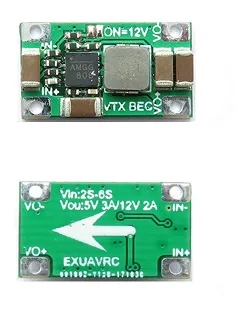
2-6S 5V 5A BEC For Quadcopter Drone
A standalone switching BEC rated for 2S–6S input and 5V 5A output — perfect for powering flight controllers, GPS, receivers, and cameras with a clean, regulated 5V supply.
Wiring Best Practices for Clean Power
Wiring quality separates crash-prone builds from reliable ones. Here are the most important practices:
Keep High-Current and Signal Wires Separated
Route your main battery leads and ESC power wires on one side of the frame. Route signal wires (FC to ESC, receiver, GPS, telemetry) on the opposite side or at least 10–15 mm away from motor phase wires. High-frequency switching currents in motor wires induce noise in nearby signal wires.
Twist Motor Phase Wires
Twist each motor’s three phase wires together (like a braid) along their length. This reduces their electromagnetic radiation significantly. Even a loose twist every 2–3 cm makes a measurable difference in gyro noise.
Solder, Don’t Use Screw Terminals
For any connection carrying more than 500 mA, solder is mandatory. Screw terminals oxidise over time, especially in India’s humid coastal regions (Mumbai, Chennai, Kolkata, Kochi). A corroded screw terminal can have 0.5–2Ω resistance, causing voltage drop and heat at full current draw.
Secure All Wires with Zip Ties and Heat Shrink
Vibration fatigues wire insulation and can eventually cause shorts. Secure wires at 3–5 cm intervals for high-current runs, use heat shrink over all bare solder joints, and use cable management to prevent wires from contacting the frame or propellers.
Use Quality Connectors
In India, counterfeit XT60 connectors are rampant on marketplaces. Buy connectors from verified sellers. Low-quality XT60 clones have thinner contact plating and fail under repeated high-current cycles — they get hot, the plastic softens, and they can cause in-flight connector failures. Genuine Amass XT60 connectors are worth the extra ₹50–₹100.
Noise Filtering and Capacitors
ESC commutation generates high-frequency voltage spikes on the power rail. Without filtering, these spikes cause gyro noise in your FC (making PID tuning harder), video noise bars in FPV feeds, and can even cause ESC overcurrent faults.
Bulk Capacitors on the Main Rail
Add a 470µF–1000µF electrolytic capacitor rated for at least 35V (for 4S builds) or 63V (for 6S builds) directly across the main battery pad on your PDB or 4-in-1 ESC. This capacitor absorbs spike energy and smooths the voltage rail. It is the single most effective noise reduction measure for FPV video quality.
In India, quality capacitors are available from Robu.in, Evelta Electronics, or any local electronics market (SP Road in Bengaluru, Lamington Road in Mumbai, Palika Bazaar in Delhi). A 1000µF 35V Nichicon or Panasonic capacitor costs ₹20–₹50 and is worth every paisa.
LC Filter for VTX Power
For extremely clean VTX power, use a dedicated LC filter (inductor + capacitor) between your 12V BEC output and the VTX input. Pre-made LC filters designed for FPV VTX use are available from Zbotic and other RC hobby suppliers.
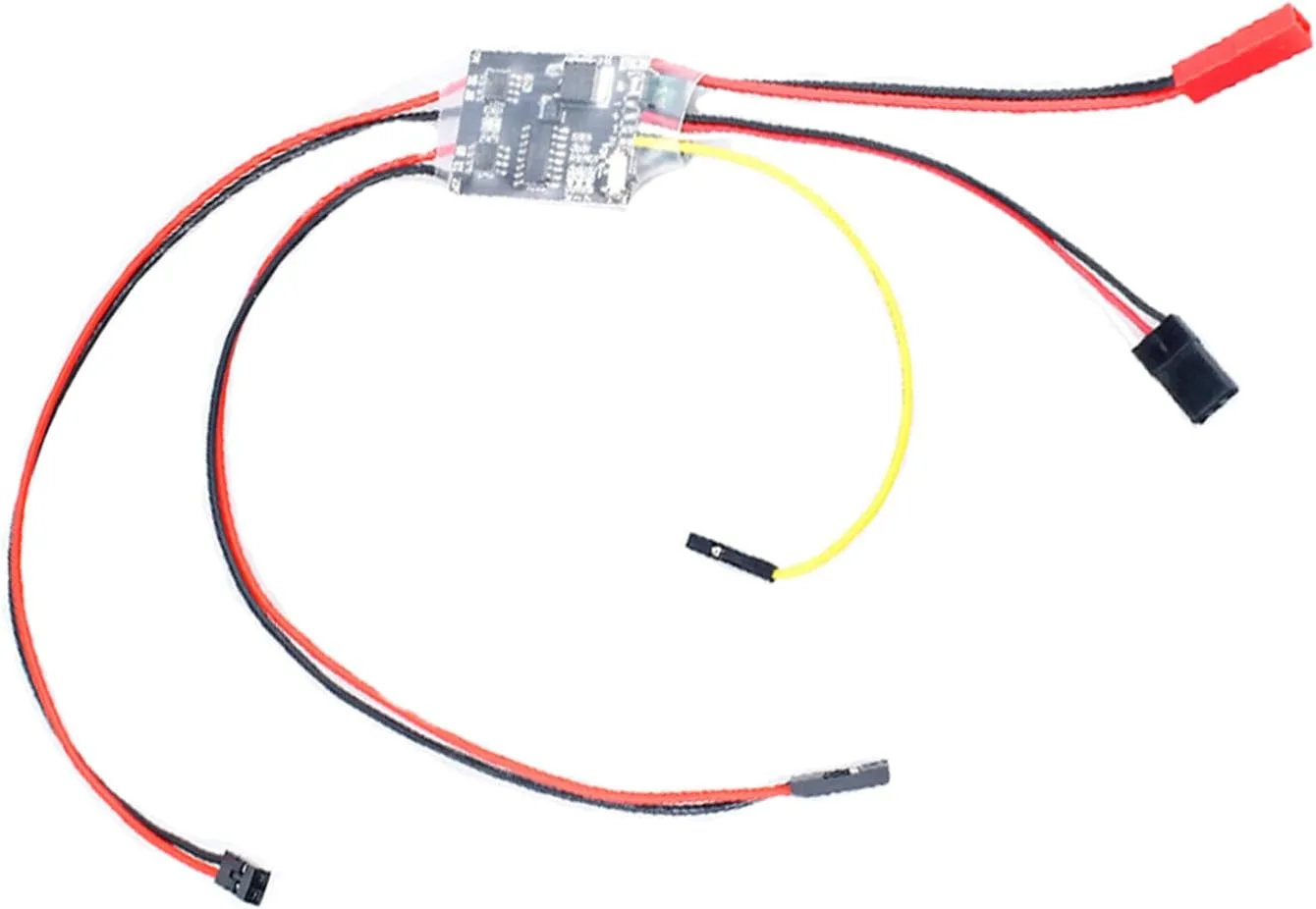
2S-6S 2Ax2 Dual Way Brushed ESC Bidirectional
A compact bidirectional brushed ESC with 2S–6S battery compatibility — useful for small payload-carrying drones and custom builds with brushed auxiliary motors.
Common Power System Failures and How to Prevent Them
BEC Failure Causing FC Brownout
Symptoms: Drone flips or falls from the sky suddenly. FC log shows voltage drop or reboot mid-flight.
Cause: BEC overloaded (too many devices drawing current), BEC overheated, or cheap BEC failed.
Prevention: Calculate total current draw of all BEC-powered devices and choose a BEC rated for 150% of that figure. Ensure adequate airflow over the BEC. Use quality BECs from reputable brands.
Voltage Sag Causing Motors to Cut Out
Symptoms: Motor hesitation or cut-out under hard throttle, OSD shows voltage dropping below 3.3V per cell under load.
Cause: Battery’s C rating is too low for the demand, or battery is old and has high internal resistance.
Prevention: Use batteries rated for at least 20–25C at the maximum current draw of your build. Replace batteries showing IR (internal resistance) above 10–15 mΩ per cell.
Video Noise Bars
Symptoms: Horizontal black or white bars scrolling through FPV feed, especially under throttle.
Cause: Motor switching noise coupling into VTX power supply.
Prevention: Isolate VTX power with a dedicated SBEC + LC filter. Add a 470µF capacitor on the main power rail. Keep VTX power wires away from motor phase wires.
Hot XT60 Connectors
Symptoms: Connector feels warm or hot after flights. Plastic may deform.
Cause: Counterfeit connector with thin plating, contact resistance too high.
Prevention: Use genuine Amass connectors. If a connector gets warm, replace it immediately — a hot connector under full throttle can melt and cause an in-flight power interruption.
Recommended Power Components from Zbotic

30A Brushed ESC No Brake
A 30A brushed motor ESC with no-brake configuration — commonly used for auxiliary payload release mechanisms, pan-tilt systems, and micro-drone builds.

110cm Fast-Fold Landing Pad for RC Drone
A 110cm portable landing pad for safe takeoff and landing — protect your drone and its power system electronics from dust, water, and debris during field operations.
Frequently Asked Questions
Can I power my flight controller directly from the LiPo battery without a BEC?
No. Modern flight controllers are rated for 5V input. Connecting a 3S (12.6V) or 4S (16.8V) battery directly will instantly destroy the FC. Always use a BEC or choose an FC with a built-in 5V regulator and connect it through the recommended voltage input pad.
My VTX has video noise bars only under throttle — is my BEC bad?
Not necessarily the BEC itself — it is almost certainly power line noise from motor switching. Add a 470µF–1000µF capacitor directly across the battery pad of your ESC, and if possible, power your VTX from a dedicated 9V or 12V BEC isolated from the main ESC power chain.
What BEC rating do I need for a 6S long-range build with GPS, VTX, companion computer, and LEDs?
Add up all peripheral current requirements: FC (500 mA) + receiver (100 mA) + GPS (80 mA) + companion computer (1000 mA) + LEDs (500 mA) = 2.18A minimum. Use a 5V 3A SBEC for this rail minimum, ideally a 5A unit for headroom. Power the VTX separately from a 12V 1A SBEC.
Is it safe to use the BEC built into my ESC to power everything?
For simple builds (FC + receiver + FPV camera) the integrated 5V/2A BEC in most 4-in-1 ESCs is adequate. If you are adding GPS, companion computer, or high-power LEDs, add a separate standalone BEC. Never push an onboard BEC past its rated current — it will overheat and fail, taking your FC and flight with it.
Why does my drone FC keep rebooting in flight?
The most common cause is a BEC brownout. The FC loses power momentarily during hard throttle punches when the battery voltage sags and the BEC cannot maintain output voltage. Solutions: add bulk capacitance on the main power rail, use a higher-quality BEC, check for loose power connections, and ensure your battery has adequate C rating for your build’s power demands.
Conclusion
A well-designed power distribution system is invisible — everything just works, flights are clean, and video is noise-free. A poorly designed one makes every flight a gamble. Take the time to calculate your current requirements, choose the right BEC for each rail, use quality connectors and wire gauges, and add proper capacitor filtering. Your drone will be safer, more reliable, and a joy to fly. The components to get it right are all available at Zbotic.


Add comment