
Table of Contents
- Why Lithium Cells Need Balancing
- Passive vs Active Balancing — Which Should You Use?
- How a Passive Balancer Circuit Works
- Building a Simple Passive Balancer for 3S Packs
- BMS Boards with Built-In Balancing
- When to Balance and How Often
- Recommended Products
- FAQ
If you have ever seen a multi-cell lithium pack get weaker and weaker despite seeming to charge fully, cell imbalance is almost certainly the culprit. A battery equalizer circuit that passively balances lithium cells solves this problem with no microcontroller, no firmware, and no moving parts. Whether you are maintaining a DIY e-bike battery, a solar storage pack, or a multi-cell FPV battery, this guide explains exactly how passive cell balancing works and how to build or buy the right equalizer for your project.
Why Lithium Cells Need Balancing
Individual lithium cells in a series pack are never perfectly identical. Even cells from the same batch have slightly different internal resistance, self-discharge rates, and capacity. Over time — and especially under repeated charge-discharge cycles — these small differences compound into significant voltage imbalance:
- The weakest cell (highest internal resistance, lowest capacity) reaches full charge voltage (4.2V) first during charging. The charger or BMS cuts off total voltage at the pack level, but the other cells in the series string are still below full charge.
- During discharge, the weakest cell hits the cutoff voltage (2.5-3.0V) first, cutting off the pack even though stronger cells still have significant charge remaining.
- Result: effective pack capacity shrinks steadily with each cycle.
Balancing redistributes charge among cells so they all reach the same voltage simultaneously — maximising both charge acceptance and discharge depth.
Passive vs Active Balancing — Which Should You Use?
There are two fundamental approaches to cell balancing:
| Feature | Passive Balancing | Active Balancing |
|---|---|---|
| How it works | Burns excess charge as heat via resistors | Transfers charge from high cells to low cells |
| Efficiency | Lower (energy wasted as heat) | Higher (85-95% transfer efficiency) |
| Circuit complexity | Simple — resistors and MOSFETs | Complex — inductors, capacitors, ICs |
| Cost | Very low | Moderate to high |
| Best for | Small packs, low imbalance maintenance | Large packs with significant imbalance |
For DIY projects with 2S-6S lithium packs, passive balancing is the practical choice. The energy wasted as heat is small relative to pack capacity, the circuit is easy to build or buy, and it requires zero maintenance once integrated into a BMS.
How a Passive Balancer Circuit Works
A passive balancer monitors individual cell voltages and, when a cell rises above a threshold (typically 4.15-4.20V), connects a resistive bleed path across that cell to drain excess charge as heat. The basic building blocks are:
- Voltage comparator or shunt regulator (e.g. TL431): Detects when a cell exceeds the balance threshold voltage.
- MOSFET or BJT switch: Activates the bleed resistor when triggered by the comparator.
- Bleed resistor: Converts excess charge to heat at a controlled rate (typically 50-200 mA balance current).
- Indicator LED (optional): Shows when balancing is active on a given cell.
In a 3S pack, you have one such circuit per cell — three total. All three circuits share only the ground reference of their respective cell tap. The most common integrated implementation is the CB3S or similar balancer IC which integrates the comparator and drive circuit in a single small package.
Balance current is intentionally kept low (50-300 mA) to avoid excessive heat generation. This means passive balancers work best for maintenance balancing — keeping a well-matched pack in sync — rather than correcting large imbalances (1V+ between cells). For large imbalances, you need to manually charge cells individually first, then rely on the balancer for maintenance.
Building a Simple Passive Balancer for a 3S Pack
Here is a practical passive balancer design using TL431 shunt regulators. This is one of the most widely used reference designs in DIY battery packs.
Components per cell
- 1x TL431 adjustable shunt regulator (TO-92 or SOT-23)
- 2x resistors for the voltage divider (calculated for 4.15V threshold)
- 1x 10-15 ohm bleed resistor (0.5W minimum)
- 1x small signal MOSFET (2N7002 or similar, for MOSFET-augmented version)
Voltage divider calculation
The TL431 reference voltage is 2.5V. The divider must produce 2.5V at the REF pin when Vcell = 4.15V. Using R1 and R2: R1/R2 = (Vcell/Vref) – 1 = (4.15/2.5) – 1 = 0.66. A practical pair: R1 = 6.8k, R2 = 10k gives a threshold of approximately 4.15V. Fine-tune by replacing R1 with a 10k trimmer.
Assembly
- Connect the TL431 cathode to cell positive, anode to cell negative.
- Connect the divider (R1+R2) between cell positive and negative, with the midpoint to TL431 REF pin.
- Connect the bleed resistor in series with the TL431 cathode-to-anode path to limit current.
- Repeat for each cell in the series string, referencing each circuit to its respective cell taps.
When Vcell rises above 4.15V, the TL431 conducts, current flows through the bleed resistor, and the cell bleeds down at ~100-150 mA until it falls below threshold. Simple, reliable, and zero software required.
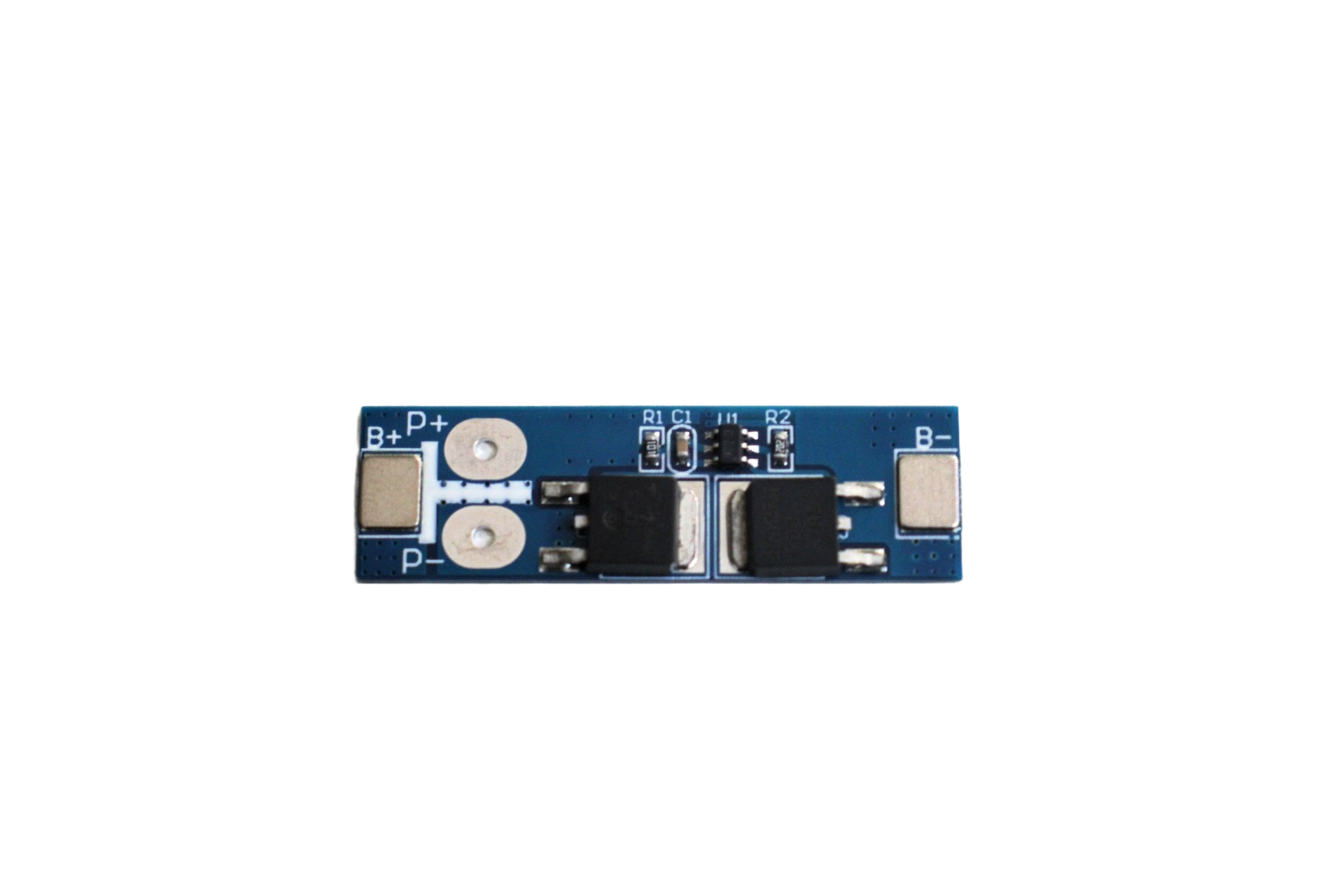
1S 12A 3.6V BMS Battery Protection Board for Li-ion
Single-cell BMS with overcharge, over-discharge, and short circuit protection. Use one per cell in a custom passive balancer build for per-cell protection plus balancing.
BMS Boards with Built-In Balancing
For most maker projects, the easiest path to passive balancing is to use a multi-cell BMS board that integrates both protection and balancing circuitry. These boards handle overcharge cutoff, over-discharge cutoff, short circuit protection, and cell balancing — all in one compact module.
When choosing a BMS with balancing:
- Check for balancing notation: Look for “with balance” or the letters “B” in the spec (e.g. “3S 20A BMS with balance”). Not all BMS boards include balancing — many are protection-only.
- Verify balance current: Higher balance current (100-200 mA) corrects imbalance faster, at the cost of slightly more heat.
- Match cell count: A 3S BMS for a 3-cell 11.1V pack; a 4S BMS for a 14.8V pack, etc.
- Rated continuous current: Must exceed your maximum discharge current. Size up by at least 20%.

1S 18650 Li-ion BMS Charger Protection Board 3.7V
Protection board for single 18650 cells with charge and discharge control. Stack multiple units to build a monitored multi-cell passive balancing pack.
When to Balance and How Often
For a well-matched, lightly used pack, balancing once every 10-20 cycles is sufficient. Indicators that you need to balance sooner:
- Pack capacity has noticeably decreased even though all cells appear healthy individually
- One cell consistently hits cutoff before the others during discharge
- Cell voltages at rest show more than 0.05V spread across the pack
- Charger terminates early (full pack voltage reached but individual cells are not all full)
For packs with passive balancers integrated into the BMS, balancing happens automatically during every top-of-charge phase. You simply charge the pack fully and the balancer engages during the constant-voltage (CV) phase when charge current has tapered to low levels. Leave the pack on the charger for an extra 30-60 minutes after the charger LED turns green to allow balancing to complete.
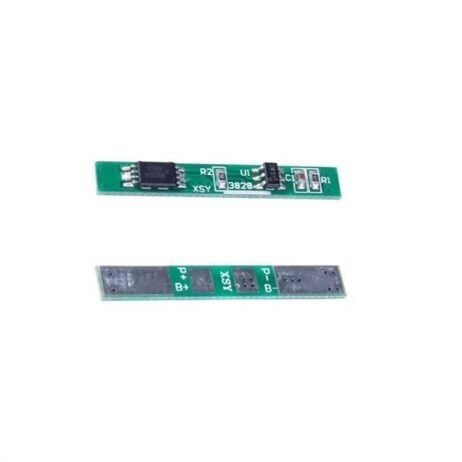
1S 3.7V 2A 1MOS BMS Li-ion 18650 Protection Board
Compact single-cell protection board with 2A rating. Ideal as the per-cell protection layer in a custom multi-cell passive balancer pack build.
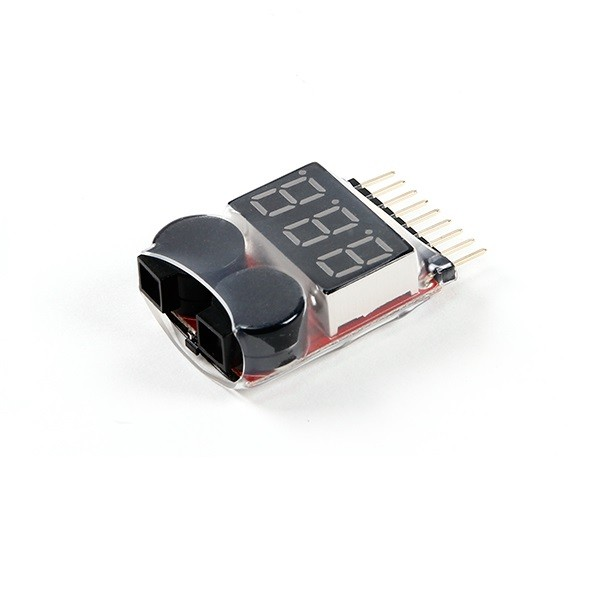
1-8S LiPo Battery Voltage Tester
Read per-cell voltages across your entire pack instantly. Invaluable for diagnosing cell imbalance before and after running your passive balancer circuit.
Frequently Asked Questions
Can I use a passive balancer on any lithium chemistry?
Passive balancers work across Li-ion, LiPo, and LiHV chemistries as long as the balance threshold is set to the correct full-charge voltage for that chemistry. LiFePO4 packs have a different voltage profile (3.65V full charge) and require a balancer set specifically for that chemistry.
How much heat does a passive balancer generate?
At 100 mA balance current with a 10-ohm bleed resistor, power dissipated per cell is P = I squared times R = 0.01 times 10 = 0.1W per cell. For a 4S pack that is 0.4W total — negligible. At 300 mA balance current, it rises to 0.9W per cell which may require small heatsinks in enclosed builds.
Will a passive balancer drain my battery when not charging?
Properly designed passive balancers only activate when cell voltage is above the balance threshold (typically 4.10-4.15V). At normal pack voltage (3.7-3.8V/cell at rest), the shunt regulator is off and quiescent current is typically below 10 microamps per cell. This is not a concern for normal storage.
Can passive balancing fix badly mismatched cells?
Not efficiently. If one cell has 500 mAh less capacity than the others, passive balancing cannot compensate for that capacity difference — it can only equalise voltage. The weak cell will always limit the pack. Replace mismatched cells rather than relying solely on balancing.
Does a BMS always include balancing?
No. Many inexpensive BMS boards provide protection only (overcharge, over-discharge, short circuit) without any balancing circuitry. Always verify the datasheet or product listing states “with balance” before assuming balancing is included.
Balance Your Pack, Extend Your Battery’s Life
A battery equalizer circuit for passively balancing lithium cells is one of the best investments you can make in a multi-cell DIY battery pack. Whether you solder your own TL431-based circuit or drop in a BMS board with built-in balancing, the result is longer pack life, more consistent capacity, and safer operation. Explore Zbotic’s range of BMS boards, protection modules, and voltage testers to build a complete, well-balanced battery solution for your next project.





Add comment