
Choosing the right drive motor is one of the most consequential decisions you will make when building a robot chassis. Pick a motor that is too weak and the robot stalls on carpet or a slight incline. Pick one that is too fast and the chassis becomes uncontrollable at low PWM duty cycles. Pick one that is physically too large and it will not fit inside your compact enclosure.
Three motor types dominate the hobbyist and student robotics scene in India: the BO motor (Battery-Operated gear motor), the TT motor (also called a yellow gear motor or smart car motor), and the tiny N20 micro gear motor. All three are brushed DC motors with an integral gearbox, yet they serve very different roles. This guide breaks down every relevant difference so you can choose with confidence.
1. What Are BO, TT, and N20 Motors?
BO Motor (Battery-Operated Gear Motor)
The BO motor is a straight-shaft DC gear motor that became popular in Indian school robotics kits. It is powered by a single 1.5 V AA battery cell — hence “battery operated” — but works perfectly well at 3–6 V from a Li-ion or AA pack. The plastic gearbox mounts directly to a wheel, and the flat rectangular body makes mechanical integration simple. Stall current is low (typically 300–500 mA at 6 V), making it safe for L293D and L298N based driver boards.
TT Motor (Yellow Gear Motor)
The TT motor — named after the shape of the letter T when viewed from the side — is arguably the most widely used DIY robot motor globally. It powers the ubiquitous yellow 2WD and 4WD smart car chassis kits. The motor operates from 3–12 V, delivers moderate torque, and has a double-sided shaft design (the worm shaft protrudes both toward the wheel and the opposite side). It uses a plastic shell with a metal output shaft and runs at roughly 200 RPM at 5 V with a 1:48 gear ratio.
N20 Micro Gear Motor
The N20 is a miniature metal gear motor whose body is approximately 12 mm wide and 10 mm tall — smaller than a AA battery. Despite its tiny size, the all-metal gearbox handles surprisingly high loads, and the gear ratio can be specified when ordering (from 1:10 up to 1:1000 in some variants). Operating voltage ranges from 3–12 V. The N20 is the go-to motor for compact robots, robotic hands, camera sliders, and any project where every gram and millimetre counts.
2. Physical Size & Mounting
| Property | BO Motor | TT Motor | N20 Motor |
|---|---|---|---|
| Body Length | ~70 mm | ~70 mm | ~28–32 mm (with gearbox) |
| Body Width/Diameter | ~20 mm | ~22 mm | ~10 mm diameter |
| Output Shaft Diameter | D-shaft ~3 mm | D-shaft ~4 mm | D-shaft ~3 mm |
| Gearbox Material | Plastic | Plastic | Metal (brass gears) |
| Wheel Compatibility | 65–70 mm BO wheels | 65 mm TT wheels | Custom hub or press-fit |
| Chassis Mounting | Clip / bracket | Screw holes on chassis | M2/M3 bracket required |
The TT motor integrates cleanly with the standard 2WD/4WD acrylic chassis plates that are widely sold in India. BO motors clip into their own chassis format. N20 motors require a custom 3D-printed or CNC bracket and a small press-fit or hub-adapter wheel — this adds design effort but enables highly compact robots.
3. Electrical Specifications Compared
Motor selection should always begin with the electrical envelope. You need to know the supply voltage your battery provides, the stall current at that voltage, and the no-load speed. Here is a consolidated comparison:
| Parameter | BO Motor | TT Motor | N20 Motor |
|---|---|---|---|
| Operating Voltage | 1.5–6 V | 3–12 V | 3–12 V |
| Typical Operating Voltage | 4.5–5 V | 6–9 V | 6–9 V |
| No-load Current | 50–150 mA | 100–200 mA | 20–80 mA |
| Stall Current | 300–500 mA | 500–800 mA | 200–600 mA (gear ratio dependent) |
| Typical No-load Speed | 150–200 RPM @ 6 V | 150–250 RPM @ 6 V | 50–1500 RPM (ratio-dependent) |
| Stall Torque | 0.4–0.8 kg·cm | 0.8–1.5 kg·cm | 0.5–4 kg·cm (ratio-dependent) |
4. Torque, Speed, and Gear Ratios
All three motors trade speed for torque through their gearbox. The key insight is that N20 motors offer the widest range of gear ratios, often in the same physical shell. This means the N20 can be tuned for high speed (1:10 ratio, ~1500 RPM at 6 V) or extremely high torque (1:1000 ratio, ~15 RPM at 6 V).
BO Motor Gear Ratio
BO motors typically come in a fixed 1:48 or 1:120 gear ratio with no user-selectable options at point of sale. The 1:48 version at 6 V gives roughly 150–200 RPM — ideal for a compact floor-running robot needing moderate speed. They are not well-suited for heavy loads because the plastic gears strip under sustained stall.
TT Motor Gear Ratio
Standard TT motors are sold at 1:48 gear ratio. At 6 V this yields approximately 200 RPM at the wheel. Some vendors also sell 1:120 versions for slower, higher-torque applications. The double-sided shaft is a distinct advantage: encoders can be attached to the rear shaft while the wheel rides on the front shaft — enabling closed-loop speed control.
N20 Gear Ratios and Their Uses
When ordering N20 motors, always specify the gear ratio. Common options include:
- 1:10 to 1:30 — High-speed applications (line followers, fast rovers)
- 1:50 to 1:150 — Balanced speed and torque for most chassis
- 1:200 to 1:300 — Slow, high-torque (robotic arms, camera sliders)
- 1:500 to 1:1000 — Very high torque, very low speed (positioning stages)
5. Which Motor for Which Robot?
Line Follower Robots
Line followers need responsive speed control, moderate torque, and lightweight construction. BO motors are the traditional choice because they work directly with AA battery packs common in school kits. TT motors at 6 V with PWM speed control also work excellently. N20 motors at 1:30–1:50 ratios give superior speed precision and suit competitive line follower bots.
2WD and 4WD Smart Car Chassis
TT motors are essentially designed for this use case. The standard smart-car chassis has pre-drilled mounting holes that match TT motor dimensions exactly. Use 6–9 V for reasonable speed and torque on flat surfaces. For 4WD, ensure your motor driver can handle four motors simultaneously.
Sumo Robots (Minisumo / Antweight)
Sumo robots demand maximum torque in minimum space. N20 motors at 1:100 to 1:300 ratios are almost universally chosen by competitive sumo builders. Their all-metal gearbox survives the repeated impacts of pushing matches, unlike the plastic gears in BO or TT motors.
Maze Solving Robots
Maze solvers need accurate speed matching between left and right motors. TT motors with encoders (using the rear shaft) or N20 motors with Hall effect encoders are ideal. The encoder feedback allows PID-based speed correction that keeps the robot driving straight.
Heavy Payload Robots (3–5 kg)
For robots carrying significant payloads, none of these three motors alone is ideal — you would move to 25GA-370 or similar metal-shaft gear motors. However, if you must use one of the three, choose N20 at high gear ratio (1:300+) or multiple parallel TT motors with a common axle.
Robotic Arms and Micro-Actuators
N20 motors are the only viable choice here. The compact size, metal gearbox, and high torque-to-weight ratio make them uniquely suited for robotic finger joints, pan-tilt camera heads, and desktop CNC tool changers.
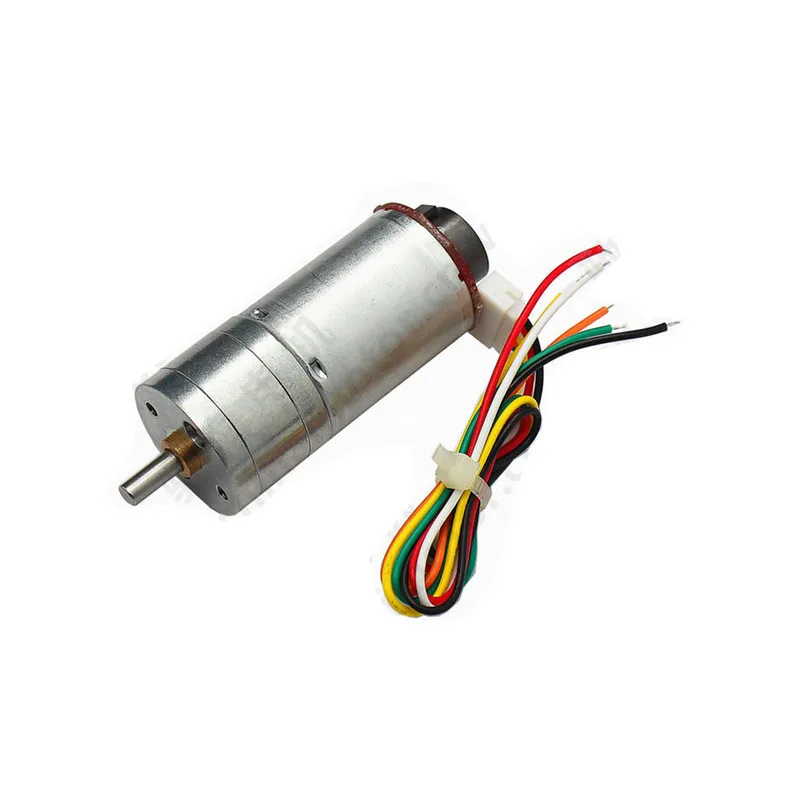
25GA-370 12V 12RPM DC Reducer Gear Motor with Encoder
When your robot needs more torque than BO/TT/N20 motors can provide, this 25GA metal-shaft gear motor with built-in encoder delivers closed-loop control for heavy-payload chassis builds.
6. Motor Driver Compatibility
Motor driver selection must be matched to the motor’s stall current and operating voltage. Here is a quick compatibility guide:
L293D Motor Driver IC
The L293D handles 600 mA per channel (1.2 A peak). It is compatible with BO and N20 motors at low gear ratios. It will thermally limit under sustained load with TT motors — a heatsink is mandatory. Many Arduino shields use the L293D.
L298N Motor Driver Module
The L298N handles 2 A per channel (3 A peak). It comfortably drives two TT motors or four N20 motors. The voltage drop across the L298N (roughly 1.5–2 V due to internal transistors) means you need at least 7.5 V input for 6 V motor operation. It is the most popular choice for TT-motor 2WD chassis.
TB6612FNG Motor Driver
The TB6612FNG handles 1.2 A per channel (3.2 A peak) with a much lower voltage drop (about 0.5 V). It is more efficient than the L298N and works excellently with all three motor types. Preferred for battery-powered designs where efficiency matters.
DRV8833 / DRV8835 Drivers
These tiny ICs (available in small breakout boards) handle 1.5–1.8 A per channel. They are ideal for N20-powered miniature robots where board space is limited.
7. Wiring & Mounting Tips
BO Motor Wiring
BO motors ship with bare wire leads. Tin the leads with solder and connect directly to your driver board terminals. Polarity reversal simply reverses the rotation direction. There is no internal protection diode — always add flyback diodes at the driver or use a driver module that includes them.
TT Motor Wiring
TT motors also have bare leads. The double-sided shaft is excellent for adding a slotted disk encoder or a magnetic encoder for speed measurement. Mount the motor into the chassis plate’s slot and use the provided plastic clips or M2 screws.
N20 Motor Mounting
N20 motors require a bracket. Two common options exist: a small L-shaped sheet metal bracket (sold separately) or a 3D-printed mount. The output shaft usually has a D-flat that accepts M3 set-screw hubs. Ensure the motor body is clamped firmly — the torque will rotate the motor body if only the shaft is constrained.
Preventing Gear Strippage (BO and TT)
- Never stall a plastic-gearbox motor for more than 2–3 seconds
- Use PWM at 20–25 kHz to prevent audible buzzing and reduce gear wear
- Add current limiting in software: if stall current is detected for >500 ms, cut power
- Use polarity protection diodes (1N4007 or Schottky) between the supply and motor driver

A4988 Stepper Motor Driver Controller Board – RED
When your project upgrades from DC gear motors to stepper motors for precise positioning, the A4988 driver handles up to 2 A and is compatible with NEMA14/17 steppers.
8. Cost & Availability in India
All three motor types are readily available from Indian electronics suppliers. Approximate pricing (as of early 2026):
- BO Motor: ₹30–60 per motor. Widely stocked in robotics kit bundles.
- TT Motor: ₹40–80 per motor. Available individually or in 4-packs with chassis.
- N20 Motor: ₹80–220 per motor depending on gear ratio and with/without encoder. Higher cost reflects metal gearbox quality.
For competition robots where reliability is critical, the N20’s metal gearbox justifies the premium cost. For school projects and prototypes where budget matters most, BO or TT motors are perfectly adequate.
Quick Selection Summary
| Use Case | Best Motor | Why |
|---|---|---|
| School robotics kit | BO Motor | Lowest cost, AA battery ready |
| 2WD smart car | TT Motor | Chassis-matched fit, rear encoder shaft |
| Competitive line follower | N20 (1:30–1:50) | Precise speed, compact, metal gears |
| Minisumo robot | N20 (1:100–1:300) | High torque density, durable gears |
| Maze solver with encoder | TT Motor + encoder | Accessible encoder shaft, good torque |
| Robotic arm joint | N20 (1:200+) | Metal gears, high torque-to-size ratio |

25GA-370 12V 12RPM DC Reducer Gear Motor
For robots that need more grunt than BO/TT/N20 motors — this 25GA gear motor delivers high torque with a metal shaft and is perfect for medium-weight chassis builds.
Frequently Asked Questions
Can I use a BO motor with an Arduino directly?
No. Arduino digital pins can supply only 40 mA, far below even the no-load current of a BO motor. You must always use a motor driver IC or module between the Arduino and any DC motor, regardless of size.
What wheel size fits a TT motor?
Standard TT motors accept 65 mm diameter wheels with a 3–4 mm D-shaft bore. These wheels are sold widely with the yellow smart-car chassis kits. Larger wheels (80–100 mm) can be fitted using a hub adapter but check ground clearance against your chassis plate.
Is the N20 motor waterproof?
Standard N20 motors are not waterproof. Sealed (IP65) variants exist but are harder to source and more expensive. For wet environments consider enclosing the motor or using a sealed gear motor designed for that purpose.
How do I reverse a DC gear motor?
Simply swap the polarity of the supply voltage to the motor terminals. In practice, your motor driver handles this in software — set the direction pin HIGH or LOW on an H-bridge driver like the L298N.
Can I run TT motors at 12V?
Many TT motors are rated up to 12 V, and this will give approximately double the speed versus 6 V. However, heat buildup increases significantly and gear wear accelerates. For sustained 12 V operation, select a TT motor explicitly rated for that voltage.
My robot pulls to one side even with identical motors — why?
Manufacturing tolerances cause BO and TT motors of the same spec to run at slightly different speeds. Use an encoder on each motor and implement PID speed control to match them. Alternatively, mechanically align the chassis carefully and accept some drift for simple projects.
Which motor is best for an obstacle-avoiding robot?
A TT motor-driven 2WD chassis is the most common and most beginner-friendly platform for obstacle-avoiding robots. It offers sufficient torque for smooth surfaces, pairs well with L298N or L293D driver boards, and the chassis kits include motor mounts already.
Conclusion
The BO motor is the budget-friendly entry point for school projects and simple floor robots. The TT motor is the workhorse of DIY smart-car chassis builds — well-supported, affordable, and mechanically convenient. The N20 micro gear motor is the professional’s choice when size, weight, or torque density are critical constraints.
Your selection should start with three questions: What is my payload? What space do I have? What is my budget? Answer those and the right motor becomes obvious. Pair your chosen motor with a properly rated driver, add encoder feedback for any closed-loop application, and your robot chassis will perform reliably from prototype through to competition day.
Shop motors and drivers at Zbotic: Browse our full range of DC gear motors, motor driver modules, and robot chassis components at zbotic.in/product-category/motors-drivers-pumps-actuators/. Fast shipping across India.






Add comment